
Does Aveda actually reduce hair loss?
The short answer: yes, with a clear caveat. Aveda's Invati Ultra Advanced 4-step system is clinically shown to reduce hair loss due to breakage by 77% over 12 weeks of consistent daily use. That figure comes from a repeat grooming test on tresses using the full system of shampoo, conditioner, serum, and leave-in treatment. The caveat matters: this is breakage reduction, not a reversal of androgenetic alopecia or genetic hair loss.
The system works through a follicle vitality complex built around botanical actives including amla, wintergreen-derived salicylic acid, and a proprietary blend designed to create a healthier follicle environment. Amla thickens and strengthens the hair fiber from root to tip. Salicylic acid gently exfoliates the scalp, clearing oil and environmental residue that can clog follicles. The revitalizing scalp serum neutralizes and invigorates follicles to support visible hair health.
Key benefits of the Invati Ultra Advanced system:
- Thickens hair fibers instantly, with Aveda reporting an 11% increase in hair thickness
- Reduces breakage from daily grooming by 77% over 12 weeks of daily use, the primary driver of visible thinning for many people
- Supports scalp health through exfoliation and follicle environment improvement
- Silicone-free, sulfate-free, and vegan, with 94% naturally derived ingredients per the ISO 16128 standard
The system comes in two formulas. The Light version suits fine to medium hair with a normal to oily scalp. The Rich version is built for medium to thick hair with a normal to dry scalp. Using the wrong formula can worsen the appearance of thinning, so matching your hair type to the right version matters.
Clinical note: The 77% reduction in hair loss applies specifically to breakage from repeat grooming, measured in a controlled tress test. It does not reflect regrowth of hair lost to hormonal or genetic causes.
What do real users say about Aveda hair thinning products?
Most people who stick with the full system report noticeably thicker-feeling hair and a cleaner, less irritated scalp within the first few weeks. The thickening effect from the conditioner tends to be the first thing people notice, often within the first wash. Scalp feel improves gradually as the serum builds up over time.

That said, user reports flag two recurring concerns: an initial shedding phase in the first two to three weeks, and mild scalp irritation for those with sensitivity to salicylic acid. Neither is unusual for an exfoliating scalp system, but it catches people off guard when they expect immediate improvement.
Formula mismatch is the most common reason people report disappointing results. Someone with a dry scalp using the Light formula often finds their hair feels stripped and brittle. Someone with fine, oily hair using the Rich formula can end up with buildup that makes thinning look worse.
Tips for getting the most out of the system:
- Match your formula to your actual hair type and scalp condition, not your desired hair type
- Use all four steps every day; skipping the serum or leave-in cuts the clinical benefit significantly
- Give it at least six weeks before judging results; the scalp environment takes time to shift
- Apply the serum to the scalp, not the hair length, and do not rinse it out
- Reduce water temperature when washing if you experience scalp irritation early on
Individual results vary, and people with underlying scalp conditions like seborrheic dermatitis may need to consult a dermatologist before starting an exfoliating system.
How does hair thinning actually work, and where does Aveda fit in?
Hair loss and hair thinning are not the same thing, and the distinction shapes which treatments can realistically help. Androgenetic alopecia, the most common form affecting up to 80% of men and 50% of women over a lifetime, involves DHT binding to follicle receptors and progressively miniaturizing them. Botanical systems cannot block DHT. What they can do is improve the scalp environment, reduce mechanical damage, and strengthen the hair shaft so existing hair survives longer.
Breakage is a separate and often underestimated cause of visible thinning. When hair snaps from brushing, heat styling, or chemical processing, the result looks identical to shedding from the follicle but has a completely different fix. Aveda's Invati Ultra Advanced targets this mechanism directly.
| Hair condition | Primary cause | What helps |
|---|---|---|
| Fine hair | Genetics, hair structure | Thickening agents, volumizing formulas |
| Thinning hair (breakage) | Mechanical damage, scalp buildup | Exfoliation, strengthening treatments |
| Thinning hair (androgenetic) | DHT, hormonal factors | Medical treatments; botanical support for scalp |
| Hair shedding (telogen effluvium) | Stress, nutritional deficiency | Addressing root cause; scalp care |
Botanical ingredients work through anti-inflammatory and circulation-boosting mechanisms rather than hormonal pathways. Rosemary, ginseng, and saw palmetto have shown promising results in clinical trials for scalp health, though evidence quality varies across studies. Amla, the cornerstone of Aveda's formula, delivers antioxidant support and structural reinforcement to the hair shaft.
Basic hair care principles that complement any botanical treatment:
- Minimize heat styling and use a heat protectant when you do
- Brush gently with a wide-tooth comb on wet hair
- Eat adequate protein and iron, both critical to hair shaft integrity
- Manage stress, a known trigger for telogen effluvium shedding
When can you expect results, and how should you use the system?
The 12-week clinical timeline is the benchmark, but the experience is not linear. Most people notice the thickening effect from the conditioner immediately. Scalp improvements typically show up around weeks three to four. The reduction in breakage and shedding (by 77% over 12 weeks) becomes measurable closer to weeks eight to twelve, provided you use the full system daily.

| Timeline | What to expect |
|---|---|
| Week 1–2 | Instant thickening from conditioner; possible initial shedding phase |
| Week 3–4 | Scalp feels cleaner; less irritation; hair feels stronger |
| Week 6–7 | Noticeable reduction in hair left in the brush or shower drain |
| Week 12 | Full clinical benefit window; hair appears visibly fuller |
The 4-step daily routine is non-negotiable for reaching the clinical result. Skipping the scalp serum, which is the step most people drop, removes the follicle vitality complex from the equation entirely.
- Exfoliating shampoo (step 1): massage into wet scalp, leave for one to two minutes, rinse thoroughly
- Thickening conditioner (step 2): apply from mid-length to ends, leave for two minutes, rinse
- Revitalizing scalp serum (step 3): apply directly to the scalp on damp hair, do not rinse
- Fortifying leave-in treatment (step 4): apply to damp hair from roots to ends, style as usual
Pro Tip: Apply the scalp serum in sections rather than pouring it over the top of your head. Parting the hair and applying directly to the scalp ensures the follicle vitality complex actually reaches the follicles instead of sitting on top of the hair.
Users often mistake a reduction in breakage for a lack of regrowth. The system preserves existing hair by reducing damage from grooming rather than stimulating new follicle activity. If you are expecting new growth in previously bare areas, this system will not deliver that.
What does the science say, and how can AI analysis help?
A 2025 systematic review published in Naunyn-Schmiedeberg's Archives of Pharmacology evaluated sixteen randomized controlled trials on herbal remedies for hair loss. Rosemary, green tea, ginseng, and saw palmetto showed promising results for hair density and shedding reduction, primarily through anti-inflammatory and circulation-enhancing mechanisms. The review also noted that study design limitations mean results vary, and further standardized research is needed before any botanical treatment can be considered a definitive clinical solution.
Botanical systems like Invati Ultra Advanced strengthen hair shafts and improve the scalp environment rather than targeting the hormonal roots of androgenetic alopecia. That is not a weakness of the formulation; it is simply the boundary of what plant-based chemistry can do without pharmaceutical intervention.
| Botanical active | Mechanism | Evidence level |
|---|---|---|
| Rosemary | Circulation boost, anti-inflammatory | Strong (multiple RCTs) |
| Saw palmetto | Mild antiandrogenic properties | Moderate |
| Amla | Antioxidant, hair shaft reinforcement | Promising, limited RCTs |
| Salicylic acid | Scalp exfoliation, pore clearing | Well-established |
This is where AI-powered hair analysis from Myhair changes the picture. Rather than guessing whether a product is working, Myhair's technology analyzes your scalp and hair health from scans, tracks changes over time, and provides personalized product recommendations based on your actual hair condition. You can see whether your hair density is improving, whether your scalp health is shifting, and whether your current routine is moving in the right direction.
Myhair's platform is particularly useful for people using botanical systems like Invati Ultra Advanced, where results are gradual and easy to miss without a baseline measurement. Tracking progress with AI hair scoring removes the guesswork and helps you decide whether to stay the course or adjust your approach.
How does Aveda compare to other hair loss treatment approaches?
Aveda's botanical positioning sets it apart from both pharmaceutical treatments and generic drugstore options, but the comparison requires honesty about what each category actually does.
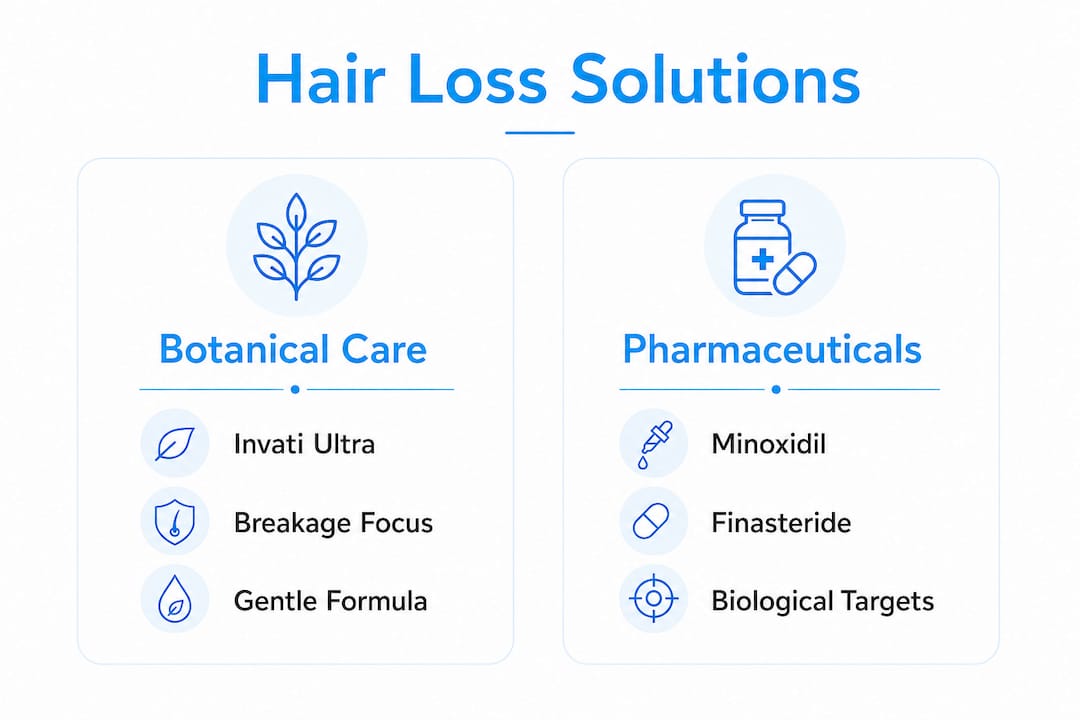
Pharmaceutical treatments like topical minoxidil and oral finasteride directly target the biological mechanisms of androgenetic alopecia. Minoxidil extends the anagen growth phase; finasteride blocks DHT conversion. Both have clinical evidence for actual regrowth in genetically thinning hair. They also carry side effect profiles that lead many people to seek alternatives, including scalp dryness, irritation, and in the case of finasteride, systemic hormonal effects.
Aveda's Invati Ultra Advanced sits in a different category: a botanical hair care system focused on reducing breakage by 77% over 12 weeks, improving scalp health, and thickening existing hair. It does not compete with minoxidil for androgenetic alopecia. It does outperform most drugstore thickening shampoos on the clinical evidence front, with the 77% breakage reduction figure backed by a controlled study rather than marketing language.
For people whose visible thinning comes primarily from breakage, heat damage, or scalp buildup, a botanical system is often the most appropriate first step. For people with significant genetic hair loss, botanical care works best as a complement to medical treatment rather than a replacement. The right approach for thinning hair depends entirely on the cause, which is why identifying your hair loss type before choosing a treatment matters more than any single product claim.
Key Takeaways
Aveda's Invati Ultra Advanced system delivers clinically proven breakage reduction through botanical actives, but works best when matched to the right hair type and used consistently for the full 12-week period.
| Point | Details |
|---|---|
| Clinical breakage reduction | The full 4-step system reduces hair loss due to breakage by 77% over 12 weeks of daily use. |
| Formula matching matters | Light suits fine to medium hair with normal to oily scalp; Rich suits medium to thick hair with normal to dry scalp. |
| Botanical limits | Botanical systems improve scalp health and reduce breakage but do not reverse androgenetic alopecia. |
| Timeline is gradual | Thickening is immediate; full breakage reduction builds over 12 weeks with consistent daily use. |
| AI tracking helps | Myhair's AI analysis lets you measure scalp and hair health changes over time to confirm whether your routine is working. |
FAQ
Is Aveda good for hair loss?
Aveda's Invati Ultra Advanced system is clinically effective for hair loss caused by breakage, reducing it by 77% over 12 weeks of daily use. It is not a medical treatment for androgenetic alopecia or hormonal hair loss.
Can the wrong Aveda formula make thinning worse?
Yes. Using the Rich formula on fine, oily hair can cause buildup that makes thinning more visible, while the Light formula on a dry scalp can strip moisture and increase breakage. Match the formula to your actual hair type.
What is the most effective hair regrowth product?
For genetic hair loss, topical minoxidil remains the most clinically validated over-the-counter option. For breakage-related thinning, Aveda's Invati Ultra Advanced system has strong clinical backing among botanical treatments.
How long before Aveda products show results?
Instant thickening occurs from the first use. The clinically proven 77% reduction in breakage typically becomes noticeable between weeks six and twelve with daily use of all four steps.
Does Myhair work with Aveda products?
Myhair's AI hair analysis tracks scalp and hair health over time, making it a useful tool for monitoring whether any treatment, including Aveda's system, is producing measurable improvement for your specific hair condition.