
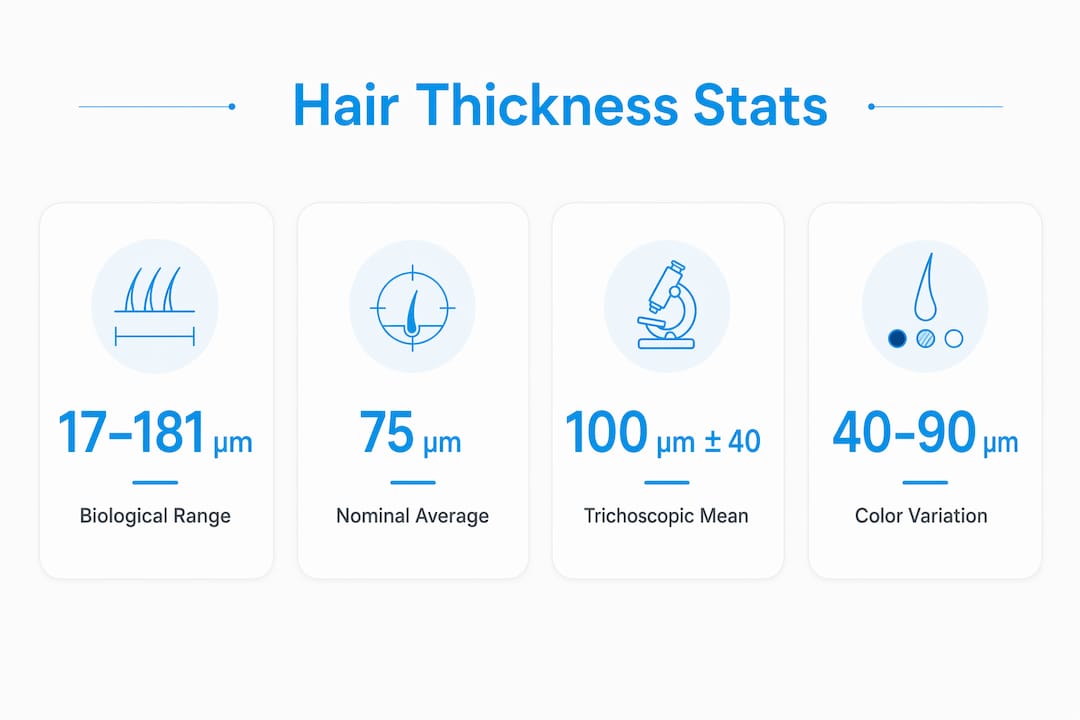
Human hair strand diameter ranges from 17 to 181 micrometers, a spread so wide that no single "average" captures it cleanly. Most literature settles on a nominal value somewhere between 75 and 100 micrometers, but that figure is a rough midpoint, not a precise standard.
What is the average hair thickness, exactly?
The short answer: your individual hair strands likely fall somewhere in the 17–181 micrometer range, depending on your ethnicity, hair color, scalp region, and the measurement method used. Here are the key numbers researchers work with:
- Full biological range: 17–181 µm, covering all human hair types globally
- Commonly cited nominal value: 75 µm, used as a rough benchmark in informal and historical contexts
- Kaswell's range (from Robbins' Chemical and Physical Behavior of Human Hair): 15–110 µm
- Randebrook's range: 40–120 µm, a slightly higher estimate from a separate measurement study
- Trichoscopic mean in healthy adults: 0.1 ± 0.04 mm (100 µm ± 40 µm), consistent across frontal, temporal, and occipital scalp areas
No single number wins. The range itself is the point.
What scientific studies actually measure

Trichoscopy, the use of a dermatoscope to image and measure hair at the scalp, has become the standard tool for quantifying hair shaft thickness in clinical research. Microscopy and scanning electron microscopy (SEM) are used in lab settings, but they often yield different values for the same hair fiber because hair has an elliptical cross-section. Measuring along the major axis versus the minor axis produces different diameters, which explains why published figures vary even within the same population.
| Study / Source | Population | Mean Hair Thickness | Method |
|---|---|---|---|
| PMC trichoscopy study | Healthy Indian males | 0.1 ± 0.04 mm (100 µm) | Trichoscopy |
| Rakowska et al. (healthy controls) | Adult white females | 0.061 ± 0.008 mm frontal | Trichoscopy |
| Hypertextbook measurement study | General | 0.06 ± 0.007 mm (60 µm) | Trichoscopy |
| Kaswell (via Robbins) | Caucasian adults | 15–110 µm | Physical measurement |
| Randebrook | General | 40–120 µm | Physical measurement |
"The mean hair thickness was 0.1 ± 0.04 mm, which was found to be similar in all three areas." — Trichoscopic Analysis of Healthy Indian Males, PMC 2024. This consistency across scalp sites held even though temporal and occipital hairs trended slightly thicker than frontal hairs.
Measurement method matters as much as biology. SEM versus calipers on the same fiber can produce different diameter values, which is why comparing studies requires knowing how each one measured.
What causes hair thickness to vary so much?
Hair diameter is not a fixed trait. Several biological and structural factors push it up or down.
- Ethnicity: Hair cross-section shape differs by ancestry. Round follicles produce straight, often thicker-shafted hair; flat or oblong follicles produce wavy or curly hair with a more variable diameter profile.
- Hair color: In Europeans, fair hair measures roughly 40–80 µm while dark brown hair averages 50–90 µm. Darker pigmentation correlates with a thicker shaft.
- Scalp region: Occipital hair (back of the head) tends to be thicker, averaging 51–66 µm, compared to frontal hair at 38–58 µm. This difference becomes more pronounced with hair loss progression.
- Hair type: Vellus hairs (the fine, nearly invisible ones covering most of the body) are far thinner than terminal hairs (scalp, beard, eyebrow). Comparing them as one category distorts any average.
- Sex: Males tend to have thicker hair shafts on average, with higher diameter variance than females.
- Measurement technique: Trichoscopy, SEM, and optical microscopy each capture the fiber differently, producing systematically different readings on the same strand.
Understanding hair thinning stages requires knowing which region of the scalp is being measured and by what method, since frontal thinning shows the steepest diameter reduction as hair loss advances.
The "hair's breadth" unit and why it's imprecise
"A hair's breadth" has been used in English as an informal length measure for centuries, appearing in historical systems of English Long Measure. Samuel Maunder's 1855 reference work listed it as a formal subdivision. The problem is obvious once you look at the data.
"This measurement is not precise because human hair varies in diameter, ranging anywhere from 17 μm to 181 μm. One nominal value often chosen is 75 micrometres (0.0030 in), but this — like other measures based upon such highly variable natural objects, including the barleycorn — is subject to a fair degree of imprecision." — Wikipedia, Hair's breadth
The 75 µm nominal figure sits near the middle of the biological range, which is why it became the default. But any two people's hairs could differ by a factor of four or more. Using "a hair's breadth" as a precise unit in any technical context is essentially meaningless without specifying whose hair, from which scalp region, measured how.
How Myhair uses AI to analyze your hair thickness
Knowing the population ranges is useful. Knowing where your hair falls within them is more useful. Myhair's AI-powered platform addresses exactly that gap.
- Scan-based analysis: Upload photos through the Myhair app and the AI measures hair shaft characteristics from your own scalp, not a population average.
- Personalized growth projections: The platform tracks changes over time, so you can see whether your hair diameter is stable, thinning, or responding to treatment.
- Tailored product recommendations: Based on your thickness profile, Myhair suggests products matched to your specific hair condition rather than generic hair type categories.
- Research-backed standards: Myhair's algorithms draw on the same trichoscopic norms and measurement standards used in published clinical research.
Pro Tip: For the most accurate personal baseline, scan consistently from the same scalp region. Frontal and occipital hair differ by up to 28 µm in healthy individuals, so mixing regions across scans will skew your tracking data.

Get your personalized hair thickness score with Myhair's AI scanner, or start with the full hair analysis to see where your strands land on the spectrum.
Key Takeaways
Human hair diameter spans 17–181 µm, with a commonly cited nominal value of 75 µm and a trichoscopic mean of 100 µm ± 40 µm in healthy adults.
| Point | Details |
|---|---|
| Biological range | Hair diameter spans 17–181 µm; no single precise average applies to all individuals. |
| Trichoscopic mean | Healthy adults average 0.1 ± 0.04 mm (100 µm), consistent across frontal, temporal, and occipital areas. |
| Scalp region matters | Occipital hair (51–66 µm) is thicker than frontal hair (38–58 µm) in most measured populations. |
| Color and ethnicity | Fair hair runs 40–80 µm; dark brown hair runs 50–90 µm in European populations. |
| Measurement method | SEM, trichoscopy, and calipers yield different values for the same strand due to hair's elliptical cross-section. |
FAQ
How thick is normal hair in micrometers?
Normal scalp hair typically falls between 17 and 181 µm in diameter, with a trichoscopic mean of around 100 µm ± 40 µm in healthy adults.
What is a good hair thickness measurement?
Trichoscopy norms define healthy hair as a mean thickness above 0.053 mm in the frontal area and above 0.050 mm in other scalp regions, with a small proportion of hairs classified as thin in frontal and occipital zones.
Does hair color affect how thick your strands are?
Yes. In European populations, fair hair averages 40–80 µm while dark brown hair averages 50–90 µm. Darker pigmentation generally correlates with a thicker hair shaft diameter.
Why do different studies report different average hair widths?
Hair has an elliptical cross-section, so measuring along different axes produces different values. Trichoscopy, SEM, and physical calipers each capture the fiber differently, which explains why published averages range from 60 µm to 100 µm across studies using different methods and populations.