
If you've struggled with thinning hair or baldness, you know the frustration of generic treatments that fail to deliver. AI technology is changing this landscape by enabling precise diagnosis and truly personalized solutions. This guide reveals how machine learning is revolutionizing baldness detection, grading severity with unprecedented accuracy, and powering next-generation treatments tailored to your unique hair loss pattern.
Table of Contents
- How AI Advances Baldness Detection And Grading
- Understanding Hair Loss Mechanisms And Standard Treatments
- Emerging AI-Formulated Products And Nutraceuticals For Hair Growth
- Personalizing Hair Growth Treatments With AI Technology
- Discover Personalized AI Solutions With MyHair
- FAQ
Key takeaways
| Point | Details |
|---|---|
| AI improves diagnosis | Machine learning models automate baldness detection with over 96% precision, eliminating subjective grading. |
| Combination therapies excel | Pairing minoxidil and finasteride delivers superior regrowth compared to single-drug approaches. |
| AI-formulated products emerge | XtalPi's Twin-Star molecules boost hair density by over 90% with fewer side effects. |
| Nutraceuticals offer modest gains | Supplements like Nutrafol provide statistically significant but moderate benefits, best used alongside proven therapies. |
| Personalization drives results | AI-powered scalp analysis and severity scoring enable customized treatment plans that improve adherence and outcomes. |
How AI advances baldness detection and grading
Traditional hair loss assessment relies on visual inspection, which introduces subjectivity and inconsistency. Machine learning techniques automate baldness detection, with convolutional neural networks and RegNet-64 models showing strong clinical performance. These algorithms analyze scalp images to classify hair loss patterns far more reliably than human observers.
AI-based grading frameworks achieve over 96% precision in male pattern hair loss severity assessment using novel metrics. Unlike older systems that measure length ratios, modern AI uses area ratio metrics. This approach proves especially accurate for severe hair loss, where follicle density differences become more pronounced.
Early detection matters enormously. Scalp dermoscopy combined with digital imaging lets you catch thinning before it becomes visually obvious. Starting treatment at early stages preserves more follicles and improves long-term outcomes. AI grading systems consistently outperform traditional BASP length ratio measures, giving both patients and clinicians objective data to track progress.
Pro Tip: Regular AI-powered scans create a quantitative baseline for your hair density, making it easier to measure treatment effectiveness over months rather than relying on subjective mirror checks.
Key advantages of AI detection include:
- Elimination of observer bias in severity grading
- Reproducible results across different practitioners and settings
- Ability to detect subtle changes invisible to the naked eye
- Faster processing compared to manual clinical assessment
"AI transforms baldness diagnosis from an art into a science, enabling evidence-based treatment decisions at every stage of hair loss."
For those tracking male pattern baldness, AI tools provide the precision needed to optimize therapy choices and timing.
Understanding hair loss mechanisms and standard treatments
Androgenetic alopecia affects the majority of men by age 50 and involves hormone-sensitive dermal papilla cells at the hair follicle base. Dihydrotestosterone binds to receptors in these cells, shortening the growth phase and miniaturizing follicles over successive hair cycles. Understanding this mechanism explains why systemic hormone modulation proves effective.
Minoxidil, finasteride, and laser therapy show superior benefits over placebo for hair regrowth with strong clinical evidence. Minoxidil widens blood vessels and prolongs the anagen growth phase. Finasteride blocks the enzyme converting testosterone to dihydrotestosterone, reducing follicle damage at its source.
Low-level laser therapy offers additional benefits by stimulating cellular energy production in follicle cells. While less dramatic than pharmaceutical options, it complements topical and oral treatments without systemic side effects. Combination topical treatments consistently outperform single-drug usage, with patients seeing faster and more substantial density improvements.
The hair growth cycle includes three phases:
- Anagen (growth phase lasting 2 to 7 years)
- Catagen (transition phase lasting 2 to 3 weeks)
- Telogen (resting phase lasting 2 to 4 months)
Successful treatment extends anagen and minimizes telogen, maximizing the proportion of follicles actively producing hair at any given time.
Pro Tip: Combining topical minoxidil with oral finasteride addresses hair loss through multiple pathways simultaneously, which is why dermatologists often prescribe both for moderate to severe cases.
For comprehensive guidance, explore the best options for alopecia androgenetica and proven solutions for male pattern baldness.
Emerging AI-formulated products and nutraceuticals for hair growth
XtalPi's AI platform created a Twin-Star molecular formula that increases hair density by over 90% with reduced shedding. This breakthrough uses computational drug design to optimize transdermal absorption and minimize common side effects like initial hair loss. AI accelerates the discovery process by simulating molecular interactions far faster than traditional laboratory methods.

Nutrafol Women's Capsules show statistically significant, modest hair growth improvements at 90 and 180 days. While measurable, these gains remain smaller than pharmaceutical interventions. Consumers often see gradual improvements in hair quality and texture rather than dramatic regrowth, making supplements most valuable as adjuncts to proven therapies.
Realistic expectations matter. Nutraceuticals provide micronutrients and botanical extracts that support follicle health, but they don't directly block hormonal miniaturization like finasteride or stimulate growth like minoxidil. Combination therapies remain key for effective hair restoration, with supplements filling nutritional gaps rather than serving as standalone solutions.
| Treatment Type | Mechanism | Expected Results | Best Used |
|---|---|---|---|
| AI-formulated topicals | Enhanced absorption, dual-action molecules | 90%+ density increase in trials | As primary therapy |
| Minoxidil + Finasteride | Growth stimulation + hormone blocking | Significant regrowth in 6-12 months | First-line combination |
| Nutraceuticals | Nutritional support, anti-inflammatory | Modest quality improvements | Adjunct to pharmaceuticals |
| Low-level laser | Cellular energy boost | Moderate density gains | Complement to topicals |
Pro Tip: Start with evidence-based treatments like minoxidil and finasteride, then add nutraceuticals and AI-formulated products to enhance results rather than replacing proven therapies.
Key considerations for AI-formulated products:
- Faster development cycles mean quicker access to innovative treatments
- Precision molecular design reduces side effect profiles
- Clinical validation remains essential despite AI optimization
- Cost may initially exceed traditional options
Explore hair loss shampoo for men and additional alopecia treatment options to build a comprehensive regimen.
Personalizing hair growth treatments with AI technology
AI scanning tools capture detailed scalp images for hair density and follicle health analysis. These platforms measure parameters like follicle diameter, hair shaft thickness, and coverage percentage across different scalp zones. Personalized scores classify hair loss severity, guiding targeted therapy choices based on your specific pattern and progression stage.
Customized treatment plans improve adherence and efficacy. When recommendations address your exact hair loss type, you're more likely to stick with the regimen and see meaningful results. Generic protocols often fail because they don't account for individual variations in hormone sensitivity, scalp condition, or treatment response.
Patients can track progress quantitatively over time with AI feedback. Monthly scans reveal subtle density changes weeks before they become visible, allowing timely adjustments to dosage or product combinations. This data-driven approach removes guesswork and builds confidence in your treatment journey.
AI platforms enable precise hair scoring and personalized regimen recommendations based on severity and scalp condition. Combining AI diagnostics with clinician input enhances management strategies, merging algorithmic precision with medical expertise.
Steps for AI-powered personalized treatment:
- Complete initial scalp scan using smartphone camera or dedicated device
- Receive automated severity score and baseline density measurements
- Get customized product and dosage recommendations
- Implement treatment plan with tracking reminders
- Conduct follow-up scans at 30, 60, and 90-day intervals
- Adjust protocol based on objective progress data
Benefits of AI-driven personalization:
- Objective severity classification removes diagnostic uncertainty
- Tailored product selection matches your hair loss mechanism
- Quantitative tracking motivates consistent treatment adherence
- Early detection of non-response triggers timely plan modifications
| Metric | Baseline | 30 Days | 60 Days | 90 Days |
|---|---|---|---|---|
| Hair Density (hairs/cm²) | 142 | 148 | 161 | 178 |
| Average Shaft Diameter (μm) | 58 | 60 | 64 | 68 |
| Anagen Percentage | 64% | 68% | 73% | 78% |
| Coverage Score (0-100) | 62 | 65 | 71 | 79 |
For a seamless start, visit AI-powered hair analysis and follow the hair analysis onboarding process.
Discover personalized AI solutions with MyHair
You've learned how AI is transforming baldness diagnosis and treatment. Now it's time to apply this technology to your own hair growth journey. MyHair offers cutting-edge AI-driven hair scoring and personalized recommendations based on the same research and algorithms discussed throughout this guide.
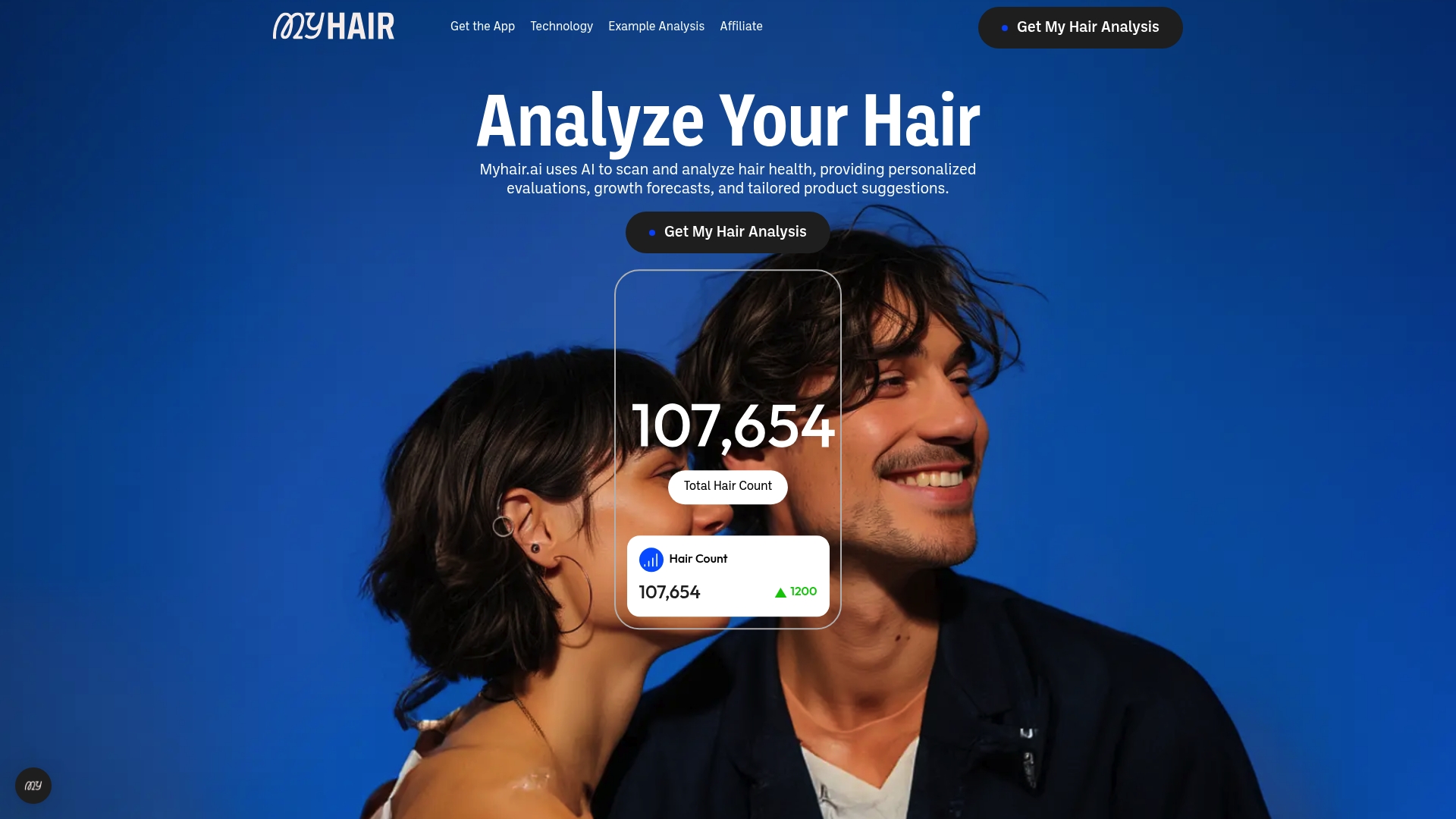
Getting started takes minutes with step-by-step app guidance designed for ease of use. Simply scan your scalp, receive your detailed analysis, and get a customized treatment plan tailored to your severity level and hair loss pattern. The platform is backed by research advancing hair loss diagnosis and treatment, giving you confidence in every recommendation.
Whether you're dealing with early thinning or more advanced baldness, AI-powered hair analysis provides the precision you need to make informed decisions. Follow the simple hair analysis onboarding process and explore the science behind the platform at MyHair research. Take control of your hair health with tools designed specifically for individuals seeking data-driven, personalized solutions.
FAQ
What is the most effective AI technology for detecting baldness?
CNNs and RegNet-64 have shown high accuracy in baldness detection and classification. These deep learning models analyze scalp images to identify hair loss patterns with precision exceeding 95%, making them the gold standard for automated diagnosis in both clinical and research settings.
How quickly can AI-formulated hair growth products show results?
Visible hair density gains often occur around 45 days of consistent use. Early follicle phase improvements can be detected in as little as 14 days using microscopic analysis. Individual results vary based on baseline severity and product formulation.
Are nutraceutical supplements enough to stop baldness?
Supplements offer modest improvements and work best as adjuncts, not as standalone treatments. They provide nutritional support that enhances follicle health but don't directly block the hormonal processes driving androgenetic alopecia. Patients should not expect dramatic regrowth from supplements alone.
What advantages does combination therapy have over single treatments?
Combination topical therapy shows superior improvements in hair density and quality compared to monotherapy. Combining minoxidil and finasteride increases hair regrowth efficacy through complementary mechanisms. Synergistic effects may reduce systemic side effects compared to oral therapies, while clinical trials demonstrate significant improvements in both density and hair shaft diameter.