
TL;DR:
- Minoxidil is the only topically proven treatment supported by clinical trials for hair regrowth. Alternatives like textured-hair oils and supplements vary in evidence, with some offering cosmetic benefits or modest results. Objective measurement tools are essential to accurately track progress over extended trials.
If your primary goal is clinically proven regrowth, minoxidil (Rogaine) is the only topical with randomized controlled trial support. For textured-hair nourishment and definition, Camille Rose, Mielle Organics, SheaMoisture, and Tropic Isle Living Jamaican Black Castor Oil cover the field. For DTC growth serums, Vegamour and The Ordinary Multi-Peptide Serum are the most-searched options. For supplement-based thickness, Nutrafol and Viviscal lead the category. Bask and Lather Co built its audience through numerous sponsored TikTok posts rather than clinical validation, which is exactly why readers look elsewhere.
Quick picks by goal:
- Clinically proven regrowth: Rogaine (minoxidil foam/solution) — the only FDA-recognized topical for pattern hair loss
- DTC growth serum: Vegamour GRO Serum or The Ordinary Multi-Peptide Serum for Hair Density — both widely available and ingredient-transparent
- Textured-hair definition and moisture: Camille Rose or Mielle Organics — routine-focused, wash-day compatible
- Scalp nourishment and growth oil: Tropic Isle Living Jamaican Black Castor Oil — a staple in the textured-hair community with a long track record
- Supplement for thinning: Nutrafol or Viviscal — both have published clinical data, though at different evidence levels
- Moisture-first, curl-focused: SheaMoisture — mass-retail availability and affordable price point
Pro Tip: Before switching brands, write down your single primary goal (regrowth, definition, scalp health, thickness). Matching that goal to a product category takes 30 seconds and saves you months of trial-and-error.
Table of Contents
- How do these alternatives compare side by side?
- How do you choose the right alternative for your hair goal?
- Which ingredients actually have evidence behind them?
- Where can you buy these alternatives in the U.S.?
- How do you test an alternative safely and measure results?
- What should you try based on your specific priority?
- Key Takeaways
- Why influencer proof alone keeps you stuck
- Myhair gives you an objective way to test any alternative
- Useful sources and further reading
- FAQ
How do these alternatives compare side by side?
| Best for | Form | Key active ingredients | Clinical evidence | Price range | Availability | How to use |
|---|---|---|---|---|---|---|
| Pattern hair loss / regrowth | Topical foam or solution | Minoxidil 2%/5% | Yes — randomized controlled trials | $20–$50/month | Drugstore, Amazon, DTC | Once or twice daily |
| Supplement-based thickness | Oral capsule | Saw palmetto, biotin, marine collagen, AnaGain | Yes — published trials (Nutrafol, Viviscal) | $50–$90/month | DTC, Amazon, Ulta | Daily with food |
| DTC growth serum | Topical serum | Peptides, redensyl, caffeine, niacinamide | Limited — small trials | $20–$60/bottle | DTC, Amazon | Daily or as directed |
| Textured-hair nourishing oil | Oil / butter blend | Castor oil, peppermint, rosemary, shea | Preliminary / limited | $8–$30/bottle | Amazon, beauty retailers, DTC | Pre-wash, scalp massage |
| Curl definition and moisture | Leave-in, cream, gel | Shea butter, aloe, glycerin, natural oils | Cosmetic — no regrowth claim | $10–$20 | Ulta, Target, Amazon | Post-wash styling |
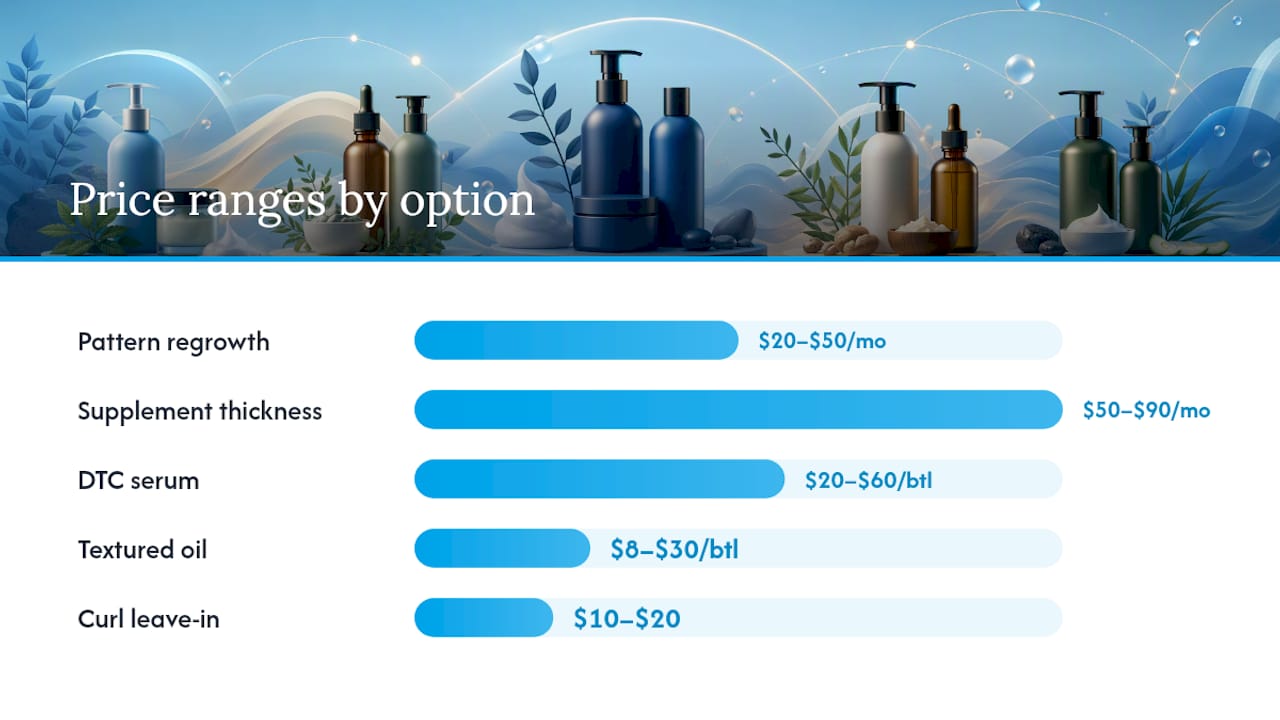
The biggest trade-off in this table is between evidence level and accessibility. Minoxidil wins on clinical proof but does nothing for curl definition or scalp moisture. Textured-hair oils score high on routine compatibility but their regrowth claims rest on small or preliminary studies. Supplements sit in the middle: Nutrafol and Viviscal have published data, but those trials are often industry-funded and smaller than pharmaceutical standards.
Pro Tip: When reading an INCI list, the first five ingredients make up the bulk of the formula. If a "growth oil" lists fragrance or alcohol in the top five, the active botanicals are likely present at trace levels.
How do you choose the right alternative for your hair goal?
Start with your primary goal, not the brand. Industry analysts recommend a gap analysis of your actual hair-health needs before comparing products. Here is a fast version:
Run this checklist on your current routine:
- Do you have scalp symptoms (flaking, itching, tenderness)? If yes, prioritize scalp-health formulas before growth claims.
- Is your hair loss diffuse thinning or pattern loss? Pattern loss points toward minoxidil; diffuse thinning may respond to supplements.
- What product form fits your routine — oil, serum, foam, or capsule?
- What is your monthly budget? Supplements run $50–$90/month; clinical topicals $20–$50.
- Do you need same-day availability (drugstore) or are you comfortable with DTC shipping?
Six questions to ask before buying:
- Does the brand publish a full INCI list on the product page?
- Is there a third-party test certificate (microbial, heavy metals) or GMP manufacturing disclosure?
- Are the clinical claims backed by peer-reviewed trials, or only influencer before/afters?
- What is the return policy — and does it require a used or unused product?
- Are verified reviews available on a neutral platform (not just the brand's own site)?
- Does the brand distinguish between cosmetic benefits (hydration, shine) and actual regrowth?
Red flags to avoid: vague "clinically inspired" language with no cited study; private-label manufacturers with no testing disclosure; no INCI list; return windows under 30 days with restocking fees.
Consumers switch brands most often when they want a different ingredient profile or dermatological validation that influencer content alone cannot provide. That is a useful filter: if you cannot find a published study or a named dermatologist partnership, treat the product as cosmetic, not therapeutic.
Which ingredients actually have evidence behind them?
Minoxidil is the clear leader. It has randomized controlled trial support for androgenetic alopecia in both men and women, and it is the only topical the FDA has recognized for pattern hair loss. Everything else in this category sits at a lower evidence tier.
Common actives and their evidence levels:
- Minoxidil (Rogaine): Randomized controlled trials; high-level clinical support for pattern hair loss
- Saw palmetto (Nutrafol, others): Small published trials showing modest DHT-blocking effect; promising but not definitive
- Marine collagen / AnaGain (Viviscal): Brand-sponsored trials showing reduced shedding; moderate evidence
- Redensyl / Capixyl (DTC serums): Manufacturer-funded in-vitro and small human studies; preliminary
- Rosemary oil: One small comparative trial against minoxidil 2% with similar results at 6 months; limited sample size
- Peppermint oil: One animal study showing follicle stimulation; human evidence is minimal
- Jamaican Black Castor Oil (Tropic Isle Living): No controlled clinical trials; benefits are primarily cosmetic (moisture, reduced breakage)
- Biotin: Only clinically useful for people with a documented deficiency; excess supplementation shows no proven benefit in healthy individuals
A common mistake is confusing cosmetic scalp benefits — hydration, reduced flaking, softer strands — with true regrowth. An oil that makes your scalp feel better is doing something real, but it is not the same as stimulating new follicle activity.
Safety notes: Patch-test any new topical for 48 hours before full application. Avoid layering minoxidil with other leave-on actives (retinoids, strong acids) without clinician guidance. If you are on prescription medication for blood pressure or hormones, check with a clinician before starting minoxidil. Most topicals and supplements require 12–16 weeks of consistent use before visible change is measurable.
Where can you buy these alternatives in the U.S.?
Bask and Lather Co operates primarily as a direct-to-consumer (DTC) brand with limited national retail presence, which pushes many shoppers toward alternatives with broader distribution. Here is how the main categories break down:
- Minoxidil (Rogaine): CVS, Walgreens, Target, Amazon, Costco — the most accessible option in the U.S.
- Nutrafol / Viviscal: DTC websites, Amazon, Ulta, and select dermatology offices
- Vegamour: DTC, Sephora, Ulta, Amazon
- The Ordinary Multi-Peptide Serum: DECIEM website, Sephora, Ulta, Amazon
- Camille Rose / Mielle Organics: Target, Walmart, Ulta, Amazon, Sally Beauty
- SheaMoisture: Target, Walmart, CVS, Ulta — the widest mass-retail footprint of any brand in this list
- Tropic Isle Living: Amazon, the brand's DTC site, select beauty supply stores
Practical buying tips:
- Buy from retailers with a clear return policy (Ulta's 60-day return window is among the most generous in beauty retail).
- Check Trustpilot and aggregator pages for verified reviews before committing to a DTC-only brand.
- Prefer retailers that display the full INCI list on the product page rather than a simplified "key ingredients" summary.
Pro Tip: Amazon's "Subscribe & Save" pricing on minoxidil and supplements can cut monthly costs by 5–15%, but always verify the seller is the brand itself or an authorized distributor to avoid counterfeit products.
How do you test an alternative safely and measure results?
Run any trial for a minimum of several months before judging results. Most topicals and supplements need that window to show measurable change, and shorter trials produce unreliable conclusions.
A practical testing protocol:
- Set a baseline. Take calibrated photos under consistent lighting (same angle, same distance, same time of day) before starting. Upload a scan to Myhair's AI scanner for an objective hair-density baseline.
- Control your variables. Keep your styling routine, diet, and stress levels as stable as possible during the trial. Changing multiple products simultaneously makes it impossible to isolate what is working.
- Apply consistently. Use the product exactly as directed — frequency and amount matter, especially for minoxidil.
- Track at weeks 4, 8, and 16. Repeat photos and scans at the same conditions. Subjective memory is unreliable; photos are not.
- Note shedding. An initial shedding phase in weeks 2–6 is normal with minoxidil and some supplements. It does not mean the product is failing.
- Evaluate at week 16. Compare baseline and current scans side by side. If there is no measurable change, the product is not working for you.
Tools that make tracking reliable:
- Calibrated smartphone photos (same app, same settings each time)
- Myhair's hair growth trackers for objective density scoring
- A simple spreadsheet logging product, dose, date, and any scalp symptoms
Pro Tip: Ask a friend to take your baseline and follow-up photos. Self-taken photos introduce angle bias that makes results look better or worse than they are.
What should you try based on your specific priority?
- Sustained regrowth from pattern hair loss: Clinical topical (minoxidil) — available at every major drugstore
- Early thinning, want a supplement: Nutrafol or Viviscal — DTC or Ulta, take daily with food
- Textured hair, curl definition: Camille Rose or Mielle Organics — Target, Walmart, Amazon
- Scalp dryness and flaking: Moisture-first cream or leave-in (SheaMoisture line) — widest retail availability
- Pre-wash scalp stimulation: Tropic Isle Living Jamaican Black Castor Oil — Amazon or beauty supply
- Ingredient-transparent DTC serum: The Ordinary Multi-Peptide Serum for Hair Density — Sephora, Ulta, or DECIEM direct
- Holistic growth support with dermatologist-adjacent positioning: Vegamour GRO Serum — Sephora, Ulta, DTC
- Objective tracking alongside any of the above: Myhair AI scan — pairs with any product category to remove guesswork from your 12–16 week trial
Key Takeaways
Choosing the right Bask and Lather Co alternative comes down to matching your primary hair goal to the correct product category and committing to a 12–16 week test with objective tracking.
| Point | Details |
|---|---|
| Match goal to category | Clinical topicals for regrowth, supplements for thinning, oils for moisture and definition. |
| Prioritize evidence | Minoxidil has randomized trial support; most botanical oils have only preliminary or cosmetic evidence. |
| Read the INCI list | The first five ingredients reveal the formula's true focus — check before buying. |
| Use objective tracking | Calibrated photos or AI scans at weeks 4, 8, and 16 give reliable before/after data. |
| Myhair for measurement | Myhair's AI scanner provides a baseline hair-density score so you can track any alternative objectively. |
Why influencer proof alone keeps you stuck
The textured-hair and growth-serum market is saturated with before/after content, and Bask and Lather Co's TikTok-heavy influencer program is a prime example of how discovery works in this space. That model is great for awareness. It is a poor substitute for evidence.
What most roundups miss is this: the problem is not the brand you are using. The problem is the absence of a measurement system. Shoppers cycle through products every 8–10 weeks, never long enough to see real results, and they attribute failure to the product when the real culprit is an incomplete trial. AI-driven tracking changes that dynamic. When you have an objective baseline score and a consistent measurement cadence, you stop relying on memory and influencer photos to judge whether something is working.
The other thing worth saying plainly: cosmetic scalp benefits and clinical regrowth are not the same outcome. A product that leaves your scalp hydrated and your curls defined is doing something valuable. But if your goal is measurable density increase, you need either a clinically validated active or a long enough trial with objective data to know whether a botanical is moving the needle for you specifically.
Myhair gives you an objective way to test any alternative
All the alternatives in this article — from minoxidil to Vegamour to Tropic Isle Living — work differently for different people. The variable that most shoppers never control is measurement. Myhair's AI-powered hair score gives you a baseline density reading from a phone scan, so when you run a 12–16 week trial on any product, you have real data to compare, not just a feeling.
Upload a scan before you start your next product switch. At week 16, scan again. The difference between "I think it's working" and "my density score improved by X" is the difference between another wasted cycle and a decision you can stand behind. Clinics can also offer Myhair scanning as part of a structured hair-health program through clinic onboarding.
Disclosure: Myhair uses affiliate partnerships with some hair-care brands. Product recommendations in this article are editorially independent.
Useful sources and further reading
- Bask and Lather Co Customer Reviews | Trustpilot — verified customer ratings and alternative brand suggestions
- Best Hair Growth Trackers | Myhair — objective tracking tools for product trials
- AI Hair Growth Therapy Guide | Myhair — step-by-step protocol for testing alternatives with AI measurement
FAQ
Does Bask and Lather growth oil really work?
Customer results vary widely, and the brand's growth claims are not backed by published clinical trials. The active botanicals (castor oil, peppermint) have preliminary evidence at best; any benefits are likely cosmetic rather than clinically proven regrowth.
Can I buy Bask and Lather in stores?
Bask and Lather Co operates primarily as a direct-to-consumer brand and is not widely stocked in major national retail chains. Most purchases go through the brand's own website or Amazon.
Can you buy Bask and Lather on Amazon?
Yes, Bask and Lather products are available on Amazon, though availability of specific SKUs can vary. Buying through Amazon gives you access to verified reviews and Amazon's standard return policy.
Does Ulta sell Bask and Lather?
Bask and Lather Co is not currently listed as a standard Ulta Beauty retail brand. Shoppers looking for textured-hair alternatives at Ulta will find Camille Rose, Mielle Organics, SheaMoisture, and Vegamour stocked there instead.
What is the best clinically proven alternative to Bask and Lather for hair regrowth?
Minoxidil (Rogaine) is the only topical with randomized controlled trial support for pattern hair loss and is available at every major U.S. drugstore. For supplements, Nutrafol and Viviscal both have published clinical data, though their trials are smaller in scale than pharmaceutical standards.