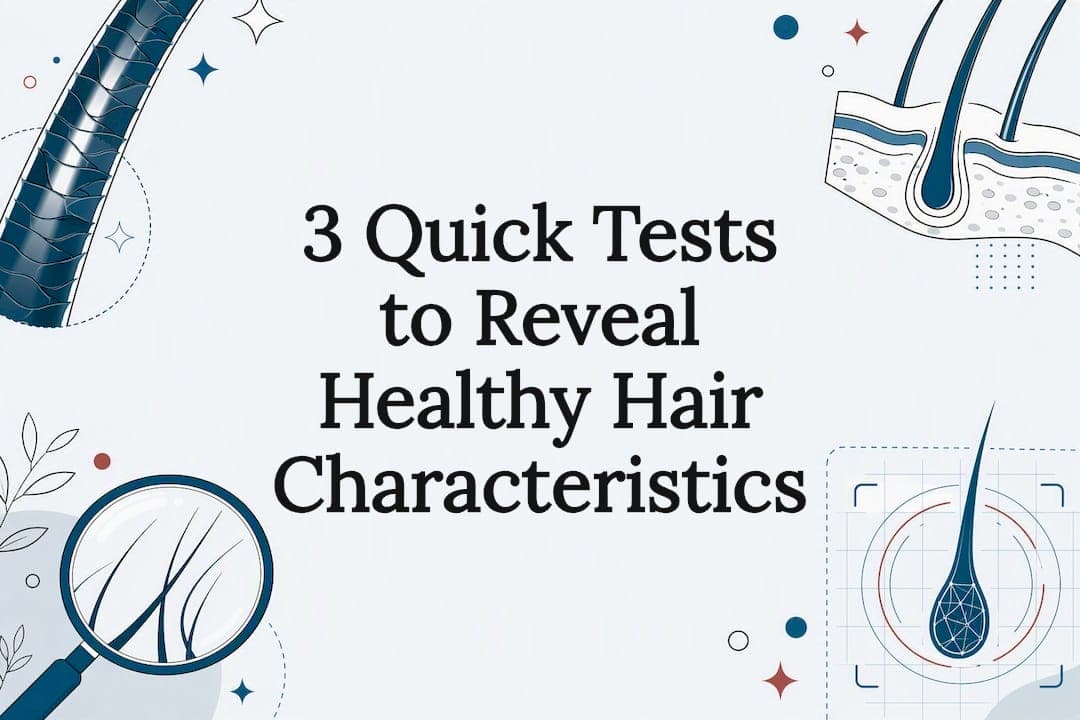
Healthy hair reflects light evenly, stretches slightly and springs back, resists snapping when you run a comb through it, and grows from a scalp that isn't red, flaking, or sore. Shedding between 50 and 100 hairs a day is normal, according to the American Academy of Dermatology, so finding a few strands on your pillow isn't a red flag on its own. The signs below, and the quick tests that confirm them, tell you far more than a glance in the mirror ever will.
TL;DR:
- Hair that stretches 20 to 30 percent without snapping and feels smooth between fingers indicates balanced protein and moisture levels.
- Floating in water suggests low porosity, while sinking fast points to high porosity and quick moisture absorption or loss.
- Sudden or sustained shedding above 100 hairs daily, along with scalp issues like redness or flaking, signals potential health problems needing medical evaluation.
- Damage from heat or chemicals often manifests as rough cuticle patches, frayed ends, or increased tangling, which can be mitigated by gentler handling and reduced styling stress.
- Objective monitoring through AI scans over time helps distinguish between temporary changes and true patterns of hair health decline.
Table of Contents
- What Healthy Hair Looks and Feels Like
- Three At-Home Tests That Tell You More Than a Mirror
- Scalp Health and Normal Shedding, By the Numbers
- What's Actually Damaging Your Hair, and What to Do About It
- When Home Checks Aren't Enough
- Where AI Scanning Fits Into This Picture
- Doing These Checks Without Overreacting to One Bad Week
- A Practical Next Step: Scanning Your Hair With Myhair
- Sources
- FAQ
What Healthy Hair Looks and Feels Like
Shine comes down to physics, not luck. When the cuticle, the outer layer of overlapping scales on each strand, lies flat, light bounces off it in one direction and the hair looks glossy. When those scales lift or chip away from heat or chemical damage, light scatters instead of reflecting, and the hair looks dull no matter how much serum you apply. A ScienceDirect review of hair structure ties this directly to cuticle integrity and the protein arrangement underneath it.
Here's where a lot of people get the wrong idea about their own hair. Coily and tightly curled hair doesn't reflect light the same way straight hair does, simply because of the shape of the strand, not because it's damaged. Dermatologist Dr. Angela Lamb notes that healthy hair has to be judged against a person's own hair type, since curl pattern changes how much shine is even physically possible. A 4C curl that looks matte can be just as healthy as a straight strand that looks glassy.
Run a clean section of hair between two fingers, from root to tip. Healthy hair feels smooth and slides easily. Rough patches, snags, or a sensation like tiny bumps usually mean cuticle damage or buildup sitting on the shaft.
A few more visual checks worth doing regularly:
- Ends: Split or frayed tips under good light signal it's time for a trim, not necessarily a health crisis.
- Body: Hair with intact cuticle layers tends to hold movement and bounce; genetics set your baseline density, so compare your hair to its own past, not to someone else's.
- Color consistency: Uneven porosity along the shaft (patches that grab dye differently) often points to damage concentrated in specific spots.
- Tangling: Hair that mats easily at the ends usually has raised, damaged cuticle scales catching on each other.
Three At-Home Tests That Tell You More Than a Mirror
Looks can deceive you. These three tests take five minutes and give you an actual read on internal hair health.
- The stretch test. Take one clean, damp strand and gently pull it between your fingers. Healthy hair stretches about 20 to 30% beyond its original length and springs back without snapping, a benchmark tied to the balance of protein and moisture inside the strand, per that same ScienceDirect analysis. If it stretches very little and snaps, or stretches too far and stays limp, that's a sign of protein or moisture imbalance.
- The float test. Drop a clean, freshly washed strand into a glass of water. Hair that floats has a tighter, low-porosity cuticle. Hair that sinks fast tends toward high porosity, meaning it absorbs moisture (and loses it) quickly.
- The wet comb test. Comb gently through wet hair from the ends upward. A few strands coming loose is normal shedding. Strands that snap mid-shaft, leaving short, ragged pieces instead of full-length ones, indicate breakage, not shedding.
Pro Tip: Photograph your comb test results or jot down a rough count once a month, same time of day, same routine. One bad hair day means nothing. A pattern over three or four months means something.
Scalp Health and Normal Shedding, By the Numbers
A healthy scalp has no persistent flaking, redness, or tenderness when you press or part your hair. Part your hair in a few different spots and look for consistent skin tone and follicle spacing. Patches of irritation or unusually visible scalp in one area should be evaluated.
On shedding, the AAD's benchmark of 50 to 100 hairs per day is the number to know. Counts well above that, sustained over weeks, suggest something is disrupting the growth cycle.
Shedding and breakage look different up close:
- Shed hairs come out at the root, usually with a small white bulb visible at the end, and are full length.
- Broken hairs snap mid-shaft, so they're shorter than the rest and look frayed or blunt at the break point.
Scalp condition isn't cosmetic background noise. Persistent inflammation or flaking can impair how well follicles function over time, and treating the underlying scalp issue often has to happen before hair quality improves at all.
What's Actually Damaging Your Hair, and What to Do About It
Most poor hair condition traces back to a handful of repeat offenders: heat tools, chemical processing, tight styles, and thin nutrition.
- Mechanical and chemical stress: Cut back on high-heat styling, space out bleach or relaxer treatments, and rotate protective styles so tension doesn't concentrate on the same section of scalp. Gentler handling and less heat exposure directly reduce breakage, according to the Cleveland Clinic. Our breakdown of hair breakage causes covers detangling technique in more depth.
- Nutrition: Hair is mostly protein, so consistent intake matters more than any single supplement, notes Healthline. Iron, zinc, and B vitamins matter too. A food-first approach beats indiscriminate supplementing, especially without testing for an actual deficiency first. Our guide to foods for healthy hair breaks down what to prioritize on your plate.
- Washing and products: Match your routine to your scalp, not general advice. Oily scalps benefit from more frequent, scalp-focused cleansing; dry or curly hair usually does better with longer stretches between washes and heavier conditioning, per AAD guidance.
- Lifestyle and medical factors: Chronic stress, rapid weight loss, and certain medications can all trigger shedding. No topical product fixes a cause rooted in the body.
Pro Tip: If you switch up your routine, change one variable at a time. Swap in a new shampoo or add a supplement, not both in the same week, or you'll have no idea what actually caused the change.
When Home Checks Aren't Enough
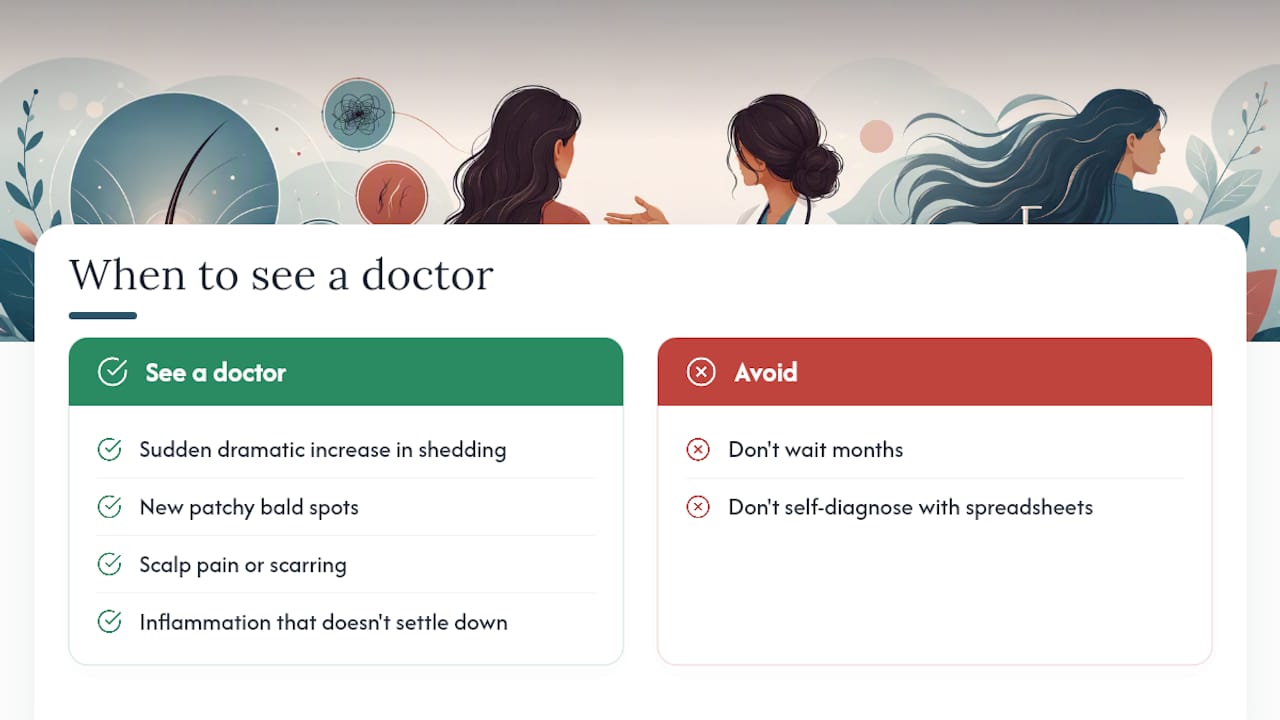
Some signs need a professional, not a spreadsheet. See a doctor for a sudden, dramatic increase in shedding, patchy bald spots, scalp pain, scarring, or inflammation that doesn't settle down. Sudden or significant hair loss can point to nutritional deficiencies, hormonal shifts, or autoimmune conditions, according to Harvard Health.
A clinician will usually take a history, examine the scalp directly, and order targeted blood work, checking iron, thyroid function, and vitamin D, before considering further procedures. Many causes turn out to be treatable once identified, per the Mayo Clinic, which is the strongest argument for not waiting months to get checked.
Where AI Scanning Fits Into This Picture
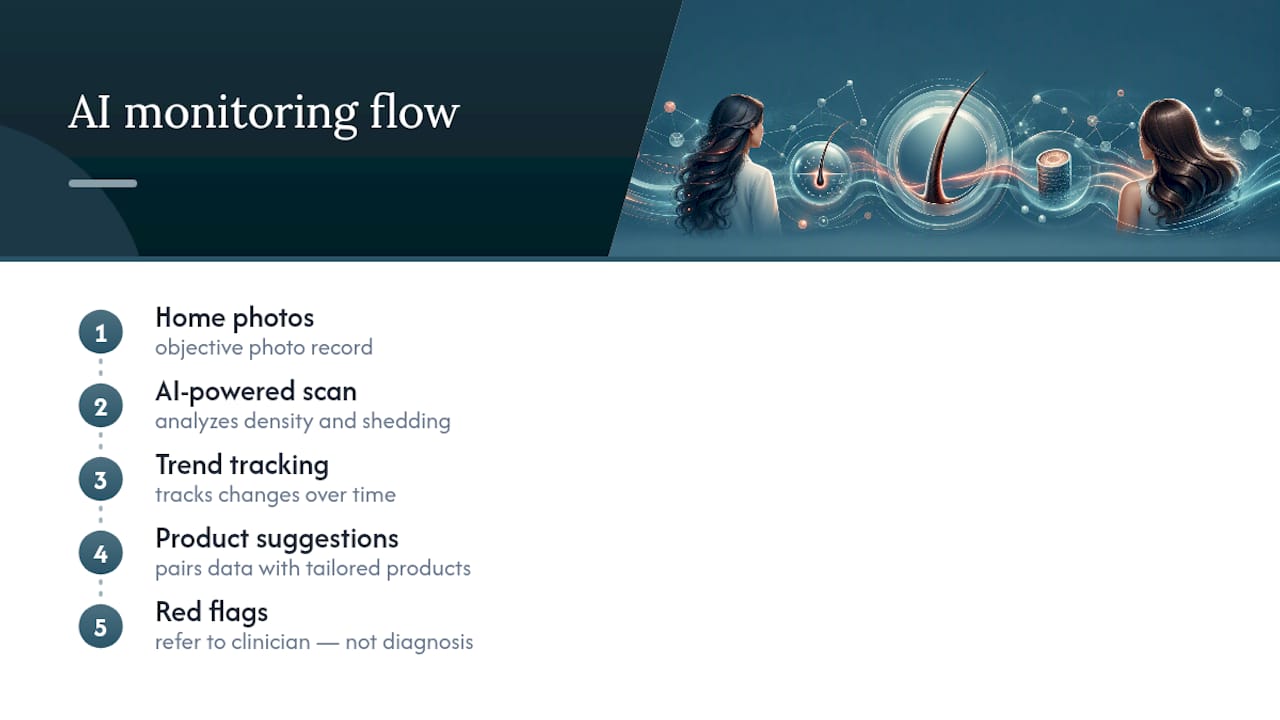
Home tests tell you a lot, but they're subjective and easy to misremember month to month. An AI-powered scan gives you an objective photo record and tracks density and shedding trends over time, pairing that data with tailored product suggestions. It's a monitoring tool, not a diagnosis. Red flags still belong in front of a clinician.
Doing These Checks Without Overreacting to One Bad Week
Consistency is what makes these tests useful. Check your hair under the same lighting, at the same point in your wash cycle, and repeat monthly rather than daily. One rough stretch test or a heavier shed day tells you almost nothing by itself.
What actually works is combining the tactile checks with a photo and a quick note each time. Patterns across a few months reveal real change. A single data point just creates anxiety.
— Cyriac
A Practical Next Step: Scanning Your Hair With Myhair
Home tests give you a snapshot. Myhair gives you the trend line, tracking the same shine, density, and shedding signals you just learned to check, but recorded consistently instead of relying on memory.
Scans of your scalp and hair over time can flag meaningful changes in density or shedding, and pair the results with product recommendations suited to what they actually find, rather than generic advice. That's useful precisely because at-home tests are subjective. A scan doesn't forget what your hair looked like three months ago.
- Objective before-and-after comparison instead of guesswork from memory
- Trend graphs that separate a bad week from an actual pattern
- Tailored product suggestions based on your specific scan results
None of that replaces a dermatologist. If you're seeing patchy loss, scalp pain, or a sudden spike in shedding, book that appointment first. For everyday tracking, start a hair scan and see where your baseline actually sits.
Sources
- American Academy of Dermatology: Hair shedding guidance
- Healthline: Tricks for healthier, fuller hair
- ScienceDirect review on hair structure and properties
- Cleveland Clinic: How to stop hair thinning
- Harvard Health: Hair loss A to Z
FAQ
What mineral deficiency causes hair loss?
Low iron and zinc are the most common mineral deficiencies linked to hair shedding, though a proper blood test is the only way to confirm one rather than guessing and supplementing blindly.
What are the signs of unhealthy hair?
Dullness, rough texture, frequent mid-shaft breakage, excessive tangling, and shedding well above 100 hairs a day are the main warning signs, along with a scalp that's persistently red, flaking, or sore.
What are the characteristics of healthy hair?
Healthy hair shows natural shine from a flat cuticle, smooth texture from root to tip, 20 to 30% elastic stretch with a snap-back, minimal breakage, and a comfortable scalp with shedding in the normal 50 to 100 hairs per day range.
How can you tell if hair is good quality?
Run the stretch test and the wet comb test: hair that stretches slightly and returns without snapping, and that doesn't leave short, ragged pieces in the comb, is in good structural condition regardless of texture or curl pattern.