
Finding effective answers for thinning hair can feel frustrating when common advice and trendy products rarely deliver lasting change. If you have struggled to separate hair care facts from myths, understanding what actually makes coconut oil unique is essential. Backed by real science and personalized with AI, coconut oil’s ability to penetrate and nourish the hair shaft offers targeted support for all hair types, promising genuine improvement in both scalp health and hair strength.
Table of Contents
- Defining Coconut Hair and Common Myths
- Types of Coconut-Derived Hair Treatments
- How Coconut Oil Supports Hair Health
- Potential Risks and How to Avoid Them
- AI-Driven Personalized Coconut Hair Solutions
Key Takeaways
| Point | Details |
|---|---|
| Coconut Hair Care Benefits | Coconut oil penetrates hair fibers to reduce protein loss, improve moisture retention, and strengthen strands against breakage. |
| Debunking Myths | Coconut oil is effective for all hair types and does not need to be expensive to be beneficial. |
| Proper Usage Guidelines | Start with a small amount of coconut oil and apply it strategically to avoid greasiness and buildup. |
| Personalized Solutions | AI can tailor coconut oil treatment recommendations based on individual hair profiles for optimal results. |
Defining Coconut Hair and Common Myths
Coconut hair care refers to using coconut oil to improve hair health, not a specific hair type or texture. The term describes a treatment approach backed by actual chemistry, not marketing hype.
Coconut oil works because of its unique molecular structure. The oil penetrates deep into individual hair fibers, reducing protein loss and strengthening your strands from within. This isn't surface-level conditioning—it's actual restoration happening inside the hair shaft.
What Coconut Hair Care Actually Does
When applied correctly, coconut oil delivers real benefits:
- Reduces protein loss from hair fibers during washing and styling
- Improves moisture retention, keeping hair hydrated longer
- Strengthens individual strands to prevent breakage
- Protects hair from mechanical damage during combing and handling
- Promotes scalp health by nourishing follicles
These benefits work across all hair types, lengths, and conditions—not just thick or long hair.
Coconut oil's effectiveness comes from its ability to penetrate the hair shaft, not coat it on the surface like most conditioners do.
Myths That Need Debunking
Misconceptions about coconut oil remain widespread. Here's what actually stands true:
Myth 1: Coconut oil always leaves hair greasy and heavy
Reality: When used correctly, coconut oil for damaged hair is lightweight. The key is using the right amount—a little goes far. Start with half a teaspoon and adjust based on your hair length and thickness.
Myth 2: It only works for long, thick hair
Reality: Coconut oil benefits all hair types, including fine, thin, and short hair. People with thin hair often worry about weighing their strands down, but proper application prevents this entirely.
Myth 3: Coconut oil is ineffective for hair loss or breakage
Reality: By reducing protein loss and strengthening individual strands, coconut oil actively prevents breakage. This matters when you're dealing with thinning hair—keeping the strands you have is as important as promoting new growth.
Myth 4: You need expensive branded versions to see results
Reality: Raw, unrefined coconut oil works just as well as pricey formulations. The molecular structure remains the same regardless of packaging or branding.
Why This Matters for Your Hair Health
If you're experiencing thinning hair or hair loss, understanding what coconut oil actually does helps you set realistic expectations. It won't regrow hair on its own, but it will protect the hair you have and create a healthier scalp environment for growth.
The science is straightforward: stronger, less damaged hair means fewer losses and a better foundation for any hair growth strategy you're pursuing.
Pro tip: Apply coconut oil to damp hair from mid-shaft to ends, avoid the roots, and leave it on for 20-30 minutes before shampooing for optimal penetration without greasiness.
Types of Coconut-Derived Hair Treatments
Coconut-derived hair treatments aren't one-size-fits-all. Different formulations exist for different hair goals, and understanding the variations helps you choose what actually works for your situation.
The main types differ in processing method, composition, and how they interact with your hair. Some penetrate deeply, while others focus on scalp health or surface conditioning. The right choice depends on your specific hair concern.
Pure and Virgin Coconut Oil
Virgin coconut oil is extracted without heat and retains all its natural compounds. It's rich in lauric acid, which penetrates hair fibers more effectively than other oils. This makes it ideal if your goal is strengthening hair from within.
Cold-pressed varieties maintain the highest nutrient content. They're typically more expensive but deliver maximum benefits for protein loss prevention and moisture retention.
The trade-off: virgin oils can feel heavier and may cause buildup with repeated use on fine hair.
Here is a comparison of the main coconut oil types for hair treatment:
| Oil Type | Best for | Absorption Level | Potential Drawback |
|---|---|---|---|
| Virgin Coconut Oil | Deep restoration | High | Can feel heavy on fine hair |
| Fractionated Coconut Oil | Lightweight scalp nourishment | Fast | Less deep shaft penetration |
| Enriched Formulations | Targeted hair/scalp concerns | Varies by additives | Some have ineffective fillers |
Fractionated Coconut Oil
Fractionated coconut oil is processed to remove longer-chain fatty acids, leaving only the lighter components. This creates a thinner, faster-absorbing oil that won't weigh down your hair.
It's particularly useful for:
- Scalp treatments and massages
- Fine or thin hair that needs nourishment without heaviness
- People concerned about greasiness
- Quick absorption before styling
The downside: it may not penetrate as deeply as virgin varieties, so it works better as a scalp treatment than a shaft conditioner.
Enriched Coconut Formulations
Many brands combine coconut oil with added ingredients to target specific issues. These might include vitamins, essential oils, or plant extracts designed for hair loss, dandruff, or repair.
Common additions include:
- Biotin and B vitamins for growth support
- Tea tree oil for scalp health
- Argan or jojoba oil for enhanced conditioning
- Keratin for damage repair
When reviewing enriched products, check ingredient lists carefully. Some add fillers that diminish coconut oil's actual benefits. Medium-chain fatty acids in coconut oil provide the core value, so prioritize formulations where coconut remains the primary ingredient.
Application Types
How you use coconut oil matters as much as which type you choose:
- Pre-wash treatments: Apply 30 minutes before shampooing to reduce protein loss during washing
- Leave-in conditioners: Lightweight oils applied to damp hair and left in throughout the day
- Deep conditioning masks: Thicker formulations left on for extended periods (4+ hours)
- Scalp oils: Fractionated versions massaged directly into scalp for follicle nourishment
Different coconut oil types serve different purposes—virgin for deep conditioning, fractionated for scalp health, and enriched formulations for targeted concerns.
If you're managing hair loss or thinning, the approach to using coconut oil for hair fall matters as much as the product itself.
Pro tip: Start with fractionated coconut oil if you have fine or thin hair, then experiment with virgin varieties on your hair ends only to find your tolerance level.
How Coconut Oil Supports Hair Health
Coconut oil doesn't just sit on your hair surface. It actively works inside your strands and on your scalp to strengthen, protect, and nourish. Understanding the mechanism helps you see why consistent use delivers real results.
The science comes down to molecular structure and biological interaction. When coconut oil contacts your hair, it initiates several protective and restorative processes simultaneously.
Penetration and Protein Protection
Lauric acid, coconut oil's primary fatty acid, penetrates deep into the hair shaft. This is different from most conditioners that coat the surface and wash away easily.

Once inside, coconut oil reduces protein loss during washing and styling. Your hair naturally loses proteins when exposed to water, friction, and heat. Coconut oil acts as a barrier, preventing this loss and maintaining the structural integrity of each strand.
This matters significantly if you're dealing with thinning hair. Keeping the proteins already in your strands means stronger, more resilient hair less prone to breaking.
Moisture Retention and Cuticle Protection
Coconut oil protects your hair's cuticle layer—the outermost protective scale. By lubricating and sealing these cuticles, the oil traps moisture inside strands and prevents environmental damage.
Drier hair breaks more easily. Moisturized hair bends without snapping. This protection becomes critical when managing hair loss concerns because each retained strand matters.
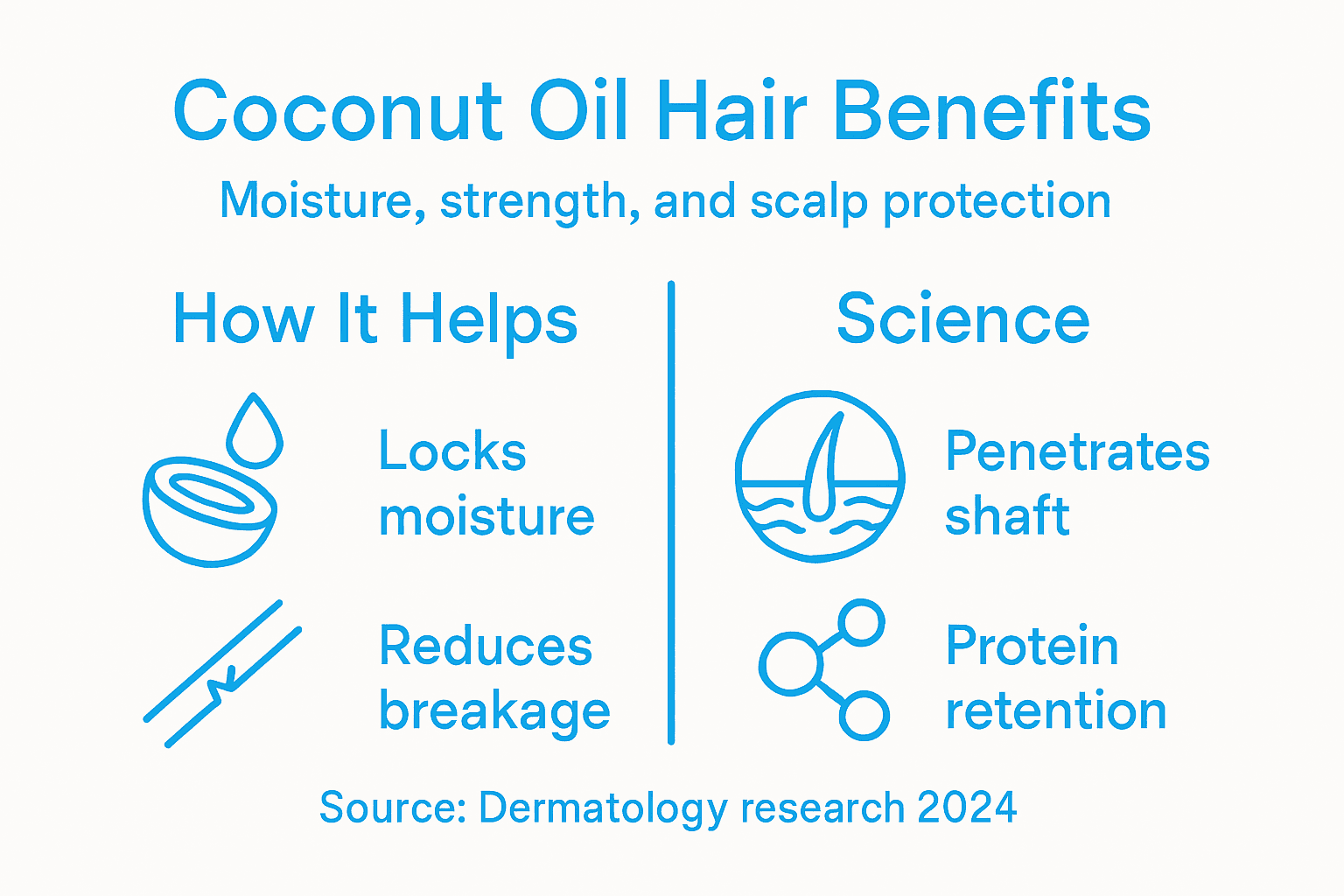
The lubrication also reduces friction damage during combing, brushing, and styling, minimizing mechanical breakage that accelerates thinning.
Scalp Health and Microbiome Balance
Your scalp hosts a complex ecosystem of microorganisms. Recent research shows coconut oil enriches beneficial scalp microbiome by increasing healthy bacteria like Cutibacterium acnes, which reduces dandruff and inflammation.
A healthier scalp environment directly supports hair growth. When inflammation decreases and beneficial bacteria increase, follicles function optimally.
Coconut oil also stimulates scalp circulation, delivering more nutrients and oxygen to follicles. Better blood flow means your hair roots receive the resources needed to produce stronger strands.
How This Translates to Real Results
These mechanisms combine to create measurable improvements:
- Reduced breakage from strengthened protein structure
- Decreased protein loss during washing
- Better moisture retention in each strand
- Healthier scalp environment supporting follicle function
- Improved resilience against styling damage
Coconut oil's effectiveness comes from working at multiple levels simultaneously—inside the hair shaft, on the cuticle, and at the scalp level.
For individuals with thinning hair or hair loss concerns, this multi-level support means fewer losses and a better foundation for any growth strategy. When you choose the right hair growth oil, consistency matters more than the product itself.
Applying coconut oil once won't create dramatic change. Regular application over weeks builds these protective benefits, strengthens existing hair, and creates conditions where new growth can thrive.
Pro tip: Apply coconut oil to clean, damp hair twice weekly and leave it on for at least 30 minutes to maximize penetration and allow the oil to work through both the scalp and hair shaft.
Potential Risks and How to Avoid Them
Coconut oil is powerful, but like any treatment, misuse creates problems. Knowing what can go wrong helps you use it safely and effectively without damaging your hair further.
The risks aren't about coconut oil itself—they're about application frequency, quantity, and technique. Get these right, and you avoid trouble entirely.
Scalp Pore Blockage and Buildup
Applying too much coconut oil or using it too frequently clogs scalp pores. When pores become blocked, your scalp can't breathe or regulate itself properly. This leads to inflammation, itching, and irritation that actually worsens hair loss.
Protein accumulation is another concern. While coconut oil reduces protein loss from your hair, overuse causes excess protein to build up on your strands, making them stiff and prone to breakage.
This becomes especially problematic on fine or thin hair, where buildup shows immediately as dullness and matting.
Greasy Hair and Moisture Imbalance
Excessive application leaves hair looking greasy and weighed down. Your strands can't hold their natural shape, and curls lose definition.
Overuse also disrupts your hair's natural moisture balance. Instead of retaining water, your hair becomes dry and frizzy despite being covered in oil. Excessive coconut oil use can cause moisture problems that seem counterintuitive but happen regularly.
This creates a frustrating cycle where your hair looks greasy yet feels dry and breaks more easily.
How to Prevent These Issues
Avoid problems by following these application guidelines:
- Start with half a teaspoon for shoulder-length hair; adjust based on thickness
- Apply only 1-2 times weekly maximum
- Focus application on the scalp and mid-shaft to ends, avoiding roots initially
- Leave on for 20-30 minutes, not overnight
- Always shampoo thoroughly to remove all residue
- Alternate with other treatments to prevent buildup
For fine or thin hair, reduce frequency to once weekly or use fractionated coconut oil instead.
To help you choose wisely, here is a summary of risks and safe practices for coconut oil hair care:
| Risk | Likely Cause | How to Prevent |
|---|---|---|
| Scalp pore blockage | Excess oil, infrequent washing | Use less, rinse thoroughly |
| Greasy appearance | Over-application | Apply sparingly, avoid roots |
| Hair feels dry | Disrupted moisture balance | Alternate treatments |
| Protein buildup | Too frequent use | Limit to 1-2x weekly |
Combining with Other Products
Coconut oil works better alongside complementary products. Pairing it with moisture-locking products like shea butter or gels prevents the greasy-yet-dry problem.
These products seal in both the coconut oil's benefits and your hair's natural moisture. The combination prevents buildup while maximizing protection.
This approach is especially important for curly hair, where definition relies on moisture retention without heaviness.
Moderation and proper technique prevent nearly all coconut oil risks—use less frequently, apply strategically, and combine with complementary products.
Realistic Expectations Matter
Understanding coconut oil's actual role prevents disappointment. It strengthens existing hair and protects your scalp, but it won't magically regrow lost hair or transform your hair type.
Some people expect dramatic results from a single application. When it doesn't happen, they increase frequency and quantity, which backfires by creating the buildup problems described above.
Pro tip: Test your tolerance by starting with coconut oil once weekly for two weeks, then assess scalp health and hair appearance before increasing frequency or quantity.
AI-Driven Personalized Coconut Hair Solutions
Coconut oil isn't a universal fix. What works perfectly for one person's hair might cause problems for another. This is where artificial intelligence changes the game by tailoring coconut hair treatments to your specific situation.
Instead of guessing which coconut oil type and application frequency suit you, AI analyzes your individual hair characteristics and recommends exactly what you need.
How AI Analyzes Your Hair Profile
AI-driven platforms examine multiple factors that generic advice ignores. They assess your hair texture, scalp condition, damage level, and environmental exposure.
The technology also considers your scalp microbiome composition. Different scalp bacteria profiles respond differently to coconut oil. What reduces dandruff for one person might not help another if their microbial ecosystem differs.
This level of personalization is impossible without data analysis. Traditional advice treats everyone the same. AI treats your hair as unique.
Optimized Recommendations Based on Your Data
Once AI analyzes your profile, it generates tailored guidance for coconut oil use. This includes:
- Specific oil type and concentration suited to your hair
- Optimal application frequency based on your scalp and strand characteristics
- Precise timing for how long to leave oil on your hair
- Complementary products that enhance coconut oil's benefits for you specifically
- Adjustments based on seasonal changes or styling damage
Personalized recommendations factor in individual variability in texture, damage levels, and scalp microbiome, ensuring safer and more effective results.
This precision eliminates the trial-and-error approach that wastes time and money.
Tracking Progress Over Time
AI platforms don't just make recommendations—they track your results. You document changes in scalp health, hair strength, and thickness over weeks and months.
The AI learns from your feedback and adjusts recommendations accordingly. If your scalp becomes irritated, it suggests reducing frequency. If you're seeing improvements, it might recommend staying consistent.
This adaptive approach means your coconut oil strategy evolves as your hair condition changes.
Real Results Through Data-Driven Decisions
Personalized coconut hair solutions leverage AI technology to optimize formulations and routines based on your unique characteristics.
This approach reduces risk of buildup and irritation while maximizing the protective and strengthening benefits you actually need.
For individuals managing thinning hair or hair loss, this precision matters significantly. When you're protecting existing strands while supporting growth, using the wrong coconut oil type or frequency wastes valuable time.
AI transforms coconut oil from a general treatment into a precision intervention tailored entirely to your hair's needs.
Integration with Your Hair Care Strategy
Personalized coconut recommendations work best as part of a comprehensive approach. Hair care treatment personalization using AI insights ensures coconut oil complements your other products and habits.
This holistic view prevents conflicts between treatments and maximizes overall results.
Pro tip: Use your AI platform's scan feature every 4-6 weeks to track progress and allow the system to refine recommendations based on visible changes in your hair and scalp.
Unlock Personalized Coconut Hair Care with AI Precision
Are you ready to move beyond generic hair advice and tackle thinning hair or breakage with confidence Coconut oil offers proven benefits like protein loss reduction and scalp nourishment but finding the right type and routine can be tricky The solution lies in personalized care that adapts to your unique hair texture scalp health and growth goals
Discover how MyHair.ai harnesses advanced AI technology to analyze your hair condition in detail Providing tailored coconut oil usage tips and product recommendations that match your profile helps you prevent buildup irritation and maximize strength every time Act now to receive customized guidance for your hair and unlock real results with a science-backed approach Start your personalized journey today at MyHair.ai and empower your hair health with data-driven precision
Frequently Asked Questions
What is coconut hair care and how does it work?
Coconut hair care refers to using coconut oil to improve hair health, primarily by penetrating the hair shaft to reduce protein loss and strengthen strands. Its unique molecular structure allows for deep restoration rather than just surface-level conditioning.
Can coconut oil benefit all hair types?
Yes, coconut oil works effectively for all hair types, including fine, thin, and short hair. Its conditioning properties can help prevent breakage and improve moisture retention, making it a versatile treatment option.
How should I apply coconut oil to achieve the best results?
For optimal results, apply coconut oil to clean, damp hair from mid-shaft to ends, avoiding the roots initially. Leave it on for 20-30 minutes before shampooing, and use it 1-2 times weekly to prevent buildup and ensure effective moisture retention.
Are there any risks associated with using coconut oil for hair care?
Yes, overuse of coconut oil can lead to scalp pore blockage and buildup, resulting in greasy hair and moisture imbalances. To avoid these issues, use it sparingly—starting with a small amount—and alternate it with other hair treatments.
Recommended
- Understanding Coconut Oil for Damaged Hair: A Deep Dive | MyHair
- Coconut Oil for Hair Loss: Boost Your Growth Naturally | MyHair
- How to Use Coconut Oil for Hair Fall: Tips & Proven Benefits (2025) | MyHair
- Natural Hair Growth Shampoo: Science, Myths, and Real Impact | MyHair
- Matcha y Colágeno: Diferencias Clave para Tu Belleza – Glow Up Era