
TL;DR:
- Prescription DHT blockers like finasteride and dutasteride effectively preserve and regrow scalp hair, with full results appearing after about a year. They work by reducing DHT levels or blocking its receptor, slowing follicle miniaturization in genetically susceptible areas. Natural supplements like saw palmetto have weaker, inconsistent evidence, and systemic blockers carry side effects requiring medical supervision.
Prescription 5-alpha reductase inhibitors, specifically finasteride and dutasteride, are the most clinically proven DHT blockers for preserving and regrowing scalp hair. Topical finasteride, ketoconazole shampoo, and spironolactone (for women) play supporting or alternative roles. Supplements like saw palmetto are much weaker. Expect early shedding in the initial months, visible change within several months, and full results after about a year or more.
Quick reference:
- Best for regrowth (men): Oral finasteride or dutasteride
- Best for preserving hair: Finasteride 1 mg daily (decades of RCT data)
- Best DHT blocker for women: Spironolactone (oral) or topical finasteride via compounded formulation
- Natural/supplement strength: Saw palmetto, pumpkin seed oil — modest, mixed evidence only
Finasteride and dutasteride require a prescription and carry pregnancy/birth-defect warnings. Neither is FDA-cleared for women of childbearing potential. Supplements need no prescription but won't match the effect of a 5-alpha reductase inhibitor.
Table of Contents
- What DHT is and how it shrinks your hair follicles
- How DHT blockers reduce hair loss and support growth
- Types of DHT blockers: which one fits your situation
- How effective are DHT blockers for hair growth, and when will you see results?
- Safety, side effects, and who needs to be careful
- How to choose the right DHT blocker for your situation
- Natural remedies and foods: what the evidence actually supports
- How to monitor your progress and know if treatment is working
- Key Takeaways
- The gap between what DHT blockers promise and what they actually deliver
- Myhair gives you an objective way to track what's actually changing
- Useful sources and further reading
- FAQ
What DHT is and how it shrinks your hair follicles
Dihydrotestosterone (DHT) is a potent androgen your body makes from testosterone via an enzyme called 5-alpha reductase. In genetically susceptible scalp follicles, DHT binds to androgen receptors and progressively shortens the hair growth cycle, a process called follicle miniaturization. Each cycle, the follicle produces a thinner, shorter strand until it stops producing visible hair altogether. That's androgenetic alopecia, the most common form of hair loss in both men and women.
The biology has a well-known paradox. DHT promotes thick terminal hair in the beard and body while simultaneously destroying scalp follicles in the same person. The difference comes down to region-specific follicle sensitivity and local signaling pathways, including Wnt/β-catenin activity, that vary by body site. Scalp follicles in people with androgenetic alopecia are simply wired to respond destructively to DHT.
"How one type of circulating hormone has such contrary effects on a single tissue depending on its body site is not clear; this biological paradox alone makes androgen action in hair follicles very intriguing." — Randall, as cited in PMC research on androgenic alopecia
When DHT is the likely culprit vs. when it isn't:
- DHT-driven: Male pattern baldness (temple recession, crown thinning), female androgenetic alopecia (diffuse thinning at the part)
- Not DHT-driven: Alopecia areata (autoimmune), telogen effluvium (stress/nutritional), thyroid-related shedding
If your hair loss is patchy, sudden, or accompanied by other symptoms, a dermatologist visit matters before starting any DHT-targeting treatment.

How DHT blockers reduce hair loss and support growth
The core mechanism is simple: reduce DHT's ability to reach and activate scalp follicle receptors, and miniaturization slows or stops. Different drug classes get there differently.
Mechanism by class:
- Type 2 5-alpha reductase inhibition (finasteride): Blocks the enzyme isoform most active in scalp tissue, cutting serum DHT by roughly 70%
- Type 1 + Type 2 inhibition (dutasteride): Blocks both isoforms, producing deeper systemic DHT suppression and stronger scalp effects
- Androgen receptor antagonism (spironolactone): Doesn't reduce DHT production; instead blocks the receptor so DHT can't bind as effectively — the mechanism behind its use as a DHT blocker for women
- Topical scalp inhibition (compounded topical finasteride/dutasteride): Delivers the drug directly to the scalp to limit systemic absorption while maintaining local DHT reduction
- Ketoconazole (shampoo): Reduces scalp inflammation and fungal activity; provides modest local DHT reduction as a secondary effect
Greater systemic DHT suppression generally means a stronger effect on scalp hair, but it also raises the likelihood of systemic side effects. That tradeoff is why topical formulations and shampoos appeal to people who want scalp-level benefits without the full systemic load.
One critical point: DHT blockers preserve follicles that are miniaturized but still active. They do not regenerate follicles that have been dormant for years. For long-standing bald patches, surgical restoration is often the only realistic path.
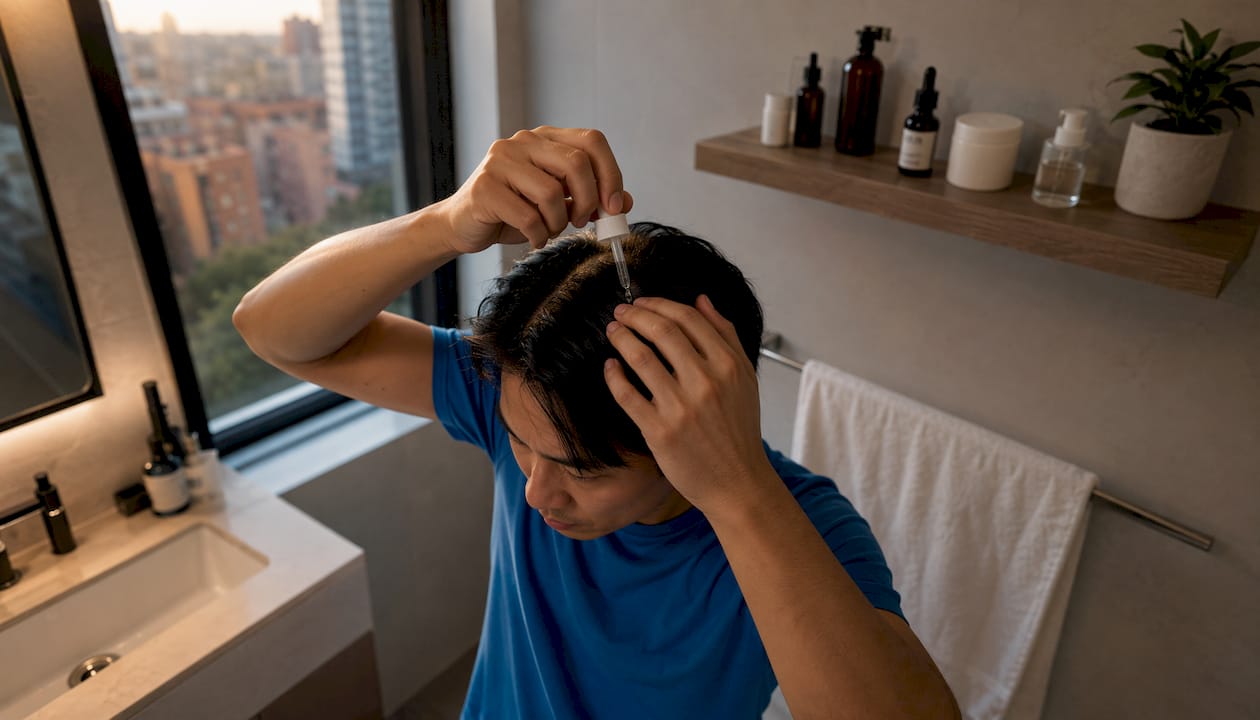
Pro Tip: If you stop treatment, DHT levels recover and hair loss typically resumes within months. Any gains from a DHT blocker require ongoing maintenance to hold.
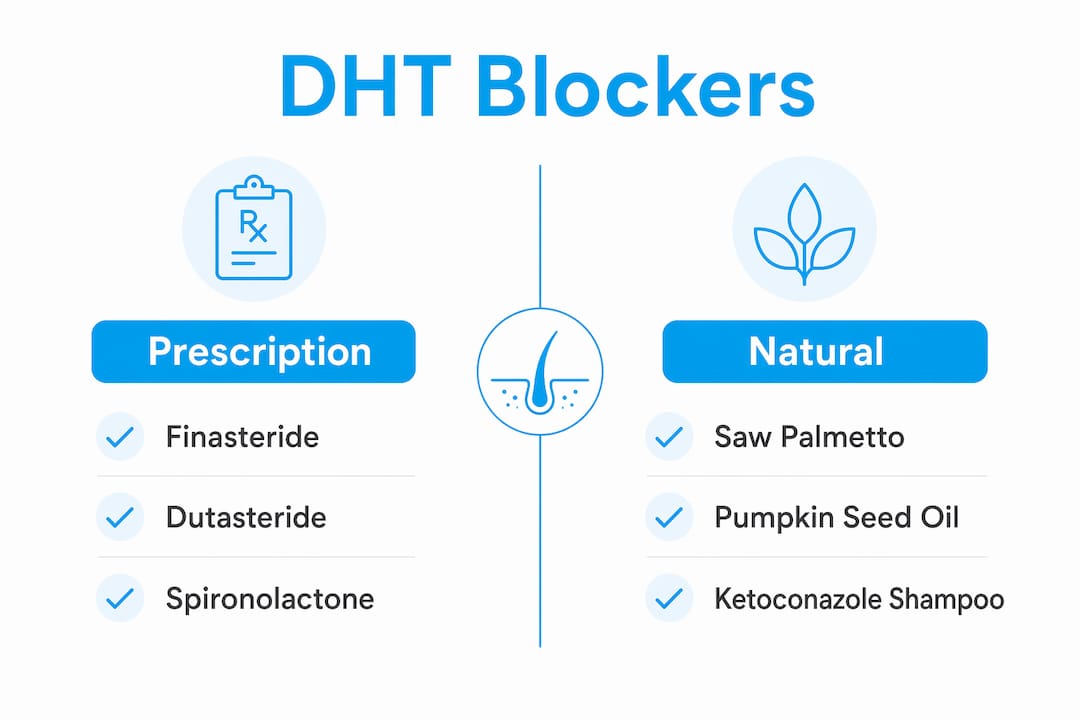
Types of DHT blockers: which one fits your situation
Comparison table
| Treatment | Efficacy for scalp hair | Route | Rx required | Key side effects | Suitable for | Time to results |
|---|---|---|---|---|---|---|
| Finasteride (Propecia) | Strong: regrowth + preservation | Oral | Yes | Sexual side effects, breast tenderness | Men only | 6–18 months |
| Dutasteride (Avodart) | Strongest: higher DHT suppression | Oral | Yes (off-label for hair) | Similar to finasteride, potentially more pronounced | Men only | 6–18 months |
| Spironolactone | Moderate: slows loss, some regrowth | Oral | Yes | Menstrual changes, potassium shifts, breast tenderness | Women | 6–12 months |
| Topical finasteride (compounded) | Moderate: local scalp benefit | Topical | Yes (compounded) | Lower systemic risk; local irritation possible | Men, some women | 6–12 months |
| Ketoconazole 2% shampoo | Modest: adjunct only | Shampoo | OTC (2% Rx in US) | Scalp dryness, rare irritation | Men and women | 3–6 months (adjunct) |
| Saw palmetto | Weak/mixed | Oral supplement | No | GI upset, rare hormonal effects | Men and women | 12–24 weeks |
| Pumpkin seed oil | Weak/mixed | Oral supplement | No | Generally well tolerated | Men | 12–24 weeks |
Key notes on each option:
- Finasteride (Propecia) has the deepest evidence base for male pattern hair loss, with decades of randomized controlled trial data showing preservation and measurable regrowth in many men.
- Dutasteride (Avodart) suppresses serum DHT by 90–98% versus finasteride's ~70%, and pooled studies show greater hair-count improvements. It's prescribed off-label for hair loss in the US.
- Spironolactone is the go-to oral option for women because finasteride is not FDA-cleared for female use due to birth-defect risks. It works by blocking androgen receptors rather than reducing DHT production.
- Topical finasteride (compounded) suits men and some women who want to minimize systemic exposure. Compounded formulations are available through telehealth prescribers and specialty pharmacies.
- Ketoconazole 2% shampoo reduces scalp DHT by about 12–16% and improves the scalp environment. Dermatologists view it as a supporting element, not a primary treatment.
- Saw palmetto and pumpkin seed oil are the most studied natural options. Evidence is limited and results are variable, but they carry low risk and may suit people who want to avoid prescription drugs entirely.
How effective are DHT blockers for hair growth, and when will you see results?
Prescription 5-alpha reductase inhibitors have the strongest evidence. Finasteride 1 mg daily reduces serum DHT by roughly 70% and has produced measurable hair-count preservation and regrowth across multiple large RCTs. Dutasteride outperforms it on both DHT suppression and hair-count metrics in pooled analyses. Topical formulations and ketoconazole shampoo offer smaller, scalp-level benefits and work best as adjuncts to a primary oral therapy.
Realistic timeline:
- Months 1–3: Possible increase in shedding — this is normal and reflects the follicle cycle resetting, not treatment failure
- Months 3–6: Shedding stabilizes; some people notice early density improvements
- Months 12–18: Full effect becomes visible; most clinical trials measure outcomes at this point
- Natural remedies: Modest gains, if any, typically appear at 12–24 weeks
Supplements like saw palmetto have one small RCT for pumpkin seed oil and limited randomized evidence for saw palmetto overall. Results are variable and substantially weaker than what prescription drugs deliver. The opportunity cost is real: every month spent on supplements alone is a month of continued follicle miniaturization for someone who would benefit from a 5-AR inhibitor.
For women with hair loss, the evidence base is thinner but growing. Spironolactone and topical finasteride show benefit in clinical practice, though large-scale RCTs specific to women are fewer than those for men.
Safety, side effects, and who needs to be careful
Systemic DHT blockers can cause sexual side effects and require medical supervision. That's the short version. The longer version matters for anyone considering treatment.
Common side effects (finasteride and dutasteride):
- Decreased libido
- Erectile dysfunction or ejaculation changes
- Breast tenderness or enlargement (gynecomastia)
- Mood changes, including reports of depression in some users
- Rash or skin reactions (less common)
A small subset of men report persistent sexual side effects even after stopping finasteride, a condition sometimes called post-finasteride syndrome. The FDA has added this to finasteride's label. It's uncommon, but worth discussing with a prescriber before starting.
Pregnancy warning: Finasteride and dutasteride can cause birth defects in male fetuses. Women who are pregnant or may become pregnant must not handle crushed or broken tablets. Neither drug is FDA-cleared for women of childbearing potential.
Monitoring checklist before and during treatment:
- Baseline medical review with a dermatologist or prescriber
- PSA (prostate-specific antigen) check for men over 40, since 5-AR inhibitors lower PSA and can mask prostate issues
- Liver function baseline if using spironolactone long-term
- Potassium monitoring for women on spironolactone (it's a potassium-sparing diuretic)
- Track sexual function and mood monthly for the first 6 months
- Stop and consult your prescriber if sexual side effects persist beyond 4 weeks or mood changes are significant
For women specifically: Spironolactone is the most widely used oral option and has a strong clinical track record. Topical options reduce systemic exposure for those who want to avoid oral medications. Women of childbearing age on spironolactone typically need contraception due to its anti-androgenic effects on a developing fetus.
Pro Tip: Ketoconazole shampoo and topical minoxidil carry no significant systemic hormonal risks and are reasonable starting points for anyone who wants to act while deciding about prescription therapy.
How to choose the right DHT blocker for your situation
The right choice depends on your sex, hair-loss pattern, risk tolerance, and whether you're planning a pregnancy. Here's a practical framework.
Selection checklist:
- Confirm the diagnosis. Androgenetic alopecia responds to DHT blockers. Other causes don't. A dermatologist can confirm with a scalp exam or trichoscopy.
- Identify your pattern. Temple recession and crown thinning in men point to finasteride or dutasteride. Diffuse thinning in women points to spironolactone or topical finasteride.
- Assess your risk tolerance. If sexual side effects are a dealbreaker, topical finasteride or ketoconazole shampoo with minoxidil is a lower-risk starting point.
- Consider pregnancy plans. Oral 5-AR inhibitors are off the table for women who are pregnant or trying to conceive.
- Factor in cost and access. Generic finasteride is inexpensive and widely available. Dutasteride is off-label and may not be covered by insurance. Compounded topicals vary by pharmacy.
- Think about combination therapy. Adding topical minoxidil to a DHT blocker is evidence-based and often recommended as a first-line combination for male pattern baldness.
Questions to ask your prescriber:
- What baseline labs do I need before starting?
- How will we monitor PSA or potassium over time?
- What's the expected timeline for my specific pattern?
- Should I combine this with minoxidil or ketoconazole shampoo?
- What are the stopping criteria if I experience side effects?
For early vertex thinning in men, finasteride 1 mg daily plus topical minoxidil is a well-supported first step. For women with diffuse thinning, spironolactone plus a scalp-care routine including ketoconazole shampoo is a common clinical approach. A hair loss dermatologist can tailor this further based on your labs and history.
Natural remedies and foods: what the evidence actually supports
Some natural options show small signals in clinical research, but none come close to prescription 5-AR inhibitors. That gap matters when follicles are actively miniaturizing.
Evidence grades for popular natural DHT blockers:
- Saw palmetto: Limited RCT evidence; results are variable. Some studies show modest reduction in hair loss, but effect sizes are small compared to finasteride.
- Pumpkin seed oil: One small RCT showed benefit in men with androgenetic alopecia; promising but not conclusive.
- Green tea (EGCG): Preclinical data suggests some 5-AR inhibitory activity; human RCT evidence is thin.
- Zinc and biotin: Support general scalp health; no direct DHT-blocking mechanism.
- Foods with limited DHT effect: Lycopene-rich foods (tomatoes), flaxseed (lignans), and soy isoflavones have weak anti-androgenic properties in lab settings but no meaningful clinical hair-loss data.
Where adjuncts genuinely help:
Ketoconazole 2% shampoo is the strongest adjunct. Dermatologists value it primarily for reducing scalp inflammation and fungal activity, with modest local DHT reduction as a secondary benefit. Leave it on for 5–10 minutes per use for maximum contact time. Minoxidil works through a completely different mechanism (vasodilation and follicle stimulation) and stacks well with any DHT blocker. Combining a prescription DHT blocker, topical minoxidil, and ketoconazole shampoo is the most evidence-supported multi-modal approach available without surgery.
For practical scalp-care routines that complement these treatments, resources like salon-based scalp care guides offer useful adjunctive context on maintaining scalp health between clinical visits.
Relying solely on supplements while avoiding proven therapy is a meaningful risk. Follicles that miniaturize past a threshold don't recover with DHT blockers or supplements.
How to monitor your progress and know if treatment is working
Objective tracking is the part most people skip, and it's the part that tells you whether to stay the course or escalate.
Monitoring plan:
- Take baseline photos before starting treatment: top-down, front hairline, and both temples in consistent lighting.
- Repeat monthly for the first 6 months, then every 3 months. Lighting and angle consistency matter more than camera quality.
- Track shedding subjectively by counting hairs on a pillow or in the shower drain weekly. A decrease after month 3 is a positive signal.
- Use objective hair-count tools if available. AI-assisted scalp scans, like those available through Myhair's hair-count feature, give you a quantified baseline and periodic comparisons that are far more reliable than memory.
- Note patient-reported outcomes: density perception, styling ease, and scalp visibility at the part.
- At 6–12 months with insufficient response, discuss stepping up with your prescriber: switching from finasteride to dutasteride, adding minoxidil, or exploring procedural options like PRP.
When to switch or escalate:
- No stabilization after 9–12 months on finasteride: consider dutasteride or adding topical minoxidil
- Persistent side effects after 4–6 weeks: discuss topical formulations or alternative agents
- Continued rapid progression despite treatment: dermatology referral for trichoscopy and possible biopsy
Pro Tip: Consistent scalp photos taken every 4 weeks in the same lighting reveal trends that are invisible day-to-day. Most people who "don't see results" simply haven't tracked objectively enough to notice gradual improvement.
Men with early vertex thinning typically see the clearest response to 5-AR inhibitors. Women with diffuse thinning often have a slower, less dramatic response curve and benefit most from combining spironolactone with topical minoxidil and consistent monitoring.
Key Takeaways
Prescription 5-alpha reductase inhibitors, finasteride and dutasteride, are the most effective DHT blockers for scalp hair preservation and regrowth, with full results typically visible at 12–18 months.
| Point | Details |
|---|---|
| Strongest options | Finasteride and dutasteride lead on clinical evidence; dutasteride produces deeper systemic DHT suppression. |
| Realistic timeline | Expect early shedding at 1–3 months, visible change at 3–6 months, full effect at 12–18 months. |
| Women's safety rules | Finasteride is not FDA-cleared for women; spironolactone or topical finasteride are the clinical alternatives. |
| Supplements are weaker | Saw palmetto and pumpkin seed oil show modest, mixed results — not substitutes for prescription therapy. |
| Track with Myhair | Myhair's AI-powered scalp scans provide objective hair-count baselines and progress comparisons to support your monitoring plan. |
The gap between what DHT blockers promise and what they actually deliver
Hair loss carries a weight that's hard to explain to someone who hasn't felt it. You notice it in photos first, then in the mirror, then in how you think about yourself. DHT blockers are genuinely useful tools, but the gap between what people hope for and what the drugs actually do is worth naming directly.
These medications are primarily preservation tools. Most people who start finasteride or dutasteride early enough will stabilize their hair loss and see modest regrowth, usually filling in thinning areas rather than restoring a hairline from ten years ago. That's a real, meaningful outcome. But it's not a reversal.
The early shedding phase, which can last 1–3 months, is the point where most people quit. They interpret it as the drug making things worse. It isn't. It's the follicle cycle resetting. Staying the course through that phase is where the results are.
What success looks like at 6–12 months is usually this: less shedding, slightly more density at the crown or part, and a sense that things have stabilized. It's not dramatic. It's quiet. And for most people, that quiet stability is exactly what they needed.
If you're not seeing any change after 12 months of consistent treatment, escalate. Switch agents, add minoxidil, or see a dermatologist for a trichoscopy. Waiting longer on a failing regimen is the one mistake that costs the most.
Myhair gives you an objective way to track what's actually changing
Most people judge their treatment progress by feel, which is unreliable. Hair density changes slowly, memory is imprecise, and the early shedding phase can make real improvement invisible until month six or later.
Myhair's AI-powered hair analysis gives you something more concrete: a quantified baseline scan before treatment starts, and periodic comparisons that show actual hair-count and density changes over time. The hair score and progress tracking features are built specifically for this kind of longitudinal monitoring, not just a one-time snapshot. You upload a scan, get a detailed assessment, and track how your scalp responds to whatever protocol you're following.
This doesn't replace a prescriber. Myhair won't write you a finasteride prescription or diagnose androgenetic alopecia. What it does is give you the objective data your prescriber needs to make better decisions with you. Start your baseline scan at Myhair's app onboarding before or at the same time you begin treatment, then scan every 8–12 weeks.
This article is general information, not medical advice. Consult a licensed dermatologist or prescriber for diagnosis and treatment decisions specific to your situation.
Useful sources and further reading
The clinical statements in this guide draw from the following primary and peer-reviewed sources:
- Cause of Androgenic Alopecia: Crux of the Matter (PMC): Peer-reviewed analysis of DHT's role in follicle miniaturization and the biological paradox of region-specific androgen response. Underpins the mechanism and biology sections.
- DHT (Dihydrotestosterone): What It Is, Side Effects & Levels (Cleveland Clinic): Authoritative clinical overview of DHT biology, including its role in androgenetic alopecia and prostate health.
- Region-specific effects of DHT on hair follicles (PMC): Research on why DHT promotes terminal hair in some regions while miniaturizing scalp follicles in others.
- Finasteride for hair loss (Keeps): Summary of finasteride's mechanism, DHT suppression figures, and clinical evidence for male pattern hair loss.
- DHT shampoos: what they do and how effective they are (New York Magazine/Strategist): Dermatologist-informed review of ketoconazole shampoo evidence, contact-time guidance, and adjunctive role.
- DHT: How It Causes Hair Loss and How to Slow It (Healthline): Evidence grading for natural supplements including saw palmetto, pumpkin seed oil, and green tea.
- DHT Blocker: How It Works for Hair Loss (Bosley): Clinical context for finasteride's FDA status, spironolactone as a female alternative, and treatment overview.
| Source | Type | Key contribution |
|---|---|---|
| PMC / Androgenic Alopecia | Peer-reviewed review | DHT mechanism, follicle miniaturization, paradox |
| Cleveland Clinic | Medical authority | DHT biology, clinical indications |
| PMC / Region-specific DHT | Peer-reviewed research | Regional follicle sensitivity |
| Healthline | Evidence-graded overview | Supplement evidence grades |
| NY Magazine / Strategist | Dermatologist-reviewed | Ketoconazole shampoo evidence and use |
FAQ
Do DHT blockers actually regrow hair?
Prescription 5-alpha reductase inhibitors like finasteride and dutasteride produce measurable regrowth in many men, though the primary effect is preservation of existing hair. Regrowth is most likely in areas where follicles are miniaturized but still active, not in long-standing bald patches.
What are the side effects of DHT blockers?
The most common side effects of oral finasteride and dutasteride are decreased libido, erectile dysfunction, and ejaculation changes. A small number of men report persistent effects after stopping, which the FDA has noted on finasteride's label. Women on spironolactone may experience menstrual changes and potassium shifts.
What are the strongest natural DHT blockers?
Saw palmetto and pumpkin seed oil have the most clinical data among natural options, but both show modest, variable results. Neither approaches the DHT suppression achieved by finasteride or dutasteride, and relying on them alone risks continued follicle miniaturization during the delay.
Does DHT increase hair growth anywhere?
Yes. DHT promotes terminal hair growth in the beard, chest, and other body regions. The paradox is that the same hormone miniaturizes scalp follicles in genetically susceptible individuals while stimulating follicles elsewhere. This regional difference is driven by local follicle sensitivity and signaling pathways, not systemic DHT levels alone.