TL;DR:
- DHT causes hair loss by gradually miniaturizing hair follicles through genetic sensitivity, not hormone levels. Early treatment with medications like finasteride or dutasteride can slow or stop this process, especially when started before follicles become fully dormant. Natural strategies may support treatment, but they are less effective than pharmaceutical options for preventing or reversing DHT-driven thinning.
DHT hair loss occurs when dihydrotestosterone (DHT), a hormone derived from testosterone, binds to androgen receptors in genetically sensitive hair follicles, causing them to shrink and produce progressively thinner hair. This condition is the primary driver of androgenetic alopecia, the most common form of pattern hair loss in both men and women. Androgenetic alopecia affects approximately 58% of men aged 30 to 50 in certain populations, and it significantly impacts women with hormonal imbalances like PCOS. The good news is that understanding the mechanism behind DHT and hair loss puts you in a much stronger position to act early and effectively.
How does DHT cause hair loss at the follicle level?
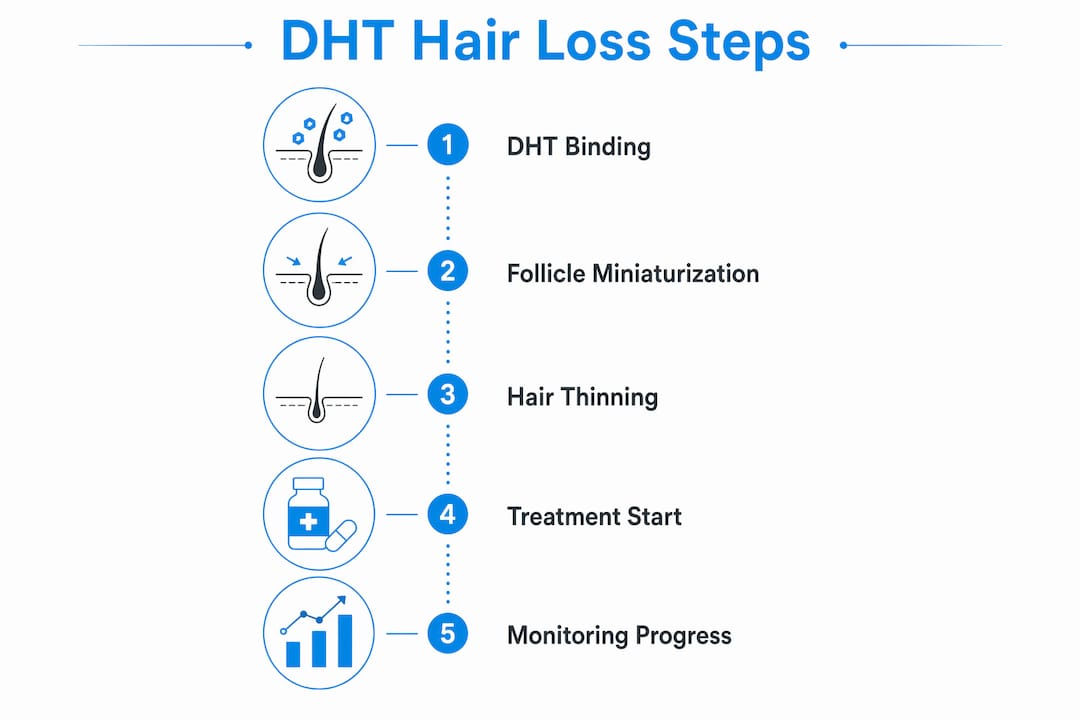
DHT does not destroy hair follicles outright. Instead, it triggers follicle miniaturization by progressively compressing the anagen phase, which is the active growth stage of the hair cycle. Each successive growth cycle produces a shorter, thinner strand until the follicle eventually stops producing visible hair.
The process works like this:
- DHT binds to androgen receptors inside genetically susceptible follicles on the scalp.
- The binding shortens the anagen phase from its normal duration of 2–7 years down to weeks or months.
- Each shortened cycle produces a finer, shorter hair strand.
- Over several cycles, the follicle shrinks to the point where it can no longer support a visible hair.
At the molecular level, signaling disruptions including upregulation of DKK1 and downregulation of VEGF impair follicle proliferation and cut off vascular support. DKK1 is a protein that blocks hair follicle growth signals, while VEGF is a growth factor that feeds blood supply to the follicle. When DHT disrupts both, the follicle loses two critical lifelines at once.
DHT does not kill follicles overnight. It gradually shortens the hair growth phase over many cycles, causing miniaturization that can span years before visible thinning becomes obvious. This slow progression is exactly why early intervention matters so much.
Pro Tip: If you notice your shed hairs have a tapered, fine tip rather than a bulb at the root, that is a classic sign of miniaturization, not normal shedding. Track this pattern over time to catch DHT-driven thinning early.
What role does genetics and follicle sensitivity play?
The real driver of DHT-related hair loss is not how much DHT circulates in your blood. Hair loss stems from follicle genetic sensitivity to DHT, not elevated circulating DHT levels. Many people with significant hair loss have completely normal blood DHT readings. This distinction matters because it explains why hormone tests alone rarely tell the full story.
Follicle sensitivity is inherited. Follicles on the top and front of the scalp carry androgen receptors that react strongly to DHT, while follicles on the back and sides do not. This genetic resistance is why hair loss follows predictable patterns, receding at the temples and thinning at the crown while the sides remain full.
| Scalp zone | DHT sensitivity | Hair loss risk |
|---|---|---|
| Top and front (crown, temples) | High | Significant thinning and recession |
| Back and sides (occipital region) | Low to none | Resistant, remains full |
This biology has a direct clinical application. Follicles at the back and sides retain their DHT resistance even after transplantation, which is why hair transplant results are considered permanent. The donor hair simply does not respond to DHT in the new location. Understanding this also clarifies why targeting follicle receptors or the 5-alpha reductase enzyme (which converts testosterone to DHT) is the most direct treatment strategy available.
What are the main medical treatments for DHT hair loss?
Two pharmaceutical treatments have the strongest clinical evidence for blocking DHT and slowing androgenetic alopecia: finasteride and dutasteride. Both work by inhibiting 5-alpha reductase, the enzyme responsible for converting testosterone into DHT.
- Finasteride (1 mg daily): Finasteride reduces scalp DHT by approximately 60% by blocking the type II isoform of 5-alpha reductase. It is the standard oral treatment for male pattern hair loss.
- Dutasteride: Dutasteride suppresses DHT by up to 90% by inhibiting both type I and type II isoforms. It is more potent than finasteride and is used when finasteride produces insufficient results.
- Topical minoxidil: Minoxidil does not block DHT directly. It extends the anagen phase and improves blood flow to the follicle, giving miniaturized follicles a better environment to recover. Topical minoxidil requires daily application for 6–9 months before noticeable improvement appears.
- Combination therapy: Pairing a DHT blocker with minoxidil addresses both the hormonal trigger and the follicle environment. Most dermatologists consider this the most effective non-surgical approach for active thinning.
| Treatment | Mechanism | DHT reduction | Time to results |
|---|---|---|---|
| Finasteride | Blocks 5-alpha reductase type II | ~60% | 6–12 months |
| Dutasteride | Blocks 5-alpha reductase types I and II | Up to 90% | 6–12 months |
| Minoxidil (topical) | Extends anagen phase, improves blood flow | None directly | 6–9 months |
One critical limitation applies to all of these treatments. Once follicles become fully dormant due to miniaturization, medications may not restore them. At that stage, hair transplant surgery is the only option for coverage in those zones. This is why starting treatment while follicles are still active produces far better outcomes.
Pro Tip: Set a calendar reminder at the 6-month mark after starting any DHT hair loss treatment. Progress photos taken in consistent lighting every 8 weeks give you objective data rather than relying on day-to-day perception, which is notoriously unreliable for slow changes.
What natural strategies can help reduce DHT?
Natural approaches to reducing DHT work best as a complement to medical treatment, not a replacement. Several foods contain compounds that may inhibit DHT production or reduce its activity at the follicle level. Foods such as green tea, pumpkin seeds, onions, and soy contain nutrients that may help lower DHT and support hair preservation.
The active compounds worth knowing:
- Epigallocatechin gallate (EGCG) in green tea inhibits 5-alpha reductase activity in lab studies.
- Zinc in pumpkin seeds plays a role in regulating 5-alpha reductase enzyme function.
- Quercetin in onions has shown anti-androgenic properties in preliminary research.
- Isoflavones in soy may weakly compete with DHT at androgen receptors.
Exercise also influences hormone balance. Moderate aerobic activity like jogging improves scalp circulation and helps regulate cortisol, which can indirectly affect androgen levels. Yoga and stress-reduction practices lower cortisol, and chronically elevated cortisol can worsen hormonal imbalances that accelerate hair thinning.
Scalp massage deserves a mention here. Regular massage increases blood flow to follicles and may improve the delivery of nutrients and growth factors. It will not block DHT, but it supports the follicle environment that DHT is trying to degrade.

Pro Tip: Combine green tea consumption with a zinc-rich diet rather than relying on a single food. Natural DHT inhibitors work through multiple pathways, and stacking them gives you broader coverage without the side effect profile of pharmaceuticals.
How can you recognize and monitor DHT-related hair loss?
Recognizing DHT-driven thinning early is the single most important factor in preserving hair density. The pattern is distinct from other types of hair loss and follows predictable routes based on genetics.
Common signs of DHT-related hair loss include:
- Recession at the temples forming an "M" shape in men.
- Thinning at the crown that spreads outward over time.
- A widening part line in women, particularly at the top of the scalp.
- Shed hairs that are noticeably finer and shorter than they used to be.
- Scalp becoming more visible under normal lighting conditions.
The difference between general thinning and follicle miniaturization is important. General thinning from stress or nutritional deficiency tends to affect the whole scalp evenly and reverses when the cause is addressed. Miniaturization follows a pattern, concentrates in DHT-sensitive zones, and does not reverse on its own.
A scalp exam by a dermatologist using dermoscopy can confirm miniaturization by measuring hair shaft diameter across different scalp zones. At home, hair density analysis tools like those offered by Myhair use AI to assess your scalp from photos, track changes over time, and give you an objective hair score. This kind of consistent monitoring catches progression that the naked eye misses between appointments.
Seek a medical consultation if you notice rapid recession, patchy loss (which may indicate alopecia areata rather than DHT), or if over-the-counter treatments have produced no change after 9 months. Early professional input gives you access to prescription-strength options before follicles reach the point of no return. You can also explore hair loss clinic options to find the right level of care for your situation.
Key Takeaways
DHT hair loss is caused by genetic follicle sensitivity to dihydrotestosterone, and early treatment with proven medical options gives you the best chance of preserving hair density long-term.
| Point | Details |
|---|---|
| DHT causes miniaturization, not instant loss | Follicles shrink over many growth cycles, making early detection critical. |
| Genetics drive sensitivity, not hormone levels | Normal blood DHT does not rule out DHT-driven hair loss. |
| Finasteride and dutasteride are most effective | They reduce scalp DHT by 60–90%, but require continuous use to maintain results. |
| Natural inhibitors support but do not replace treatment | Foods like green tea and pumpkin seeds complement medical therapy. |
| Monitoring progression objectively matters | AI-based scalp analysis tools track changes that daily observation misses. |
Why I think most people wait too long to treat DHT hair loss
The most common mistake I see is treating hair loss as a cosmetic problem to address "when it gets bad enough." That framing is exactly backwards. By the time thinning is obvious to others, follicle miniaturization has been underway for years. The window for medical treatment to make a real difference is already narrowing.
Medications like finasteride and minoxidil modify follicle behavior rather than cure androgenetic alopecia. They require continuous use and months to show results. That is not a flaw in the treatment. It reflects the biology of slow follicle change. The people who get the best outcomes are the ones who start early, stay consistent, and track their progress objectively rather than relying on bathroom mirror impressions.
I also think the natural versus medical debate wastes time that people cannot afford. Green tea and pumpkin seeds are worth including in your routine. They are not a substitute for a conversation with a dermatologist about finasteride. Use both. The lifestyle piece supports the medical piece. Neither alone is as effective as the combination.
Hair transplants are a legitimate permanent solution, but only for follicles that are already dormant. The goal of early medical treatment is to keep as many follicles active as possible so that if you do eventually choose surgery, you have more viable donor hair and less ground to cover. Think of treatment adherence now as protecting your future options.
— Cyriac
Myhair's AI analysis for tracking your hair health
Managing DHT-related hair loss is easier when you have objective data rather than guesswork. Myhair uses AI-powered scanning technology to assess your scalp from photos, measure hair density, and generate a personalized hair score that tracks changes over time.
The platform identifies thinning patterns consistent with androgenetic alopecia and maps progression across DHT-sensitive zones. That means you can see whether your current treatment is holding the line or whether miniaturization is continuing. Myhair also connects you with tailored treatment insights and product recommendations backed by research. If you are serious about managing DHT and hair growth long-term, start with a clear baseline. Myhair gives you that baseline in minutes.
FAQ
What is DHT and why does it cause hair loss?
DHT (dihydrotestosterone) is a hormone derived from testosterone by the enzyme 5-alpha reductase. It causes hair loss by binding to androgen receptors in genetically sensitive follicles, shortening the growth cycle and causing progressive miniaturization.
Can you block DHT naturally?
Foods like green tea, pumpkin seeds, and soy contain compounds that may reduce DHT activity, but their effect is modest compared to pharmaceutical options like finasteride. Natural inhibitors work best as a complement to medical treatment, not a standalone strategy.
How long does DHT hair loss treatment take to work?
Both finasteride and topical minoxidil require 6–9 months of consistent use before visible improvement appears. Stopping treatment causes hair loss to resume, as neither medication cures androgenetic alopecia.
Does everyone with high DHT lose their hair?
No. Hair loss is driven by follicle sensitivity to DHT, not by elevated DHT levels in the blood. People with normal circulating DHT can still experience significant hair loss if their follicles are genetically programmed to react strongly to the hormone.
Are hair transplants a permanent solution for DHT hair loss?
Yes, in the treated areas. Donor follicles from the back and sides of the scalp carry genetic resistance to DHT, and they retain that resistance after transplantation. However, transplants do not prevent ongoing loss in untreated areas, so medical management typically continues post-surgery.