Yes: severe calorie or protein restriction, undiagnosed iron deficiency, and megadosing supplements like vitamin A, selenium, or vitamin E rank among the biggest diet-related causes of hair loss. If your shedding started after a diet change, a fast weight drop, or a new supplement stack, the smart move is to check your recent history and get blood work before adding anything else to your routine.
TL;DR:
- Severe calorie restriction or rapid weight loss can cause hair shedding two to three months later, but recovery is typically slow and requires nutritional stabilization.
- Iron deficiency, especially in women with heavy periods, is the most supported nutritional cause, requiring testing and targeted correction rather than blanket supplementation.
- Excessive intake of vitamin A, selenium, or vitamin E can trigger hair loss, making high-dose supplements and nutrient bundling risky rather than beneficial.
- Drinking alcohol and consuming high-sugar diets may worsen hair outcomes through inflammatory pathways, especially when combined with other poor nutritional habits.
- Regular monitoring, including lab tests and photo tracking, is crucial to differentiate diet-related hair loss from other causes and to assess recovery progress.
Table of Contents
- The Dietary Mistakes for Hair That Trigger Shedding
- Key Nutrients: When Deficiency Matters and When Supplements Backfire
- Is Your Hair Loss Actually Diet-Related? How to Find Out
- Safe Supplementation: What Actually Helps and What to Avoid
- Diets and Habits That Raise Your Risk
- A Food-First Checklist to Support Hair Recovery
- The Impact of Hydration and Water Intake on Hair Health
- Common Food Allergies or Intolerances That May Contribute to Hair Loss
- Interactions Between Medications and Dietary Nutrients Affecting Hair Health
- Practical Judgment: Test Before You Supplement
- Track Your Progress While You Fix the Root Cause
- Sources
- FAQ
The Dietary Mistakes for Hair That Trigger Shedding
Hair loss tied to diet almost always traces back to one of a handful of repeatable patterns. Some are obvious once you know what to look for. Others hide inside "healthy" choices, like a green smoothie cleanse or a biotin gummy habit that started with good intentions.
Here are the mistakes that show up again and again in clinical literature and in dermatology practice.
-
Crash dieting and rapid weight loss. Dropping calories fast, whether through an extreme diet, illness, or bariatric surgery, can push a large share of hair follicles out of their growth phase and into a resting phase called telogen. The shedding usually doesn't show up immediately. It tends to appear two to three months after the triggering event, which is exactly why so many people don't connect the dots. The good news: telogen effluvium from a temporary calorie deficit is usually reversible once eating stabilizes, though regrowth takes months, not weeks.
-
Inadequate protein intake. Hair is built almost entirely from a protein called keratin, so a chronic shortfall shows up in the strands themselves. For most healthy adults, though, protein deficiency alone is an uncommon standalone cause of hair loss. The general guidance from Harvard Health puts baseline needs around 0.36 grams per pound of body weight daily, roughly 50 to 60 grams for many adults, with higher requirements for larger people, older adults, pregnant people, and anyone recovering from illness or surgery.
-
Iron deficiency. Iron plays a direct role in how hair follicle cells divide and grow, which is why low iron stores show up so often in people with diffuse thinning, especially women with heavy periods. A peer-reviewed review on diet and hair loss recommends screening patients with hair complaints for iron status through history and targeted labs rather than assuming the connection or ignoring it outright. The evidence supports correcting a documented deficiency. It does not support iron supplementation on a hunch.
-
Blind, high-dose supplementation, especially biotin. Biotin has become the default answer to hair thinning in supplement marketing, but true biotin deficiency is rare in people eating a normal diet. The NIH Office of Dietary Supplements notes that excess biotin can also interfere with common lab tests, including thyroid panels, which can send a workup in the wrong direction entirely. Taking biotin because a bottle promises thicker hair, without any lab evidence of a shortfall, is one of the most common and least useful habits people fall into.
-
Hypervitaminosis from A, selenium, or vitamin E. More is not better here. Vitamin A toxicity, selenium excess, and very high vitamin E intake have all been linked to hair shedding in case reports and reviews. Many consumer hair supplements bundle these nutrients together, which multiplies the risk instead of the benefit. Signs of vitamin A toxicity can include dry skin, headaches, and joint pain alongside hair changes, none of which show up on the supplement label.
-
Absorption and interaction problems. Diet quality isn't only about what you eat. It's also about what your body actually absorbs. Phytates in whole grains and legumes can bind iron and zinc, reducing how much reaches your bloodstream. Antacids and acid reducers can blunt iron absorption too. This is one reason plant-forward eaters sometimes need a different strategy than a simple food swap to correct a shortfall.
-
Alcohol and high-sugar diets. Heavier alcohol intake and higher consumption of sugary beverages have both been associated with worse hair outcomes in systematic review data, likely through inflammatory and metabolic pathways rather than any single vitamin shortfall. It's rarely the whole story, but it's frequently part of it.
Pro Tip: Before you change your supplement routine, write down every diet or medication change from the past four to six months. Telogen effluvium has a lag time, so the trigger is often something you stopped connecting to your hair weeks ago.
Key Nutrients: When Deficiency Matters and When Supplements Backfire
The nutrient conversation around hair loss splits cleanly into two categories: shortfalls worth correcting, and excesses worth avoiding. Confusing the two is where most dietary mistakes for hair actually happen.
Iron has the strongest evidence base of any single nutrient. Ferritin, the storage form of iron measured on a blood panel, is the standard screening marker, and low levels correlate with diffuse hair thinning in multiple studies. The NIH's Iron fact sheet is explicit about the flip side: iron overload is a real toxicity risk, so supplementation should follow a documented deficiency and include monitoring, not open-ended dosing.
Vitamin D shows a consistent association with hair health in observational research, with higher vitamin D levels linked to better hair outcomes in several cohort studies. That's a correlation, not proof that supplementing fixes thinning hair in someone who isn't deficient. Testing before treating still applies.
Zinc deficiency has documented case reports of reversible hair loss once levels are corrected. Zinc is also easy to overdo, and excess zinc can interfere with copper absorption, creating a second deficiency while trying to fix the first.
Biotin and other B vitamins rarely show a true deficiency in people eating a varied diet, and the evidence that supplementing beyond normal levels improves hair growth in non-deficient people is thin.
Protein needs a daily floor, not a dramatic increase. The baseline is about 0.36 grams per pound of body weight, per Harvard Health, which works out to roughly 50 to 60 grams a day for many adults.
- Iron: screen with ferritin and a full iron panel before supplementing; monitor for overload during treatment.
- Vitamin D: correct documented low levels; don't assume supplementing will help if your levels are already normal.
- Zinc: deficiency-driven hair loss is often reversible, but excess zinc creates its own problems.
- Biotin: true deficiency is rare; high-dose supplements can distort thyroid lab results.
- Protein: hit a daily baseline through food across every meal rather than a single large serving.
A peer-reviewed review of nutrient deficiency and hair loss puts it plainly: correction of a documented deficiency is supported, but supplementation without evidence of deficiency is unproven and, for several nutrients, potentially harmful.
Is Your Hair Loss Actually Diet-Related? How to Find Out
Diet-related shedding has a recognizable shape once you know the questions to ask and the labs to request.
Start with history. Walk through the past several months and note: any significant weight loss, a new restrictive diet, changes in menstrual bleeding, any GI surgery, and every supplement you've started or stopped. Diffuse shedding that started two to three months after one of these events points strongly toward diet or a related metabolic shift rather than a scalp condition.
- Collect the timeline. Match the onset of shedding against diet changes, weight loss, illness, or new medications from the prior two to four months.
- Request core labs. A complete blood count with ferritin, a vitamin D level, thyroid-stimulating hormone (TSH), and a targeted zinc panel cover most of the diet-related causes worth ruling out.
- Interpret results with context, not panic. A slightly low ferritin in an otherwise healthy person may not need aggressive treatment; a very low ferritin alongside heavy menstrual bleeding usually does.
- Track the expected timeline. Telogen effluvium typically surfaces two to three months after the trigger, and visible regrowth after correcting the cause often takes several more months to become obvious.
- Know when to escalate. Patchy hair loss, scalp scarring, redness, or hair loss alongside fatigue, unexplained weight change, or irregular periods warrants a dermatology or endocrine referral rather than a diet fix alone.
A tool like MyHair's tracking feature can help you document density and pattern changes over these months, which gives you and your clinician something concrete to compare against lab results.
Safe Supplementation: What Actually Helps and What to Avoid
Supplementation earns its place only after a documented shortfall or a specific clinician recommendation, never as a default response to shedding.
When iron studies confirm deficiency, supplementing makes sense, but it needs monitoring because excess iron carries real toxicity risk. The same logic applies to vitamin D: correct a confirmed low level, follow standard dosing guidance, and don't assume more is better once you're back in range. Zinc follows the same rule. Treat a documented deficiency, then stop or reduce the dose rather than continuing indefinitely.
Some supplements deserve real caution regardless of what the label promises:
- Vitamin A, at high doses, is one of the more consistently reported causes of drug-induced or supplement-induced hair shedding.
- Selenium, taken in excess, has documented toxicity that includes hair loss among its symptoms.
- Very high-dose vitamin E shows similar risk patterns in case reports, particularly when stacked with other fat-soluble vitamins.
- High-dose biotin won't cause the same toxicity profile, but it can distort thyroid lab results, which complicates diagnosis rather than helping it.
Before starting anything, confirm the deficiency with a lab result, choose a dose based on clinical guidance rather than the highest number on the shelf, and set a follow-up test in 8 to 12 weeks to check whether levels are actually moving in the right direction.
Pro Tip: If a supplement bottle lists five or more "hair vitamins" bundled together, treat it as a marketing product, not a medical one. Nutrient bundling is common in this category, and it raises your odds of hitting a toxic dose on something you didn't even know you needed.
For a deeper look at what can go wrong with over-the-counter hair supplements, Myhair's guide to supplement risks covers specific cases worth knowing before you buy anything.
Diets and Habits That Raise Your Risk
Certain overall eating patterns carry more diet-related hair loss risk than others, independent of any single nutrient.
Vegetarian and vegan diets can run lower in bioavailable iron and zinc, partly because plant-based iron (non-heme iron) absorbs less efficiently than iron from meat, and partly because phytates in grains and legumes bind minerals during digestion. Pairing iron-rich plant foods with vitamin C, think lentils with tomatoes or spinach with citrus, improves absorption meaningfully. If you've followed a strict plant-based diet for years without ever checking ferritin or zinc, that's a reasonable thing to test.

Crash diets and bariatric surgery both create a fast nutritional shift that the body reads as a stress signal, pushing hair follicles into the resting phase. Anyone who has had bariatric surgery should have structured nutrition follow-up, since the surgery itself changes how nutrients are absorbed long after the initial recovery period.
Alcohol and sugary drinks, consumed heavily and consistently, have been linked to worse hair outcomes in systematic review evidence, likely through inflammatory pathways rather than displacing nutrients outright.
- Pair plant iron sources with a vitamin C food at the same meal.
- Get ferritin and zinc checked if you've eaten strictly plant-based for more than a year without testing.
- Build a structured refeeding plan with a clinician after any rapid weight loss or bariatric surgery.
- Swap at least one sugary drink a day for water or unsweetened tea as a low-effort first step.
A Food-First Checklist to Support Hair Recovery
Correcting diet-related hair loss usually starts with food, not a supplement aisle. Whole foods deliver nutrients alongside the cofactors that help your body actually use them, something a pill can't replicate.
- Hit your calorie and protein floor daily. Include a protein source at every meal, eggs, fish, poultry, beans, or tofu, rather than trying to catch up with one large dinner.
- Choose iron-rich foods and pair them smart. Lentil stew with tomatoes, or a spinach salad with orange segments, combines iron with the vitamin C that helps you absorb it.
- Add fatty fish or plant omega sources weekly. Salmon, sardines, walnuts, and flaxseed all supply the fatty acids tied to scalp and hair health.
- Round out zinc and B vitamins through variety. Pumpkin seeds, shellfish, eggs, and whole grains cover both without needing a supplement.
- Reserve supplements for confirmed shortfalls. Fortified foods are a reasonable middle step; high-dose pills are not the first move.
Realistically, expect a diet correction to take a few months before you see less shedding, and several more before regrowth becomes visually obvious. Myhair's food-first guide and nutrition insights both walk through specific meal combinations if you want a starting template.
The Impact of Hydration and Water Intake on Hair Health
Water doesn't get the same research attention as iron or protein, but chronic dehydration shows up in hair the same way it shows up in skin: dull, brittle, and prone to breakage rather than genuine shedding from the root. Hair strands are partly made of water, and a scalp that's consistently under hydrated tends to produce weaker, more fragile strands over time.
This isn't the same mechanism as telogen effluvium or nutrient deficiency, and drinking more water won't reverse a diet-driven shedding pattern on its own. But dehydration is often a secondary factor riding alongside the bigger dietary mistakes, especially during crash diets, when water intake often drops along with food intake. If you're already correcting calorie or protein deficits, make sure fluid intake isn't an afterthought in that same recovery plan. There's no dramatic fix here, just a baseline worth maintaining: consistent daily water intake, adjusted for activity level and climate, supports the same scalp environment that nutrient correction is trying to improve.
Common Food Allergies or Intolerances That May Contribute to Hair Loss
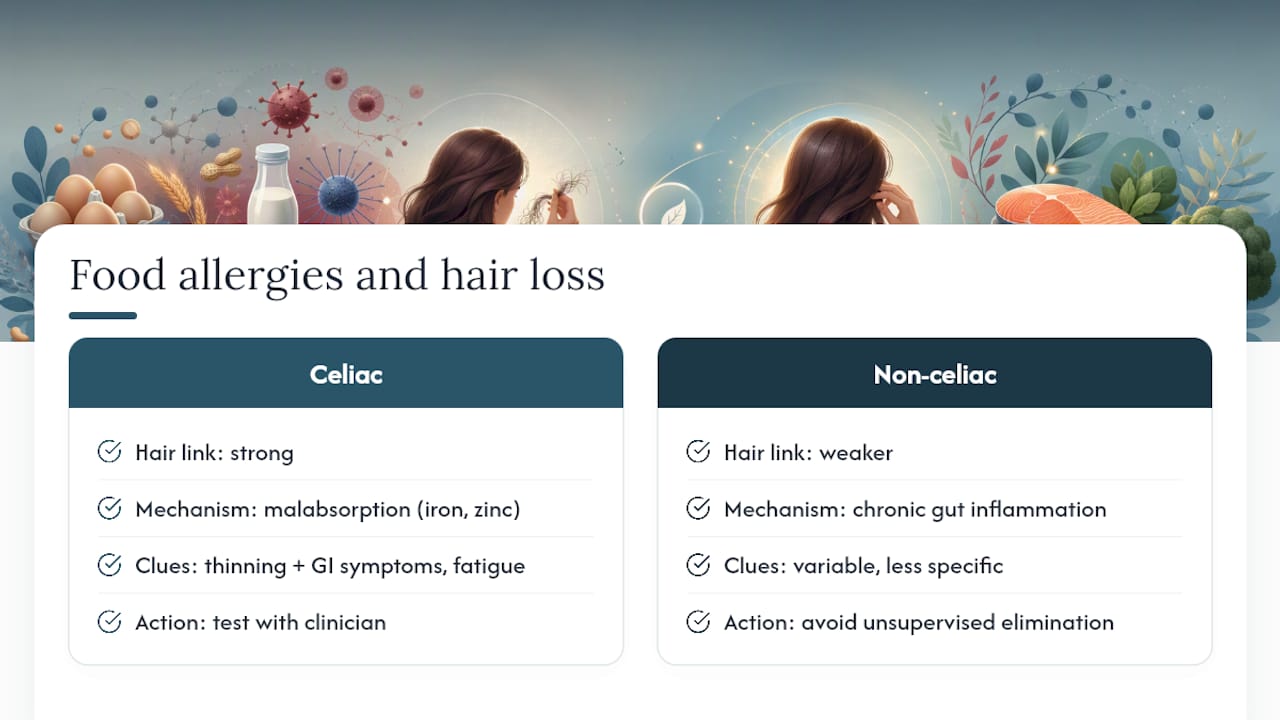
Undiagnosed celiac disease is the clearest example of a food-related condition tied to hair loss that has nothing to do with what you're choosing to eat and everything to do with what your gut can absorb. Celiac disease damages the small intestine's lining, which blunts absorption of iron, zinc, and other nutrients even when your diet includes plenty of them. Diffuse hair thinning alongside GI symptoms, fatigue, or unexplained weight change is a reasonable trigger to ask about celiac screening.
Other food sensitivities, dairy or gluten intolerance without celiac disease, for instance, don't have the same strong documented link to hair loss, though chronic gut inflammation from any cause can indirectly affect nutrient status. The practical takeaway isn't to start eliminating food groups on your own. Unsupervised elimination diets frequently create new nutrient gaps while trying to solve one. If you suspect a food intolerance is playing a role, that's a conversation for a clinician who can test rather than guess, since cutting out entire food categories without a diagnosis often does more harm than good to your overall nutrient intake.
Interactions Between Medications and Dietary Nutrients Affecting Hair Health
Medications can quietly undercut the nutrients your hair depends on, which is why a full medication list belongs in any diet-related hair loss workup. Acid-reducing medications, proton pump inhibitors and H2 blockers among them, lower stomach acid in ways that reduce iron absorption over time. Long-term use of these medications alongside a borderline iron intake can push someone into deficiency who otherwise would have been fine.
Metformin, commonly prescribed for diabetes, is well documented to lower vitamin B12 levels with long-term use. Some cholesterol medications and blood thinners have also been associated with hair changes independent of diet, which matters when you're trying to isolate a dietary cause from a medication side effect. If you started a new prescription around the same time your hair loss began, that timeline deserves as much attention as any diet change. Bring your full medication list to whatever clinician orders your labs. It changes which deficiencies are worth suspecting and which supplements might interact with what you're already taking.
Practical Judgment: Test Before You Supplement
The biggest mistake I see repeated across supplement marketing is treating hair loss like a single-nutrient problem with a single-bottle solution. It rarely works that way. Iron deficiency, crash dieting, and megadose vitamins are three completely different mechanisms that happen to produce the same symptom, and treating all three the same way explains why so many people spend months on biotin gummies with nothing to show for it.
Supplements are not risk-free interventions. Vitamin A, selenium, and high-dose vitamin E all carry documented harm at excess levels, which means guessing your way through a supplement stack can genuinely make things worse. Small, targeted dietary corrections, guided by an actual lab result, are usually safer and just as effective as anything sold as a "hair growth complex." Track your progress with photos and density notes over several months rather than judging results week to week; diet-related recovery is slow by nature, and patience paired with real data beats another bottle on the shelf.
— Cyriac
Track Your Progress While You Fix the Root Cause
Correcting a dietary mistake takes months to show results, and it's easy to lose track of whether anything is actually working without a way to measure change over time. The platform offers AI-powered scans that assess hair density and pattern from photos, longitudinal tracking to monitor changes over time, and personalized product or clinic recommendations based on scan results.
This isn't a replacement for the bloodwork discussed above. It's what happens after you've talked to a clinician and started correcting a confirmed deficiency: a way to watch your scalp change over the following months instead of guessing from the mirror. The Free Plan gets you started with an initial scan at no cost, and if you want ongoing tracking, the Monthly plan runs $9.99. If your labs point toward something that needs professional treatment rather than a diet fix, Myhair's clinic directory and doctor listings can help you find the right specialist next. Start with a scan through the app and give your diet correction something concrete to measure against.
Sources
For readers who want to go deeper than this guide, a few sources form the evidence base behind it: the PMC review on nutrient deficiency and hair loss, Harvard Health's pieces on protein intake and vitamins and minerals, and the NIH Office of Dietary Supplements fact sheets on iron and biotin. Each covers testing thresholds, dosing caution, and toxicity risk in more clinical detail than a general guide can.
This article is general information, not a substitute for advice from a qualified doctor. Consult a qualified healthcare professional about your own circumstances before acting on anything here.
- Diet and hair loss: effects of nutrient deficiency and supplement use — PMC
- Can insufficient protein intake cause hair loss? — Harvard Health
FAQ
Which foods are unhealthy for hair?
Foods high in added sugar and refined carbohydrates, along with heavy alcohol intake, have been linked to worse hair outcomes in review data, likely through inflammatory and metabolic pathways rather than a single missing nutrient.
What is the "big three" for hair loss?
There's no single universally agreed "big three," but iron deficiency, inadequate protein intake, and rapid weight loss consistently show up as the three most-cited diet-related triggers for hair shedding across clinical reviews.
What foods stop hair loss?
No food reverses hair loss on its own, but iron-rich foods paired with vitamin C, protein at every meal, and fatty fish for omega-3s address the most common diet-related deficiencies tied to shedding. Correcting an actual deficiency, confirmed by labs, is what drives recovery, not any single "hair food."
What foods trigger hair growth?
Growth depends on overall nutritional adequacy rather than one trigger food: sufficient protein, adequate iron and zinc, and enough calories overall create the conditions your follicles need to stay in an active growth phase. Tracking your response with a tool like Myhair's scanning feature can help you see whether dietary changes are translating into real density improvement over time.
How long does it take for diet-related hair loss to recover?
Shedding from a dietary trigger typically appears two to three months after the cause, and once the deficiency or restriction is corrected, visible regrowth often takes several more months to become noticeable.