Yes, most adult hair thinning is genetic. Androgenetic alopecia (AGA), the clinical name for hereditary pattern hair loss, accounts for the majority of progressive thinning in both men and women, and twin studies suggest heritability as high as ~80%. The condition is not caused by a single gene flipping on or off. Dozens of genetic variants, each contributing a small amount of risk, add up to a polygenic trait that interacts with hormones and aging.
A few things worth knowing up front:
- The AR gene (androgen receptor, located on the X chromosome) is the only single locus with consistent variant-level confirmation across studies, but it explains only part of individual risk.
- Family history on both sides matters. The idea that baldness comes only from your mother's father is a myth; genes from both parents shape your risk.
- Treatments exist and work, but they are maintenance therapies. Stopping them typically reverses the gains.
- Genetic testing has real limits. Consumer panels and polygenic scores cannot reliably predict whether you personally will go bald.
- Early evaluation matters. A dermatologist can distinguish hereditary thinning from reversible causes and start treatment while more follicles are still active.
If you are noticing a widening part, a receding hairline, or diffuse thinning at the crown, the genetic causes of thinning hair are the most likely explanation, but a clinical exam is the only way to confirm it.
Key Takeaways
| Point | Details |
|---|---|
| AGA is polygenic, not single-gene | Dozens of loci contribute to risk; the AR gene is the only consistently confirmed single locus. |
| Both parents' family history matters | Genes from both sides shape risk; the "mother's father" rule captures only the X-linked AR signal. |
| Treatments require ongoing use | Minoxidil and finasteride are maintenance therapies; stopping them typically reverses gains. |
| Genetic tests have limited predictive value | Consumer polygenic scores explain only part of heritable risk and cannot reliably predict individual outcomes. |
| Myhair tracks what matters | AI-powered scalp scans provide objective, longitudinal data to measure treatment response and detect early miniaturization. |
Table of Contents
- Which kinds of hair loss are linked to genes, and which usually aren't?
- How do genes actually cause thinning? The biology behind AGA
- How is genetic hair thinning inherited?
- How male-pattern and female-pattern hereditary thinning differ
- How doctors diagnose hereditary thinning and when to see a dermatologist
- Can a genetic test tell you whether you'll go bald?
- Evidence-based treatments in the U.S.: what works and what to expect
- What to do now if you're noticing genetic-type thinning
- Where genetics research and new treatments are heading
- What the genetics of thinning hair actually tells us, and what it doesn't
- Myhair's AI tracking gives your treatment a measurable baseline
- Sources
- FAQ
Which kinds of hair loss are linked to genes, and which usually aren't?
Not every form of hair loss runs in families, and mixing them up leads to unnecessary worry or, worse, missed treatment. Clinical reviews confirm that timing, distribution, and scalp-exam findings are what separate hereditary thinning from other causes.
Strongly genetic:
- Androgenetic alopecia (AGA): Patterned, progressive miniaturization of follicles. The most common form of hair loss in adults. Clusters unmistakably in families.
- Alopecia areata: An autoimmune condition with a partial genetic predisposition. It can run in families, but environmental triggers and immune dysregulation are also central. Patchy, sudden-onset loss is the hallmark, not gradual thinning.
Usually not genetic (or only weakly so):
- Telogen effluvium: Diffuse shedding triggered by a physiologic stressor, such as surgery, rapid weight loss, childbirth, or thyroid dysfunction. Typically resolves once the trigger is removed. Family history is not a meaningful risk factor here.
- Traction alopecia: Mechanical damage from tight hairstyles. Entirely behavioral in origin; genetics play no role.
- Scarring alopecias (e.g., lichen planopilaris, frontal fibrosing alopecia): Inflammatory conditions that destroy follicles permanently. Some have immune-genetic underpinnings, but they are not classic hereditary-pattern loss.
Clinical signs that point toward hereditary thinning:
- Gradual onset over months to years, not sudden shedding
- Patterned distribution (temples and vertex in men; diffuse crown thinning in women)
- Dermoscopy showing follicle miniaturization and hair shaft diameter variability
- Positive family history on either parent's side
Signs that suggest a non-hereditary cause:
- Sudden, diffuse shedding following a stressor (telogen effluvium)
- Discrete, round bald patches (alopecia areata)
- Scalp inflammation, scaling, or scarring
- Associated symptoms like fatigue, cold intolerance, or irregular periods
How do genes actually cause thinning? The biology behind AGA
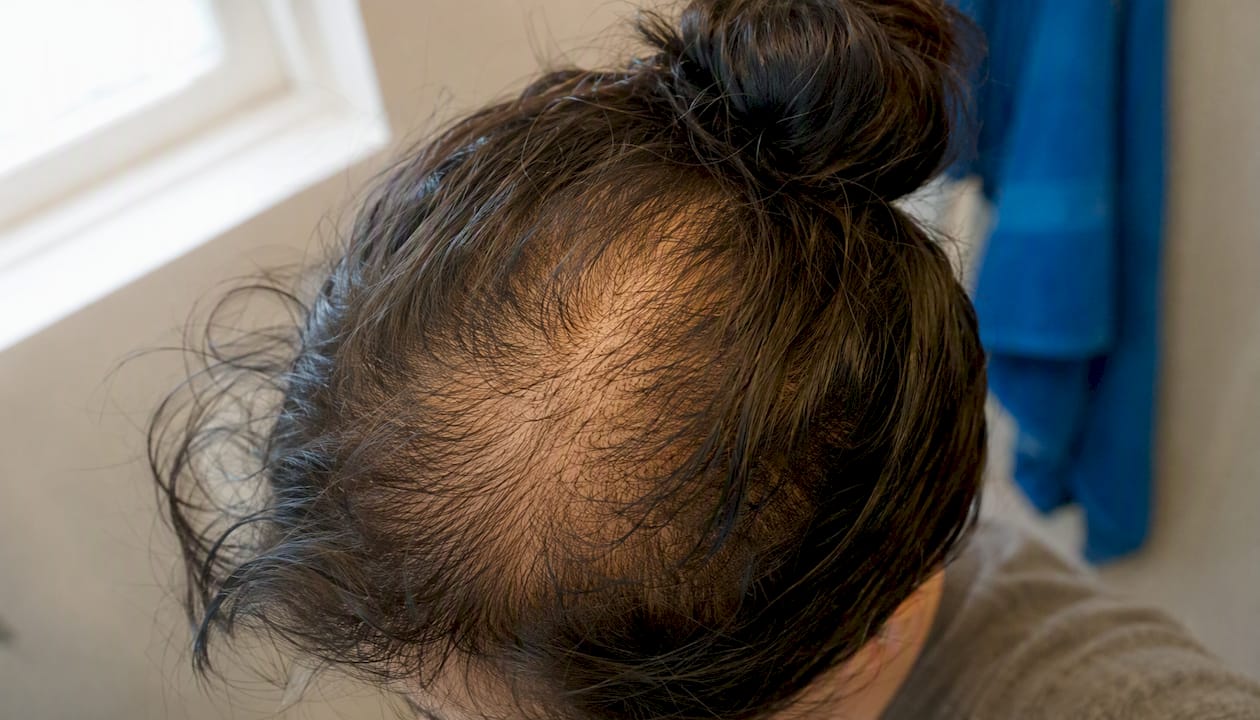
The core mechanism is follicle miniaturization: genetically susceptible follicles progressively shrink over successive hair cycles, producing finer, shorter hairs until the follicle eventually stops producing visible hair altogether. The anagen (growth) phase shortens with each cycle, while the telogen (resting) phase stays the same or lengthens, so the ratio of growing to resting hairs shifts unfavorably.
The androgen signaling pathway
Testosterone is converted to dihydrotestosterone (DHT) by the enzyme 5-alpha reductase, primarily in the scalp. DHT binds to the androgen receptor (AR) inside susceptible follicle cells, triggering the miniaturization cascade. The AR gene sits on the X chromosome, which is why the maternal grandfather's hairline has historically been used as a rough proxy for risk. But that is only one piece of a much larger puzzle.

AGA is genetically predetermined in predisposed individuals through this excessive AR response to androgens, and the result is progressive loss of terminal hair in characteristic patterns. Importantly, DHT levels in the blood are not necessarily elevated in people with AGA. The follicles themselves are simply more sensitive to normal androgen concentrations.
Polygenic architecture: dozens of loci, not one gene
Key finding: A landmark genome-wide association study (GWAS) identified 71 independent susceptibility loci and explained approximately 38% of SNP-based risk in a large European-ancestry cohort. Multiple biological pathways were implicated, including androgen signaling and WNT/β-catenin signaling.
Beyond the AR locus, large-scale genetic studies define AGA as polygenic with hits across chromosomes. Two of the better-characterized non-AR signals are:
- WNT10A: Part of the WNT/β-catenin pathway, which regulates follicle cycling and regeneration. Variants here affect how follicles respond to growth signals.
- 20p11 locus: One of several autosomal signals identified in GWAS work; the exact mechanism is still under investigation.
Each individual variant contributes a small effect. Risk accumulates additively across dozens of loci, which is why AGA does not follow a simple dominant or recessive inheritance pattern.
Epigenetics and environment
Carrying risk variants does not guarantee visible thinning. Genetic risk is meaningfully modified by epigenetic changes and environmental factors: chronic stress, metabolic dysfunction (insulin resistance, obesity), nutritional deficiencies, and even scalp microbiome composition can influence whether and when genetic predisposition becomes visible thinning. DNA methylation patterns differ between thinning and non-thinning scalp sites, a finding that is actively informing research into future diagnostics.

How is genetic hair thinning inherited?
The short answer: it is complicated, and the "you got it from your mom's dad" rule is far too simple. Hereditary-pattern baldness depends on genes from both parents, not solely the maternal line.
Key inheritance principles:
- Polygenic, not Mendelian. AGA is not caused by one dominant or recessive gene. Many variants across the genome each add a small increment of risk. This is why two brothers with the same parents can have very different hair outcomes.
- The X-chromosome signal is real but partial. Because the AR gene is X-linked, a son inherits his X chromosome from his mother. If her father had significant AGA, that AR variant may pass through her to her son. But autosomal loci (on chromosomes other than X) come from both parents equally, so paternal family history is equally informative.
- Variable penetrance. Even people who carry many risk variants may not develop clinically obvious thinning, particularly if other modifying factors (hormonal environment, age, lifestyle) do not align.
- Twin-study heritability estimates. Twin and family studies show high heritability for AGA, with some analyses placing the genetic contribution at roughly 80% of phenotypic variance. That leaves meaningful room for non-genetic influences.
- Ancestry differences. GWAS studies have been conducted predominantly in European-ancestry populations. Risk loci and their effect sizes differ across ancestral groups, so polygenic scores built on European data have reduced accuracy in other populations.
- Practical implication: If either parent, or any grandparent on either side, had significant pattern thinning, your genetic risk is elevated. The more relatives affected, and the earlier their onset, the stronger the signal.
Pro Tip: When you see a dermatologist, bring a brief family history covering both parents and all four grandparents if possible. Note the age of onset for any affected relatives, not just whether they had hair loss. Earlier onset in a relative is a stronger risk signal than late-onset thinning.
How male-pattern and female-pattern hereditary thinning differ
The underlying genetics are largely shared between sexes, but the clinical picture looks quite different, and that matters for diagnosis and treatment.
Male-pattern AGA:
- Typically begins at the temples and vertex (crown), following the Hamilton-Norwood scale.
- Onset can start as early as the late teens or early 20s in men with strong genetic loading.
- Progression is often faster and more extensive than in women.
- DHT-driven miniaturization is the dominant mechanism.
Female-pattern AGA (FPHL):
- Presents as diffuse thinning over the crown with a preserved frontal hairline, following the Ludwig scale.
- Onset is most common in the 40s–50s, with acceleration after menopause as estrogen levels fall and the androgen-to-estrogen ratio shifts.
- The androgen component is less dominant than in men; many women with FPHL have normal androgen levels, suggesting other genetic and hormonal pathways are involved.
The female presentation is where diagnosis gets genuinely tricky. Telogen effluvium, thyroid dysfunction, iron deficiency, and polycystic ovary syndrome (PCOS) can all produce diffuse crown thinning that looks like FPHL on casual inspection. Early-onset AGA in either sex can be associated with metabolic comorbidities including insulin resistance and obesity in some studies, which is one reason clinicians often run bloodwork even when the pattern looks classic.
Women who notice thinning before age 30, or who have irregular periods, acne, or other signs of androgen excess, should specifically ask their dermatologist about PCOS screening alongside the standard hair loss workup.
How doctors diagnose hereditary thinning and when to see a dermatologist
A clinical diagnosis of AGA is usually straightforward when the pattern is classic and the family history is positive. The challenge is ruling out reversible causes before attributing thinning to genetics, because treating a nutritional deficiency or thyroid problem is far simpler than long-term pharmacotherapy.
Standard diagnostic steps:
- History: Onset, rate of progression, shedding versus miniaturization, family history, medications, recent stressors, diet changes, and menstrual history in women.
- Scalp examination: Visual assessment of distribution and density.
- Dermoscopy: A handheld magnifier that reveals follicle miniaturization (variable hair shaft diameter), peripilar signs, and yellow dots. This is the most informative non-invasive tool for distinguishing AGA from other causes.
- Pull test: Gently pulling 40–60 hairs to assess active shedding. A positive result (more than 6 hairs) suggests a telogen effluvium component.
- Bloodwork: At minimum, thyroid-stimulating hormone (TSH), complete blood count, serum ferritin, and iron studies. Low ferritin is a common and correctable contributor to shedding, particularly in premenopausal women. Some clinicians also check vitamin D, zinc, and androgens (DHEA-S, free testosterone) in women.
- Scalp biopsy: Reserved for ambiguous cases, particularly when scarring alopecia cannot be excluded. Histology showing miniaturized follicles with a normal follicle count confirms AGA.
When to seek evaluation:
See a board-certified dermatologist rather than waiting if: you notice visible scalp through your hair, your part has widened noticeably, you are losing more than roughly 100–150 hairs per day for more than three months, or you have a strong family history and are in your 20s. Treatments are most effective earlier in the miniaturization process, before follicles become permanently dormant. Waiting until thinning is obvious means working with fewer viable follicles.
Pro Tip: Before your appointment, take three to five photos in consistent lighting (ideally natural light, same angle each time) and bring them to the visit. Clinicians can assess rate of change far more accurately with a photographic baseline than from memory alone. A hair tracking app can help you standardize this before you even walk in the door.
Can a genetic test tell you whether you'll go bald?
Probably not with enough precision to be clinically useful for most people. That is not a knock on genetic science; it reflects the genuine complexity of a polygenic trait.
Types of available tests:
- Single-variant tests (AR locus): Some early consumer tests focused on the AR gene variant. Useful for confirming one known risk signal, but the AR locus alone explains only a fraction of total genetic risk.
- Polygenic risk scores (PRS): Aggregate risk across dozens or hundreds of variants. More informative than single-locus tests, but still explain only a portion of heritable risk. A high PRS means elevated statistical risk in a population, not a personal guarantee.
- Direct-to-consumer (DTC) panels: Companies offering hair loss genetic panels typically combine AR and a selection of GWAS-identified variants. Results are usually reported as "elevated," "average," or "reduced" risk categories.
Limitations that matter:
- Only the AR gene has consistent variant-level confirmation across studies. Many implicated loci have modest effect sizes and uncertain functional roles.
- Most GWAS data comes from European-ancestry populations. Polygenic scores built on that data perform less well in people of African, East Asian, or South Asian ancestry.
- A "low risk" score does not mean you will not lose hair. A "high risk" score does not mean you will. Environmental and epigenetic factors modify the outcome substantially.
- Consumer test reports often lack the clinical context needed to interpret probabilistic scores correctly, which can cause unnecessary anxiety or false reassurance.
When testing is and isn't useful:
Testing is most relevant in research contexts and for people who want to understand their biological risk profile in general terms. It is not a substitute for a clinical exam, and it is not useful for family planning decisions in the way that single-gene disorder testing is. If you are already noticing thinning, a dermatologist's dermoscopy exam and a basic blood panel will give you more actionable information than any consumer genetic test.
Pro Tip: If you do get a genetic test report, look for the specific variants tested and their individual odds ratios, not just the summary risk category. Avoid making treatment decisions based on a summary score alone.
Evidence-based treatments in the U.S.: what works and what to expect
The good news is that effective, FDA-approved options exist. The realistic expectation is that they slow or halt progression and, in many cases, produce some regrowth, but they require ongoing use. Stopping treatment typically reverses gains within months.
First-line FDA-approved options
It does not block DHT. Visible results typically take four to six months of consistent use, and initial shedding in the first few weeks is normal (a sign that resting follicles are cycling into growth). Oral low-dose minoxidil (0.25–1.25 mg/day for women, 2.5–5 mg/day for men) has gained traction as an off-label option with growing evidence.
Oral finasteride (1 mg/day, brand name Propecia) is a 5-alpha reductase inhibitor that blocks the conversion of testosterone to DHT. It is FDA-approved for men and is the most studied pharmacologic treatment for male AGA. In clinical trials, it halted progression in the majority of men and produced measurable regrowth in many. It is not FDA-approved for women and is contraindicated in pregnancy. Sexual side effects (reduced libido, erectile dysfunction) occur in a minority of users and typically resolve on discontinuation, though post-finasteride syndrome remains a subject of ongoing research.
Dutasteride inhibits both type I and type II 5-alpha reductase (finasteride inhibits only type II), producing a more complete DHT reduction. It is FDA-approved for benign prostatic hyperplasia but used off-label for AGA, with evidence suggesting greater efficacy than finasteride in some studies. The side-effect profile is similar, and its longer half-life means effects persist longer after stopping.
Hair transplantation (follicular unit extraction, FUE, or follicular unit transplantation, FUT) moves DHT-resistant follicles from the occipital scalp to thinning areas. Results are permanent for the transplanted follicles, but native hair in the recipient area continues to miniaturize without ongoing medical therapy. Transplant is best suited for people with stable donor areas and realistic expectations about coverage.
Treatment comparison
| Treatment | Typical onset of effect | Durability | Key adverse effects |
|---|---|---|---|
| Topical minoxidil | several months | Requires ongoing use | Scalp irritation, initial shedding |
| Oral finasteride | several months | Requires ongoing use | Sexual side effects (minority of users) |
| Dutasteride (off-label) | several months | Requires ongoing use | Similar to finasteride; longer washout |
| Hair transplant (FUE/FUT) | several months post-surgery | Permanent for transplanted hair | Surgical risks, cost, donor area limits |
Combination therapy and emerging options
Clinical practice resources confirm that combining minoxidil and finasteride produces better outcomes than either alone for most men. For women, minoxidil (topical or oral) is the primary pharmacologic option; spironolactone (an antiandrogen) is commonly added off-label.
Low-dose oral minoxidil requires medical supervision: it can cause fluid retention, a faster heart rate, and lowered blood pressure, so clinicians typically monitor blood pressure and ask about heart conditions before prescribing. It is not recommended during pregnancy or breastfeeding. Discuss these risks with a physician before starting.
Emerging approaches with early but not yet definitive evidence include low-level laser therapy (LLLT) devices cleared by the FDA as medical devices (not drugs), platelet-rich plasma (PRP) injections, and topical antiandrogens like clascoterone. None of these have the depth of evidence behind minoxidil or finasteride yet.
Practical guidance: Men in their 20s or 30s with early AGA typically benefit most from finasteride plus minoxidil. Women should start with minoxidil and a full hormonal workup before adding antiandrogens. Anyone with advanced thinning and stable donor hair is a potential transplant candidate, ideally combined with ongoing medical therapy to protect remaining native hair.
What to do now if you're noticing genetic-type thinning
Early action matters more than most people realize. Once a follicle has been dormant long enough to stop penetrating the skin surface, pharmacologic reversal becomes unlikely. The window for meaningful intervention is open now, not after another year of watching.
Immediate steps:
- Take standardized photos today. Use consistent lighting, the same camera distance, and the same angles (top of head, hairline, temples). Repeat monthly. Progression that feels invisible day-to-day becomes obvious over six months of photos.
- Schedule a dermatology appointment. Bring your photos and a written family history. Ask specifically about dermoscopy and bloodwork to rule out reversible causes.
- Address reversible contributors. Get ferritin, TSH, and a complete blood count checked. Low ferritin (below 30–40 ng/mL is a commonly cited threshold, though some clinicians target higher) is a correctable and frequently overlooked contributor to shedding.
- Consider starting topical minoxidil. It is available without a prescription and has a strong safety record. Starting while you wait for a dermatology appointment is reasonable for most adults.
- Avoid traction hairstyles. Tight ponytails, braids, and extensions add mechanical stress to already-vulnerable follicles.
- Manage metabolic health. Insulin resistance and chronic inflammation are associated with earlier-onset AGA. Regular exercise, stable blood sugar, and adequate sleep are not cosmetic choices here.
Pro Tip: Use a dedicated hair growth tracker or an AI-powered app to document changes objectively. Record the date, lighting conditions, and any treatment changes alongside each photo set. Subjective impressions of shedding are notoriously unreliable; objective photo documentation is what lets you and your clinician make real decisions.
Where genetics research and new treatments are heading
The science of AGA genetics is moving fast, and the near-term outlook is genuinely promising, even if the timeline for clinical translation is measured in years, not months.
Active research directions:
- Larger, ancestry-diverse GWAS: Current datasets are heavily skewed toward European-ancestry populations. Expanding to include African, East Asian, South Asian, and Latin American cohorts will identify new loci, improve polygenic score accuracy across populations, and may reveal population-specific therapeutic targets.
- Single-cell transcriptomics: Mapping gene expression at the individual cell level within follicles is revealing which cell types are most affected by androgen signaling and at what stage of the hair cycle. This level of resolution was not possible five years ago.
- WNT/TGF-β pathway targeting: Both WNT activation and TGF-β inhibition have shown promise in preclinical models for promoting follicle regeneration. Several compounds targeting these pathways are in early clinical trials.
- Pharmacogenetics: Understanding which genetic variants predict response to finasteride or minoxidil could eventually allow clinicians to select treatments based on a patient's genetic profile rather than trial and error.
- Epigenetic diagnostics: DNA methylation differences between thinning and non-thinning scalp sites may eventually serve as early biomarkers, detectable before visible miniaturization begins. Myhair's research efforts in AI-driven scalp analytics are positioned to complement this kind of longitudinal biomarker work.
The honest timeline: most of these approaches are five to fifteen years from routine clinical use. In the near term, the most actionable advance for most people is not a new drug but better tracking. Longitudinal AI-driven analysis of scalp photos can detect miniaturization earlier and measure treatment response more objectively than any current clinical standard, which means you can make better decisions with your dermatologist right now.
Pro Tip: Stay current through ClinicalTrials.gov (search "androgenetic alopecia") and the NIH's MedlinePlus genetics pages rather than consumer health news, which tends to overstate early-phase findings. A phase I safety trial is not a treatment; a phase III result with a large sample is.
What the genetics of thinning hair actually tells us, and what it doesn't
The framing that genetics "causes" hair loss is technically accurate but practically incomplete, and that gap is where most people get stuck.
Here is what the evidence actually supports: AGA is predominantly genetic, polygenic, and largely predetermined in people who carry sufficient risk variants. That is real. Environment, metabolic health, and timing of intervention all shift the trajectory.
The part that frustrates me about how this topic gets covered is the implicit fatalism. Someone reads "it's genetic" and concludes there is nothing to do. That is exactly backwards. Knowing the cause is genetic is actually the most useful piece of information you can have, because it tells you the mechanism (DHT-driven miniaturization), the target (5-alpha reductase or the AR pathway), and the timeline (progressive, so earlier is better). A genetic diagnosis is a call to act, not a reason to accept the outcome.
The other thing worth saying plainly: genetic testing is not the bottleneck. The bottleneck is people waiting two to three years after noticing thinning before seeing a dermatologist. By then, a meaningful portion of the follicles that could have been preserved are gone. No genetic score tells you anything more useful than a dermoscopy exam and a ferritin level. Start there.
Myhair's AI tracking gives your treatment a measurable baseline
Knowing you have a genetic predisposition is step one. Measuring what is actually happening to your scalp, month by month, is what makes treatment decisions real.
Myhair uses AI-powered scalp scans to detect early follicle miniaturization and track changes over time with a precision that mirrors are not built for. The scanner camera captures high-resolution scalp images and feeds them into an algorithm that quantifies hair density, shaft diameter variability, and coverage, producing a hair score you can compare across visits. That means when you start minoxidil or finasteride, you are not guessing whether it is working. You have data. Clinicians using Myhair can track patient progress between appointments, and individuals can monitor their own trajectory at home. AI tracking complements clinical evaluation; it does not replace it. Start your baseline scan through the Myhair app onboarding and give your treatment plan something concrete to measure against.
Sources
These are the primary clinical and research sources behind this article, organized by what each is most useful for.
- The Genetic Landscape of Androgenetic Alopecia: Current Knowledge and Future Perspectives
- Androgenetic alopecia: MedlinePlus Genetics
- Hereditary-patterned baldness
- Androgenetic alopecia: StatPearls - NCBI Bookshelf
- An overview of the genetic aspects of hair loss and its ... - PMC
FAQ
What is the most common genetic cause of hair thinning?
Androgenetic alopecia (AGA) is the most common genetic cause of thinning hair in both men and women. It results from genetically determined sensitivity of hair follicles to dihydrotestosterone (DHT), leading to progressive miniaturization driven by androgen receptor signaling.
Is hair loss inherited from your mother or your father?
Both. While the androgen receptor (AR) gene is X-linked and passes through the maternal line, the dozens of autosomal loci that also contribute to AGA risk come from both parents equally. Harvard Health confirms that the "from mom's side only" rule is inaccurate.
Can you treat genetic hair thinning effectively?
Yes, though treatments are maintenance-oriented rather than curative. FDA-approved options include topical minoxidil and oral finasteride; hair transplantation offers a permanent surgical option for suitable candidates. Stopping pharmacologic treatment typically reverses any gains within months.
Why do some younger people seem to be thinning earlier?
Earlier detection and lifestyle factors, including metabolic health, are the most likely explanations rather than a new genetic shift. Research suggests that early-onset AGA is associated with metabolic comorbidities such as insulin resistance in some studies, and that earlier awareness is prompting earlier presentation to clinicians.