TL;DR:
- A proper wavy hair routine involves gentle cleansing and lightweight products that enhance natural waves without weighing them down. Different subtypes require tailored Wash frequencies, product weights, and drying techniques to maintain wave integrity and minimize frizz. Understanding hair porosity and subtype helps optimize product use and routine consistency for healthier, more defined waves.
A successful hair care routine for wavy hair works by combining gentle cleansing, lightweight conditioning, and precise product application to enhance your natural wave pattern without weighing it down. Wavy hair, classified under the Type 2 category (subtypes 2A, 2B, and 2C), sits between straight and curly hair. It needs a different approach than either extreme. The biggest mistake most people make is borrowing routines designed for coily or straight hair. The result is flat, frizzy waves that never reach their potential. Get the fundamentals right, and your waves will define themselves.
What does a hair care routine for wavy hair actually involve?
A wavy hair care routine is a structured set of cleansing, conditioning, styling, and drying steps calibrated to your specific wave subtype. The core principle is that wavy hair requires different products and techniques than curly or straight hair, particularly in terms of product weight and styling method. Applying heavy creams or thick leave-in conditioners designed for coily hair will flatten 2A and 2B waves within hours. The routine succeeds when every step protects the wave's natural shape rather than fighting it.

Wave health also depends on scalp health. Your scalp produces natural oils that travel down the hair shaft and give waves their moisture and shine. Disrupting that oil balance through overwashing or harsh sulfate shampoos breaks the foundation of any good routine.
How often should you wash wavy hair?
Wash frequency is one of the most misunderstood parts of wavy hair care. Washing 2–3 times per week is the general recommendation for most wavy hair types. That frequency preserves the natural scalp oils that keep waves defined and hydrated.
Subtype matters here more than most people realize:
- Type 2A (loose, fine waves): benefits from washing every 1–2 days because fine hair accumulates oil faster and goes limp quickly
- Type 2B (medium waves with more defined S-shape): washes well every 2–3 days; this subtype tolerates a bit more product and moisture
- Type 2C (thick, coarser waves bordering on curly): does best washing every 3–4 days, since it needs more time to absorb and distribute natural oils
Overwashing strips the scalp of sebum. Without that natural oil, waves lose their shape and frizz increases. On non-wash days, a simple water rinse or a light co-wash (conditioner-only wash) refreshes the hair without resetting the oil balance.
Pro Tip: Flip your hair upside down when massaging shampoo into your scalp. This lifts the roots and prevents the shampoo from dragging down through the lengths, which reduces unnecessary friction and frizz.
Signs you need a full wash include product buildup that makes hair feel sticky or heavy, visible scalp oil, or waves that won't form no matter how you style them. Signs you only need a rinse include mild flatness or slight frizz that a water spray can fix.
Which products work best for a wavy hair care routine?
Product selection makes or breaks a wavy hair routine. The wrong products do not just underperform. They actively damage wave definition.
Follow this order for product application:
- Sulfate-free shampoo on the scalp only. Sulfates strip natural oils aggressively. A gentle, sulfate-free formula cleans the scalp without drying out the lengths. Work the shampoo into the scalp with your fingertips, not your nails, and let the rinse water carry it through the ends.
- Lightweight conditioner from mid-lengths to ends. Applying conditioner at the roots weighs down waves and causes limp, flat results. Focus from the ears down, leave it on for 2–3 minutes, and rinse thoroughly.
- Deep conditioning treatment every 2–4 weeks. Deep conditioning with lightweight formulas nourishes the hair without collapsing the wave pattern. Over-conditioning causes limp waves and loss of shape, so keep treatments infrequent.
- Styling product on soaking-wet hair. This is the step most people get wrong. Applying mousse or light-hold gel on dripping wet hair ensures even distribution and helps wave clumps form and hold. Waiting until hair is damp breaks up the clumps before they set.
- Scrunch upward, then leave it alone. Scrunch the product in from ends to roots to encourage wave formation. After that, do not touch it.
Product weight by subtype matters significantly. Type 2A hair does best with a light mousse or a very diluted gel. Type 2B handles a medium-hold gel well. Type 2C can use a slightly heavier gel or a light curl cream, but still nothing close to what a 3A or 3B curl type would use. Heavy oils, butters, and thick leave-ins are the fastest way to flatten 2A and 2B waves.
Pro Tip: Less product is almost always better. Start with a dime-sized amount of gel or mousse, scrunch it in, and add more only if your hair feels dry or undefined. You can always add, but you cannot remove product without rewashing.
For a deeper look at which products work best at each step, the essential wavy hair routine products guide from Myhair breaks down specific categories and what to look for on ingredient labels.
How should you dry and style wavy hair to define waves?
Drying technique determines whether your waves look defined or frizzy. The single most important rule is minimal touching during drying.
"The gel cast from styling gel protects wave pattern and should remain untouched until hair is fully dry. Touching hair before it dries completely causes frizz. Breaking the cast after drying softens the texture without disrupting the waves."
The gel cast technique works because the gel film shields each wave clump from humidity and friction while it dries. Once the hair is completely dry and crunchy, scrunch gently with your palms to break the cast and release soft, defined waves.
Key drying practices:
- Use a microfiber towel or a cotton t-shirt to blot hair after washing. Terry cloth towels cause friction that disrupts the cuticle and creates frizz. A quick-dry microfiber towel absorbs excess water gently without roughing up the hair shaft.
- Air dry when possible. Air drying preserves wave shape with zero heat damage. Flip your hair upside down while it dries to add volume at the roots.
- Diffuse on low heat if you need speed. A diffuser attachment distributes heat evenly and keeps wave clumps intact. High heat breaks the gel cast too early and causes frizz.
- Sleep on a satin or silk pillowcase. Friction from regular pillowcases disrupts the cuticle and causes frizz overnight. Satin reduces that friction significantly.
- Use the pineapple technique at night. Loosely gather hair at the top of your head with a soft scrunchie before sleeping. This preserves wave shape without creating a crease.
How do you maintain healthy wavy hair between washes?
Between-wash care is where most wavy hair routines fall apart. The goal is refreshing waves without resetting the entire routine.
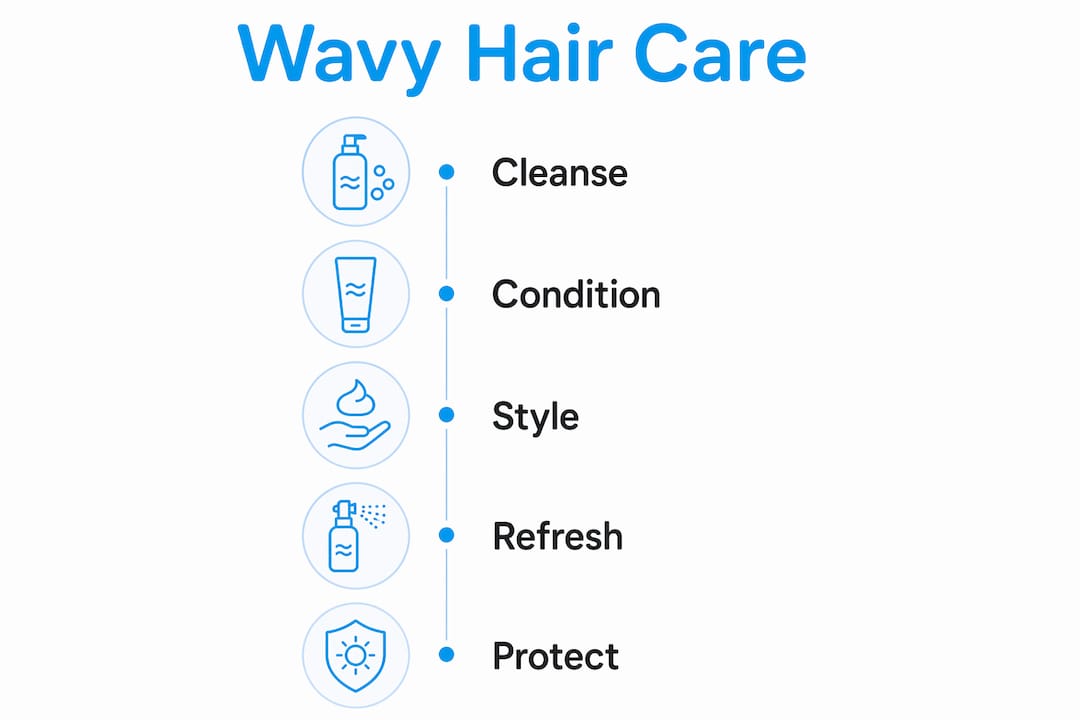
A simple water spray bottle is your most useful tool on non-wash days. Lightly mist your hair, scrunch upward, and let it air dry. If waves need more hold, add a tiny amount of the same gel or mousse you used on wash day. Apply it to wet sections only, not dry hair.
Common mistakes that damage wave shape between washes:
- Brushing dry hair. Dry brushing disrupts wave clumps and creates frizz instantly. Detangle only when hair is saturated with conditioner in the shower.
- Using heavy products to "fix" frizz. Thick creams applied to dry hair coat the surface without penetrating, leaving waves greasy and flat.
- Touching hair repeatedly throughout the day. Every touch separates wave clumps and introduces frizz.
- Washing daily. Daily washing strips natural oils and prevents waves from forming properly over time.
Pro Tip: On day two or three, flip your hair upside down, mist with water, scrunch, and let gravity do the work. Waves often look better on day two than on wash day because the products have fully set.
For a broader look at scalp and wash care, the hair wash routine guide from Myhair covers scalp technique in detail.
How does wave subtype and porosity change your routine?
Not all wavy hair responds the same way. Subtype and porosity determine how your hair absorbs moisture, holds products, and responds to heat.
| Hair Type | Wave Pattern | Product Weight | Wash Frequency | Key Concern |
|---|---|---|---|---|
| 2A | Loose, fine S-waves | Ultra-light mousse | Every 1–2 days | Goes limp easily |
| 2B | Defined S-waves, medium texture | Light to medium gel | Every 2–3 days | Frizz at the crown |
| 2C | Thick, coarse waves near curly | Light curl cream or gel | Every 3–4 days | Dryness and definition |
Porosity adds another layer. High-porosity hair (often from color treatment or heat damage) absorbs moisture quickly but loses it just as fast. These people benefit from a light protein treatment every 4–6 weeks to reinforce the hair shaft, alongside regular deep conditioning. Low-porosity hair resists moisture absorption. Applying products with a little heat, like sitting under a hooded dryer or using a warm towel wrap, helps products penetrate.
Color-treated or heat-damaged wavy hair needs extra attention. The cuticle is already compromised, which makes frizz worse and waves less defined. Reducing heat styling frequency, using a bond-building treatment monthly, and keeping protein and moisture in balance are the most effective strategies for restoring wave definition over time.
Key Takeaways
A consistent wavy hair care routine built around gentle cleansing, lightweight products, and minimal manipulation produces the most defined, frizz-free waves over time.
| Point | Details |
|---|---|
| Match wash frequency to subtype | Type 2A washes every 1–2 days; 2B every 2–3 days; 2C every 3–4 days. |
| Apply products on soaking-wet hair | Wet application ensures even distribution and stronger wave clumps. |
| Use the gel cast technique | Leave gel untouched until fully dry, then scrunch out the crunch for soft waves. |
| Avoid heavy products and dry brushing | Heavy creams and dry brushing flatten waves and cause frizz immediately. |
| Protect hair from friction | Satin pillowcases and microfiber towels reduce cuticle damage and overnight frizz. |
What I have learned after years of watching wavy hair routines succeed and fail
The most common pattern I see is people overcomplicating their routine. They layer four or five products, buy the heaviest conditioner on the shelf, and then wonder why their waves look flat and greasy by noon. The fix is almost always subtraction, not addition.
Wavy hair is not curly hair. It does not need the same moisture load. The moment you treat 2A or 2B waves like a 3C curl, you lose the wave entirely. The hair just sits there, weighed down and shapeless. Switching to a single lightweight gel on soaking-wet hair, then leaving it completely alone until dry, produces better results than any five-product stack I have ever seen.
Patience is the other piece people skip. Wavy hair often takes 4–6 weeks of consistent routine before it starts behaving predictably. The scalp needs time to recalibrate its oil production. The hair needs time to recover from product buildup or heat damage. Consistency beats any single product choice.
The pineapple technique and satin pillowcase combination is the most underrated overnight strategy in wavy hair care. People spend $40 on a styling product and sleep on a cotton pillowcase that undoes everything. Protect what you built during the day, and your morning routine becomes much easier.
— Cyriac
Myhair's AI analysis takes the guesswork out of your routine
Understanding your exact wave subtype and porosity level changes everything about how you build a routine. Myhair uses AI-powered hair analysis to give you a personalized assessment based on your actual hair condition, not a generic quiz.
The Myhair hair scanner analyzes your hair from photos and generates a detailed health score with product and routine recommendations matched to your specific type. You can track changes over time and see whether your current routine is actually improving your hair health. If you want a starting point that is specific to your waves, the Myhair app onboarding walks you through the process in minutes.
FAQ
How often should I wash wavy hair?
Most wavy hair types do best with 2–3 washes per week. Type 2A hair can handle washing every 1–2 days, while 2C hair benefits from waiting 3–4 days between washes.
Why does my wavy hair look frizzy after washing?
Frizz after washing usually comes from touching hair while it dries, using a terry cloth towel, or applying products on damp rather than soaking-wet hair. Apply styling products immediately after washing and leave hair undisturbed until fully dry.
Can I brush wavy hair?
Brush only when hair is saturated with conditioner in the shower. Dry brushing breaks wave clumps and causes frizz. Use a wide-tooth comb or your fingers on wet, conditioned hair instead.
What products should I avoid for wavy hair?
Avoid heavy butters, thick oils, and rich leave-in conditioners designed for coily hair types. These weigh down 2A and 2B waves and flatten the natural wave pattern within hours.
Does porosity affect a wavy hair routine?
Yes. High-porosity hair needs periodic protein treatments to hold moisture, while low-porosity hair benefits from applying products with gentle heat to improve absorption. Knowing your porosity helps you choose the right conditioner weight and treatment frequency.