
TL;DR:
- Hair growth progresses on a fixed timeline, with visible signs typically appearing between three and five months. Patience is essential, especially during the “ugly duckling” phase, which occurs from months three to six when progress may seem worse before improving. Tracking with consistent photos and AI tools provides the most accurate assessment of recovery milestones over time.
When you’re watching for any sign of progress after hair loss, a single month can feel like a year. Understanding the hair growth milestones to expect takes that anxiety and replaces it with a roadmap. Your biology is not failing you. It is following a precise, slow schedule that almost nobody explains upfront. This article breaks down exactly what you will see, when you will see it, and why the timeline is fixed in ways no product can change. If you are in a restoration program or recovering from shedding, this is the clarity you have been looking for.
Table of Contents
-
1. Understanding the hair growth milestones to expect from biology first
-
2. The month-by-month milestones during a typical restoration journey
-
5. Best practices to support healthy growth through every milestone
Key takeaways
| Point | Details |
|---|---|
| Growth rate is fixed | Hair grows about 0.5 inches per month regardless of what products you use. |
| First signs appear at 3 to 5 months | Fine baby hairs signal active regrowth and should not be styled heavily or forced flat. |
| The ugly duckling phase is real | Months 3 through 6 look patchy despite real progress, and this is when most people quit too soon. |
| Crown areas take the longest | Frontal growth finishes around 12 to 15 months; crown density may require 18 to 20 months. |
| Photos beat mirrors | Monthly photos under consistent lighting are the most reliable way to measure real progress over time. |
1. Understanding the hair growth milestones to expect from biology first
Before you can appreciate any milestone, you need to understand why hair grows at the pace it does. Your scalp follicles cycle through three phases: anagen (active growth), catagen (transition), and telogen (resting and shedding). At any given moment, about 85 to 90 percent of your follicles are in anagen, while the rest are preparing to shed.
The anagen phase lasts 2 to 8 years depending on your genetics and scalp zone. This duration, not any product or supplement, determines your maximum possible hair length. Treatments like PRP aim to extend this phase or reactivate dormant follicles. They do not make the shaft grow faster.
The average hair growth rate is 0.5 inches per month, or roughly six inches per year. Genetics, age, and health create variations of 20 to 30 percent in either direction, but no intervention meaningfully changes the base rate.
Here is what that means in practice for your restoration goals:
-
Anagen phase: Active shaft growth. This is the only phase where length increases.
-
Catagen phase: A two to three week transition where the follicle detaches from its blood supply.
-
Telogen phase: A three to four month resting period before the old hair sheds and new growth begins.
-
Retention matters as much as growth: Products preserving length do so by reducing breakage, not accelerating growth. Keeping what you grow is half the battle.
Pro Tip: If you are taking a new supplement or using a topical treatment, give it a full anagen cycle before judging results. That means committing to at least four to six months before drawing conclusions.
2. The month-by-month milestones during a typical restoration journey
This is the section most people search for and rarely find with enough honesty. Here is a realistic look at the expected hair growth timeline across 12 to 18 months.
Months 1 to 2: The quiet phase
Nothing visible is happening, and that is normal. If you had a hair transplant, your scalp is healing. If you experienced shedding from stress, illness, or postpartum changes, your follicles are resetting. You may notice increased shedding during this window. Normal daily shedding is 50 to 100 strands, but postpartum shedding can reach 300 strands per day at its peak. This is your biology clearing the way.
Months 3 to 5: First signs of hair growth
This is where hope shows up, quietly. Fine, fluffy hairs begin to push through. They often grow at irregular angles and feel nothing like your mature hair. That is completely normal. New regrowth appears as fine baby hairs that may look wispy or uneven, and forcing them flat with heavy products can damage them before they mature. Celebrate this milestone. It is proof your follicles are active.
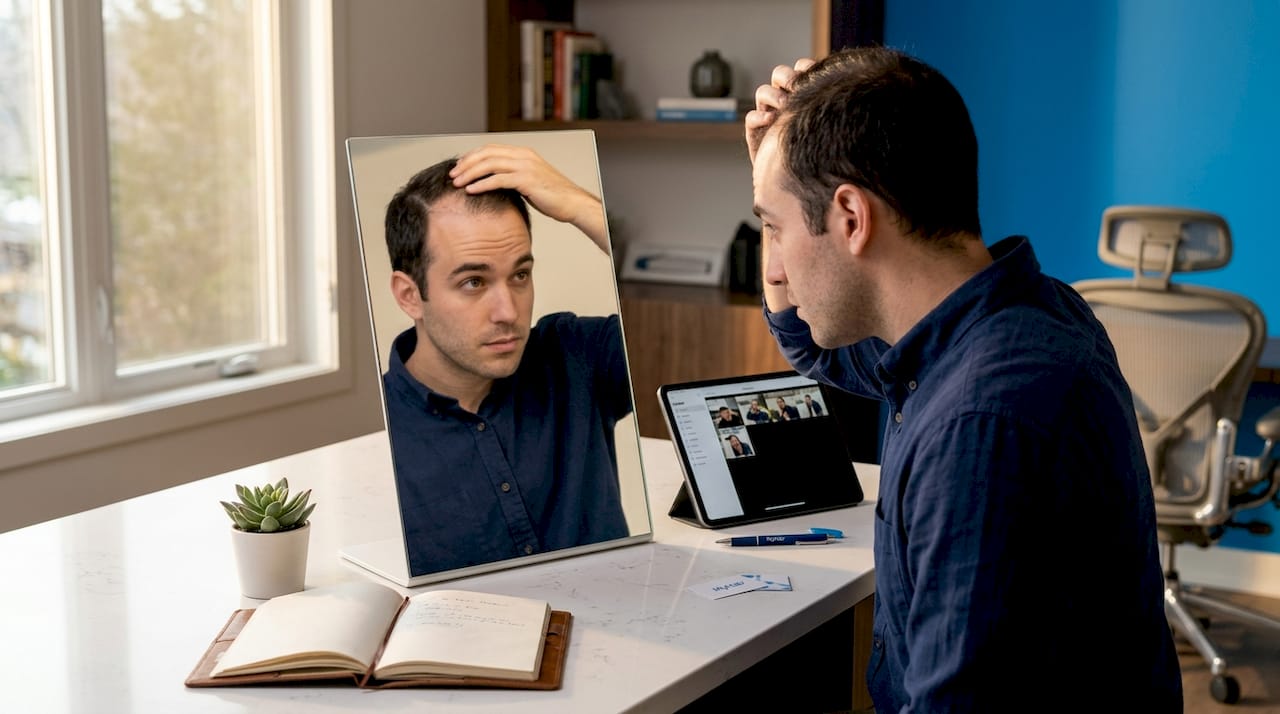
Pro Tip: Take a close-up photo of your hairline or affected area every four weeks under the same lighting. You will not notice day-to-day changes, but comparing month 2 to month 5 will be genuinely surprising.
Months 5 to 6: The “ugly duckling” phase
This phase has a name because it is so universally frustrating. Your hair is actively growing but the density is uneven, the texture is inconsistent, and the overall look can feel worse than before treatment. Research identifies this as the phase where most patients quit due to discouragement, even though their follicles are doing exactly what they should. Knowing this phase exists before you hit it is the single best thing you can do to get through it.
Months 6 to 8: Noticeable acceleration
This is when people around you start to notice. The baby hairs from month three and four have thickened and lengthened. Density improves visibly. Significant density improvements typically emerge between six and eight months in most restoration cases. Texture begins to normalize. For many people, this is the first month they feel genuinely encouraged.
Months 9 to 12: Near-final results for most areas
By month nine, the frontal hairline and mid-scalp are approaching their final look. Hair texture continues to settle, and density gaps fill in progressively. At month twelve, most people with frontal or mid-scalp concerns are looking at results very close to their endpoint. This does not mean the work is done, particularly if the crown is involved.
Months 12 to 18: Crown maturation and full density
The crown is the slowest area on your scalp to recover. Crown areas can take 18 to 20 months for full results, compared to 12 to 15 months for the frontal hairline. If you judge your crown results at month nine, you will almost certainly underestimate your final outcome. Patience here is not optional. It is the only strategy that works.
3. How to track your progress without losing your mind
One of the most underappreciated skills in hair recovery is learning to measure progress objectively. Your daily mirror is your worst tool for this. You see yourself too often to notice gradual changes, and bad lighting days can erase three months of real gains from your perception.
Monthly photos under consistent conditions are the clinical standard for tracking progress. Same location, same lighting, same angle, same day of the week. Within three months of starting this practice, you will have visual evidence that is far more reliable than how you feel on any given morning.
Beyond photos, here are the signs to look for that indicate real milestones in hair recovery:
-
Increased density at the part line. Run your finger along your part. If the scalp is less visible than it was two months ago, that is measurable progress.
-
Texture changes. Regrowth often starts fine and wiry before softening. This transition signals healthy follicle maturation.
-
Reduced daily shedding. Tracking your average daily shed count weekly gives you trend data, not just isolated snapshots.
-
Scalp visibility at the crown. Use a handheld mirror and your phone camera to document this area monthly, since it is impossible to assess in a standard mirror.
Technology tools like Myhair’s AI hair analysis scanner remove the guesswork entirely by quantifying hair count and density changes in ways your eyes cannot detect.
4. Managing the patience gap and staying motivated
The patience gap is not a metaphor. It is a documented challenge in hair restoration where patients expect rapid visible results while their biology operates on a multi-month cycle. Research confirms that patients often abandon treatment too early because the timeline feels incompatible with their emotional expectations.
Here is a mindset shift that actually helps: stop measuring against your desired end result and start measuring against last month. A five percent density improvement in 30 days is invisible if you compare it to a full head of hair. It is unmistakable if you compare it to your photo from four weeks ago.
“The biggest mistake people make is evaluating a six-month treatment at month three. You are not seeing failure. You are seeing the process.”
If you are working with a clinical provider, check in at regular intervals rather than waiting until you feel discouraged. Providers who set clear milestones at the start keep patients far more adherent through the difficult middle phases. If you are self-managing, commit to a 9 to 14 month horizon as your evaluation window before making any treatment decisions.
5. Best practices to support healthy growth through every milestone
You cannot make your hair grow faster, but you can absolutely prevent it from falling further behind. These practices protect what your follicles are producing and create the conditions for your best possible results.
-
Prioritize protein and iron intake. Hair is primarily keratin. Inadequate protein or iron deficiency directly impairs growth rate and shaft quality.
-
Handle regrowth gently. During months three through six especially, avoid tight styles, heat tools, and heavy products on new growth areas.
-
Consider clinically supported options. Treatments like PRP therapy work by stimulating follicular activity and may extend the anagen phase. They require consistent sessions and realistic expectations, not one-time miracles.
-
Avoid products promising to double growth speed. Hair growth speed is biologically fixed. Any claim otherwise is marketing, not science.
-
Protect your scalp. UV exposure, harsh chemicals, and aggressive brushing all compromise follicle health. Your scalp is the foundation for everything growing through it.
-
Track with technology. Objective data from tools like Myhair removes the emotional noise and gives you something concrete to evaluate your treatment against.
For those recovering from alopecia specifically, the timeline and approach share some key differences worth understanding in detail at hair growth after alopecia.
My honest take on hair growth milestones
I have seen more people give up at month four than at any other point, and it genuinely bothers me. Not because quitting is weak, but because month four is almost always right before the first real visible signs appear. The ugly duckling phase is not a sign that your treatment is failing. It is a sign that your biology is doing the slow, unglamorous work of actual recovery.
What I have learned from watching this process closely is that the psychological weight of hair loss almost always outpaces the biological timeline. People want month twelve results at month six, and when they do not get them, they assume nothing is working. The truth is that nothing about this process is broken. It is just slower than our impatience allows.
The most successful people I have seen navigate this process are the ones who celebrate micro-wins. A slightly denser part line. A few more fine hairs at the crown. Those early signs of hair growth are not consolation prizes. They are proof that your follicles are alive and responding. Give them the time the biology actually requires, document everything, and evaluate honestly at the 12-month mark.
— Cyriac
Track every milestone with Myhair’s AI-powered tools
Waiting and wondering are the hardest parts of any restoration journey. Myhair removes the guesswork by giving you objective, data-driven insight into exactly what your scalp is doing month by month. The AI-powered scanner measures actual hair count and density changes that your eyes simply cannot detect in a mirror. You get a hair score that tracks shifts over time, not just a feeling about whether things look better or worse today.
For clinics managing patients through hair restoration programs, Myhair’s clinic onboarding integrates this tracking technology directly into your treatment workflow, keeping patients motivated and adherent through every phase. For individuals managing their own journey, the app onboarding gets you started with a personalized baseline scan and tailored product recommendations to support your growth from day one.
FAQ
How fast does hair actually grow per month?
The average rate is 0.5 inches per month, or about six inches per year. Genetics, age, and scalp health create a 20 to 30 percent variation around that average.
What are the first signs of hair growth after loss?
Fine, soft baby hairs emerging at irregular angles are the earliest visible milestone, typically appearing between months three and five after shedding or treatment begins.
How long does it take for hair transplant results to be final?
Frontal areas finalize around 12 to 15 months; crown areas take 18 to 20 months for full density. Evaluating results before these windows gives an incomplete picture.
Why does hair look worse at month four or five?
This is the ugly duckling phase. New hairs are growing unevenly and at different rates, which creates a patchy appearance. It signals active regrowth and resolves as density increases through months six to eight.
How do I track hair growth progress accurately?
Monthly photos under consistent conditions are the most reliable method. AI-based tools that measure hair count and density provide objective data that eliminates perception bias.