
TL;DR:
- Hair masks provide deeper, longer-lasting moisture absorption than conditioners or water alone.
- Selecting masks based on hair porosity and using heat enhances benefits for natural hair.
- Regular, personalized mask routines improve softness, shine, elasticity, and reduce breakage.
Natural hair is beautiful, but it comes with real challenges. Dryness, breakage, and shrinkage are not just cosmetic inconveniences; they are signs that your strands need deeper, more consistent moisture than a standard rinse-out conditioner can offer. The curl pattern in natural hair makes it harder for scalp oils to travel down each strand, leaving ends brittle and prone to snapping. A well-formulated hair mask, applied correctly and consistently, changes that equation. This guide walks you through the science, the selection process, the application, and how to verify your results so every mask session actually moves your hair health forward.
Table of Contents
- Why use a hair mask for natural hair? Science and benefits
- What you need: Choosing the right mask, tools, and ingredients
- How to apply a hair mask for natural hair: Step-by-step instructions
- Verifying results: How to tell if your mask worked and avoid common mistakes
- The truth about hair masks for natural hair: What experts and real users miss
- Get personalized hair mask recommendations with MyHair
- Frequently asked questions
Key Takeaways
| Point | Details |
|---|---|
| Hair masks boost moisture | Scientific studies show masks penetrate and retain moisture better than water or conditioners. |
| Choose mask ingredients wisely | Selecting lightweight, humectant-rich masks prevents buildup and maximizes softness for natural hair. |
| Heat enhances absorption | Applying hair masks with heat or steam improves penetration, especially for low-porosity hair. |
| Evaluate results each time | Look for signs of softness and elasticity after every mask to ensure you're on track. |
Why use a hair mask for natural hair? Science and benefits
Standard rinse-out conditioners sit on the surface of your hair for a few minutes before being washed away. That is fine for daily maintenance, but it does not address the chronic moisture deficit that natural hair deals with week after week. Hair masks are formulated with higher concentrations of conditioning agents, proteins, and oils that need extended contact time to do their job properly.
Research confirms this difference is real, not just marketing language. Empirical data from 3D Raman spectroscopy shows that hair care product masks deliver greater absorption, deeper penetration, and sustained moisture retention over 30 minutes compared to water alone, with statistically significant results (p<0.05). User tests from the same study also report measurable reductions in dryness, breakage, and improved softness scores. That is the scientific case in plain terms: masks reach places conditioners simply do not.
For natural hair specifically, the benefits stack up quickly:
- Reduced dryness: Coily and kinky textures lose moisture faster due to their shape. Masks replenish what daily styling and environmental exposure strip away.
- Breakage prevention: Stronger, more hydrated strands flex instead of snap under tension. If you are dealing with breakage and growth remedies, a consistent mask routine is one of the most direct interventions available.
- Improved elasticity: Healthy natural hair should stretch slightly without breaking. Masks restore that stretch by keeping the cortex (the inner layer of each strand) hydrated.
- Enhanced softness and manageability: Detangling becomes dramatically easier when strands are saturated with conditioning agents rather than fighting through dryness.
- Shine and definition: Moisturized hair reflects light and holds curl patterns better than dry, frizzy strands.
Here is a quick look at how masks stack up against plain water and standard conditioners:
| Treatment | Penetration depth | Moisture duration | Breakage reduction |
|---|---|---|---|
| Water rinse | Surface only | Less than 1 hour | Minimal |
| Rinse-out conditioner | Surface to mid-cortex | 4 to 8 hours | Moderate |
| Hair mask (30+ min) | Deep cortex | 24 to 72 hours | Significant |
"The difference between a mask and a conditioner is not just ingredients. It is contact time, concentration, and formulation depth. Natural hair needs all three working together."
If you are serious about tips for stopping hair breakage, incorporating a weekly mask is not optional. It is foundational. Products like the sea kelp deep mask are a strong example of what targeted deep conditioning looks like when formulated with natural hair in mind.
What you need: Choosing the right mask, tools, and ingredients
Once the benefits are clear, the next step is understanding what you will need to succeed with your hair mask routine. Not all masks work for every natural hair type, and the wrong formula can cause buildup, stiffness, or even increase breakage over time. Knowing your hair's porosity is the most important starting point.
Porosity describes how well your hair cuticles open and close to absorb and retain moisture. Low-porosity hair has tightly packed cuticles that resist absorption. High-porosity hair has raised or damaged cuticles that absorb quickly but lose moisture just as fast. Most natural hair falls somewhere on this spectrum, and your mask strategy should reflect that.
For low-porosity natural hair, tight cuticles actively resist absorption, so you need lightweight, water-based masks with humectants such as aloe vera, honey, and glycerin, combined with light oils like jojoba and argan. Heat or steam during application is essential to coax the cuticles open. Heavy butters and excess proteins should be avoided because they sit on top of the strand and create buildup and stiffness without delivering actual moisture.

High-porosity hair, by contrast, benefits from richer masks with heavier conditioning agents and proteins like hydrolyzed keratin or silk amino acids, which help temporarily fill gaps in the cuticle and slow moisture loss.
Here is a quick reference for ingredient selection by porosity:
| Porosity type | Best ingredients | Avoid |
|---|---|---|
| Low porosity | Aloe, glycerin, honey, jojoba oil, argan oil | Shea butter, heavy proteins, thick oils |
| High porosity | Hydrolyzed keratin, coconut oil, avocado butter, silk proteins | Excessive humectants in dry climates |
| Normal/medium | Balanced blends, olive oil, mango butter | Overuse of either extreme |
Beyond ingredients, the tools you use matter just as much:
- Shower cap or plastic wrap: Traps body heat during treatment to assist absorption without a dedicated steamer.
- Hooded dryer or hair steamer: The gold standard for low-porosity hair. Consistent heat opens cuticles evenly across all strands.
- Application brush or wide-tooth comb: Distributes product evenly from root to tip, preventing clumping and missed sections.
- Sectioning clips: Divide hair into four or more sections for thorough, even coverage.
If you want to explore formulas specifically designed for textured patterns, the curly hair masks guide breaks down options by curl type. For a broader look at routine essentials, natural hair care products covers the full toolkit. Products like the hyaluronic dew mask offer an excellent balance of humectants and lightweight hydration for those with low to medium porosity.
Pro Tip: Always do the float test before buying a new mask. Drop a single clean strand of your hair into a glass of water. If it floats for several minutes, you have low porosity. If it sinks quickly, your hair is high porosity. This takes less than two minutes and changes every product decision you make from that point forward.
How to apply a hair mask for natural hair: Step-by-step instructions
With the right ingredients and tools in hand, you can now move through a proven mask application routine that maximizes every benefit the formula has to offer.
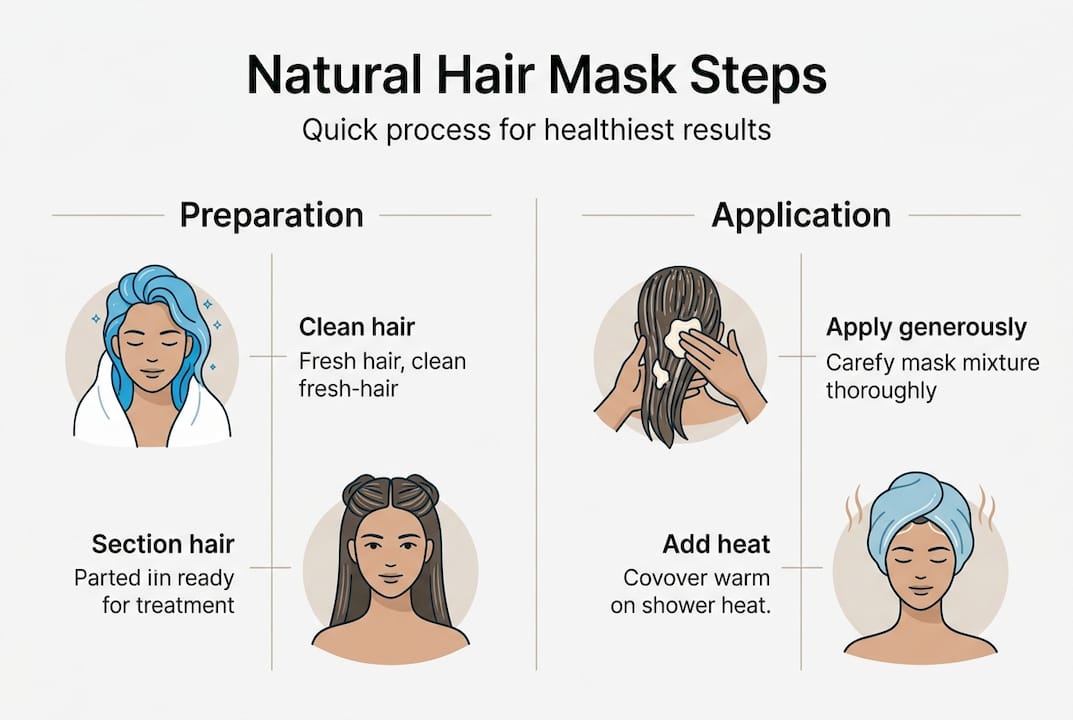
Step 1: Start with clean, damp hair. Apply your mask after shampooing. Clean hair allows the conditioning agents to reach the cortex without fighting through product buildup or sebum. Squeeze out excess water so your hair is damp, not soaking wet.
Step 2: Section your hair into four parts. Clip each section out of the way. Working in sections ensures you cover every strand, not just the top layer. For very thick or long natural hair, use six to eight sections.
Step 3: Apply mask generously from ends to roots. Ends are the oldest, most damaged part of your hair. Start there, then work toward the roots. Use an application brush for precision or your fingers for warmth and control. Do not skimp on the amount; natural hair absorbs product quickly.
Step 4: Use your fingers or a wide-tooth comb to distribute. Gently comb through each section after applying the mask to ensure even coverage and start the detangling process while the product is in.
Step 5: Add heat. Cover with a shower cap and sit under a hooded dryer for 20 to 30 minutes, or use a hair steamer. If you do not have either, wrap a warm towel around your shower cap. The goal is sustained heat, which opens cuticles and allows deeper mask penetration that delivers significantly better moisture retention compared to no heat.
Step 6: Rinse with cool water. Cool water closes the cuticle after treatment, sealing in the moisture the mask just delivered. This step is often skipped, but it makes a visible difference in shine and smoothness.
Step 7: Follow with a leave-in or sealant. Lock in the moisture with a lightweight leave-in conditioner and a sealing oil. This extends the results of your mask treatment and supports your optimal hair routine between wash days.
Pro Tip: For low-porosity hair, pre-warming your mask product in a bowl of hot water for two minutes before application makes it significantly easier to work through tight curl patterns and improves absorption before you even add external heat.
For those looking to go beyond DIY and explore what professional hair treatment can add to a home routine, combining professional and at-home care often produces the fastest visible results.
Verifying results: How to tell if your mask worked and avoid common mistakes
Applying the mask is only half the battle. The final step is confirming your results and learning what went well or needs adjustment for next time.
Signs your mask is working:
- Strands feel noticeably softer and more pliable after rinsing
- Shine is visible, especially in natural light
- Detangling is easier than before treatment
- Hair holds its curl definition longer through the week
- Reduced shedding and fewer broken strands on your comb
Signs something went wrong:
- Hair feels stiff or coated after rinsing, which signals product buildup or too much protein
- Hair feels dry within hours, suggesting the mask was rinsed out too early or the formula was too light for your porosity
- Increased shedding, which can happen if you used excessive protein on moisture-deprived hair
- Scalp irritation, which usually points to a fragrance or allergen in the formula
Research consistently shows that sustained moisture retention over 30 minutes is a key marker of an effective mask treatment. If your results fade within a few hours, the problem is likely premature rinsing or a formula mismatch, not your hair.
Stat callout: In user testing, hair masks showed statistically significant improvements in softness and dryness scores compared to water-only treatments, with results that held measurably beyond 30 minutes of wear time.
Common mistakes to correct immediately:
- Using masks too frequently: Once or twice per week is the right range for most natural hair. Daily masking leads to buildup and stiffness because even beneficial ingredients accumulate on the strand when there is no recovery time between treatments.
- Skipping the heat step for low-porosity hair: No amount of extra product compensates for unopened cuticles. Heat is not optional for this hair type.
- Applying to dry hair: Dry hair absorbs product unevenly, leaving some sections oversaturated and others barely treated.
- Ignoring the cool rinse: Finishing with warm or hot water counteracts the sealing effect you just worked 30 minutes to achieve.
For deeper reading on building a complete care system, natural hair care essentials and dry damaged hair solutions are practical next reads. If you want a targeted treatment to try, the birch moisture mask is a well-regarded option for deep hydration that works across multiple porosity types.
The truth about hair masks for natural hair: What experts and real users miss
Most mask advice online lands in one of two camps: either a complicated DIY recipe with ten ingredients, or a simple "just use coconut oil" shortcut. Neither works reliably, and here is why.
The real determinant of mask success is not recipe complexity or ingredient count. It is ingredient quality matched to your specific hair porosity, applied with consistency over weeks, not days. A single impressive mask session does nothing for chronic dryness. A mediocre mask used every week for two months outperforms an elaborate treatment done twice a year.
What influencers miss most often is the protein-moisture balance. Heavy proteins on moisture-deprived hair create the illusion of strength while actually making strands more brittle and prone to breakage. The hair growth mask guide addresses this balance specifically, and it is worth reading before committing to any new formula.
The other overlooked factor is feedback. Your hair tells you what it needs if you pay attention. Stiffness after a mask means less protein, more moisture. Rapid dryness means your sealant step is missing or your formula is too light. Trust the science as your foundation, but adapt your approach based on your own hair's response over time. That combination of evidence and personalization is what separates transformative results from a routine that goes nowhere.
Get personalized hair mask recommendations with MyHair
Understanding the science of hair masks is one thing. Finding the exact formula that matches your unique curl pattern, porosity level, and hair goals is another challenge entirely.
That is where MyHair's AI-powered hair analysis makes a real difference. By scanning your hair and scalp, the platform identifies your specific hair health patterns and recommends masks and treatments tailored to your actual needs, not a generic hair type category. No more guessing whether your hair is low or high porosity, or whether you need more protein or more moisture.
Getting started is straightforward through the hair analysis onboarding process, which walks you through a quick assessment and delivers personalized product recommendations you can act on immediately. MyHair tracks your results over time, so your recommendations improve as your hair does.
Frequently asked questions
How often should I use a hair mask on natural hair?
Most experts recommend once weekly for natural hair, but your ideal frequency depends on your dryness level, porosity, and how prone your strands are to product buildup.
What ingredients should I avoid in hair masks for low-porosity hair?
Avoid heavy butters and excess proteins, as low-porosity hair cannot absorb them effectively and they lead to stiffness and buildup on the strand surface.
How long should I leave a hair mask on my natural hair?
Thirty minutes is the research-backed sweet spot, as masks over 30 minutes show statistically significant improvements in absorption depth and sustained moisture retention compared to shorter treatments.
Can I apply heat during hair mask treatments?
Yes, and for low-porosity natural hair it is essential. Heat or steam opens cuticles so conditioning agents can actually enter the strand rather than sitting on the surface.
What signs show a hair mask is working?
Increased softness, visible shine, easier detangling, and reduced breakage are the most reliable indicators, all of which align with user-reported improvements in clinical mask testing.