TL;DR:
- Hair replacement options for women include surgical transplants, non-surgical hair systems, and medical therapies like minoxidil and PRP. Accurate diagnosis and evaluation of hair loss pattern are essential to determine the most suitable treatment, as only a small percentage of women qualify for transplantation. Combining medical stabilization, hair systems, and surgery often yields the best long-term results.
Hair replacement for women is defined as any surgical or non-surgical method used to restore hair density, coverage, or appearance in women experiencing hair loss. The options range from FDA-approved topical treatments like minoxidil to custom female hair systems, platelet-rich plasma (PRP) therapy, and follicular unit transplants. Female hair loss affects an estimated 40% of women by age 50, yet the path to the right solution is rarely straightforward. This guide breaks down every major category of women's hair restoration, explains who qualifies for each, and gives you a clear framework for making an informed decision.
What hair replacement options are available for women?
Hair replacement for women divides into three main categories: surgical transplants, non-surgical hair systems, and medical therapies. Each category targets a different degree of hair loss and suits a different lifestyle. The right starting point depends on your diagnosis, not your preference. Female androgenetic alopecia, alopecia areata, and telogen effluvium each respond differently to treatment, so a confirmed diagnosis is the foundation of any effective plan.

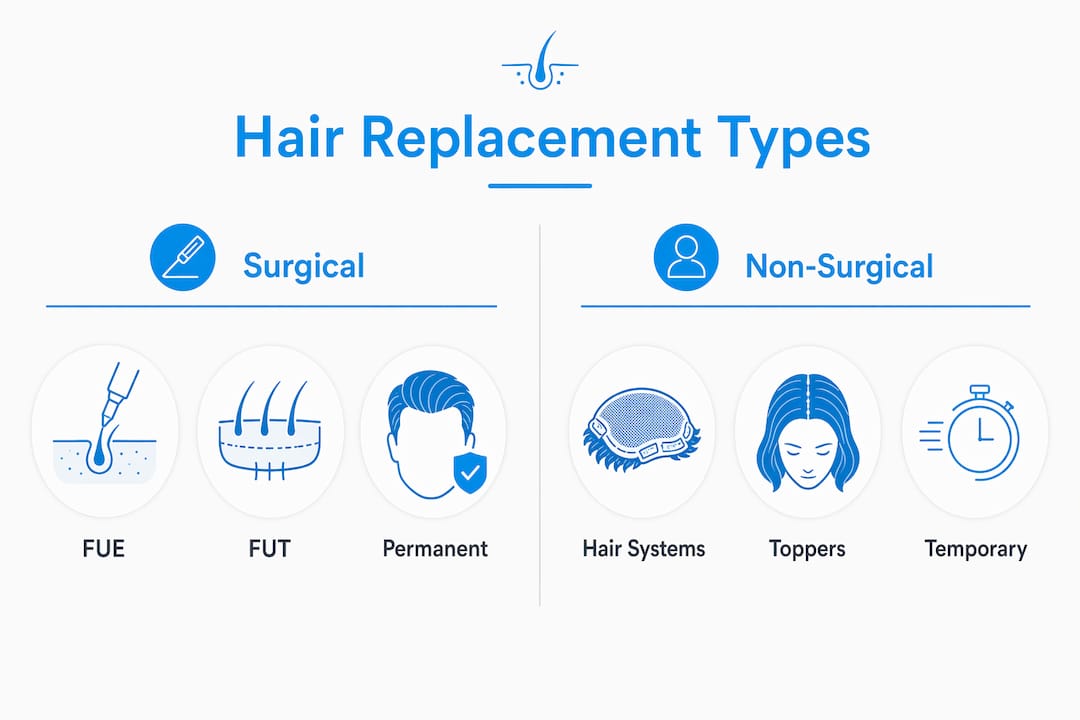
Surgical options permanently restore hair using your own follicles. Non-surgical hair systems, including full caps, toppers, and integration units, provide immediate cosmetic coverage. Medical therapies like topical minoxidil and PRP slow loss and stimulate regrowth over months. Many women combine all three in a staged approach, starting with medical stabilization, adding a hair system for coverage, and considering surgery only when the loss pattern stabilizes.
What surgical hair replacement options exist for women?
Follicular Unit Excision (FUE) and Follicular Unit Transplantation (FUT) are the two primary surgical techniques used in female hair restoration. FUE removes individual follicles from a donor area with minimal visible scarring. FUT removes a strip of scalp tissue, leaving a linear scar but allowing higher graft counts in a single session. Both methods transplant follicles into thinning zones, where they grow permanently.
The critical difference in female transplants is the goal. Men typically want a defined hairline recreated. Women prioritize density restoration across the crown and part line, which requires a different surgical plan and a different way of measuring success. A skilled surgeon maps the thinning zones, calculates available donor grafts, and designs a distribution pattern that looks natural at every stage of growth.
Who qualifies for surgical hair restoration?
Candidacy is the most misunderstood part of surgical hair replacement. Only 2–5% of women with hair loss qualify for transplantation, compared to roughly 90% of men. The main disqualifier is diffuse unpatterned alopecia, a condition where thinning affects the donor area as well as the recipient area. Transplanting follicles from a miniaturizing donor zone produces grafts that continue to thin after surgery, wasting both money and tissue.
A good candidate has a stable, dense donor area, a clearly defined zone of thinning, and a hair loss pattern that has not progressed for at least one to two years. Women with active autoimmune conditions, nutritional deficiencies, or hormonal imbalances are typically advised to resolve those issues before any surgical evaluation. For more on the evaluation process, the Myhair guide on female hairline transplants covers candidacy criteria in detail.
Risks and recovery expectations
Donor area management is the highest-stakes variable in female transplants. Overharvesting the donor zone creates permanent visible thinning in an area that was previously unaffected. This risk is higher in women because their donor density is often lower than in men. Surgeons must plan conservatively, preserving follicles for potential future sessions.
Recovery typically involves 7–14 days of visible redness and scabbing. Transplanted hairs shed within the first month, which alarms many patients but is a normal part of the growth cycle. New growth appears at 3–4 months, with full results visible at 12–18 months.
Pro Tip: Ask your surgeon for a written graft count and a donor density measurement before agreeing to any procedure. This protects you from overharvesting and gives you a baseline for future planning.
- Stable donor area with no miniaturization is required for candidacy
- FUE leaves no linear scar; FUT allows more grafts per session
- Diffuse thinning across the scalp is the most common disqualifier
- Results take 12–18 months to fully appear
- Medical stabilization before surgery improves long-term outcomes
How do non-surgical hair systems work for women?
Non-surgical hair replacement systems are custom-fitted units made from natural or synthetic hair, designed to match your existing color, texture, and density. They are the most accessible option for women who are not surgical candidates, and they deliver immediate results. The industry term for medically prescribed units is cranial prosthesis, which distinguishes them from fashion wigs and makes them eligible for insurance coverage in many cases.
Full-cap systems provide complete scalp coverage for women with total or near-total hair loss. Toppers cover partial thinning at the crown or part line and blend with existing hair. Integration systems weave through your natural hair, adding volume without full coverage. Each type attaches differently, and the right choice depends on your activity level, budget, and how much natural hair you have remaining.
Attachment methods and daily maintenance
Attachment methods fall into three categories: clips, adhesives, and bonding agents. Clips are the least permanent and easiest to remove at home. Medical-grade adhesives hold for days to weeks and are water-resistant. Bonding agents, applied by a professional, can last four to six weeks between maintenance appointments.
| System Type | Best For | Attachment | Maintenance Frequency |
|---|---|---|---|
| Full Cap | Total or near-total hair loss | Adhesive or bonding | Every 4–6 weeks |
| Topper | Crown or part-line thinning | Clips or adhesive | Weekly to biweekly |
| Integration System | Diffuse thinning with existing hair | Woven attachment | Every 6–8 weeks |
| Hair Extensions | Mild volume loss | Clips or tape | Every 6–8 weeks |
Caring for a hair system requires sulfate-free shampoos, gentle detangling, and regular professional cleaning. Natural hair systems last 6–12 months with proper care. Synthetic units typically last 3–6 months. For a broader look at non-surgical hair options, Myhair's thinning hair guide covers maintenance protocols in depth.
Pro Tip: When ordering a custom system, request a color ring sample before committing. Color matching from photos alone frequently results in a shade that looks off in natural light.
What role do minoxidil and PRP play in women's hair restoration?
Medical therapies do not replace lost hair overnight. They slow the rate of loss, extend the growth phase of existing follicles, and in many cases produce measurable regrowth over 6–12 months. They are the most evidence-backed non-invasive tools available and should be the first line of treatment for most women.
How topical minoxidil works
Topical minoxidil is FDA-approved since 1988 for female androgenetic alopecia. It is available in 2% solution applied twice daily and 5% foam applied once daily. The foam formulation contains no propylene glycol, which is the ingredient responsible for most scalp irritation in the liquid version. This matters because foam improves adherence by reducing the side effects that cause women to stop using the product.
Results require patience. Most women see measurable improvement at 4–6 months, with peak results at 12 months of consistent use. Stopping minoxidil reverses the gains within 3–6 months, so it is a long-term commitment, not a short-term fix. Oral minoxidil at low doses (0.25–1.25 mg daily) is an emerging option prescribed off-label, showing strong results in women who cannot tolerate topical application.
- Confirm your diagnosis as female androgenetic alopecia before starting minoxidil
- Choose the 5% foam formulation to reduce scalp irritation
- Apply consistently for at least 6 months before evaluating results
- Do not stop without consulting a dermatologist, as shedding resumes quickly
- Combine with a dermatologist-supervised plan for best outcomes
What the research says about PRP therapy
PRP therapy involves drawing a small amount of your blood, concentrating the platelets, and injecting the growth-factor-rich plasma into the scalp. A meta-analysis of 28 randomized controlled trials found a 16.4 hairs per cm² increase in density and measurable thickness improvement at six months. That result is comparable to minoxidil, which makes PRP a credible alternative or complement for women who cannot use topical treatments.
PRP is not a one-time procedure. Maintenance sessions every 3–6 months are needed to sustain results. Cost and clinic access are real barriers. PRP is best used as an adjunct therapy alongside minoxidil or after a transplant to accelerate healing and density. It is not yet established as superior to minoxidil and should be selected based on individual diagnosis and tolerance.
How do you choose the best hair replacement option?
The best hair replacement option for any individual woman starts with a professional diagnosis, not a product search. Female hair loss has more than 30 known causes, and treating the wrong cause produces no results and wastes significant money. A board-certified dermatologist or trichologist can identify whether your loss is hormonal, autoimmune, nutritional, or genetic, and that diagnosis determines your entire treatment path.
Once you have a diagnosis, evaluate these factors before committing to any option:
- Degree of loss: Mild thinning responds well to minoxidil and toppers. Moderate to severe loss may require a full cap system or surgical evaluation.
- Donor hair quality: If you are considering surgery, a donor assessment is non-negotiable. Diffuse thinning in the donor area rules out transplants entirely.
- Lifestyle and maintenance tolerance: Hair systems require regular upkeep. Surgical results require patience. Medical therapies require daily consistency.
- Budget: Topical minoxidil costs $20–$50 per month. PRP sessions run $500–$1,500 each. Custom hair systems range from $500 to $3,000. Surgical transplants cost $4,000–$15,000 depending on graft count.
- Timeline: Systems provide immediate results. Surgery takes 12–18 months. Medications take 6–12 months.
Combining treatments often produces the best outcomes. Many women stabilize loss with minoxidil, use a topper for immediate coverage, and reassess surgical candidacy after 12 months of medical therapy. For a detailed look at treatment combinations, Myhair's women's treatment guide covers staged approaches with clinical context.
Key takeaways
Effective hair replacement for women requires matching the right method to the right diagnosis, because no single treatment works for every type of female hair loss.
| Point | Details |
|---|---|
| Diagnosis comes first | Confirm the cause of hair loss before choosing any surgical or non-surgical option. |
| Surgery suits very few women | Only 2–5% of women with hair loss qualify for transplantation due to diffuse thinning. |
| Hair systems work immediately | Custom toppers and full caps provide same-day coverage for women who are not surgical candidates. |
| Minoxidil is the first-line medical treatment | FDA-approved since 1988, the 5% foam formulation improves adherence by reducing scalp irritation. |
| Combining treatments improves outcomes | Medical stabilization followed by a hair system or surgery produces better long-term results than any single approach. |
What i've learned after years of watching women navigate hair loss
The most damaging myth in this space is that hair replacement is a single decision. Women come in having already spent months researching one option, usually surgery or a specific product, without knowing their actual diagnosis. That sequence is backwards. I have seen women invest in transplants before stabilizing their loss, only to watch the transplanted area thin alongside the untreated zones. The result is worse than where they started.
The second thing I have learned is that non-surgical systems are dramatically underestimated. There is a stigma attached to wearing a hair system that has no basis in the quality of modern products. A well-fitted cranial prosthesis from a skilled specialist is indistinguishable from natural hair in daily life. For women who are not surgical candidates, which is the majority, a quality hair system paired with minoxidil is often the most practical and confidence-restoring path available.
My honest advice: get a trichoscopy or scalp biopsy before spending a dollar on any treatment. The non-surgical restoration options available today are genuinely good. Surgery, when appropriate, is genuinely effective. But neither works without a clear diagnosis driving the decision. Patience and a specialist are not optional extras. They are the plan.
— Cyriac
Start with what your hair is actually telling you
Before choosing between surgery, a hair system, or a medication protocol, you need objective data about your current hair health. Myhair uses AI-powered analysis to assess your scalp condition, map thinning patterns, and track changes over time from a simple scan.

The platform gives you a personalized hair score based on your individual scan, not a generic quiz result. That score tells you where your hair stands today and which treatment categories are most relevant to your pattern of loss. It takes minutes and removes the guesswork from your first consultation. Start your AI hair assessment at Myhair and walk into your next dermatologist appointment with data, not just concerns.
FAQ
What is the most effective hair replacement for women?
The most effective option depends on the type and degree of hair loss. Topical minoxidil is the first-line medical treatment for female androgenetic alopecia, while custom hair systems provide immediate coverage for women who are not surgical candidates.
How do i know if i qualify for a hair transplant?
A board-certified hair restoration surgeon assesses your donor area density and loss pattern. Only 2–5% of women with hair loss qualify, primarily because diffuse thinning affects the donor zone in most female patients.
How long does minoxidil take to work for women?
Most women see measurable improvement at 4–6 months, with peak results at 12 months of consistent daily use. Stopping the treatment reverses gains within 3–6 months.
What is the difference between a wig and a cranial prosthesis?
A cranial prosthesis is a medically prescribed custom hair system fitted to your scalp measurements and matched to your natural color and texture. Unlike fashion wigs, cranial prostheses may qualify for insurance coverage and are designed for daily, active wear.
Can PRP therapy replace minoxidil for women?
PRP is not yet established as superior to minoxidil. A meta-analysis of 28 trials shows comparable density improvements at six months, but PRP requires ongoing maintenance sessions and is best used as a complement to, not a replacement for, proven medical therapies.