
If you're searching for harleystreethairtransplant.co.uk alternatives and you're based in the U.S., the most practical option isn't another surgical clinic. It's Myhair, an AI-powered scalp analysis platform that gives you an objective baseline, tracks change over time, and pairs directly with U.S.-available non-surgical treatments. Three immediate steps: upload a baseline scan, review your density and severity scores, then consult a U.S. telehealth dermatologist to start an evidence-backed treatment plan.
Key Takeaways
AI-powered scalp analysis paired with U.S.-approved non-surgical treatments is the most practical alternative to surgical hair restoration for U.S. consumers, with Myhair providing the objective baseline that makes every subsequent treatment decision more defensible.
| Point | Details |
|---|---|
| AI accuracy is clinically validated | Segmentation accuracy exceeds 92% and ICC scores reach 0.97 versus expert dermatologists in peer-reviewed studies. |
| First-line treatments are OTC-accessible | Minoxidil 5% (vertex, twice daily) and FDA-cleared LLLT devices are available without a prescription for eligible users. |
| Prescription options require a clinician | Finasteride is FDA-approved for men only and requires a U.S. prescribing physician; dutasteride is off-label. |
| Scan every 3 months for reliable data | Quarterly scans give you objective density and severity trends to share at dermatology appointments. |
| Myhair provides the baseline | Myhair delivers AI hair counts, severity scores, and clinician-ready reports to support U.S. treatment pathways. |
Table of Contents
- What does Myhair do as a U.S.-focused alternative?
- What non-surgical treatments can you pair with an AI assessment?
- How accurate is AI hair analysis, and what are its limits?
- How do you go from an AI scan to an actual treatment plan?
- What safety and privacy issues should you know before scanning?
- Why objective baselines matter more than most people realize
- Myhair gives you a clear starting point for hair health
- Sources
- FAQ
What does Myhair do as a U.S.-focused alternative?
Myhair uses advanced AI algorithms to analyze scalp photos and deliver clinician-ready reports. The core outputs include hair density counts, follicular unit estimates, severity scores, and longitudinal progress tracking. Each report maps directly onto U.S. treatment pathways.
Here's what the platform produces for you:
- AI scalp scan analysis: density counts, follicular unit estimates, and severity grading from uploaded photos
- Progress tracking: side-by-side comparisons across scan sessions to measure real change
- Clinician-ready reports: structured outputs you can share with a U.S. dermatologist or telehealth provider
- Tailored product recommendations: suggestions tied to your specific scan findings, not generic advice
- Hair score metrics: a standardized severity index that supports prescription conversations and in-office treatment planning
Those reports slot cleanly into U.S. treatment workflows. A dermatologist reviewing your Myhair output can immediately see whether you're a candidate for OTC minoxidil, prescription finasteride, or an FDA-cleared low-level laser therapy (LLLT) device. For telehealth platforms, a structured AI report often speeds up the consultation considerably.
Finasteride is FDA-indicated for men only. Women who are or may become pregnant must not handle crushed or broken finasteride tablets, due to the risk of harm to a male fetus. It can also cause sexual side effects (reduced libido, erectile dysfunction) in a minority of men, which usually resolve after stopping treatment. Discuss these risks with a physician before starting.
Pro Tip: For the most accurate scan, use a well-lit room with natural or bright overhead light, hold your phone camera 6–8 inches from the scalp, and capture at least three angles: crown, temples, and hairline. Avoid flash, which creates glare that degrades segmentation accuracy.
What non-surgical treatments can you pair with an AI assessment?
The U.S. has several FDA-approved and FDA-cleared non-surgical options for androgenetic alopecia (AGA). Here's how each one works and where it fits after an AI scan.
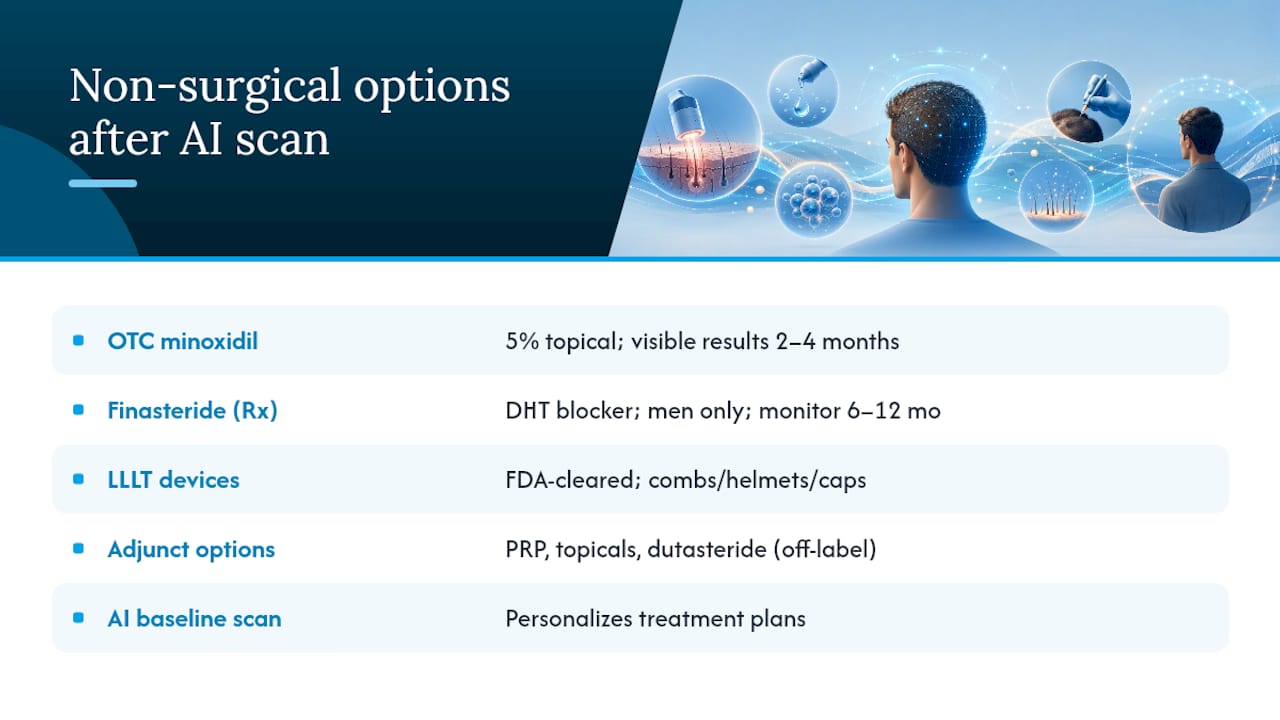
OTC minoxidil is the most accessible starting point. The 5% topical solution label specifies 1 mL applied twice daily to the vertex area of the scalp in men. Visible results typically appear between 2–4 months, with some trials running to 48 weeks.
Prescription finasteride works by inhibiting 5-alpha reductase, the enzyme that converts testosterone to DHT. It's approved for men only. Side effects, including sexual dysfunction in a small percentage of users, require discussion with a prescribing physician. Monitoring every 6–12 months is standard.
FDA-cleared LLLT devices are indicated for hereditary hair loss. Handheld combs, helmets, and caps in this category deliver low-level laser energy to the scalp. Evidence is moderate; Mayo Clinic lists LLLT among its recognized treatment options for hereditary hair loss alongside medications and procedural approaches.
Adjunct and off-label options include platelet-rich plasma (PRP) injections, compounded topical formulas, and dutasteride. Dutasteride is used off-label in the U.S. for AGA; it is not FDA-approved for hair loss. PRP has growing clinical support but is not FDA-approved as a standalone hair-loss treatment.
Cleveland Clinic notes that treatment plans work best when personalized to the underlying cause, which is exactly where an AI baseline scan earns its keep.
How accurate is AI hair analysis, and what are its limits?
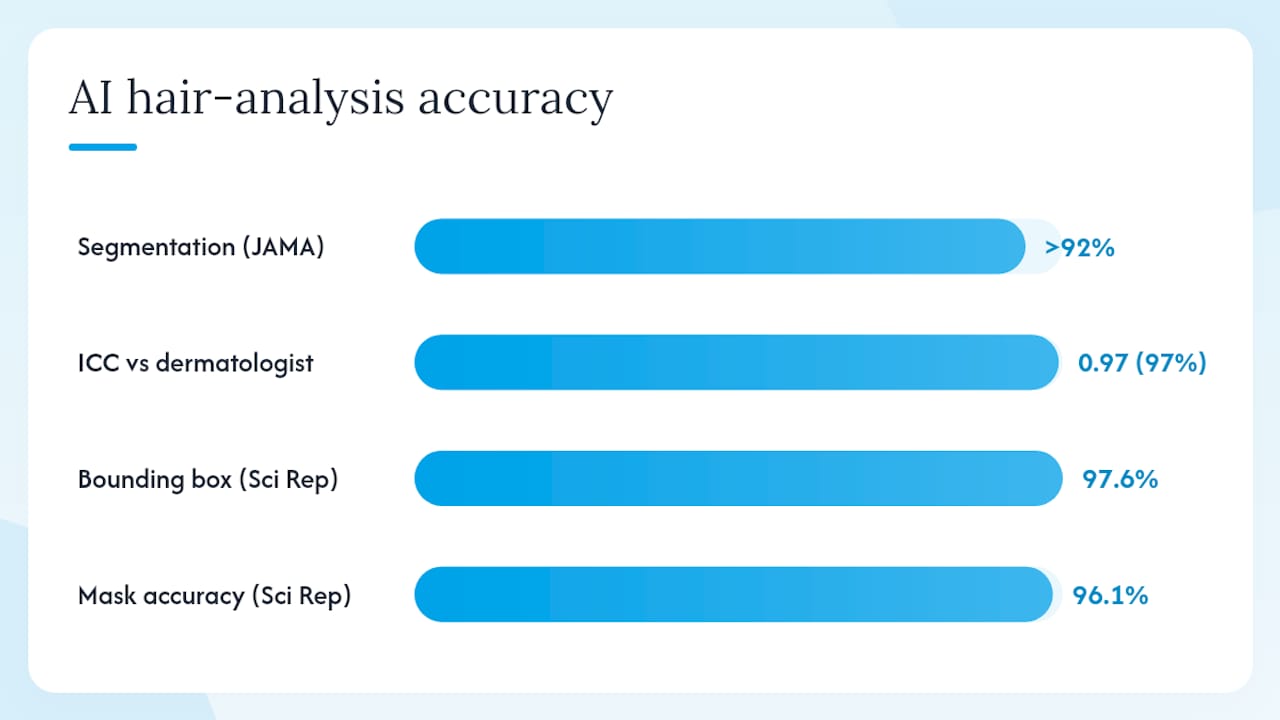
The short answer: in controlled studies, AI models reach accuracy levels that rival trained dermatologists. Research published in JAMA Dermatology reports segmentation accuracy above 92% and intraclass correlation coefficients (ICC) as high as 0.97 compared to expert dermatologists. An area-ratio framework using Mask R-CNN on 761 images from 257 patients achieved 97.6% precision in bounding box evaluations and 96.1% mask accuracy for identifying hair-loss regions.
Key accuracy figures: AI segmentation accuracy exceeds 92%, and ICC scores reach 0.97 versus veteran dermatologists in peer-reviewed validation studies, indicating near-expert agreement on standardized severity metrics.
For SALT scoring specifically, an AI system validated against a U.S. dermatologist across 188 four-view head images produced ICC = 0.97, with per-view ICCs ranging from 0.92 to 0.97. Traditional grading scales like Norwood-Hamilton are inherently subjective; AI-driven area metrics produce more reproducible scores and support longitudinal tracking.
Limits matter too. Performance drops with poor image quality, unusual lighting, or very short white hair. Training sets have historically skewed toward certain ethnicities and device types, which can affect generalizability. An ongoing clinical trial (NCT07294313) is enrolling 400 participants to validate CNN models using handheld dermoscopes across diverse populations. A 2024–2025 study using ResNet-18 on trichoscopic images showed strong early-detection performance but flagged device and population diversity as ongoing limitations.
| Metric | Value | Source |
|---|---|---|
| Segmentation accuracy | >92% | JAMA Dermatology |
| ICC vs. dermatologist (SALT) | 0.97 | PMC / AI SALT study |
| Bounding box precision | 97.6% | Scientific Reports |
| Mask accuracy | 96.1% | Scientific Reports |
Pro Tip: Trust an AI report for baseline tracking and treatment monitoring. If you notice sudden patchy loss, scalp inflammation, or rapid diffuse shedding, skip the app and book an in-person trichoscopy. Those patterns need a clinician's eyes, not a segmentation algorithm.
How do you go from an AI scan to an actual treatment plan?
This is where most people stall. Here's a clear sequence.
- Capture a baseline scan. Use the Myhair scanner camera setup for standardized image capture. Three angles minimum: crown, temples, hairline. Consistent lighting and distance matter more than camera quality.
- Read your AI report. Focus on hair density (follicular units per cm²), hair count, and severity grade. A density below typical age-matched norms combined with a moderate severity score is usually enough to justify starting a first-line treatment.
- Start low-effort, OTC options if eligible. Minoxidil 5% twice daily to the vertex is the logical first step for most men with AGA. Set a 3-month checkpoint scan to measure response. For LLLT, follow the device manufacturer's regimen, typically 3–4 sessions per week.
- Pursue prescription options when OTC isn't enough. If your 3-month scan shows minimal density change, book a telehealth dermatology consult. Bring your Myhair report. Finasteride or a compounded topical formula are the usual next steps. For in-office adjuncts like PRP, your AI report gives the clinician an objective pre-treatment baseline.
For the first 6–12 months, scan every 3 months. If density scores plateau or worsen after 6 months on a consistent regimen, that's the signal to escalate to an in-person dermatology visit. The Myhair AI hair growth therapy guide walks through treatment sequencing in more detail.
Key checkpoints:
- Month 3: first follow-up scan, compare density and hair count
- Month 6: assess severity grade change, decide on prescription escalation
- Month 12: full review with clinician if response is incomplete
What safety and privacy issues should you know before scanning?
Medical cautions by treatment:
- Minoxidil: vertex use only in men (5% formulation); women should use the 2% formulation; not for use under 18; stop and consult a physician if chest pain, rapid heartbeat, or sudden weight gain occurs
- Finasteride: contraindicated in women who are pregnant or may become pregnant (handling crushed tablets carries absorption risk); sexual side effects affect a minority of men and may persist after stopping
- LLLT: generally well tolerated; minor scalp warmth or irritation is the most common adverse event; avoid direct eye exposure
Seek urgent clinical follow-up if you notice sudden patchy loss, scalp tenderness, redness, or scaling. These can signal alopecia areata, scarring alopecia, or infection, none of which an AI scan can diagnose or treat.
Before uploading scalp images to any AI service, ask:
- Where is your data stored, and is it U.S.-based?
- Does the platform comply with HIPAA if it integrates with telehealth providers?
- How long are images retained, and are they shared with third parties?
- Can you delete your data on request?
Important: An AI scalp scan is a monitoring and triage tool, not a medical diagnosis. Use it to track change and prepare for clinical conversations, not to replace them. Any treatment decision, especially prescription medications, requires a licensed U.S. clinician.
Why objective baselines matter more than most people realize
The conventional advice is to "see a dermatologist first." That's correct, but incomplete. Most people arrive at a dermatology appointment with no objective data, which means the clinician is working from a single snapshot and a subjective description of how much hair has been lost. An AI baseline scan changes that dynamic entirely.
What I'd do in your position: run one scan before starting any treatment, note the density and severity scores, then trial a first-line option for 90 days. At the 3-month mark, rescan under identical conditions. If the numbers move, you have evidence. If they don't, you walk into a dermatology appointment with documented progression, not a feeling.
That's the real value of an objective baseline, and it's something no surgical consultation can give you upfront.
Myhair gives you a clear starting point for hair health
Most people researching hair loss solutions spend weeks comparing options without ever getting an objective picture of where they actually stand. Myhair changes that. Upload a scan, get a hair count and severity score backed by research-validated algorithms, and walk into any telehealth or in-person dermatology appointment with documented data instead of guesswork.
For clinics looking to integrate AI-assisted patient monitoring, Myhair's clinic onboarding connects the platform directly to clinical workflows, standardizing pre- and post-treatment documentation. For individual users, the app onboarding gets you scanning in minutes. Start your baseline scan today at Myhair.
Sources
- AI system for quantifying alopecia areata and assigning SALT scores (PMC)
- MINOXIDIL Topical Solution information (DailyMed)
- Clinical trial: AI models for diagnosis and severity assessment of pattern hair loss (NCT07294313)
This article provides general information only and is not a substitute for professional medical advice. Consult a licensed U.S. clinician before starting any hair-loss treatment.
FAQ
What is the best U.S.-focused alternative to surgical hair restoration?
Myhair is the strongest AI-powered option for U.S. consumers, delivering scalp scans, density counts, and severity scores that pair directly with FDA-approved non-surgical treatments and U.S. telehealth workflows.
How accurate are AI hair analysis tools?
Does minoxidil work for frontal hairline loss in men?
When should I see a dermatologist instead of relying on an AI scan?
Seek in-person evaluation for sudden patchy loss, scalp inflammation, tenderness, or rapid diffuse shedding, as these may indicate conditions an AI scan cannot diagnose.
Is finasteride safe for everyone with hair loss?
Finasteride is FDA-approved for men only and is contraindicated for women who are pregnant or may become pregnant; a U.S. prescribing physician must evaluate suitability before use.