TL;DR:
- Hormonal imbalances primarily drive hair loss through mechanisms involving DHT, estrogen, and thyroid hormones. These hormonal changes affect hair cycles during key life stages such as puberty, postpartum, and menopause, leading to patterned or diffuse thinning. Effective treatment targets specific hormonal pathways with medications like minoxidil, anti-androgens, or hormone replacement, emphasizing a multifactorial diagnostic approach.
Hormones are the primary biological drivers of hair loss, regulating every phase of the hair growth cycle from follicle activation to shedding. When hormone levels shift, even slightly, the scalp responds. The connection between hormones and hair loss is not a theory. It is a documented biochemical process involving androgens like dihydrotestosterone (DHT), estrogen, thyroid hormones, cortisol, and insulin. Understanding which hormones affect your hair, and why, is the first step toward choosing a treatment that actually works.
Which hormones most affect hair growth and loss?
Hair loss driven by hormonal imbalance falls under the clinical umbrella of androgenetic alopecia (AGA) and telogen effluvium, two distinct but sometimes overlapping conditions. Each is governed by a different hormonal mechanism.
Androgens: the most studied culprit
Testosterone and its more potent derivative DHT are the hormones most directly linked to follicle miniaturization. In androgenetic alopecia, the scalp enzyme 5-alpha-reductase converts testosterone into DHT, which binds to androgen receptors in hair follicles and progressively shrinks them. Critically, local scalp DHT activity explains hair thinning even when blood testosterone levels appear normal. This is why a standard hormone panel showing "normal" testosterone does not rule out androgen-driven hair loss.
Estrogen: the hair protector
Estrogen extends the anagen (growth) phase of the hair cycle, which is why many women notice thicker, fuller hair during pregnancy. When estrogen drops, as it does at menopause or postpartum, the protective effect disappears and shedding accelerates. The ratio of androgens to estrogen matters more than either hormone in isolation.
Thyroid hormones: the overlooked factor
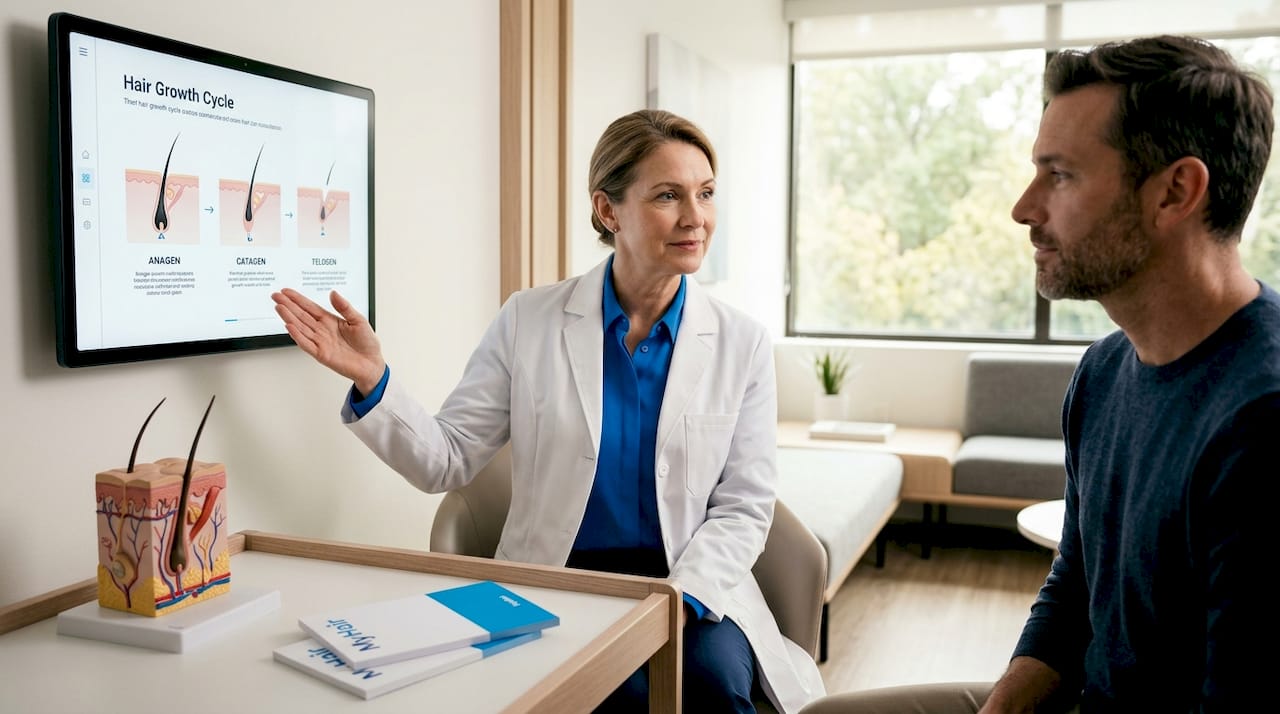
Both hypothyroidism and hyperthyroidism disrupt the hair cycle. Thyroid dysfunction causes diffuse shedding by pushing follicles prematurely into the telogen (resting) phase. Unlike androgen-driven loss, thyroid-related shedding is typically uniform across the scalp rather than patterned.
Cortisol and insulin: the systemic disruptors
Chronic stress elevates cortisol, which interferes with follicle cycling and can trigger telogen effluvium. Insulin resistance, common in conditions like polycystic ovary syndrome (PCOS), raises circulating androgens and compounds follicle damage. Neither cortisol nor insulin acts on hair follicles as directly as DHT, but both amplify existing hormonal imbalances.
Pro Tip: If you are losing hair and your thyroid panel comes back "normal," ask your doctor to test both TSH and free T3/T4. Subclinical thyroid dysfunction frequently causes diffuse shedding that standard TSH screening misses.
How do hormonal changes during life stages affect hair loss?
Hormonal hair loss is not a single event. It tracks across the entire lifespan, with predictable triggers at each major hormonal transition.
-
Puberty. Rising androgen levels during adolescence activate androgen receptors in genetically susceptible follicles. This is when early-onset androgenetic alopecia first appears in both males and females, often dismissed as normal teenage hair changes.
-
Pregnancy. Elevated estrogen during pregnancy prolongs the anagen phase, reducing normal daily shedding. Hair appears denser and healthier. This is a temporary hormonal effect, not a permanent improvement.
-
Postpartum. After delivery, estrogen and progesterone drop sharply. Follicles that were held in the growth phase simultaneously enter telogen, causing postpartum telogen effluvium with shedding typically starting two to five months after birth. Most women see natural recovery within six to twelve months as hormones normalize.
-
PCOS. Polycystic ovary syndrome is one of the most common female hair loss causes in women of reproductive age. Elevated androgens from PCOS drive follicle miniaturization in a pattern similar to male-pattern baldness, concentrated at the crown and temples. Because circulating testosterone can appear only mildly elevated, PCOS-related hair loss is frequently underdiagnosed.
-
Menopause. Estrogen production falls significantly at menopause, shifting the androgen-to-estrogen ratio in favor of androgens. This is why female pattern hair loss accelerates after age 50. The thinning is diffuse but most visible at the part line and crown.
-
Thyroid disease. Autoimmune thyroid conditions like Hashimoto's thyroiditis and Graves' disease are among the most common triggers of diffuse hormonal hair loss in women. Hair shedding often precedes other thyroid symptoms by months, making it a useful early clinical signal.
What distinguishes hormonal hair loss from other types?
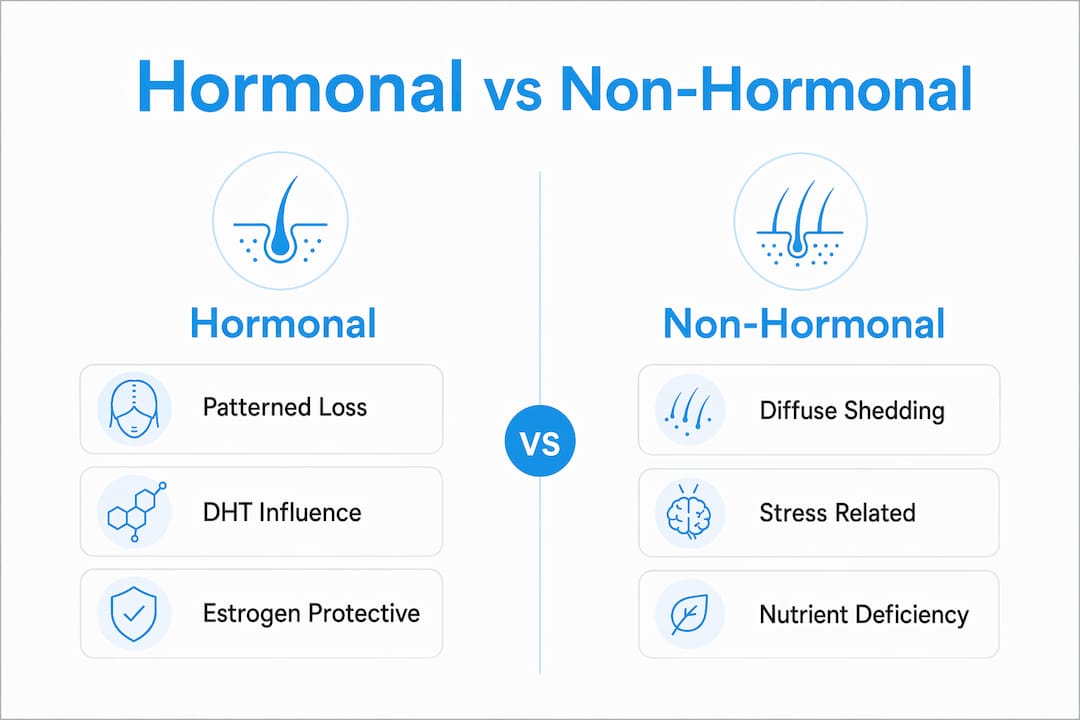
Not every case of hair shedding has a hormonal cause. Telogen effluvium results from multiple intersecting causes, including nutritional deficiencies, physical trauma, and psychological stress. Accurate diagnosis requires distinguishing between these overlapping patterns.
| Feature | Hormonal hair loss | Non-hormonal hair loss |
|---|---|---|
| Pattern | Patterned (crown, temples) or diffuse | Diffuse or patchy |
| Onset | Gradual or triggered by life event | Often sudden after stressor |
| Primary driver | DHT, estrogen decline, thyroid dysfunction | Iron deficiency, crash dieting, surgery, stress |
| Lab findings | Elevated DHT, abnormal thyroid, low estrogen | Normal hormones; low ferritin, B12, or zinc |
| Recovery | Slow; requires targeted treatment | Often self-resolving once trigger is removed |
The key diagnostic distinction is pattern versus diffuse loss. Androgenetic alopecia produces a recognizable pattern: recession at the temples and thinning at the crown in men, and widening of the part line in women. Telogen effluvium from stress or nutritional deficiency causes uniform thinning across the entire scalp. Overlaps are common. A woman with PCOS may experience both patterned androgen-driven loss and stress-triggered telogen effluvium simultaneously.
Local androgen receptor expression in scalp follicles determines whether a person develops androgenetic alopecia regardless of systemic hormone levels. This genetic component explains why two people with identical testosterone levels can have completely different hair outcomes.
Which treatments effectively address hormonal imbalance hair loss?
Treatment for hormone-driven hair loss works best when it targets the specific mechanism causing the problem. There is no single solution that addresses all hormonal pathways.
Topical minoxidil
Topical minoxidil is FDA-approved for androgenetic alopecia in both 2% and 5% formulations. It does not alter hormone levels. Instead, it extends the anagen phase and improves blood flow to follicles, stimulating growth independent of hormone correction. This makes it effective even when the hormonal trigger has not been fully resolved.
Oral minoxidil
Oral minoxidil produces stronger results than topical formulations but carries systemic risks including cardiovascular symptoms and increased body hair growth. Medical supervision and careful dose titration are non-negotiable with oral use. It is not a first-line option for most patients.
Anti-androgens
Spironolactone at doses around 200 mg per day is the most commonly prescribed anti-androgen for women with androgen excess. It works by blocking androgen receptors and suppressing testosterone, slowing follicle miniaturization and encouraging regrowth. Finasteride, a 5-alpha-reductase inhibitor, is used in men and increasingly off-label in postmenopausal women. Both require ongoing use to maintain results.
Hormone replacement therapy (HRT)
For menopausal women, estrogen-based HRT can partially restore the androgen-to-estrogen ratio and slow hair loss progression. Results vary significantly depending on the type of HRT, timing of initiation, and individual hormonal profile. HRT is not appropriate for everyone and requires a full medical evaluation.
Lifestyle interventions
Managing insulin resistance through diet and exercise reduces circulating androgens in women with PCOS. Addressing iron deficiency, which frequently coexists with hormonal hair loss in women, removes a compounding factor. Stress reduction practices that lower cortisol support the overall hormonal environment, though they rarely reverse established androgenetic alopecia on their own.
Pro Tip: Track your hair shedding alongside your menstrual cycle for two to three months. Many women notice peak shedding at specific cycle phases, which points directly to the hormonal driver and helps your doctor choose the right treatment.
| Treatment | Mechanism | Best for |
|---|---|---|
| Topical minoxidil | Extends anagen phase, improves follicle blood flow | AGA in men and women |
| Spironolactone | Androgen receptor blockade | Women with androgen excess or PCOS |
| Finasteride | Inhibits 5-alpha-reductase, reduces DHT | Men; off-label postmenopausal women |
| Estrogen HRT | Restores androgen-to-estrogen ratio | Menopausal women with pattern loss |
| Thyroid treatment | Normalizes hair cycle disruption | Thyroid-related diffuse shedding |
You can explore androgenetic alopecia treatment options in more detail, including how local hormonal mechanisms shape the choice between topical and systemic therapies.
Key takeaways
Hormonal hair loss is driven by specific, identifiable mechanisms. Targeting the right hormone at the right stage produces measurably better outcomes than generic hair loss treatments.
| Point | Details |
|---|---|
| DHT drives follicle miniaturization | Local scalp DHT activity causes AGA even when blood testosterone is normal. |
| Estrogen protects hair growth | Estrogen decline at menopause or postpartum accelerates shedding by shortening the anagen phase. |
| Thyroid dysfunction causes diffuse loss | Both hypothyroidism and hyperthyroidism push follicles into telogen, causing uniform shedding. |
| Diagnosis must be multifactorial | Stress, nutrition, and genetics intersect with hormones; assuming a single cause leads to wrong treatment. |
| Treatment targets the mechanism | Minoxidil extends growth phase; spironolactone blocks androgens; HRT restores estrogen balance. |
What I've learned about hormone-driven hair loss after years of watching people chase the wrong diagnosis
Most people who come to me convinced their hair loss is hormonal are partially right. Hormones are almost always involved. But the mistake I see repeatedly is treating "hormonal" as a complete diagnosis rather than a starting point. A woman with PCOS-related hair loss who also has low ferritin and chronic sleep deprivation will not respond well to spironolactone alone. The androgen blockade addresses one pathway while the other two continue doing damage.
The second misconception I encounter constantly is the belief that normalizing a hormone panel means the hair will recover quickly. It does not. Follicle miniaturization from years of DHT exposure does not reverse overnight. Even after successful hormonal correction, regrowth takes six to twelve months to become visible. Patients who stop treatment at the three-month mark because they "don't see results" are abandoning the process right before it would have worked.
What I find genuinely promising in current research is the shift toward targeting local scalp androgen metabolism rather than systemic hormone levels. Topical anti-androgens and scalp-specific 5-alpha-reductase inhibitors are in development, and they represent a more precise approach than systemic drugs that affect the entire endocrine system. The future of hormonal hair loss treatment is local, not systemic.
If you are managing stress-related shedding alongside a hormonal condition, address both simultaneously. Treating them sequentially wastes months.
— Cyriac
See your hair's hormonal story with Myhair
Understanding the hormonal drivers of your hair loss is one thing. Seeing exactly how those changes are affecting your scalp density, follicle health, and growth patterns over time is another level of clarity entirely.
Myhair uses AI-powered analysis to give you a precise hair health score based on your actual scalp scans, not generic questionnaires. The platform tracks changes over time so you can see whether your treatment is working before your next dermatology appointment. Start with the AI scanner tool to get your baseline assessment, then use the data to have a more informed conversation with your doctor about which hormonal pathway to target first.
FAQ
What hormones cause hair loss in women?
The primary hormones causing hair loss in women are DHT (converted from testosterone by scalp enzymes), declining estrogen at menopause or postpartum, and thyroid hormones when levels are abnormal. PCOS-related androgen excess is one of the most common hormonal hair loss triggers in women under 40.
Can hormonal imbalance hair loss be reversed?
Hormonal hair loss can be slowed and partially reversed when the underlying imbalance is treated early. Postpartum telogen effluvium typically resolves naturally within six to twelve months. Androgenetic alopecia requires ongoing treatment since follicle miniaturization from DHT exposure does not fully reverse without sustained intervention.
How is hormonal hair loss diagnosed?
Diagnosis combines a clinical assessment of shedding pattern with blood tests for androgens, thyroid hormones (TSH, free T3/T4), estrogen, and ferritin. Because normal systemic hormone levels do not rule out androgen-driven loss, scalp biopsy or trichoscopy is sometimes needed to confirm follicle miniaturization.
Does testosterone cause hair loss in women?
Testosterone itself is not the direct cause. The scalp enzyme 5-alpha-reductase converts testosterone to DHT, which is the active driver of follicle miniaturization. Women with elevated testosterone from PCOS or adrenal disorders are at higher risk, but even women with normal testosterone levels can experience androgen-driven hair loss due to increased local scalp sensitivity.
How long does it take for hair to grow back after hormonal treatment?
Most treatments require a minimum of six months before visible regrowth appears. Topical minoxidil and anti-androgens like spironolactone both require consistent daily use over this period. Stopping treatment early is the most common reason for treatment failure.