
TL;DR:
- Routine scalp massage, correcting nutritional deficiencies, and using evidence-backed topicals can lead to thicker hair within three to six months. Combining these biological strategies with styling tricks provides instant fullness, and regular monitoring helps track progress. Consistency and patience are key to achieving lasting natural hair thickening results.
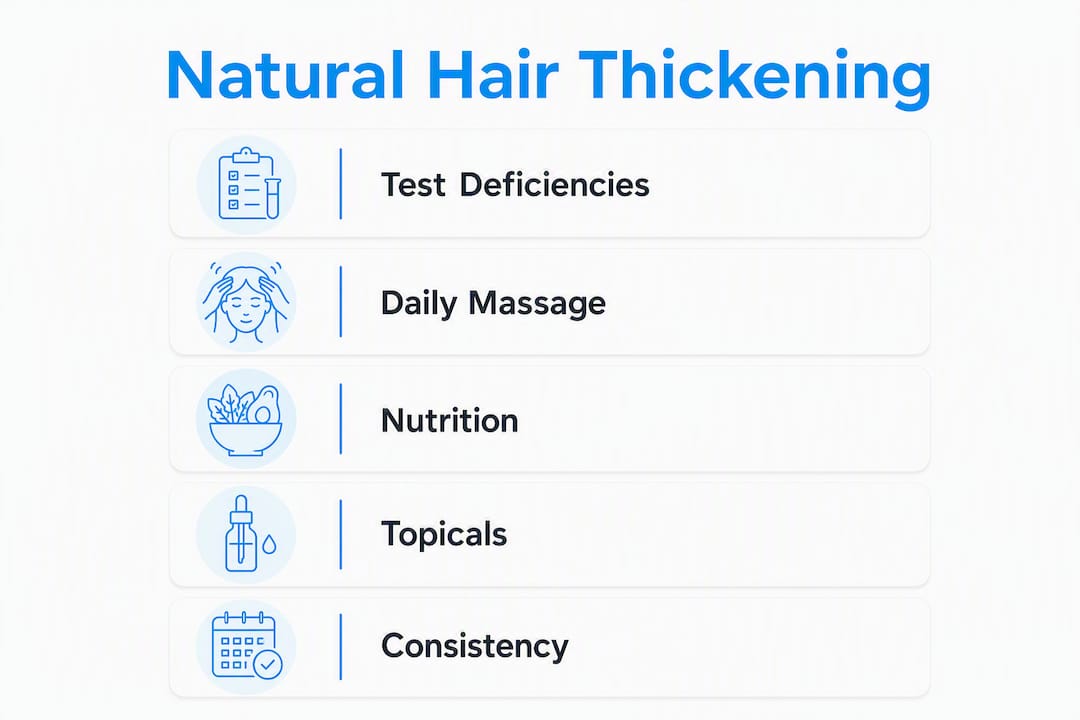
You can make your hair look fuller and support measurably thicker growth by combining daily scalp stimulation, targeted nutrition, and a few careful routine changes. The highest-impact steps, in order of evidence strength:
- Daily scalp massage: 4 minutes on a dry scalp, fingertip pads only. A 2016 ePlasty study found thicker hair shafts after 24 weeks of this exact routine.
- Fix deficiencies first: Low ferritin, vitamin D, or protein are among the most common reversible causes of thinning. Get bloodwork before buying supplements.
- Add rosemary oil or pumpkin seed oil: Both have controlled-trial support (details in sections below).
- Cut heat and tension: Flat irons, tight ponytails, and heavy silicone products cause breakage that makes thin hair look even thinner.
Timeline: Expect measurable biological change in 3–6 months. Styling fixes work the same day.
Pro Tip: Patch-test any essential oil on your inner arm 24 hours before applying it to your scalp, and confirm iron levels via a ferritin blood test before supplementing iron. Unnecessary iron intake can be toxic.
Table of Contents
- What can you do today to make hair look fuller?
- What should you eat and supplement for thicker hair?
- How does scalp care and stimulation support thicker growth?
- Which home oils and topical remedies actually work?
- How should you build a daily routine for fuller hair?
- How long does it take to get thicker hair naturally?
- When should you see a doctor about hair thinning?
- What does the research actually say about natural hair thickening?
- Key Takeaways
- The part most people skip
- Personalized hair analysis with Myhair
- Useful sources
- FAQ
What can you do today to make hair look fuller?
Visual density is achievable right now, while longer-term methods take effect. Styling tricks like part changes and root-lifting products provide instant, visible fullness and should run alongside biological strategies.
Styling shortcuts:
- Change your part to the opposite side. Flat, trained hair lifts immediately.
- Add loose waves or curls with a diffuser. Texture reads as volume.
- Apply a root-lifting spray or volumizing mousse to damp roots before blow-drying upside down.
- Dry shampoo and texturizing powder at the roots absorb oil and add grip, making hair look thicker on day two.
Cut and trim strategy:
- Ask for a blunt cut or shoulder-length bob. Blunt ends create the illusion of density because all strands end at the same point.
- Avoid heavy layering. As celebrity stylist George Northwood puts it, excessive layering removes volume and leaves fine hair looking flat.
- A micro-trim every six weeks removes split ends before they travel up the shaft.
Night and handling habits:
- Sleep on a silk pillowcase. It reduces friction and prevents the overnight breakage that thins strands over time.
- Wear hair in a loose braid or low bun, never a tight elastic.
- Detangle with a wide-tooth comb starting at the ends, not the roots.
Products to avoid:
- Heavy silicones (dimethicone high on the ingredient list) coat fine strands and weigh them down.
- Rich hair oils applied near the scalp flatten roots and accelerate greasiness.
- Thick, creamy leave-in conditioners on the scalp. Keep moisture products on mid-lengths and ends only.
What should you eat and supplement for thicker hair?
Nutrition is the foundation everything else rests on. Hair is made of keratin, a protein, and it depends on iron, vitamin D, zinc, and B vitamins to cycle normally. When any of those run low, the follicle miniaturizes or sheds early, and no topical remedy compensates for that.
Core nutrients and why they matter:
- Protein: Aim for 0.7–1 gram per pound of body weight daily. Eggs, Greek yogurt, lentils, and salmon are the most practical sources.
- Iron (ferritin): Ferritin deficiency is one of the most common causes of hair loss in women. Spinach, red meat, and lentils help; pair plant-based iron with vitamin C to improve absorption.
- Vitamin D: Levels below 30 ng/mL are associated with alopecia areata. Fatty fish and fortified foods help, but most people need a supplement to correct a true deficiency.
- Zinc: Supports oil gland function around the follicle. Pumpkin seeds, oysters, and chickpeas are strong sources.
- Biotin (B7): Supports keratin production. Found in eggs, nuts, and whole grains. Nutritionist Moon Bedeaux recommends a minimum of 5,000 mcg daily in liquid form for noticeable results, though supplementing only makes a difference if your intake is genuinely low.
Testing before supplementing: Request ferritin, serum iron, TIBC, vitamin D, B12, and a standard thyroid panel. Clinicians advise supplementation only when lab values confirm deficiency. Blind iron supplementation carries real toxicity risk.
Evidence-backed supplements:
- Pumpkin seed oil: In Cho et al. (2014), participants who took pumpkin seed oil saw roughly a 40% increase in hair count over 24 weeks versus about 10% in the placebo group. A typical study dose was 400 mg daily. More detail on hair growth supplements and safety notes is worth reviewing before starting.
- Omega-3 and omega-6 with antioxidants: Le Floc'h et al. (2015) gave 120 women an omega-3/6 and antioxidant formula for six months; large percentages reported reduced shedding and perceived thicker hair.
Practical food swaps: Replace a processed-carb lunch with a salmon and spinach bowl three times a week. Add a handful of walnuts as a snack. Those two changes cover omega-3, zinc, biotin, and iron in one move.
Safety warnings: Omega-3 supplements can interact with blood thinners. Pregnant women should confirm supplement safety with their OB before starting anything beyond a prenatal vitamin.

How does scalp care and stimulation support thicker growth?
A clean, well-circulated scalp is the physical environment your follicles live in. Neglect it and even a perfect diet underperforms.
Daily scalp massage routine:
- Start on a dry scalp before washing or applying any oil.
- Place the pads of all ten fingers on your scalp. Never use fingernails.
- Apply medium pressure and move in small, firm circles across the entire scalp.
- Spend 4 minutes total, focusing extra time on the crown and temples.
- If adding a carrier oil (coconut or jojoba), apply it after the dry massage and leave for 30 minutes before shampooing.
"Massage stretches the follicle and improves conditions for thicker shafts." — Dr. Akis Ntonos, board-certified dermatologist
The 2016 ePlasty study that documented increased shaft diameter used exactly 4 minutes daily. The mechanism is straightforward: mechanical stretch improves blood flow, delivering more oxygen and nutrients to the follicle base.
Clarifying and exfoliation:
- Oily scalps benefit from weekly exfoliation with a gentle scalp scrub or exfoliating shampoo.
- Dry scalps need exfoliation only every 2–3 weeks.
- Always rinse thoroughly. Residue left on the scalp blocks the treatments you apply next.
Ketoconazole shampoo: If you have dandruff, flaking, or seborrheic dermatitis, a ketoconazole shampoo (such as Nizoral) reduces scalp inflammation that can contribute to follicle miniaturization. Use it 2–3 times per week in place of your regular shampoo, not in addition to it. A thickening shampoo guide covers how to integrate ketoconazole options safely into a weekly routine.
Which home oils and topical remedies actually work?
Not every popular DIY treatment has study support. Here is what the evidence actually shows, and what is mostly cosmetic.
Rosemary oil (strongest topical evidence): Panahi et al. (2015) compared rosemary oil with 2% minoxidil over 6 months and found similar improvements in hair count, with less scalp itch in the rosemary group. Dilute 3–5 drops in one tablespoon of a carrier oil (coconut or jojoba), apply to the scalp, massage gently, and leave for at least 30 minutes before washing. Use 2–3 times per week. Always patch-test first.
Pumpkin seed oil (topical): Most of the evidence is for the oral supplement form. Topically, it functions as a carrier oil with some anti-inflammatory properties, but the oral route is better supported.
Oils and masks with plausible benefit:
- Coconut oil: Penetrates the hair shaft and reduces protein loss from washing. Best used as a pre-wash treatment on the lengths, not the scalp.
- Castor oil: Thick and occlusive. Some people find it improves strand texture, but it is heavy and can clog follicles if applied directly to the scalp. Mix with a lighter carrier oil.
- Aloe vera: Soothes scalp inflammation and adds slip. Apply fresh gel to the scalp, leave 20 minutes, then rinse.
- Egg mask: Protein-rich. Whisk one egg with a tablespoon of olive oil, apply to damp hair, leave 20 minutes, rinse with cool water. Useful for reducing breakage.
Mostly cosmetic (limited biological evidence):
- Avocado masks condition the surface of the strand but do not penetrate the follicle.
- Onion juice has a small study behind it, but the smell and skin irritation make compliance difficult for most people.
Pro Tip: For a simple weekly treatment, mix 5 drops of rosemary essential oil into 1 tablespoon of jojoba oil. Apply to the scalp after your dry massage, leave for 30 minutes, then shampoo out. That single habit covers both mechanical and topical stimulation in one session.
More recipes and ingredient breakdowns are covered in the hair thickening oil guide.
How should you build a daily routine for fuller hair?
A sustainable wash-and-style routine matters more than any single product. The goal is to stop the daily damage that makes hair look thinner while supporting the growth happening underneath.
Shampoo and conditioner strategy:
- Wash 2–3 times per week. Daily washing strips natural oils that protect the shaft.
- Apply shampoo to the scalp only and massage gently. Never rub it through the lengths.
- Apply conditioner from mid-lengths to ends only. Conditioner near the scalp flattens fine hair.
- Use a clarifying shampoo once every 1–2 weeks to remove product buildup.
Ingredient checklist:
- Look for: caffeine (stimulates follicles), hydrolyzed proteins (temporarily plump the shaft), ketoconazole (when dandruff is present), biotin-enriched formulas.
- Avoid: heavy silicones (dimethicone, cyclopentasiloxane) in leave-in products if your hair is fine. They coat strands and create buildup over time.
Styling products:
- Volumizing mousse applied to damp roots before blow-drying adds lift that lasts all day.
- Root-lifting spray targets the scalp area for maximum height.
- Texturizing powder on dry roots on day two gives grip and volume without washing.
- For barber-recommended styling techniques and product picks that add immediate visual fullness, that guide covers the practical details well.
Heat styling limits:
- Cap flat irons and curling wands at 350°F for fine or damaged hair.
- Always apply a heat protectant spray before any heated tool.
- Air-dry at least 2–3 days per week. The less heat, the less breakage.
How long does it take to get thicker hair naturally?
The honest answer: months, not weeks. Hair grows roughly half an inch per month, and the follicle needs to complete a full growth cycle before you see the result of any biological intervention.
The hair growth cycle in plain terms: Each follicle cycles through growth (anagen), transition (catagen), and rest (telogen) phases. Most interventions work by extending the anagen phase or improving the follicle environment. That process takes time to show up as visible hair.
Realistic milestones:
- Weeks 1–4: Reduced shedding, less breakage, better scalp condition.
- Months 2–3: Improved strand texture, early new growth visible at the hairline.
- Months 4–6: Measurable increase in density and shaft diameter if deficiencies were corrected.
- Month 12: Full picture of what the intervention achieved.
The pumpkin seed oil trial ran for 24 weeks before measuring results. The rosemary vs. minoxidil study also used a 6-month window. Those durations are the standard for a reason. Allow any single natural intervention at least 3–6 months before judging whether it is working.
Simple tracking routine: Take a photo in the same lighting, same angle, every four weeks. Note your part width and any areas of visible scalp. Myhair's hair count tracking tool gives you an objective density score from a scan, which removes the guesswork from comparing photos month to month.
When should you see a doctor about hair thinning?
Natural methods work well for mild, nutrition-driven, or stress-related thinning. They have real limits when the cause is medical or genetic.
Red flags that warrant a prompt appointment:
- Sudden shedding of more than 150–200 hairs per day for more than 2 weeks
- A visibly widening part or patches of scalp showing through
- Patchy, asymmetric loss (possible alopecia areata)
- Nail changes (pitting, ridging) alongside hair loss
- Fatigue, cold intolerance, or unexplained weight changes (thyroid signs)
- Hair loss after starting a new medication
Tests to request at your first appointment:
- Ferritin and serum iron, TIBC
- Vitamin D (25-OH)
- B12
- TSH and free T4 (thyroid panel)
- Standard CBC (complete blood count)
When to consider prescription options: If natural methods show no improvement after 6 months and bloodwork is normal, a dermatologist can evaluate you for androgenetic alopecia and discuss minoxidil, finasteride (for men), or PRP therapy. For prescription hair-loss options and clinical context, RoenRx's hair loss prescriptions page explains the main medical routes clearly. The American Academy of Dermatology's hair loss diagnosis guidance is the best primary reference for understanding when clinical treatment is appropriate.
What to bring to your appointment: A folder with dated photos (at least 8 weeks apart), a list of every supplement and medication you take, and a written timeline of when shedding started and any life events that preceded it. That context cuts the diagnostic time significantly.
What does the research actually say about natural hair thickening?
The evidence base for natural methods is real but modest. Here is what the strongest studies found.
Pumpkin seed oil (Cho et al., 2014): Participants who took pumpkin seed oil saw roughly a 40% increase in hair count over 24 weeks, compared to about 10% in the placebo group. That is a meaningful effect size for a supplement trial, though the sample was small.
Scalp massage (ePlasty, 2016): Four minutes of daily standardized massage produced measurable increases in hair shaft thickness over 24 weeks. The researchers found that mechanical stress positively affected gene expression in follicle cells, upregulating growth-related genes and downregulating loss-related ones.
"Massage stretches the follicle and improves conditions for thicker shafts — the mechanical stimulus itself is doing real biological work, not just improving circulation." — Dr. Akis Ntonos, board-certified dermatologist
Rosemary oil (Panahi et al., 2015): A randomized controlled trial found rosemary oil produced similar hair-count gains to 2% minoxidil over 6 months, with fewer side effects (less scalp itch). That comparison is notable because minoxidil is the most widely studied OTC hair-loss treatment available.
Microneedling (Pei et al., 2024 meta-analysis): A pooled analysis of randomized trials found that combined microneedling plus topical therapy improved hair density and diameter significantly more than topical treatment alone. At-home dermarollers carry infection risk if not sterilized properly, so this approach is better supervised by a clinician.
The honest caveat: most of these trials are small and short. They justify trying these methods, not guaranteeing results. Bloodwork to rule out correctable deficiencies remains the single most evidence-backed first step.
Key Takeaways
Consistent scalp massage, corrected nutritional deficiencies, and evidence-backed topicals like rosemary oil are the three most supported natural strategies for thicker hair, with results visible in 3–6 months.
| Point | Details |
|---|---|
| Fix deficiencies first | Test ferritin, vitamin D, and B12 before buying supplements; deficiency correction often moves the needle more than any topical. |
| Daily scalp massage | 4 minutes per day with fingertip pads on a dry scalp; the 2016 ePlasty study documented thicker shafts after 24 weeks. |
| Evidence-backed topicals | Rosemary oil (2–3x/week, diluted) and pumpkin seed oil (400 mg oral) have controlled-trial support; patch-test before use. |
| Allow 3–6 months | Hair cycles are slow; judge any single intervention only after a full 3–6 month trial with consistent use. |
| Track with Myhair | Myhair's AI hair scan gives you an objective density score so you can measure real change, not just guess from mirror checks. |
The part most people skip
The natural hair thickening conversation tends to spiral into product hunting. Someone reads about castor oil, tries it for two weeks, sees nothing, and moves on to the next thing. That cycle is the problem, not the methods themselves.
What actually works is less exciting: fix what is measurably broken (bloodwork), add one mechanical stimulus (massage), and give it time. The studies that showed real results ran for 24 weeks. Not 14 days.
There is also a sequencing issue most guides ignore. Styling fixes belong in week one because they work immediately and keep you motivated while the biological work happens underneath. But they are not a substitute for the biological work. A volumizing mousse on a follicle that is starved of iron is just decoration.
The readers who see the most durable change tend to combine three things at once: a corrected diet, a daily massage habit, and one evidence-backed topical. Not ten things. Three, done consistently for six months. The data from the pumpkin seed oil and rosemary trials both point to the same conclusion: consistency over a long window beats intensity over a short one.
Personalized hair analysis with Myhair
Most people trying to get thicker hair naturally are working blind. They pick a supplement, try a new shampoo, and have no way to know whether anything is actually changing at the follicle level. That is where Myhair's AI-powered scan changes the picture.
Upload a scan through the Myhair app and you get a detailed hair density assessment, a hair score, and a baseline you can compare against every month. Instead of guessing whether your scalp massage routine is working, you see the number move. The platform also surfaces tailored product and routine recommendations based on your specific pattern, so you are not running a generic protocol on a unique problem.
If you want to know exactly which deficits are most likely driving your thinning before you spend months on the wrong fix, start with a Myhair hair analysis and let the data set the priority order.
Useful sources
The following sources informed this article and are worth reading directly for deeper context:
- American Academy of Dermatology: Hair loss diagnosis and treatment — the primary clinical reference for when to escalate beyond natural methods.
- American Academy of Dermatology: Female-pattern hair loss — explains androgenetic alopecia in women and what to expect from treatment.
- Assure Clinic: How to regrow hair naturally — practical summary of scalp massage, essential oils, and dietary approaches with study references.
- WebMD: Ways to help hair grow faster and stronger — clinical guidance on testing for deficiencies before supplementing.
Confirm any supplement plan with your primary care clinician, especially if you are pregnant, on blood thinners, or have an existing thyroid condition.
FAQ
How can I thicken my hair naturally?
Combine daily 4-minute scalp massage, a protein-rich diet, and a topical like diluted rosemary oil applied 2–3 times per week. Correct any ferritin or vitamin D deficiency first, since those are among the most common reversible causes of thinning.
Can thin hair actually become thick again?
Yes, if thinning is caused by nutritional deficiencies, stress, or hormonal shifts, hair can regain density once the underlying cause is addressed. Advanced androgenetic alopecia (genetic pattern baldness) is unlikely to reverse fully with natural methods alone.
How do you increase hair shaft thickness?
Daily scalp massage is the most evidence-backed non-pharmacologic method. The 2016 ePlasty study found measurably thicker shafts after 24 weeks of 4-minute daily massage. Pumpkin seed oil (400 mg oral daily) also showed a roughly 40% increase in hair count over 24 weeks in a controlled trial, compared to about 10% in the placebo group.
How long before I see results from natural methods?
Most biological interventions require 3–6 months before visible change appears. Styling fixes like root-lifting products and blunt cuts work the same day. Myhair's hair score tool lets you track density objectively so you know whether a method is working before the six-month mark.
What stimulates hair to grow thicker?
Mechanical stimulation (scalp massage), adequate protein and iron intake, and topical rosemary oil all have study support for improving hair thickness or count. Fixing a measurable deficiency, particularly ferritin or vitamin D, is often the single most effective step before any topical or supplement makes a difference.