Eight lifestyle factors drive most non-genetic hair loss and hair damage: poor diet, chronic stress and short sleep, smoking and heavy alcohol use, obesity and inactivity, pollution and UV exposure, aggressive styling, untreated scalp conditions, and certain medications. Fix three things first: get enough protein and iron from food, protect your sleep window, and stop treating your scalp like it's separate from your hair.
Those three moves cover the fastest-acting mechanisms. Hair follicles are metabolically demanding tissue, and they're often the first thing your body deprioritizes when nutrition, sleep, or inflammation go sideways. That's not a flaw in the system. It's triage, and you can work with it.
The rest of this guide breaks down why each factor matters biologically, how strong the evidence actually is for each one (some of this is well-established, some is still emerging), and what a realistic timeline for improvement looks like.
- Diet and nutrients: protein, iron, zinc, vitamin D, and omega-3 deficits show up in hair before almost anywhere else.
- Stress and sleep: chronic short sleep and prolonged stress can trigger telogen effluvium, a diffuse shedding pattern.
- Smoking and alcohol: both accelerate oxidative damage to follicles and speed up premature graying.
- Weight and exercise: obesity-linked inflammation disrupts the follicle's micro-environment; regular movement helps reverse it.
- Pollution and UV: particulate matter and sun exposure weaken the hair shaft and irritate the scalp.
- Styling habits: heat, chemical processing, and tight hairstyles cause damage that's largely preventable.
- Scalp health: dandruff and seborrheic dermatitis quietly suppress growth if left untreated.
Pro Tip: Start tracking before you start changing. A baseline photo, a shed-hair count over one week, or a scan through an app like MyHair gives you something to compare against in three months, when most people can't remember what their hairline looked like in January.
Key Takeaways
Diet, sleep, stress, smoking, weight, pollution, styling habits, and scalp health together account for most non-genetic hair loss, and fixing the highest-impact ones first produces visible improvement within four to six months.
| Point | Details |
|---|---|
| Fix nutrition before supplementing | Prioritize protein, iron, zinc, and vitamin D from food; test levels before adding supplements. |
| Protect sleep and manage stress | Seven to nine hours nightly and a daily stress-discharge habit reduce cortisol-driven shedding. |
| Cut smoking and heavy drinking | Both accelerate oxidative damage and vascular constriction at the follicle level. |
| Move regularly, lose weight gradually | Exercise and gradual weight loss reduce inflammatory cytokines linked to follicle disruption. |
| Shield hair from pollution and UV | Wash after heavy exposure and use antioxidant serums or UV protection on high-exposure days. |
| Treat the scalp, not just the hair | Inflammatory conditions like dandruff or seborrheic dermatitis must be resolved to restore growth. |
Track your progress with something more reliable than memory, a weekly photo or a scan through MyHair gives you an objective baseline to measure against as these changes take effect.
Table of Contents
- How Lifestyle Factors Affecting Hair Actually Work Biologically
- What Diet and Key Nutrients Do for Hair Growth
- Can Stress and Poor Sleep Cause Hair Loss?
- How Smoking and Alcohol Affect Hair Follicles
- Does Being Overweight Affect Hair Growth?
- How Pollution, UV, and Chemical Exposure Damage Hair
- What Hairstyling Habits Cause the Most Damage?
- Can Scalp Conditions or Medications Cause Hair Loss?
- What Is a Realistic Timeline for Improving Hair Health?
- What Does an AI Hair Scan Add That a Mirror Can't?
- Does Drinking More Water Improve Hair Quality?
- Can Managing Stress Actually Regrow Hair?
- Sources
- FAQ
How Lifestyle Factors Affecting Hair Actually Work Biologically
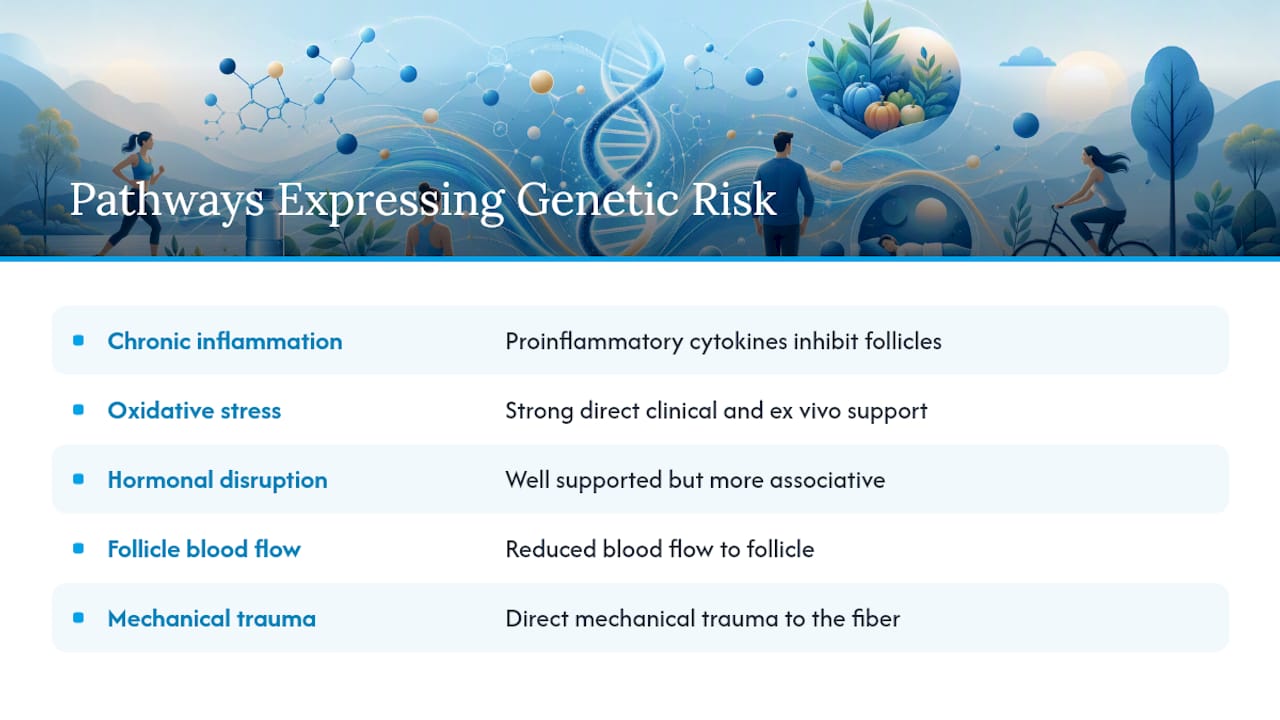
Five biological pathways explain almost every lifestyle-driven hair problem: chronic inflammation, oxidative stress, hormonal disruption, reduced blood flow to the follicle, and direct mechanical trauma to the fiber. Genetics decides your baseline risk. These five pathways decide how much of that risk actually gets expressed.
That's the core of what researchers call the exposome: the cumulative sum of every environmental and lifestyle exposure you've had, layered on top of your genetic code. A 2024 clinical review on hair disorders frames it directly. Genetics loads the gun, but exposure patterns pull the trigger by altering how genes get expressed over time. Identical twins with identical DNA can end up with meaningfully different hair outcomes, and the difference traces back to epigenetics, meaning the same genetic code getting switched on or off differently depending on what each twin's follicles were exposed to.
A 2026 Frontiers review found that chronic stress, obesity, smoking, alcohol misuse, and sleep disturbance can all function as epigenetic drivers that accelerate androgenetic alopecia. The mechanism runs through systemic inflammation and oxidative stress, which release proinflammatory cytokines that directly inhibit follicle growth. Obesity's contribution is particularly well-documented: excess adipose tissue produces TNF-α and IL-6, cytokines that damage the fatty tissue surrounding the follicle and disrupt the signals that keep hair in its growth phase.
The evidence strength varies by mechanism. Oxidative stress and mechanical trauma have strong, direct clinical and ex vivo support. Hormonal and inflammatory pathways linking obesity or chronic stress to hair loss are well-supported but more associative, since isolating one variable in a living person is hard. Treat the strongest claims as near-certain and the associative ones as "worth acting on, not yet fully proven."
Picture it as a funnel: the exposome sits at the top (everything you're exposed to over decades), it filters down into these five mechanisms, and it exits at the bottom as visible outcomes on the follicle and fiber, thinning, breakage, slower regrowth, premature graying. Every section below fits somewhere in that funnel.
What Diet and Key Nutrients Do for Hair Growth
Adequate protein and four micronutrients, iron, zinc, vitamin D, and B vitamins, matter more for hair quality than any other dietary factor, with omega-3 fatty acids playing a supporting role in scalp inflammation control. Hair is roughly 90% keratin, a protein, which means your body needs a steady protein supply just to keep manufacturing the stuff.

Cleveland Clinic's guidance on hair thinning is blunt about priorities: get these nutrients from food first, not from a supplement aisle. Lean meats, eggs, and legumes cover protein. Iron-rich foods like spinach, lentils, and red meat matter especially for menstruating women, who run a higher risk of iron-deficiency-related shedding. Zinc shows up in pumpkin seeds and shellfish. Fatty fish like salmon and sardines deliver omega-3s that help calm scalp inflammation.
| Nutrient | Role in Hair Health | Good Food Sources |
|---|---|---|
| Protein | Structural building block of the hair shaft (keratin) | Eggs, poultry, fish, legumes |
| Iron | Supports oxygen delivery to the follicle | Red meat, lentils, spinach |
| Zinc | Aids tissue repair and oil gland function around the follicle | Pumpkin seeds, oysters, chickpeas |
| Vitamin D | Linked to follicle cycling; deficiency associated with shedding | Fatty fish, fortified dairy, sunlight |
| Omega-3s | Reduces scalp inflammation | Salmon, walnuts, flaxseed |
Crash diets are where this goes wrong fastest. Rapid, severe calorie restriction is one of the most reliable triggers of telogen effluvium, a stress-related shedding pattern that typically shows up two to three months after the dietary shock, not immediately. If you've ever wondered why hair loss seemed to "come out of nowhere" a couple of months after a hard diet, that delay is exactly why.
- Avoid diets under 1,000 to 1,200 calories a day sustained for more than a few weeks without medical supervision.
- Rebuild lost weight gradually rather than repeating extreme cycles, since yo-yo dieting compounds the shedding risk each time.
- Get bloodwork before supplementing. Iron, zinc, and vitamin D can all be tested cheaply, and dosing blind is a real risk.
Supplements have a place, but only when a deficiency is confirmed. Cleveland Clinic's Dr. Ranasinghe specifically warns against guessing: excess iron or vitamin A, for instance, can actually worsen hair loss rather than help it. If you want a closer look at which supplements have real evidence behind them versus which are mostly marketing, our breakdown of hair growth supplements separates the two.
Pro Tip: Food first, pills second. A daily multivitamin rarely fixes a real deficiency, and megadosing a nutrient you're not actually short on can backfire.
Can Stress and Poor Sleep Cause Hair Loss?
Yes, both acute shocks and chronic, ongoing stress or sleep deprivation can push hair follicles out of their growth phase and into shedding, a pattern called telogen effluvium. The distinction between acute and chronic matters because the timeline and severity differ.
An acute shock, a major illness, surgery, or a sudden crash diet, can trigger a wave of shedding roughly two to three months later, then usually resolve on its own within six months once the trigger passes. Chronic stress and ongoing short sleep work differently: they keep the follicle in a low-grade inflammatory state indefinitely, which means the shedding doesn't resolve until the underlying stressor does.
The mechanism runs through cortisol and a neuropeptide called substance P. Elevated cortisol from prolonged stress disrupts the hair growth cycle directly, while substance P (released during stress responses) has been shown in research models to push follicles prematurely into the resting phase. Both pathways generate reactive oxygen species along the way, adding oxidative damage on top of the hormonal disruption.
- Fix sleep duration before anything else. Aim for seven to nine hours consistently; hair follicles regenerate largely during deep sleep cycles.
- Build one daily stress-discharge habit, walking, breathing exercises, journaling. Consistency matters more than intensity.
- Cut evening screen time. Blue light exposure late at night delays melatonin release and shortens deep sleep, compounding the problem.
- Track shedding weekly rather than daily. Day-to-day counts are noisy; weekly averages show the real trend.
- Weeks 1 to 4: no visible change yet, even if you've fixed sleep and stress. The follicle cycle has a lag.
- Weeks 8 to 12: shedding from an acute trigger typically starts to slow.
- Months 4 to 6: visible regrowth becomes noticeable for most people, assuming the trigger has genuinely resolved.
How Smoking and Alcohol Affect Hair Follicles
Smoking and heavy alcohol use both accelerate hair aging through a shared mechanism: increased oxidative stress combined with reduced blood flow to the scalp. Smoking adds vascular constriction on top of that, since nicotine narrows the small blood vessels that feed each follicle, cutting off part of its nutrient and oxygen supply.
The strongest evidence here connects smoking to premature graying and to accelerated miniaturization in people already genetically predisposed to androgenetic alopecia, the pattern covered in the 2026 Frontiers review on lifestyle drivers of hair loss. Heavy alcohol use compounds this by depleting zinc and B vitamins, two nutrients already flagged as essential for follicle health, and by disrupting sleep architecture even in people who feel like alcohol helps them fall asleep faster.
The evidence on outcomes like overall shedding rate is more associative than the graying and vascular data, since isolating alcohol or tobacco from someone's broader lifestyle (diet, sleep, stress) in a real-world study is genuinely difficult.
- Circulation to the scalp starts improving within days to weeks of quitting smoking.
- Vitamin and mineral absorption normalizes within weeks of stopping heavy drinking.
- Visible reduction in shedding tends to lag behind these internal changes by two to three months, following the same telogen effluvium timeline as other triggers.
- If full cessation isn't realistic right now, cutting frequency and volume still reduces cumulative oxidative load, even partial reduction helps.
Does Being Overweight Affect Hair Growth?
Obesity contributes to hair loss primarily through chronic low-grade inflammation, driven by cytokines like TNF-α and IL-6 released from excess fat tissue, which disrupt the follicle's immediate environment and can accelerate androgenetic alopecia in genetically susceptible people. This isn't a cosmetic side note. It's one of the more mechanistically well-supported pathways in the 2026 Frontiers review on lifestyle-driven hair loss.
The fix isn't dramatic weight loss, it's gradual, sustainable weight loss combined with regular movement. Aerobic exercise improves circulation, which gets more oxygen and nutrients to the scalp. Resistance training helps regulate insulin sensitivity, which matters because insulin resistance is tied to the same inflammatory cascade that damages follicles. Both forms of exercise also lower cortisol over time, connecting back to the stress pathway covered earlier.
- Aim for 150 minutes of moderate aerobic activity weekly (brisk walking counts), plus two sessions of resistance training.
- Lose weight at a rate of roughly one to two pounds per week rather than attempting rapid loss.
- Rebuild any calorie deficit gradually if you've hit a plateau, don't slash intake further.
- Pair movement with the sleep and stress habits from the earlier section, since the pathways overlap.
Pro Tip: Rapid weight loss, even from a "healthy" source like intense dieting for a wedding or event, can trigger the same telogen effluvium seen with crash diets. If you're losing more than two pounds a week for an extended stretch, that's a signal to slow down.
How Pollution, UV, and Chemical Exposure Damage Hair
Urban pollution and UV radiation degrade hair through oxidative modification of its structural proteins, and the damage is measurable at the molecular level, not just visible as dullness or frizz. A 2024 exposome review describes how cumulative exposure to particulate matter, UV, humidity, and pollution progressively weakens the cuticle and cortex, the outer and inner structural layers of each hair fiber.
Ex vivo experiments back this up with a specific biomarker. Combined exposure to particulate matter and UV-A radiation produces dose-dependent protein carbonylation in cuticle and cortex proteins, an early chemical signature of fiber damage that shows up before visible breakage. The same research found that topical antioxidants prevented this carbonylation in lab models, which is the strongest evidence available for why antioxidant hair products aren't just marketing.
Humidity makes UV damage worse, not better. Moisture increases molecular mobility inside the hair shaft, which accelerates reactive oxygen species formation and protein degradation, explaining why hair often feels more damaged after a humid, sunny vacation than a dry one of equal length.
A separate 2024 review connects certain pollutants, phthalates and pesticides among them, to follicular inflammation and endocrine disruption, with epidemiologic signals showing higher rates of alopecia areata in industrialized regions compared to less polluted ones.
| Exposure | Documented Effect | Practical Mitigation |
|---|---|---|
| UV radiation | Cuticle protein carbonylation, weakened fiber | Hats, UV-protectant sprays, shade during peak hours |
| Particulate matter (PM) | Follicular deposition, oxidative damage | Wash hair after heavy pollution exposure, use antioxidant serums |
| High humidity + UV combined | Accelerated protein degradation | Leave-in protectants before sun exposure on humid days |
| Phthalates/pesticides | Follicular inflammation, endocrine disruption | Choose low-phthalate cosmetics, wear protective gear if occupationally exposed |
- Wash hair the same day after prolonged outdoor pollution exposure rather than letting particulates sit overnight.
- Use a topical antioxidant serum if you live in a high-pollution urban area; the carbonylation research above is the direct evidence for why.
- Wear a hat or UV-protectant spray during peak sun hours, especially on humid days when the combined effect is stronger.
- Check ingredient labels for phthalates if you're using styling products daily, small daily exposure adds up over years.
What Hairstyling Habits Cause the Most Damage?
Mechanical stress from heat tools, chemical processing, and tight hairstyles ranks among the most common, and most reversible, causes of hair shaft damage and traction alopecia. A classic dermatology review on environmental and cosmetic factors in hair loss documents exactly how this happens: heat and traction lift the cuticle and expose the cortex, leading to conditions like bubble hair deformity (heat-induced bubbles inside the shaft) and traction alopecia (hair loss from sustained pulling at the root).
The American Academy of Dermatology's 2024 guidance lays out a routine that minimizes this damage without requiring you to abandon styling altogether:
- Wash by scalp type, not habit. Oily scalps may need daily washing; dry or curly hair often only needs it every two to three weeks.
- Use a wide-tooth comb, especially on wet hair, which is at its most fragile and stretchable state.
- Pat dry with a soft towel instead of rubbing vigorously, which roughens the cuticle.
- Apply conditioner from mid-length to ends, not the roots. Root application weighs hair down and can leave the scalp looking greasy without adding any real benefit to the ends that actually need it.
- Use a heat protectant, like argan oil, before any hot tool contact, and keep tools below 365°F when possible.
- Avoid tight ponytails, braids, and buns worn daily. Traction alopecia is a mechanical problem with a mechanical fix: less sustained tension.
Pro Tip: If you're doing chemical services, coloring, relaxing, keratin treatments, space them out by at least eight weeks and skip a round entirely if you're already noticing active shedding. Processing damaged, actively-shedding hair compounds the problem rather than fixing it.
If you notice split ends climbing higher up the shaft, visible thinning at the point of a ponytail, or hair that snaps rather than stretches when pulled gently, that's the signal to pause chemical services and switch to protective, low-tension styles until the shaft recovers.
Can Scalp Conditions or Medications Cause Hair Loss?
Yes. Inflammatory scalp disorders like dandruff, seborrheic dermatitis, and psoriasis can suppress hair growth directly, and treating the underlying inflammation often restores normal growth without any other intervention. Dermatology guidance frames this plainly: hair care is fundamentally scalp care, and skipping that step undermines every other lifestyle fix in this article.
Inflammation on the scalp doesn't stay contained to the surface. It disrupts the follicle's growth cycle directly, which means a flaky, itchy scalp isn't just uncomfortable, it's actively working against hair growth until it's treated.
Certain medications are also known contributors to hair loss, including some blood thinners, beta-blockers, certain antidepressants, and retinoids used at high doses. If you started a new medication in the months before shedding began, that timeline overlap is worth raising with the prescribing clinician rather than assuming it's unrelated.
Watch for these red flags that go beyond ordinary lifestyle-related shedding and warrant a dermatologist visit:
- Patchy hair loss rather than diffuse thinning across the whole scalp.
- Sudden, dramatic shedding that seems disconnected from any obvious trigger.
- Scarring, redness, or scaling on the scalp itself.
- Pain, burning, or tenderness at the scalp.
- Hair loss accompanied by other systemic symptoms (fatigue, weight change, joint pain).
What Is a Realistic Timeline for Improving Hair Health?
A realistic plan sequences changes over 12 weeks to 12 months, starting with diet and sleep in the first month, adding scalp care and grooming adjustments by month two, and expecting measurable regrowth only after month four. Trying to fix everything simultaneously usually backfires, since you lose the ability to tell which change actually worked.
- Weeks 1 to 4: Fix sleep duration, address any confirmed nutrient deficiency, and start a consistent, gentle wash and comb routine. Expect no visible change yet, this phase is foundation-laying.
- Weeks 5 to 8: Add stress-management habits and cut back on smoking or heavy drinking if either applies. Begin tracking shedding weekly.
- Weeks 9 to 12: Shedding from acute triggers typically starts slowing here. This is also when a baseline scan becomes useful for comparison later.
- Months 4 to 6: Visible regrowth becomes noticeable for most people whose shedding was lifestyle-driven rather than genetic or medical.
- Months 6 to 12: Reassess. If shedding hasn't improved by month six, that's the point to involve a dermatologist rather than continuing to adjust lifestyle alone.
Track progress with something more objective than the mirror. A weekly photo from the same angle and light, a simple shed-hair count over one week each month, or a scan through the MyHair app all beat relying on memory, since hair changes gradually enough that day-to-day comparison is unreliable.
Roughly two to three months is the typical lag between a lifestyle trigger (or fix) and its visible effect on shedding, a pattern that shows up consistently across telogen effluvium research regardless of the specific trigger.
What Does an AI Hair Scan Add That a Mirror Can't?
Objective scan-based analysis can catch changes in shedding rate and fiber quality weeks before they're visible to the naked eye, and it gives you a quantified baseline to compare against as you make lifestyle changes. That's a real advantage over the "does it look thinner?" method most people default to, which is notoriously unreliable because memory of your own hair is subjective and gradual change is hard to self-detect.
A scan doesn't diagnose an inflammatory scalp condition or a hormonal disorder. It measures what's observable, density, thickness, growth patterns, over time, which is a different job from clinical diagnosis, and a useful complement to it rather than a replacement.
MyHair's scanner tool tracks these observable metrics through a hair score that updates as you upload new scans, giving you a number to watch instead of guessing. It's most useful in two specific situations: monitoring whether a lifestyle change (better sleep, diet fix, quitting smoking) is actually translating into less shedding, and tracking regrowth timelines after a triggering event has passed. Our research page covers how the underlying analysis works if you want the methodology.
Where it hits its limit is anything requiring a clinical diagnosis, scarring alopecia, active seborrheic dermatitis, or a hormonal condition like thyroid dysfunction all need a dermatologist's exam, not just image analysis. Use the scan to monitor trends between visits, not to replace the visit itself.
Pro Tip: Take your first scan before you change anything. The value of any tracking tool comes entirely from having a real "before," and most people skip this step and regret it three months in.
Does Drinking More Water Improve Hair Quality?
Adequate hydration supports hair indirectly, by maintaining scalp circulation and cell function, rather than through any direct mechanism that makes strands themselves grow faster or shinier. Dehydration can make hair appear dull and brittle partly because a dehydrated scalp produces less of the natural oil that keeps hair flexible, and brittle hair breaks more easily under normal daily handling.
There's no strong clinical evidence that drinking extra water beyond normal hydration needs meaningfully speeds up growth, and be skeptical of any claim promising dramatic results from water intake alone. What water does support is the broader physiological environment, blood volume, nutrient transport, and cellular function, that everything else in this article depends on. Think of it as a supporting condition rather than a standalone fix: necessary, but not sufficient on its own.
Practical target: consistent daily intake (commonly cited as roughly half an ounce to an ounce per pound of body weight, adjusted for activity and climate) rather than sporadic large amounts. Spiking your water intake for a few days won't undo months of dehydration any more than one salad undoes a month of poor eating.
Can Managing Stress Actually Regrow Hair?
Psychological interventions that lower chronic stress, cognitive behavioral techniques, mindfulness practice, and structured relaxation training, can reduce the cortisol-driven inflammatory signal that pushes follicles into premature shedding, though they work by removing a trigger rather than by directly stimulating growth. That distinction matters for setting expectations: reducing stress stops making things worse; it doesn't fast-forward regrowth beyond the follicle's normal cycle.
Mindfulness-based stress reduction and cognitive behavioral therapy are the two most studied approaches for general stress reduction, and both work through the same downstream pathway covered earlier: lowering cortisol and substance P activity, which in turn reduces the oxidative and inflammatory load on the follicle. Simpler daily practices, structured breathing exercises, short walks, consistent wind-down routines before sleep, produce smaller but more sustainable versions of the same effect for most people.
The practical challenge is consistency, not technique selection. A twenty-minute meditation practiced twice and abandoned does less than five minutes of breathing exercises done daily for two months. Pick the smallest version of a stress practice you'll actually stick with, since the hair-relevant benefit comes from sustained cortisol reduction, not from any single session.
Author perspective: concise expert advice and realistic framing
The evidence here points to a specific, sequenced approach: fix nutrition and sleep first because they act fastest, layer in scalp care and gentler styling next, and treat obesity, smoking, or heavy drinking as longer-arc projects that pay off over months rather than weeks. What I'd push back on is the framing that lifestyle change is a guaranteed fix. It isn't, particularly for anyone with a strong genetic predisposition to androgenetic alopecia, where lifestyle adjustments slow and soften the process rather than reverse it outright.
Set expectations at "meaningfully better," not "solved," and pair lifestyle changes with a dermatologist visit if you're seeing patchy loss, scarring, or shedding that isn't responding after six months of genuine effort. The two approaches aren't competing, they're complementary, and treating them as an either/or choice is where a lot of people waste time.
Sources
- Lifestyle factors affecting the pathogenesis of androgenetic ...
- Hair Care: Daily Tips For Healthy Hair And Scalp - Acibadem Hospitals Group
- Influence of Nutrition, Food Supplements and Lifestyle in Hair Disorders - PMC
- Environmental stressors and hair fiber protein carbonylation (Cosmetics, 2022)
For diagnosis of an inflammatory or scarring scalp condition, consult a dermatologist directly rather than relying on lifestyle changes alone.
This article is general information, not a substitute for advice from a qualified doctor. Consult a qualified healthcare professional about your own circumstances before acting on anything here.
FAQ
What are the "big three" for thinning hair?
The three highest-impact factors are nutrition (protein, iron, zinc, vitamin D), sleep and stress management, and scalp health. Fixing these first addresses the fastest-acting mechanisms behind non-genetic shedding.
What foods help stop hair fall?
Protein sources like eggs, poultry, and fish, iron-rich foods like lentils and spinach, and omega-3 sources like salmon most directly support the nutrients hair needs to grow, according to Cleveland Clinic's nutrition guidance. No single food reverses hair loss, but consistent nutrient intake removes a common deficiency-driven trigger.
What actually stimulates hair growth best?
Addressing the underlying trigger, nutrient deficiency, chronic stress, scalp inflammation, or excess inflammation from obesity, does more than any single product, since these mechanisms directly disrupt the follicle's growth cycle. Consistent scalp care and gentle grooming habits support whatever growth capacity remains.
Why does Gen Z seem to be losing hair earlier?
Increased chronic stress, disrupted sleep from screen use, and higher exposure to processed diets and pollution are the most plausible contributing factors, based on the mechanisms linking these exposures to earlier follicle stress. There's no single confirmed cause, but the exposome framework suggests cumulative early-life exposure plays a role.
How soon will I see less shedding after making lifestyle changes?
Most people notice reduced shedding around eight to twelve weeks after addressing the underlying trigger, with visible regrowth typically appearing by month four to six. This lag reflects the natural hair growth cycle rather than a failure of the changes themselves.