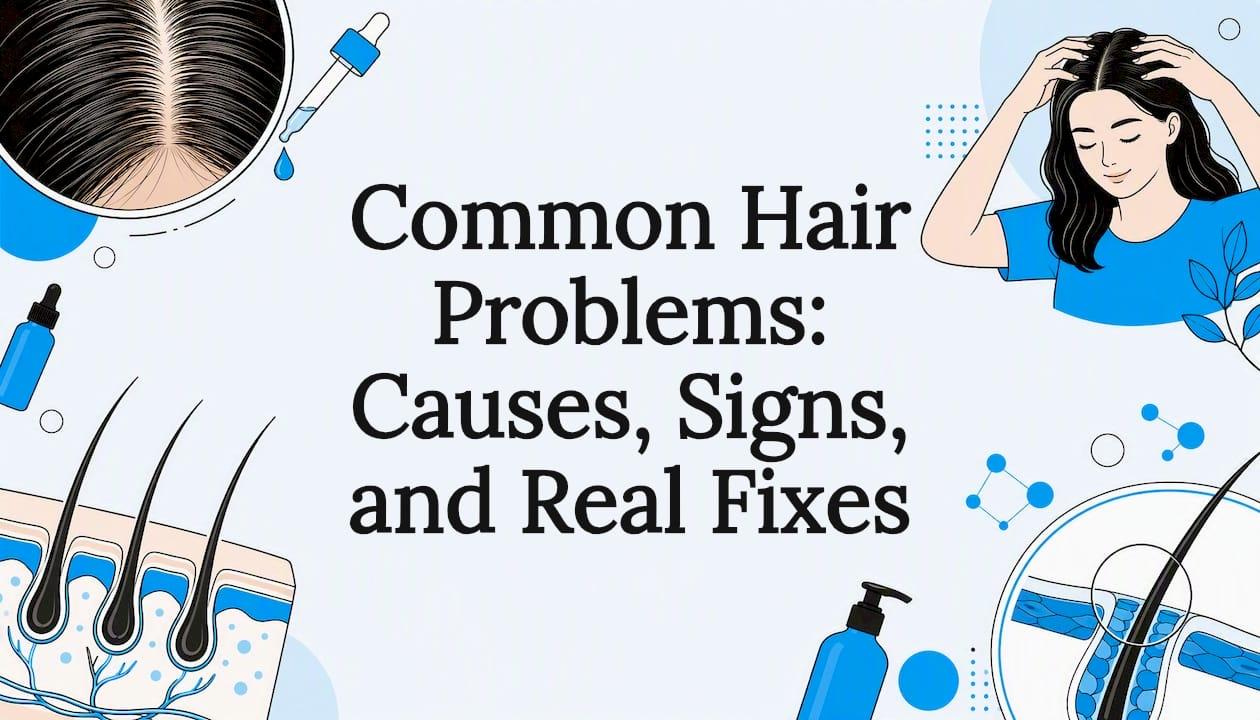
The most common hair and scalp problems are hair loss (including androgenetic alopecia and telogen effluvium), dandruff and seborrheic dermatitis, dry and brittle hair, frizz and flyaways, split ends and breakage, heat and chemical damage, oily scalp, scalp infections and infestations, folliculitis, traction alopecia, thinning and miniaturization, and texture or shine loss. According to MedlinePlus, losing a moderate amount of hairs daily is normal. Anything beyond that range, especially if it comes with patchy loss, scalp pain, or sudden onset, deserves a closer look.
Here is the full list of common hair problems covered below:
- Androgenetic alopecia (pattern hair loss)
- Telogen effluvium (stress/illness shedding)
- Alopecia areata (autoimmune patchy loss)
- Dandruff vs. seborrheic dermatitis
- Dry and brittle hair
- Frizz and flyaways
- Split ends and breakage
- Heat and chemical damage
- Oily or greasy scalp
- Scalp infections and infestations (tinea capitis, lice)
- Folliculitis
- Traction alopecia
- Slow growth, thinning, and miniaturization
- Loss of shine and texture changes
Key Takeaways
Most hair and scalp problems fall into a handful of identifiable categories, and matching the right fix to the right cause is what separates effective care from wasted effort.
| Point | Details |
|---|---|
| Normal shedding baseline | Losing 50–100 hairs per day is normal; consistent loss above that range warrants evaluation. |
| Shedding vs. breakage vs. miniaturization | Check for a white bulb (shedding), mid-shaft snapping (breakage), or tapering diameter (miniaturization) to direct your next step. |
| Red flags requiring a dermatologist | Sudden heavy shedding, painful or inflamed scalp, scaly patches, and rapid pattern loss all need professional evaluation. |
| Scalp health first | Medicated shampoos for dandruff and seborrheic dermatitis often improve hair quality faster than cosmetic conditioners alone. |
| Myhair for personalized tracking | Myhair's AI scan analysis tracks hair changes over time and delivers tailored product recommendations as a non-diagnostic next step. |
Table of Contents
- The complete list of common hair problems: causes, signs, and fixes
- How to tell shedding, breakage, and miniaturization apart
- Everyday prevention: what to do (and stop doing) for healthier hair
- Why diagnosis matters more than the shampoo you choose
- Personalized hair analysis, without the guesswork
- Sources
- FAQ
The complete list of common hair problems: causes, signs, and fixes
1. Androgenetic alopecia (pattern hair loss)
What it is: Gradual, genetically driven thinning that follows a predictable pattern, a receding hairline and crown thinning in men, and diffuse thinning at the part in women.
Causes: Genetics plus the hormone dihydrotestosterone (DHT), which shrinks follicles over time. Androgenetic alopecia is the most common cause of permanent hair thinning, and early recognition changes both treatment options and long-term prognosis.
Key signs: Widening part, visible scalp at the crown, temples receding, hair that looks thinner in photos over time.
Scalp massage may support circulation, though evidence is limited.
When to see a doctor: If thinning progresses quickly or you are under 30, a dermatologist can confirm the diagnosis with trichoscopy and discuss prescription options like finasteride or low-level laser therapy. See Myhair's guide to androgenetic alopecia treatment for a breakdown of current options.
Finasteride is FDA-indicated for men only. Women who are or may become pregnant must not handle crushed or broken finasteride tablets, due to the risk of harm to a male fetus. It can also cause sexual side effects (reduced libido, erectile dysfunction) in a minority of men, which usually resolve after stopping treatment. Discuss these risks with a physician before starting.
2. Telogen effluvium
What it is: A temporary, diffuse shed triggered when a large proportion of follicles shift into the resting (telogen) phase at once.
Causes: Physical or emotional stress, illness (including post-viral recovery), crash dieting, surgery, childbirth, or sudden hormonal shifts. The shed typically appears 2–3 months after the trigger.
Key signs: Handfuls of hair on the pillow or in the shower drain, diffuse thinning across the scalp rather than a defined pattern, no scalp inflammation.
At-home fixes: Address the root trigger first. Eat adequate protein and iron, reduce chronic stress, and give it time. Most cases resolve within 6 months once the trigger is gone.
When to see a doctor: If shedding is heavy and persists beyond 6 months, bloodwork for iron, ferritin, and thyroid function is the standard first step. Identifying the root cause is what changes the treatment path, not switching shampoos.
3. Alopecia areata
What it is: An autoimmune condition where the immune system attacks hair follicles, producing smooth, coin-shaped bald patches.
Causes: Autoimmune dysregulation, often with a genetic component. Stress may trigger flares but is not the sole cause.
Key signs: Sudden round or oval patches of complete hair loss, sometimes with exclamation-mark hairs (short, tapered strands) at the patch border. Nails may show pitting.
At-home fixes: None proven. Avoid picking at patches or using harsh products on affected areas.
When to see a doctor: Promptly. A dermatologist can confirm with a pull test or biopsy and prescribe topical or injected corticosteroids, or newer JAK inhibitors for extensive cases.
4. Dandruff vs. seborrheic dermatitis
What it is: Dandruff is mild, non-inflammatory flaking of the scalp. Seborrheic dermatitis is a more inflamed version, with greasy yellow or white scales, redness, and sometimes itching that extends to the eyebrows, ears, or sides of the nose.
Causes: Both involve an overgrowth of Malassezia yeast on the scalp, but seborrheic dermatitis also involves an inflammatory skin response. Stress, cold weather, and oily skin worsen both. Scalp conditions like seborrheic dermatitis can directly affect hair quality, and treating the scalp itself, not just the hair, is often necessary.
Key signs: Dandruff produces dry, white flakes; seborrheic dermatitis produces oilier, yellowish scales with visible redness.
At-home fixes: Zinc pyrithione, selenium sulfide, or ketoconazole shampoos used 2–3 times per week. Rotate between two formulas to prevent resistance.
When to see a doctor: If OTC antifungal shampoos fail after 4 weeks, or if the redness and scaling spread significantly.
5. Dry and brittle hair
What it is: Hair that lacks moisture or structural integrity, snapping easily and feeling rough or straw-like.
Causes: Low-porosity hair that repels moisture, over-washing, harsh sulfate shampoos, low humidity, nutritional deficiencies (especially biotin, zinc, and essential fatty acids), and heat styling.
Key signs: Hair that tangles easily, feels rough even after conditioning, and breaks mid-shaft rather than at the root.
At-home fixes: Switch to a sulfate-free shampoo, use a deep conditioner weekly, and apply a leave-in with humectants like glycerin or hyaluronic acid. For high-porosity hair (damaged or chemically treated), seal moisture with a heavier oil like castor or argan oil after conditioning.
When to see a doctor: If dryness is sudden and accompanied by fatigue or weight changes, thyroid testing is worth requesting.
6. Frizz and flyaways
What it is: Hair strands that lift away from the main body of the hair, creating a halo of unruly texture.

Causes: Humidity causes the hair shaft to absorb water unevenly, swelling the cuticle. Damaged or high-porosity hair is far more susceptible because the cuticle is already raised.
Key signs: Frizz worsens in humid weather or after towel-drying aggressively.
At-home fixes: Use a microfiber towel or a cotton T-shirt to blot (not rub) hair dry. Apply a frizz-control serum or cream with silicones or plant-based smoothers while hair is still damp. Sleeping on a satin pillowcase reduces overnight friction significantly.
7. Split ends and breakage
What it is: Split ends occur when the protective cuticle wears away at the tip, allowing the cortex to fray. Breakage is mid-shaft snapping, usually from mechanical or chemical stress.
Causes: Heat styling opens the cuticle and strips moisture, which is a primary driver of both split ends and breakage. Tight elastics, rough brushing, and repeated chemical services compound the damage.
Key signs: Visible Y-shaped or frayed tips, hair that snaps when you stretch a strand gently, and shorter pieces mixed in with longer hair after washing.
At-home fixes: Trim every 8–12 weeks. Use a wide-tooth comb on wet hair, starting at the ends and working up. Protein treatments (keratin masks, rice water rinses) can temporarily reinforce the shaft. See Myhair's breakdown of hair breakage causes for product-level guidance.
When to see a doctor: Breakage alone rarely requires a dermatologist, but if it coincides with scalp symptoms or sudden diffuse thinning, get evaluated.
8. Heat and chemical damage
What it is: Structural damage to the hair shaft from repeated thermal styling (flat irons, curling wands, blow dryers) or chemical processes (bleaching, relaxers, perms).
Causes: Temperatures above 300°F begin to degrade the keratin protein structure. Bleaching raises the pH of the hair dramatically, breaking disulfide bonds and leaving the shaft porous and fragile. Relaxers work similarly.
Key signs: Hair that feels gummy when wet, loses curl pattern, breaks at the point of chemical application, or has a distinctly different texture at the line between treated and new growth.
At-home fixes: Use a heat-protectant spray rated for your styling temperature before any heat tool. Space chemical services at least 8–10 weeks apart. Bond-building treatments (products containing bis-aminopropyl diglycol dimaleate, such as Olaplex No. 3) can partially restore broken disulfide bonds between services.
When to see a doctor: Scalp burns from chemical services need prompt medical attention. Persistent scalp soreness or hair loss at chemical application sites warrants a dermatology visit.
9. Oily or greasy scalp
What it is: Excess sebum production that leaves hair looking flat, greasy, and unwashed within a day or two of shampooing.
Causes: Genetics, hormonal fluctuations (androgens stimulate sebaceous glands), over-conditioning the scalp, and paradoxically, over-washing, which strips oil and triggers a rebound response.
Key signs: Hair that looks wet or flat at the roots hours after washing, scalp odor, and product buildup.
At-home fixes: Wash every 1–2 days with a clarifying or balancing shampoo. Apply conditioner only from mid-shaft to ends. A scalp scrub with salicylic acid once a week removes buildup without over-stripping.
10. Scalp infections and infestations
What it is: Tinea capitis is a fungal infection of the scalp caused by dermatophytes, common in children but possible at any age. Head lice (Pediculus humanus capitis) are parasitic insects that cause intense itching. Both require a different treatment approach than cosmetic care.
Causes: Tinea capitis spreads through direct contact or shared combs, hats, and pillows. Lice spread through head-to-head contact.
Key signs: Tinea capitis: scaly, circular patches with broken-off hairs, sometimes with swollen lymph nodes. Lice: intense itching, visible nits (eggs) attached to hair shafts close to the scalp.
Tinea capitis requires prescription oral antifungals (griseofulvin or terbinafine); topical treatments alone are insufficient.
When to see a doctor: Any suspected tinea capitis needs a dermatologist or pediatrician for oral antifungal prescribing.
11. Folliculitis
What it is: Inflammation or infection of the hair follicle, producing red, pimple-like bumps on the scalp or body.
Causes: Bacterial (Staphylococcus aureus most often), fungal, or from physical irritation (tight helmets, occlusive products, shaving). Hot tub folliculitis is caused by Pseudomonas aeruginosa.
Key signs: Clusters of red or white-headed bumps around follicles, tenderness, and sometimes crusting.
At-home fixes: Gentle antibacterial cleansing, avoiding occlusive styling products on affected areas, and keeping the scalp dry. Mild cases often resolve on their own.
When to see a doctor: Spreading, painful, or recurring folliculitis needs a culture and possibly topical or oral antibiotics.
12. Traction alopecia
What it is: Hair loss caused by chronic tension on the follicle from tight hairstyles.
Causes: Tight braids, weaves, high ponytails, and extensions worn repeatedly over months or years. Traction alopecia is preventable and often reversible if the tension is removed early; prolonged tension can cause permanent scarring.
Key signs: Thinning along the hairline (especially at the temples and nape), small broken hairs, and sometimes scalp tenderness or follicular bumps where tension is greatest.
At-home fixes: Immediately switch to looser styles. Give the hairline a break from any tension for at least 3–6 months. Scalp massage may support recovery.
When to see a doctor: If the hairline does not recover within 6 months of releasing tension, or if the scalp shows scarring, a dermatologist can assess whether the damage is reversible.
13. Slow growth, thinning, and miniaturization
What it is: Miniaturization is a decrease in hair shaft diameter, the key diagnostic sign of androgenetic thinning, and is distinct from increased shedding or breakage. Slow growth may also reflect nutritional gaps or scalp conditions that impair the follicle environment.
Causes: Androgenetic alopecia (DHT-driven follicle shrinkage), iron deficiency, hypothyroidism, protein malnutrition, and chronic scalp inflammation.
Key signs: Hair that feels finer than it used to, a part that looks wider in photos, and scalp that becomes more visible over time even without obvious shedding.
At-home fixes: Address nutrition first. Adequate protein (at least 0.8 g per kg of body weight daily), iron, and zinc support the hair growth cycle. Minoxidil is the most studied topical option for miniaturization.
When to see a doctor: Bloodwork for ferritin, thyroid-stimulating hormone (TSH), and complete blood count is the standard starting point for unexplained thinning.
14. Loss of shine and texture changes
What it is: Hair that has lost its natural luster, feels rough, or has changed in curl pattern or density without obvious shedding.
Causes: Cuticle damage from heat or chemicals, hard water mineral buildup, product residue, hormonal changes (menopause, postpartum), and aging-related changes in sebum production.
Key signs: Hair that looks dull even when clean, curl pattern that has loosened or tightened unexpectedly, and a rough feel when running fingers down the shaft.
At-home fixes: A clarifying shampoo once a month removes mineral and product buildup. A weekly gloss treatment or acidic rinse (diluted apple cider vinegar) can temporarily smooth the cuticle. For hard water, a shower filter is a practical investment.
Quick-reference summary
| Problem | Key sign | Everyday fix | When to see a pro |
|---|---|---|---|
| Androgenetic alopecia | Widening part, crown thinning | Topical minoxidil | Rapid progression, under 30 |
| Telogen effluvium | Diffuse shed, no pattern | Fix trigger (diet, stress) | Persists beyond 6 months |
| Alopecia areata | Round bald patches | None proven | Immediately |
| Dandruff / seb. derm. | Flakes, oily scales | Antifungal shampoo | OTC fails after 4 weeks |
| Dry/brittle hair | Snaps mid-shaft | Deep conditioner, sulfate-free wash | Sudden onset with fatigue |
| Frizz/flyaways | Halo of lifted strands | Microfiber towel, frizz serum | Rarely needed |
| Split ends/breakage | Y-shaped tips, short snapped pieces | Trim, protein mask | With scalp symptoms |
| Heat/chemical damage | Gummy when wet, texture change | Heat protectant, bond builder | Scalp burns, persistent loss |
| Oily scalp | Flat, greasy roots within hours | Clarifying shampoo, scalp scrub | Rarely needed |
| Tinea capitis / lice | Scaly patches, intense itch | Permethrin (lice); see doctor (tinea) | Tinea capitis always |
| Folliculitis | Red bumps around follicles | Antibacterial cleanser | Spreading or recurring |
| Traction alopecia | Temple/nape hairline thinning | Loosen styles immediately | No recovery after 6 months |
| Miniaturization/thinning | Finer strands, wider part | Protein, iron, minoxidil | Bloodwork for ferritin/TSH |
| Shine/texture loss | Dull, rough, changed curl | Clarifying wash, gloss treatment | Hormonal change suspected |
How to tell shedding, breakage, and miniaturization apart
These three look similar in the mirror but have completely different causes and fixes. Getting the distinction right saves months of using the wrong products.
Three quick checks you can do right now:
- Root check: Pull a few shed hairs from your brush or shower drain. If you see a small white bulb at the end, that is a shed hair (telogen effluvium or normal shedding). No bulb means the strand broke mid-shaft.
- Diameter check: Hold a shed strand between your fingers. If it tapers noticeably toward the scalp end, that is miniaturization. A uniform, thin strand that snaps easily is breakage.
- Part-width photo: Take a photo of your part in consistent lighting today. Compare it to a photo from 6–12 months ago. A widening part over time points to miniaturization or pattern loss, not breakage.
Step-by-step self-check routine:
- Do the pull test: gently grasp 40–60 hairs near the scalp and pull slowly. Losing more than 6 hairs is a positive result and warrants evaluation.
- Inspect strand diameter by holding a shed hair next to a new growth hair from the same area.
- Count wash-day shed hairs for two consecutive washes and note whether the number is consistently above 100.
- Photograph your part and crown every 4 weeks under the same lighting and at the same distance.
- Track frequency: is the shedding getting worse, stable, or improving?
What a dermatologist will typically do: A scalp exam, pull test, and trichoscopy (dermoscopy of the scalp) are standard first steps. Bloodwork for ferritin, TSH, and a complete blood count follows for diffuse shedding. A scalp culture or biopsy is added when infection or scarring alopecia is suspected. Many scalp symptoms overlap, so careful symptom mapping and, when needed, scalp sampling clarifies the diagnosis.
Red flags that need a dermatology referral:
- Sudden heavy shedding (more than 200 hairs per day) lasting more than 2 weeks
- Painful, tender, or inflamed scalp
- Scaly, crusted, or oozing patches
- Rapid pattern loss over weeks rather than months
- Bald patches that appear overnight
Pro Tip: For reliable tracking, photograph your part and crown in the same spot every 4 weeks. Use a window with natural light, hold the camera at the same height, and name files by date. Side-by-side comparison over 3 months is far more informative than any single snapshot.
Everyday prevention: what to do (and stop doing) for healthier hair
The most common hair care challenges are largely preventable with a consistent, low-intervention routine. Here is what actually moves the needle.
Daily and weekly checklist:
- Wash with a sulfate-free or gentle shampoo at a frequency that matches your scalp's oil production (daily for very oily scalps, every 2–3 days for normal, 1–2 times per week for dry or coily hair).
- Apply conditioner from mid-shaft to ends only, never on the scalp.
- Use a heat-protectant product before any tool above 300°F.
- Detangle with a wide-tooth comb starting at the ends, working upward.
- Trim every 8–12 weeks to prevent split ends from traveling up the shaft.
- Eat adequate protein and iron; hair follicles are among the most metabolically active structures in the body and are sensitive to nutritional shortfalls.
- Wear protective styles loosely; avoid tight elastics directly on the hairline.
Hair porosity and why it changes everything:
Porosity describes how easily your hair absorbs and retains moisture. Low-porosity hair (tightly closed cuticle) repels products and benefits from lightweight, water-based leave-ins and heat to open the cuticle during deep conditioning. High-porosity hair (raised or damaged cuticle) absorbs moisture fast but loses it just as quickly. It needs heavier sealants like shea butter or castor oil after conditioning to lock moisture in. Knowing your porosity stops you from spending money on products that work against your hair's structure.
Ingredient callouts:
- For dandruff/seborrheic dermatitis: ketoconazole, zinc pyrithione, selenium sulfide, or coal tar shampoos.
- For dryness: glycerin, hyaluronic acid (humectants), and plant oils (argan, jojoba) as sealants.
- For damage and breakage: hydrolyzed keratin, rice protein, or bond-building actives between chemical services.
- Avoid: sodium lauryl sulfate on already dry or damaged hair; repeated bleaching within 6 weeks; alcohol-heavy styling products on coily or dry textures.
Pro Tip: Lower your flat iron or curling wand to the lowest effective temperature for your hair type. Fine or color-treated hair rarely needs more than 350°F. Coarse or thick hair may need up to 400°F, but never higher. Dropping the temperature by even 50°F meaningfully reduces cumulative cuticle damage over months of daily styling.
Why diagnosis matters more than the shampoo you choose
Getting a clear diagnosis changes the treatment path more than any product swap. This is the part most hair-care content skips: the cause of your shedding might have nothing to do with your scalp. Iron-deficiency anemia and hypothyroidism are two of the most common systemic drivers of hair loss, and both are fully reversible with the right medical treatment. Treating the underlying condition often resolves the shedding entirely, while no topical product touches the root cause.
The same logic applies to scalp infections, autoimmune conditions like alopecia areata, and medication-induced shedding. A dermatologist's evaluation, including bloodwork and sometimes a scalp biopsy, is the only way to confirm which category you are in. Myhair's AI-powered hair analysis can give you a personalized picture of your hair's condition and track changes over time, but it is not a substitute for that medical workup when red flags are present.
Personalized hair analysis, without the guesswork
Myhair gives you something most hair-care resources don't: a personalized, scan-based assessment of your hair's actual condition, not a generic quiz result. Upload photos through the Myhair app, and the AI analyzes your hair and scalp to deliver growth projections, condition observations, and tailored product recommendations based on your specific patterns. It is not a medical diagnosis, and if you have red-flag symptoms (sudden patchy loss, scalp pain, or rapid thinning), a dermatologist visit comes first. But for readers who want to track changes over time, understand their hair's baseline, and get product guidance that actually fits their situation, Myhair is a practical, low-friction next step. Start your assessment at Myhair.
Sources
- Hair loss - Symptoms and causes - Mayo Clinic
- Hair Loss: Causes, Treatments and Prevention Options - Cleveland Clinic
- Hair loss: MedlinePlus Medical Encyclopedia
- Scalp problems - WebMD
- 5 Types of Damaged Hair and How to Treat Them | Allure
- PMC article: (see source) - PubMed Central
FAQ
What are the most common hair problems?
The most common hair problems are androgenetic alopecia (pattern hair loss), dandruff and seborrheic dermatitis, dry and brittle hair, split ends and breakage, and oily scalp. Telogen effluvium (stress-related shedding) and heat damage are also among the most frequently reported concerns.
What is the most common hair disorder?
Androgenetic alopecia is the most common hair disorder, affecting both men and women. It is the leading cause of permanent hair thinning and is driven by genetics and the hormone DHT.
How do I know if I'm losing too much hair?
Losing 50–100 hairs per day is within the normal range. If you are consistently losing more than that, seeing patchy bald spots, or noticing a rapidly widening part, those are signs worth discussing with a dermatologist.
What are the five common hair diseases?
The five most clinically recognized hair and scalp diseases are androgenetic alopecia, alopecia areata, telogen effluvium, tinea capitis, and seborrheic dermatitis. Each has a distinct cause and requires a different treatment approach.
How do I identify my specific hair issue?
Start with the root check: pull a few shed hairs and look for a white bulb (shedding), no bulb (breakage), or a tapering shaft (miniaturization). If symptoms include scalp pain, patches, or rapid loss, see a dermatologist for a pull test, trichoscopy, or bloodwork.