TL;DR:
- Shedding up to 100 hairs daily is normal; more indicates a potential problem.
- Consistent photo and AI tracking help monitor hair loss trends objectively.
- Proven treatments like minoxidil and finasteride are the most effective for hair regrowth.
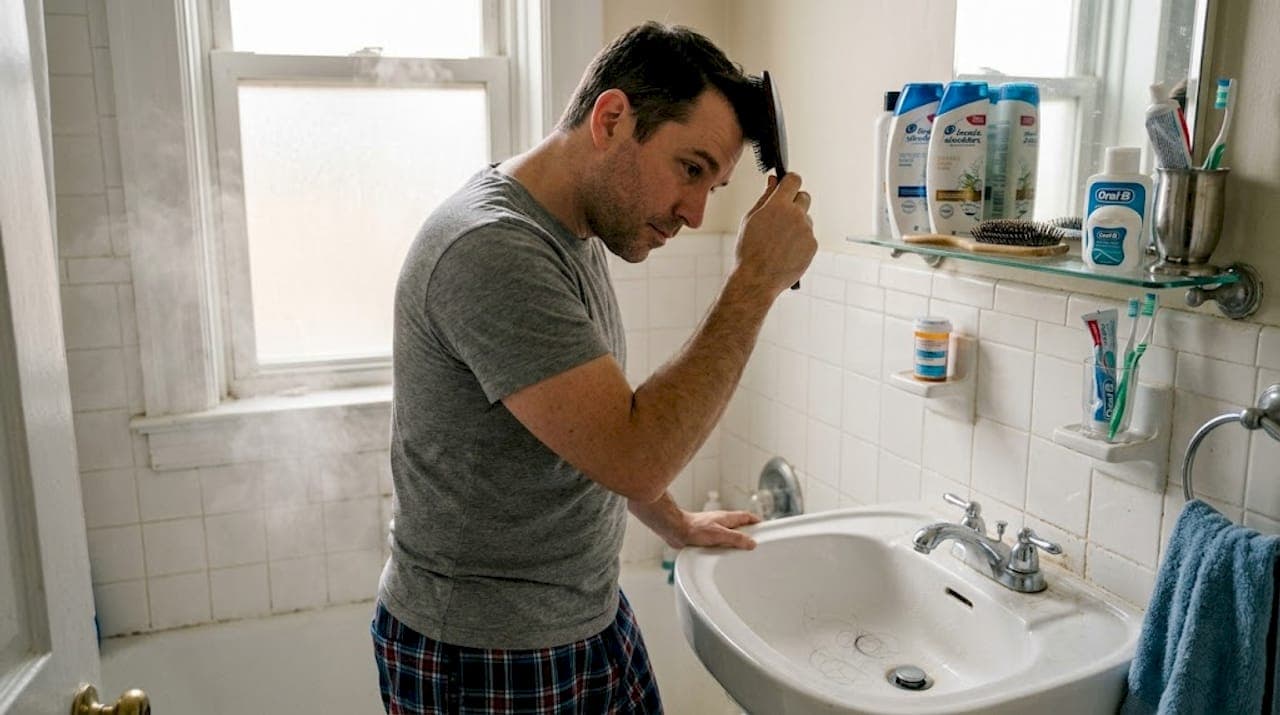
Noticing hair on your pillow or clogging the shower drain is enough to send most people into a panic. But here's what most people get wrong: shedding is a built-in part of how your hair works. Up to 100 hairs lost per day is completely physiological, meaning your body is doing exactly what it should. The real question is knowing where ordinary ends and a genuine problem begins. Once you understand that line, you can stop guessing and start making real, measurable progress using the right tools and treatments.
Table of Contents
- Understanding ordinary hair loss: What's normal and what's not
- Personalized tracking: Monitoring your hair loss with technology
- Evidence-based treatments for ordinary hair loss
- Building a tailored hair health routine for lasting improvement
- Why hair tracking beats 'just trust the process'
- Take the next step: Personalized hair solutions with MyHair
- Frequently asked questions
Key Takeaways
| Point | Details |
|---|---|
| Normal hair loss explained | Losing up to 100 hairs daily is ordinary and typically not a cause for concern. |
| Track for personal insight | Using consistent photos or AI tools helps you accurately monitor your own progress. |
| Combination treatments are best | The minoxidil-finasteride combo delivers superior regrowth compared to using either alone. |
| Tailored routines boost results | Personalizing products and routines improves long-term hair health and motivation. |
| Visible measurement fuels adherence | Tracking your improvement makes it easier to stick with effective solutions. |
Understanding ordinary hair loss: What's normal and what's not
Your hair does not grow continuously. It cycles through three phases: anagen (active growth, lasting 2 to 7 years), catagen (a short transitional phase of about 2 weeks), and telogen (a resting phase of roughly 3 months before the hair sheds). At any given moment, around 85 to 90 percent of your hairs are in anagen, which means only a small fraction are ready to fall out. That shedding is what you see in your brush.
The important benchmark: losing up to 100 hairs per day is considered ordinary. Anything above that, paired with visible thinning or a positive pull test (grasping 60 hairs and pulling gently, with more than 6 hairs coming out as a warning sign), signals it's time for a closer look.
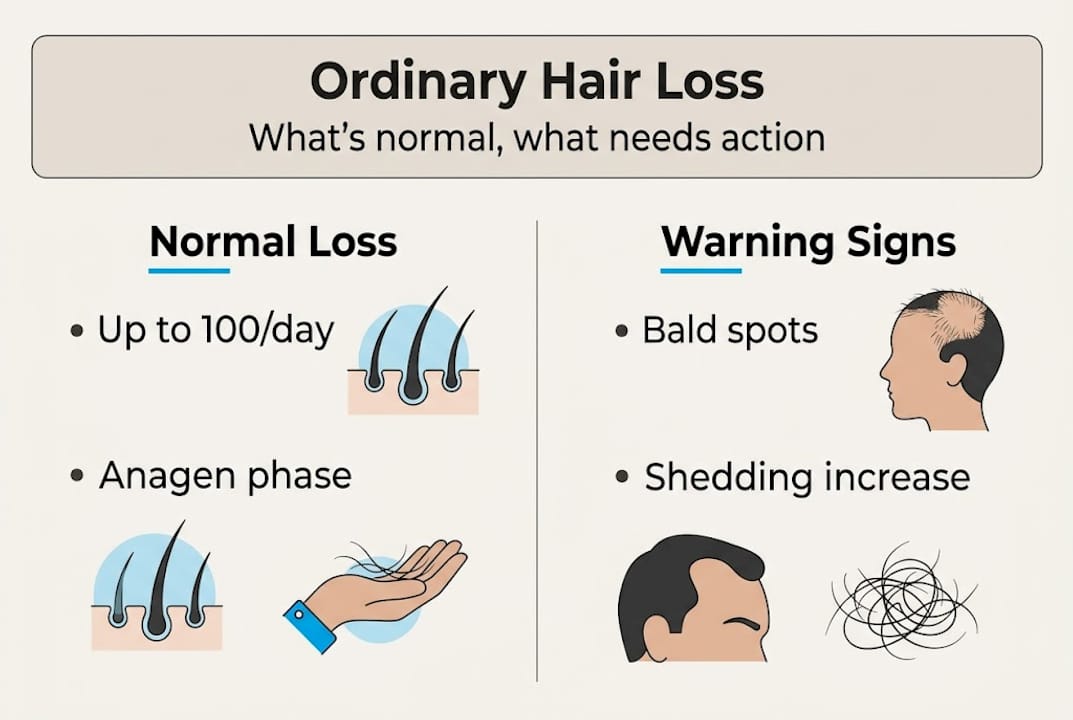
| Factor | Ordinary loss | Abnormal loss |
|---|---|---|
| Daily shed count | Up to 100 hairs | More than 100 hairs |
| Scalp visibility | Not noticeable | Visible thinning patches |
| Pull test result | Fewer than 6 hairs | 6 or more hairs |
| Hairline change | Stable | Receding or widening part |
| Duration | Temporary or cyclical | Persistent, 3+ months |
Several factors naturally affect how much you shed on any given day:
- Age: Shedding increases gradually after your 30s
- Genetics: Your family history shapes your baseline loss rate
- Styling habits: Heat, tight styles, and chemical treatments stress follicles
- Seasonality: Many people notice more shedding in late summer and fall
- Hormonal changes: Pregnancy, postpartum, and thyroid shifts all cause spikes
'Visible thinning or a positive pull test signals a need for further evaluation.'
Understanding your personal baseline is the first step. Fortunately, AI-powered hair solutions now make it possible to go beyond guesswork and get real data about your scalp and follicle health.
Personalized tracking: Monitoring your hair loss with technology
Knowing that up to 100 hairs per day is normal does not tell you whether your 80 hairs today is trending toward 120 next month. That is where tracking becomes your biggest advantage. Consistent, repeatable measurement turns a vague worry into actionable information.
Here's a simple step-by-step system for setting up a photo tracking routine:
- Choose a fixed location with natural light, ideally near a window at the same time of day
- Use the same angle every time: top-down for crown coverage, front-facing for hairline, and side-profile for temples
- Take photos on the same day each week, not daily (daily variation adds noise, not signal)
- Store photos in a dedicated folder with dates clearly labeled so comparison is effortless
- Compare monthly, not weekly, to see trends that matter rather than day-to-day fluctuation
Manual photo tracking works, but AI tools take it further. They analyze pixel-level density, detect subtle changes in coverage, and flag patterns you would miss with the naked eye. Personalized hair loss tracking platforms use these algorithms to give you a score over time, not just a static snapshot.

The motivational benefit is real too. When you can see a measurable improvement between month two and month four, you keep going. Without data, most people quit early because hair regrowth is slow and hard to perceive in a mirror. Studies confirm that consistent photo and AI tracking improves personalization and long-term adherence to treatment plans. Comparing top hair growth trackers can help you find the right fit for your lifestyle and budget.
Pro Tip: Always photograph in the same lighting conditions and from the same distance. Even small changes in angle can make healthy hair look thinner. If you use an AI hair loss treatment app, follow its guided capture feature to eliminate that variability automatically.
Evidence-based treatments for ordinary hair loss
Not all treatments are created equal. The internet is full of serums, supplements, and scalp massages that promise growth but deliver little. Here is what the science actually supports.
The two FDA-approved frontrunners are minoxidil (a topical vasodilator that prolongs the anagen phase) and finasteride (an oral 5-alpha-reductase inhibitor that blocks DHT, the hormone that shrinks follicles). More recently, dutasteride has emerged as a stronger alternative in the same drug class, blocking more DHT.
| Treatment | Mechanism | Efficacy | Main side effect risk |
|---|---|---|---|
| Topical minoxidil (5%) | Extends anagen phase | Moderate hair density increase | Scalp irritation, initial shed |
| Oral finasteride (1mg) | Blocks DHT production | Significant density improvement | Sexual side effects (rare) |
| Topical finasteride | Local DHT suppression | Similar to oral, lower systemic risk | Minimal |
| Dutasteride | Blocks both DHT isoforms | Highest density gains | Higher systemic risk |
| Combo: minoxidil + finasteride | Dual mechanism | 9.22 hairs/cm² more than minoxidil alone | Combined risks, manageable |
The combination approach is where the real gains happen. Research shows that minoxidil plus finasteride outperforms either therapy alone, with hair diameter improvements of +2.26μm and an odds ratio of 3.29 for marked photographic improvement. Dutasteride leads for raw density gains but carries a higher side effect profile.
Pro Tip: Early combination therapy often brings faster, better results. The longer follicles are miniaturized, the harder regrowth becomes. Starting smart from the beginning beats playing catch-up a year later.
Avoid relying on shampoos or home cures as your primary treatment. They may support scalp health, but they do not replicate the follicle-level activity of clinically proven drugs. An AI-powered hair growth therapy plan can help match you to the right protocol based on your specific loss pattern. Tailored hair loss shampoos work best as a complement, not a standalone fix.
Building a tailored hair health routine for lasting improvement
There is no single routine that works for everyone. Your loss pattern, lifestyle, tolerance for side effects, and budget all shape what the right plan looks like for you.
Start by deciding between topical and oral options. Topical treatments minimize systemic exposure, making them a lower-risk entry point. If topical minoxidil irritates your scalp, a foam formulation is often gentler. Adding a topical finasteride option lets you access DHT-blocking benefits without the systemic load of oral pills.
Consistency matters more than perfection. A regimen you maintain 90 percent of the time beats an aggressive protocol you abandon after 6 weeks. Tailored product combinations paired with consistent tracking produce the strongest long-term regrowth outcomes.
Here are the habits that quietly power up your results:
- Sleep 7 to 9 hours: Growth hormone peaks during deep sleep, directly supporting follicle repair
- Eat enough protein: Hair is almost entirely keratin, a protein; deficiency starves follicles
- Manage stress actively: Chronic stress elevates cortisol, which can push follicles into telogen prematurely
- Style gently: Tight ponytails and heat tools cause traction and thermal damage over time
- Stay hydrated: Scalp circulation depends on adequate hydration
Revisit your routine every 3 to 6 months. If you are not seeing any change by month 4, it is time to reassess your product selection or dosage with a professional. Personalized hair care platforms that use AI can flag these plateaus for you automatically, turning guesswork into guided decisions.
Why hair tracking beats 'just trust the process'
Most people give up on hair loss treatment somewhere between month two and month four. Not because the treatment isn't working, but because they cannot see it working. Hair grows roughly half an inch per month. Density changes are nearly invisible to the eye without a baseline to compare against.
Here is the truth most hair advice skips: motivation is a byproduct of visible evidence. When you see your own data trending upward, even slightly, your brain registers progress. That keeps you consistent. Without it, the process feels like faith in something invisible.
'Visible measurement is the highest form of motivation for meaningful hair regrowth.'
Data-driven hair care using AI does something deeply practical: it removes the subjectivity. You stop asking 'do I look better?' and start reading 'density score up 8 percent in 90 days.' That shift from hope to evidence changes everything about how you approach the routine. Trusting the process works best when you can actually see the process moving.
Take the next step: Personalized hair solutions with MyHair
You now have a clear picture of what ordinary hair loss looks like, how to track it accurately, and which treatments actually work. The next move is putting that knowledge into a system that works specifically for you.
MyHair.ai brings together AI hair analysis, personalized tracking, and seamless clinic onboarding in one platform. Upload a scan, get a detailed assessment of your scalp and follicle health, and receive product recommendations built around your unique pattern. The hair analysis onboarding process takes minutes and gives you a data baseline to measure real progress against. Stop guessing. Start tracking. Your hair health journey gets a whole lot clearer when the right tools are in your hands.
Frequently asked questions
How much daily hair loss is considered normal?
Losing up to 100 hairs per day is typical and considered normal for most people. Anything above that, especially with visible thinning, is worth evaluating.
Is early treatment more effective for hair regrowth?
Yes. Starting evidence-based treatments early, before follicles miniaturize significantly, produces better results. The minoxidil plus finasteride combo increases hair density by 9.22 hairs/cm² compared to minoxidil used alone.
What is the safest way to track my hair loss at home?
The most reliable method is a consistent photo routine taken in the same lighting, angle, and conditions each week, ideally supported by an AI-powered tracking app for objective measurement.
Can drugstore shampoos or DIY remedies reverse ordinary hair loss?
Unlikely. Only clinically proven treatments like minoxidil and finasteride deliver real, measurable results. Research confirms the minoxidil and finasteride combination far outperforms monotherapy, with hair diameter gains of +2.26μm. Most shampoos and home remedies do not reach the follicle level where change actually happens.