TL;DR:
- Moroccan oil supports scalp health and reduces inflammation but does not directly stimulate hair regrowth.
- Consistent use and personalized routines enhance its benefits for dryness, breakage, and scalp conditions.
- Combining Moroccan oil with AI analysis and other treatments creates a tailored strategy for hair health.
Hair loss pushes people toward every promising remedy they can find, and natural oils sit near the top of that list. Moroccan oil, the golden extract pressed from Moroccan argan tree kernels, has built a devoted following, but separating genuine benefit from marketing hype is harder than it looks. Preclinical studies show antioxidants in argan oil can support scalp health, giving real weight to its reputation. This guide walks you through what the science actually says, what results you can realistically expect, and how to build Moroccan oil into a routine that delivers.
Table of Contents
- The science behind Moroccan oil and hair loss
- Realistic expectations: What Moroccan oil can and can't do
- How to use Moroccan oil for optimal hair health
- Integrating Moroccan oil with personalized and AI-powered hair loss strategies
- Why Moroccan oil alone isn't enough: An expert perspective
- Get expert, AI-powered support for your hair loss journey
- Frequently asked questions
Key Takeaways
| Point | Details |
|---|---|
| Moroccan oil’s key benefits | Its antioxidants and fatty acids help nourish the scalp and reduce dryness. |
| Realistic hair loss results | Moroccan oil supports scalp health but does not regrow hair overnight. |
| Personalized routines boost results | Pairing Moroccan oil with tailored, AI-driven care increases effectiveness for hair loss. |
| Consistent use is essential | Regular application and integration into a holistic routine yield the best outcomes. |
The science behind Moroccan oil and hair loss
Moroccan oil is simply another name for argan oil, cold pressed from the nuts of the Argania spinosa tree native to Morocco. The name became popular in the beauty industry, but the ingredient itself is the same prized botanical oil Moroccan women have used for centuries to protect skin and hair from harsh desert conditions.
What makes it interesting for hair health is its nutrient profile. Argan oil is dense with vitamin E (tocopherols), polyphenols, oleic acid, and linoleic acid. These compounds work at a cellular level to calm inflammation and neutralize free radicals, two forces that can disrupt the scalp environment where healthy hair follicles live.
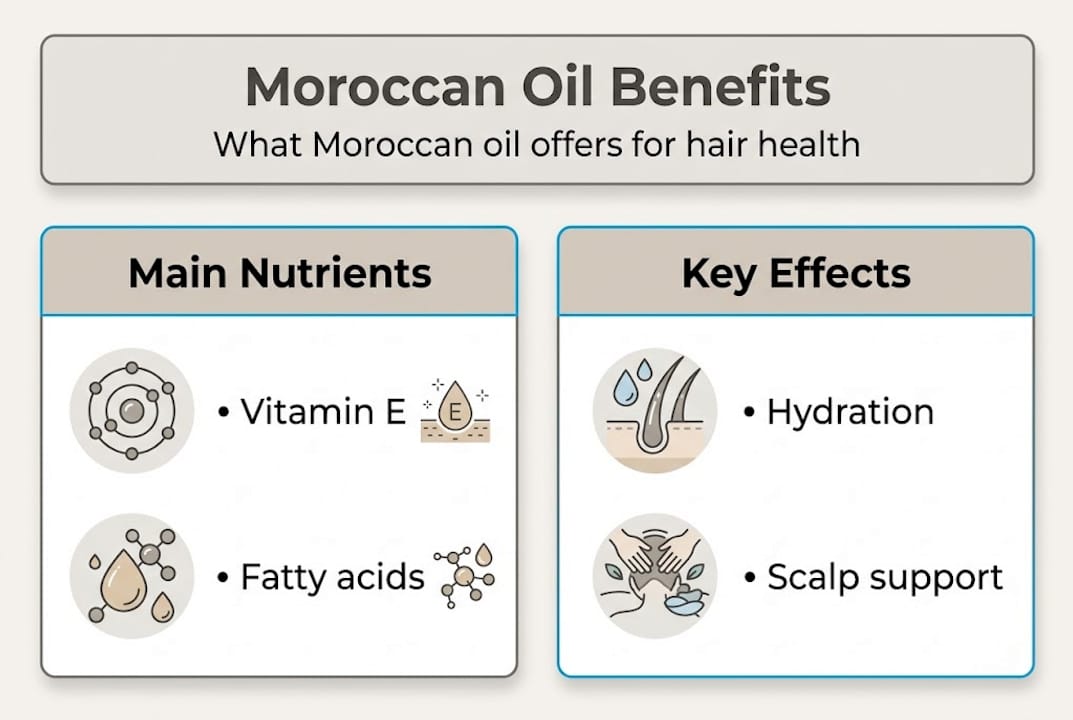
| Compound | Function | Benefit for hair/scalp |
|---|---|---|
| Vitamin E | Antioxidant | Reduces oxidative damage |
| Polyphenols | Anti-inflammatory | Calms scalp irritation |
| Oleic acid | Fatty acid | Penetrates hair shaft, adds moisture |
| Linoleic acid | Fatty acid | Supports scalp barrier function |
| Squalene | Emollient | Smooths cuticle, reduces frizz |
The research picture is nuanced. Argan oil's antioxidants modulate oxidative stress and inflammation, both of which are linked to scalp conditions that can worsen hair loss. These are real, measurable effects in preclinical studies. What science has not yet delivered is a large, controlled human trial proving argan oil directly stimulates new hair growth.
"Antioxidant compounds in argan oil show meaningful activity against oxidative stress pathways relevant to scalp health, making it a compelling adjunctive ingredient even if standalone efficacy for hair regrowth remains under investigation."
That distinction matters. Exploring argan oil benefits reveals a well-documented story of improved scalp conditions, stronger strands, and better moisture retention. For a deeper breakdown, understanding argan oil hair care covers how these mechanisms translate to real-world use.
The bottom line at this stage: Moroccan oil is not a miracle regrowth serum, but it is a scientifically plausible ingredient for building a healthier scalp foundation, which is exactly where lasting hair health begins.
Realistic expectations: What Moroccan oil can and can't do
Now that the science is clear, let's talk about achievable outcomes: what can you expect from Moroccan oil in your real-world routine?
Moroccan oil genuinely excels in specific areas. It hydrates the scalp, fills gaps in the hair cuticle to reduce breakage, and creates a surface that reflects light and resists damage from heat styling. People with dry, brittle, or chemically treated hair often see noticeable improvement within a few weeks.
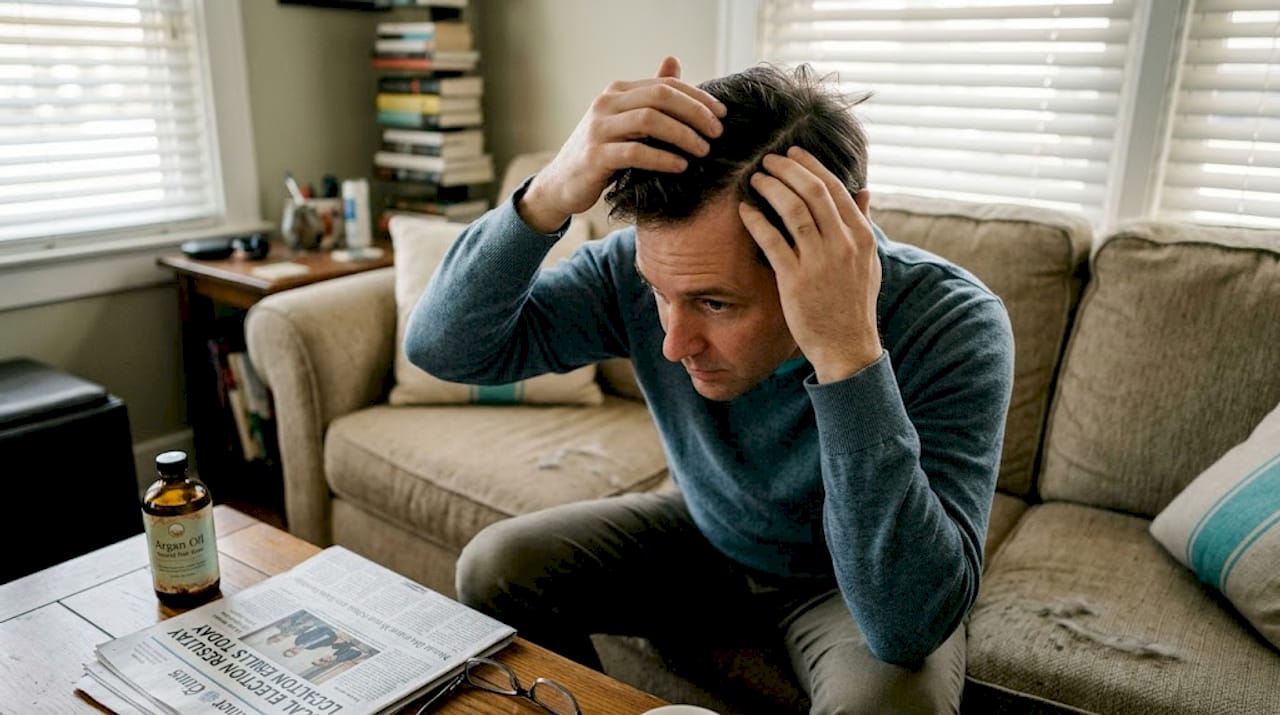
What it will not do is reverse androgenetic alopecia (pattern hair loss) on its own. Scientific research on argan oil's direct effect on hair loss is limited, and no credible study suggests it can override genetic programming or hormonal triggers. If you are looking for measurable regrowth, Moroccan oil works best as one layer of a broader strategy.
What Moroccan oil can do:
- Deeply hydrate a dry, flaky scalp
- Reduce mechanical breakage and split ends
- Calm mild scalp irritation and redness
- Add shine and improve manageability
- Create a healthier environment for existing follicles
What it cannot do:
- Replace clinically proven treatments like minoxidil or finasteride
- Reverse significant follicle miniaturization
- Produce results without consistent use and supporting habits
| Oil | Strength | Best for |
|---|---|---|
| Argan (Moroccan) | Antioxidants, light texture | All hair types, scalp health |
| Castor | Thick, ricinoleic acid | Stimulating scalp circulation |
| Coconut | Deep penetration | Protein loss prevention |
| Jojoba | Mimics sebum | Oily or sensitive scalps |
Learning about natural oils for hair loss helps you see how argan fits alongside other options rather than competing with them. Understanding hair oil for hair loss gives you a framework for choosing the right oil based on your actual condition.
Pro Tip: Results depend heavily on consistency. Using Moroccan oil twice weekly for 90 days gives you a far more accurate picture of its benefits than sporadic use over a few weeks.
How to use Moroccan oil for optimal hair health
Understanding what to expect is only half the story; here's exactly how to make Moroccan oil a productive part of your regimen.
Application technique matters more than most people realize. Pouring oil directly onto dry hair without working it into the scalp limits its reach. The follicle environment is where you actually want those anti-inflammatory compounds to land.
Step by step routine:
- Start with clean, slightly damp hair. Apply Moroccan oil after washing, when the cuticle is open and absorption is highest.
- Dispense 3 to 5 drops into your palm. Less is more. Argan oil is lightweight but concentrated.
- Warm it between your palms for 10 seconds before applying, which improves spreadability.
- Massage into the scalp first using your fingertips in small circular motions for 2 to 3 minutes. This stimulates blood flow while delivering the oil.
- Work the remainder through mid-lengths and ends to address breakage and dryness along the shaft.
- Repeat 2 to 3 times per week. Daily use can lead to buildup, particularly on fine hair.
For deeper treatment, check out this Moroccan oil hair mask approach that combines argan oil with other nourishing ingredients for a monthly intensive. If you prefer a leave-in format, a hydrating styling cream can extend moisture benefits between wash days.
Application to scalp may help modulate local inflammation and support scalp health, which is exactly why massaging the oil in rather than just coating the hair surface produces better outcomes.
For those dealing with itching or flaking, dry scalp solutions using argan oil pair well with this routine.
Pro Tip: Avoid applying Moroccan oil to soaking wet hair. Too much water on the strand dilutes absorption. Damp but not dripping is the sweet spot.
Common mistakes to avoid:
- Applying too much, which leaves hair greasy and heavy
- Concentrating only on ends while skipping the scalp
- Using heat tools immediately after heavy application without letting the oil absorb
- Expecting results after just one or two uses
Integrating Moroccan oil with personalized and AI-powered hair loss strategies
With your Moroccan oil strategy set, combining personalization and technology can elevate your results further.
No two people experience hair loss the same way. Your scalp's sebum production, your follicle density, your stress levels, and your nutritional status all interact to shape the pattern you see. A product that transforms one person's hair may do very little for another. That gap is exactly where personalization closes the loop.
AI-powered hair analysis tools can now scan your scalp and hair characteristics, identifying thinning patterns, density changes, and scalp conditions that the naked eye misses. This data informs product choices, application frequency, and whether you need to layer Moroccan oil with other targeted treatments.
Ways to integrate Moroccan oil into a personalized plan:
- Use AI scalp analysis to identify areas of thinning before and after 90 days of consistent Moroccan oil use
- Pair argan oil with biotin supplementation or a protein-rich diet if your analysis reveals structural weakness
- Combine with dermatologist-recommended treatments if your pattern loss is moderate to advanced
- Adjust frequency based on your scalp's oil production (less often for oily scalps, more often for dry)
- Track progress monthly with digital photography under the same lighting conditions
Reviewing argan treatment results from real users shows how outcomes vary based on starting conditions, reinforcing the need for a tailored approach. For a broader toolkit, proven growth strategies combine multiple natural oils with lifestyle changes for measurable improvement.
Personalized and holistic routines may offer better outcomes than one-size-fits-all solutions, which is a finding that aligns with what we see across thousands of hair health journeys. An oil chosen based on your actual scalp chemistry simply works harder than a generic recommendation.
If hair loss is severe, progressive, or sudden, professional input from a dermatologist or trichologist (a hair and scalp specialist) remains essential. Natural oils support treatment; they are not a substitute for it.
Why Moroccan oil alone isn't enough: An expert perspective
Let's step back for a grounded look at what Moroccan oil really offers and what it doesn't.
The biggest mistake we see is people using Moroccan oil as their entire hair loss plan. They buy a premium bottle, use it consistently for a few months, and feel disappointed when the mirror doesn't show a dramatic change. That disappointment is predictable, because the expectation was wrong from the start.
Moroccan oil is a supporting actor, not the lead. Its real value is creating optimal conditions. A nourished, calm scalp retains existing hair longer and responds better to active treatments. That is genuinely significant, even if it is not dramatic.
What actually transforms hair loss outcomes in 2026 is the combination: natural ingredients like argan oil working alongside AI-driven personalization, clinical treatments where appropriate, and lifestyle factors including sleep, protein intake, and stress management. Technology is now precise enough to tell you which combination fits your biology. Using that insight to guide your Moroccan oil routine, rather than applying it randomly and hoping for the best, is the difference between a supportive habit and a meaningful strategy.
Get expert, AI-powered support for your hair loss journey
Ready to move from information to action? Here's how to make Moroccan oil and advanced insights work for you.
MyHair.ai takes the guesswork out of building your routine. The platform's AI analyzes your scalp and hair characteristics to deliver recommendations matched to your specific patterns, not a generic checklist.
Start your hair analysis today to get a personalized baseline before adding Moroccan oil to your routine, so you can track real change over time. The AI-powered analysis identifies thinning zones and scalp conditions with clinical-grade precision, giving your natural care routine the data it needs to actually perform. Browse the latest hair loss research on the platform to stay current with emerging natural and clinical solutions as your journey evolves.
Frequently asked questions
Does Moroccan oil regrow hair?
Moroccan oil may improve scalp health and hair condition, but preclinical studies show limited evidence for direct hair regrowth. It works best as part of a broader, personalized hair care strategy.
How should I use Moroccan oil for hair loss?
Massage a few drops into your scalp and hair 2 to 3 times a week, since application may help modulate local inflammation and support scalp health when combined with a consistent overall routine.
Is Moroccan oil better than other oils for hair loss?
Moroccan oil contains unique antioxidants and fatty acids that offer strong hydration and scalp protection, but whether it outperforms other oils depends on your individual hair type and primary concern.
Can personalized hair care improve results with Moroccan oil?
Absolutely. Personalized and holistic routines may offer better outcomes than generic approaches, and pairing Moroccan oil with AI-driven analysis helps you apply it where your scalp needs it most.