
TL;DR:
- MSM supplies sulfur to support keratin and reduces hair shedding, but does not speed hair growth. Consistent use over 3 to 6 months enhances hair thickness and reduces breakage, especially when combined with a healthy lifestyle. It works best when integrated with other nutrients like biotin and paired with proper scalp care.
MSM (methylsulfonylmethane) is a sulfur-based compound that strengthens hair structure and reduces shedding, but does not significantly speed up the biological rate of hair growth. That distinction matters. Most people searching for MSM for hair growth expect faster length gains. What they actually get is thicker, stronger hair with less breakage. That is a real benefit, but it works through a different mechanism than most supplements promise. Understanding that difference saves you months of frustration and helps you use MSM correctly from day one.

How does MSM biochemically support hair growth?
MSM is a bioavailable source of organic sulfur. Sulfur is a structural component of keratin, the protein that makes up roughly 95% of each hair strand. Without adequate sulfur, keratin chains form weak cross-links, and hair becomes brittle and prone to snapping before it reaches visible length.
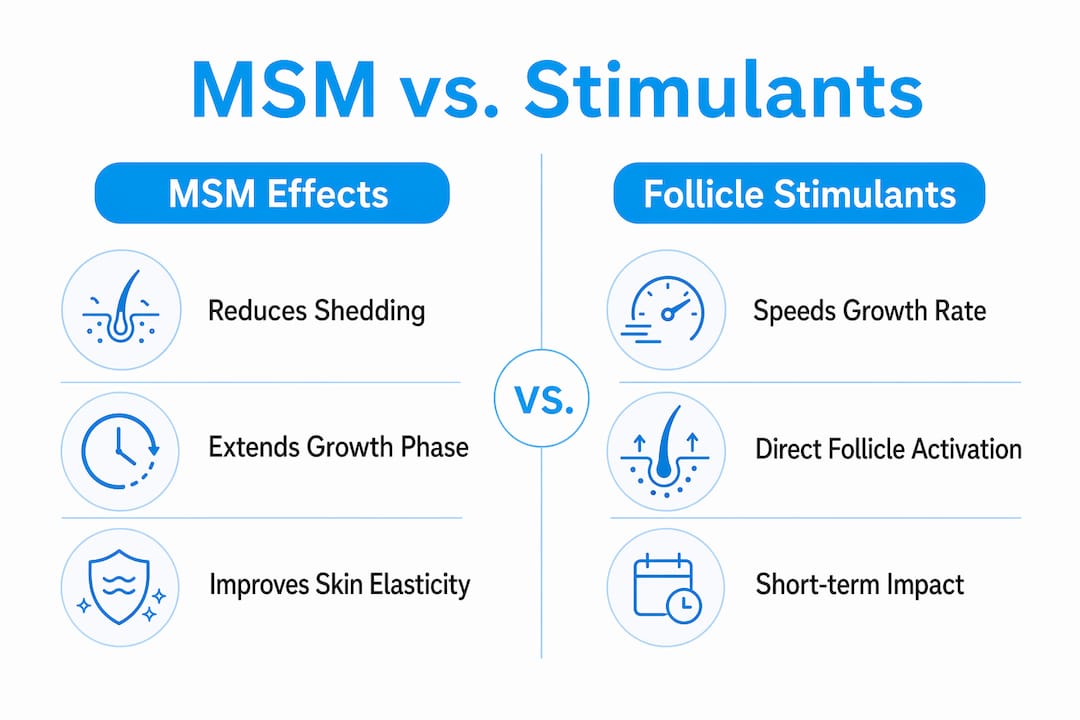
The most important effect MSM has on hair is extending the anagen phase, the active growth period of the hair follicle. A longer anagen phase means each strand stays on your head longer before shedding. The result is fuller, denser-looking hair, even though the follicle is not producing hair any faster.
Hair grows at roughly 0.5 inches per month. MSM does not change that number. What it does is reduce the shedding that cuts growth short. Think of it this way: if your hair grows half an inch each month but breaks off at the same rate, your length never changes. MSM addresses the breakage side of that equation.
Research also shows that 1,000 mg daily for 16 weeks produces measurable improvements in skin elasticity and connective tissue, which includes the scalp tissue surrounding each follicle. A healthier scalp environment supports stronger root anchorage and reduced shedding.
| Effect | MSM | Direct follicle stimulants (e.g., minoxidil) |
|---|---|---|
| Speeds up hair growth rate | No | Yes |
| Reduces shedding | Yes | Yes |
| Strengthens hair fiber | Yes | No |
| Extends anagen phase | Yes | Yes |
| Requires prescription | No | No (topical) |
| Typical onset of results | 3–6 months | 2–4 months |
Pro Tip: If you are already using a topical follicle stimulant like minoxidil, MSM can work alongside it by reinforcing the structural quality of new growth, not by replacing it.
What is the recommended dosage and form of MSM?
The standard daily dosage for hair support falls between 1,000 mg and 3,000 mg, taken consistently every day. Most people start at 1,000 mg and increase gradually if they tolerate it well. Going higher does not automatically produce faster results. Consistency over time matters far more than dose size.
MSM comes in several forms, each with practical trade-offs:
- Powder: The most cost-effective form and easy to scale doses. The downside is a noticeably bitter taste. Mixing MSM powder for hair into orange juice or another citrus drink masks the bitterness effectively and improves daily compliance.
- Capsules: More convenient and tasteless, but typically more expensive per gram. Good for people who travel or dislike measuring powder.
- Topical balms: Products like the Qhemet Biologics MSM + Rosemary Scalp Nutrients Balm combine MSM with rosemary and oils to nourish the scalp directly. Topical forms complement oral supplementation but do not replace it.
- Combined formulas: Some MSM supplements for hair pair the compound with biotin. Biotin handles metabolic processes in the follicle while MSM provides the sulfur for structural keratin support. The two work through different pathways, so combining them is logical.
Purity is a real concern with MSM powder for hair growth. Products made with OptiMSM®, a GMP-certified MSM standard, offer verified bioavailability and freedom from contaminants. Generic bulk powders vary widely in quality. Spending slightly more on a verified source protects your results.
Pro Tip: If you buy MSM in bulk powder form, transfer it to a wide-mouth glass jar. The original packaging is often narrow and hard to scoop from cleanly, which makes daily dosing messier and less consistent.
Visible results from an MSM supplement for hair require a minimum of 3–6 months of daily use. Stopping after six weeks because you see no change is the most common reason people conclude it does not work.
What realistic outcomes can you expect from MSM?
MSM primarily improves hair quality, not hair speed. That framing sets the right expectations before you spend money on a three-month supply.
Here is what a realistic timeline looks like for most people:
- Weeks 1–4: No visible change. MSM is building sulfur availability at the cellular level. This phase is invisible but necessary.
- Months 2–3: Reduced shedding becomes noticeable. You may see fewer hairs in the shower drain or on your brush. Hair feels slightly stronger to the touch.
- Months 3–4: Hair appears thicker and fuller. This is the anagen extension effect showing up visually. More strands are staying in the growth phase simultaneously.
- Months 5–6: Improved texture, reduced breakage, and better volume are all reported consistently by people who stay the course. User reviews of MSM products frequently describe stronger hair and reduced breakage after several months of regular use.
Individual results vary based on diet, hydration, sleep quality, and scalp health. MSM works best when your body already has adequate nutrition. If you are deficient in iron, zinc, or protein, MSM alone will not compensate.
"MSM should be understood as foundational to hair quality improvement, not a direct stimulant of growth speed. Preventing premature disappointment starts with realistic expectations." — Dr Ann
One misconception worth addressing directly: MSM is not a natural hair growth remedy that makes hair grow faster. It is a structural support supplement. The perceived growth comes from retaining more of the hair you already grow each month, not from producing more of it.
How does MSM work with other hair growth supplements?
MSM fits into a broader hair health routine rather than standing alone. Its sulfur contribution is specific and structural. Other supplements address different gaps.
Biotin is the most common pairing. Biotin regulates the metabolic processes that fuel follicle activity, while MSM supplies the sulfur that keratin needs to form strong bonds. They address different parts of the same system, which is why combined MSM and biotin formulas have become popular in the hair supplement category. You can find a broader comparison of top hair growth supplements that includes MSM alongside other evidence-backed options.
Lifestyle factors carry equal weight alongside any supplement:
- Protein intake: Hair is protein. Without adequate dietary protein, no supplement fully compensates.
- Hydration: Scalp tissue health depends on consistent water intake. Dehydration affects follicle environment directly.
- Sleep: Growth hormone release during deep sleep supports follicle cycling. Poor sleep disrupts this.
- Scalp hygiene: Product buildup and inflammation block follicle function. Regular cleansing matters. A quality hair towel reduces mechanical friction during drying, which cuts breakage at a point MSM cannot address.
Topical MSM products add a localized layer of support. The Qhemet Biologics balm mentioned earlier combines MSM with rosemary extract, which has its own evidence base for scalp circulation. Using a topical alongside an oral MSM supplement for hair covers both systemic and local pathways.
One caution: stacking too many supplements at once makes it impossible to know what is working. Introduce MSM first, run it for at least 8 weeks, then add other supplements one at a time. If sudden or severe shedding occurs, that requires medical evaluation. MSM supports wellness but does not replace medical diagnosis for conditions like alopecia areata or thyroid-related hair loss. For men specifically, the science-based supplement guide from Myhair covers how MSM fits within a broader male hair health protocol.
Key takeaways
MSM strengthens hair and reduces shedding by supplying sulfur for keratin production, with visible results requiring 3–6 months of consistent daily use at 1,000–3,000 mg.
| Point | Details |
|---|---|
| MSM does not speed growth | Hair grows at 0.5 inches per month regardless; MSM reduces shedding instead. |
| Dosage range | Take 1,000–3,000 mg daily; purity matters, so choose GMP-verified products like OptiMSM®. |
| Timeline for results | Expect 3–6 months before visible thickness and reduced breakage appear. |
| Best form for compliance | Mix MSM powder with citrus juice to mask bitterness and improve daily consistency. |
| Combine strategically | Pair MSM with biotin for complementary support; add lifestyle factors for full effect. |
MSM works, but only if you respect the timeline
I have seen a consistent pattern with people who try MSM and quit early. They expect to see length gains within a month, notice nothing, and conclude the supplement is useless. That conclusion is almost always wrong. The problem is the expectation, not the compound.
MSM is a wellness supplement in the truest sense. It builds a better foundation for hair health over time. The people who get the most from it are the ones who treat it like a daily habit rather than a treatment. They take it every morning with breakfast, they stay patient through the first two months of invisible progress, and they combine it with decent nutrition and scalp care.
The biggest pitfall I see is supplement stacking from day one. Someone reads about biotin, MSM, collagen, and saw palmetto all in the same week and starts taking all four simultaneously. When their hair improves, they have no idea what worked. When it does not improve, they have no idea what failed. Start with MSM alone. Give it a real trial. Then build from there.
MSM is not a cure for hair loss. If you are experiencing significant shedding, get bloodwork done before spending money on supplements. But for people with generally healthy hair who want stronger, thicker strands and less daily breakage, MSM is one of the most well-supported options in the natural hair treatment category. The science is not flashy, but it is consistent.
— Cyriac
Tracking your MSM results with Myhair
Starting MSM without a baseline is like starting a diet without stepping on a scale. You will not know if it is working.
Myhair uses AI-powered hair analysis to give you a measurable starting point before you begin any supplement routine. The platform scans your hair and scalp, generates a detailed health score, and tracks changes over time as you use MSM or other supplements. That kind of objective data tells you whether your shedding has actually decreased or whether you are just hoping it has. You can run your first AI hair analysis in minutes and get personalized product recommendations based on your specific hair condition, not generic advice.
FAQ
What does MSM actually do for hair?
MSM supplies bioavailable sulfur that supports keratin production, reduces shedding, and extends the hair follicle's active growth phase. The result is thicker, stronger hair rather than faster-growing hair.
How long does MSM take to show results for hair?
Most people see noticeable changes in shedding and thickness after 3–6 months of daily use at 1,000–3,000 mg. Results before the 8-week mark are uncommon.
Is MSM powder or capsules better for hair?
Both deliver the same compound. Powder is more cost-effective and easier to dose, but the bitter taste requires mixing with citrus juice. Capsules are more convenient for daily compliance.
Can MSM cause hair loss?
MSM does not cause hair loss. Mild side effects like digestive discomfort are occasionally reported at higher doses, but increased shedding is not a documented effect of MSM supplementation.
Should I combine MSM with biotin for hair growth?
Yes. Biotin supports follicle metabolism while MSM provides structural sulfur for keratin. They work through different pathways, making them a logical and commonly used combination for hair health support.