TL;DR:
- Personalized hair care emphasizes tailoring cleansing, conditioning, and treatments to your scalp and hair type for better strength and growth. Using accurate self-assessment and matching products to your biology, especially scalp health, results in more effective routines and improved results over generic methods. Objective tools like AI scans help track progress and ensure your routine adapts accurately to changing hair conditions.
My hair care is the practice of tailoring your cleansing, conditioning, and treatment steps to your specific scalp biology and hair texture to achieve measurable improvements in strength, growth, and appearance. Most people follow generic routines copied from product labels or social media, which explains why so many experience persistent dryness, breakage, or stalled growth. Success in hair care depends on structure and consistency tailored to your hair texture and porosity, not genetics or luck. This guide walks you through every layer of a correct hair care routine, from accurate self-assessment to product selection, daily habits, and troubleshooting, with tools like Myhair's AI analysis to sharpen your results.
What does my hair actually need? How to assess your type
The foundation of any personal hair care routine is an accurate read of your hair texture, porosity, and scalp condition. Without this, even the best hair care products work against you.

Hair texture falls into four categories: straight (Type 1), wavy (Type 2), curly (Type 3), and coily (Type 4). Each category behaves differently. Straight hair distributes scalp oils quickly and tends toward greasiness. Coily hair, by contrast, struggles to retain moisture because the tight curl pattern slows oil travel down the strand. Knowing your type tells you how often to wash and how much moisture your routine needs to deliver.
Hair porosity is equally critical and far less discussed. Porosity describes how readily your hair absorbs and retains moisture. Low-porosity hair repels water and product, making lightweight liquids more effective than heavy creams. High-porosity hair absorbs moisture fast but loses it just as quickly, requiring sealing oils like castor or jojoba. Porosity is a spectrum affected by bleach, heat, and weather exposure rather than a fixed state, meaning your routine must adapt as your hair's condition changes over time.
Scalp type determines your shampoo choice more than anything else. Oily scalps need clarifying formulas. Dry or sensitive scalps need gentle, hydrating options. A flaky scalp is not always dry; it can signal seborrheic dermatitis, which responds to ketoconazole-based shampoos rather than moisturizing ones.
- Straight hair: prone to oiliness, needs lighter products
- Wavy hair: benefits from curl-enhancing, frizz-reducing formulas
- Curly hair: requires deep moisture and defined hold
- Coily hair: needs heavy conditioning and protective styling
- Oily scalp: clarifying shampoo every 2 to 3 days
- Dry or sensitive scalp: hydrating, sulfate-free shampoo every 4 to 5 days
Pro Tip: Run the float test to check porosity. Drop a clean, shed strand into a glass of water. If it sinks fast, your porosity is high. If it floats for several minutes, it is low. This single test changes which products you should buy.
Myhair's AI scanner removes the guesswork entirely by analyzing your scalp and hair from a photo scan, generating a Hair Score that maps your specific concerns and recommends a starting routine.
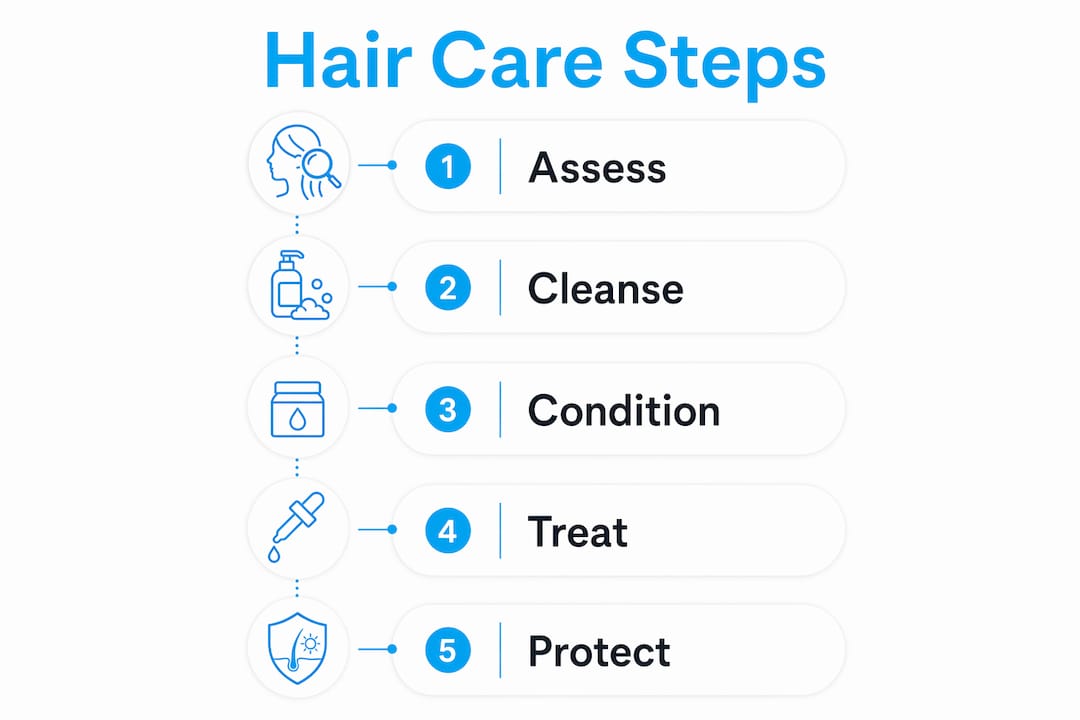
How do you choose the right products for your haircare routine?
Product selection is where most personal hair care routines break down. People buy based on packaging claims rather than ingredient lists matched to their biology.
Shampoo and conditioner: the non-negotiables
Your shampoo's job is to clean the scalp, not the hair length. Clarifying shampoos benefit oily scalps, while hydrating shampoos with glycerin or ceramides serve dry scalps best. Sulfate-free formulas are gentler and prevent dryness and irritation, making them the preferred choice for curly, coily, or sensitive scalps. Conditioner belongs on your mid-lengths and ends, not your roots. Applying conditioner from mid-length to ends prevents greasy roots while improving texture and detangling.
Treatments, oils, and stylers
Beyond shampoo and conditioner, treatments address specific concerns. Deep conditioning masks repair high-porosity, chemically treated hair. Scalp serums with ingredients like niacinamide or zinc target sebum regulation and irritation. For growth concerns, look for formulas that support circulation rather than relying on topical peptides alone.
| Product type | Best for | Key ingredients |
|---|---|---|
| Clarifying shampoo | Oily scalp, product buildup | Salicylic acid, tea tree |
| Hydrating shampoo | Dry, curly, or coily hair | Glycerin, ceramides |
| Ketoconazole shampoo | Dandruff, seborrheic dermatitis | Ketoconazole 1-2% |
| Deep conditioning mask | High-porosity, damaged hair | Proteins, shea butter |
| Scalp serum | Thinning, irritated scalp | Niacinamide, zinc, caffeine |
| Leave-in conditioner | Curly, frizz-prone hair | Glycerin, aloe vera |
Matching shampoo ingredients to your scalp biology directly improves routine outcomes. This is not a minor detail. The wrong shampoo can worsen dandruff or strip natural oils that protect the scalp barrier.
Pro Tip: Limit your active routine to five products maximum: shampoo, conditioner, one treatment, one protector, and one styler. Excessive product layering causes buildup that dulls hair and irritates the scalp, undoing the work of every other step.
For ingredient-specific guidance on what works for dryness, dandruff, or thinning, the top hair care ingredients breakdown from Myhair is worth bookmarking.
How to build a consistent routine for healthy growth
Consistency beats complexity in every hair care routine. A simple routine followed every week outperforms an elaborate one used sporadically.
Washing frequency and technique
The American Academy of Dermatology recommends washing hair based on oiliness and dirt accumulation, averaging every 2 to 4 days for most people. Overwashing strips the scalp's natural oils, triggering compensatory oil production and creating a cycle of greasiness. Underwashing allows product buildup and dead skin accumulation, which blocks follicles and slows growth.
Follow this sequence for every wash:
- Wet hair thoroughly with lukewarm water before applying shampoo.
- Apply shampoo only to the scalp and massage with fingertips, not nails, for 60 to 90 seconds.
- Rinse completely, then apply conditioner from mid-length to ends.
- Leave conditioner on for 2 to 3 minutes before rinsing with cool water to seal the cuticle.
- Gently squeeze excess water out with a microfiber towel. Never rub.
- Apply leave-in conditioner or serum to damp hair before heat styling or air drying.
Scalp massage and exfoliation
Scalp massage enhances blood circulation and is more effective at encouraging hair growth than topical growth products used without it. Spend 3 to 5 minutes massaging your scalp during each wash, using circular motions across the entire head. Monthly scalp exfoliation with a physical scrub or a salicylic acid treatment removes dead skin and product residue that routine shampooing misses. Healthy hair starts at the scalp. Exfoliating and clarifying the scalp leads to stronger, glossier growth over time.
| Routine step | Frequency | Purpose |
|---|---|---|
| Shampoo | Every 2 to 4 days | Cleanse scalp and remove buildup |
| Conditioner | Every wash | Smooth cuticle, improve texture |
| Deep conditioning mask | Once weekly | Repair and strengthen hair fiber |
| Scalp massage | Every wash | Stimulate circulation and growth |
| Scalp exfoliation | Once monthly | Remove dead skin and product residue |
| Heat protectant | Before every heat tool use | Prevent structural damage |
Pro Tip: Adjust your routine seasonally. Humidity in summer increases frizz and scalp oiliness, calling for lighter products and more frequent washing. Cold, dry winters strip moisture, requiring heavier conditioners and less frequent clarifying.
For a step-by-step breakdown of daily habits, the simple hair routine guide from Myhair covers the essentials without overcomplicating the process.
When your routine stops working: troubleshooting common problems
Even a well-designed routine needs adjustment. Hair and scalp conditions shift with seasons, stress, diet changes, and hormonal fluctuations.
Signs your routine needs a reset:
- Hair feels dry or brittle despite regular conditioning
- Scalp is itchy, flaky, or producing excess oil
- Hair is shedding more than 100 strands per day consistently
- Products stop delivering the results they once did
- Hair looks dull and lacks its usual texture or volume
The most common mistake people make is treating a scalp problem with hair products. Dryness at the ends is a hair issue. Flaking and itching are scalp issues. These require completely different solutions. A clarifying treatment every 4 to 6 weeks removes product buildup that regular shampoo cannot address, restoring scalp balance and product effectiveness.
Scalp health is more critical for hair quality than washing frequency alone. A calm, balanced scalp produces stronger, healthier strands regardless of how many products you apply to the hair itself. If irritation persists after adjusting your routine, a dermatologist consultation is the right next step, not another product purchase.
Tracking your progress matters more than most people realize. Keeping a simple growth journal with monthly photos gives you objective data on what is and is not working. Myhair's AI scanner takes this further by generating a Hair Score from each scan, allowing you to track changes in scalp condition and hair density over time with precision that a mirror cannot provide. For deeper reading on improving scalp health, Myhair's resource covers the clinical side of scalp management in practical terms.
Key takeaways
A personalized hair care routine built on accurate self-assessment, matched ingredients, and consistent scalp care produces stronger, healthier hair than any single product can deliver alone.
| Point | Details |
|---|---|
| Assess before you buy | Identify your hair texture, porosity, and scalp type before selecting any product. |
| Match ingredients to biology | Use ketoconazole for dandruff, ceramides for dryness, and glycerin for moisture retention. |
| Wash at the right frequency | Most scalps benefit from washing every 2 to 4 days; adjust based on oiliness and season. |
| Prioritize scalp over strands | Scalp massage and exfoliation drive growth more reliably than topical hair treatments. |
| Track progress with data | Use photos, growth journals, or AI tools like Myhair to measure routine effectiveness over time. |
Why I think most people are overcomplicating their hair care
After working with hair health content and tools for years, the pattern I keep seeing is this: people invest in complexity when they should be investing in consistency. A ten-step routine with premium products, used inconsistently, produces worse results than a four-step routine followed every single week without exception.
The other thing I have noticed is that scalp health gets treated as a footnote when it is actually the whole story. I have seen people spend hundreds of dollars on hair growth serums while ignoring a flaky, inflamed scalp that was blocking follicle function entirely. The scalp-first approach is not a trend. It is the biological reality of how hair grows.
I am also skeptical of the homemade hair care recipes trend. Coconut oil masks and egg treatments have their place, but they are not substitutes for understanding your actual porosity and scalp condition. A DIY mask applied to low-porosity hair often sits on top of the strand rather than penetrating it, creating buildup without benefit. Know your hair first, then decide whether a homemade treatment makes sense for your specific profile.
The most underrated tool available right now is objective tracking. Most people assess their hair progress by feel and appearance, which are both unreliable. Monthly scans with a tool like Myhair give you actual data on density and scalp condition, which means you can stop guessing and start making decisions based on evidence. That shift from intuition to data is where real, lasting improvement happens.
— Cyriac
See your hair's real condition with Myhair
If you have been adjusting your routine by trial and error, there is a faster path. Myhair's AI hair scanner analyzes your scalp and hair from a simple scan, generating a personalized Hair Score that identifies your specific concerns, whether that is thinning, dryness, scalp irritation, or slow growth.
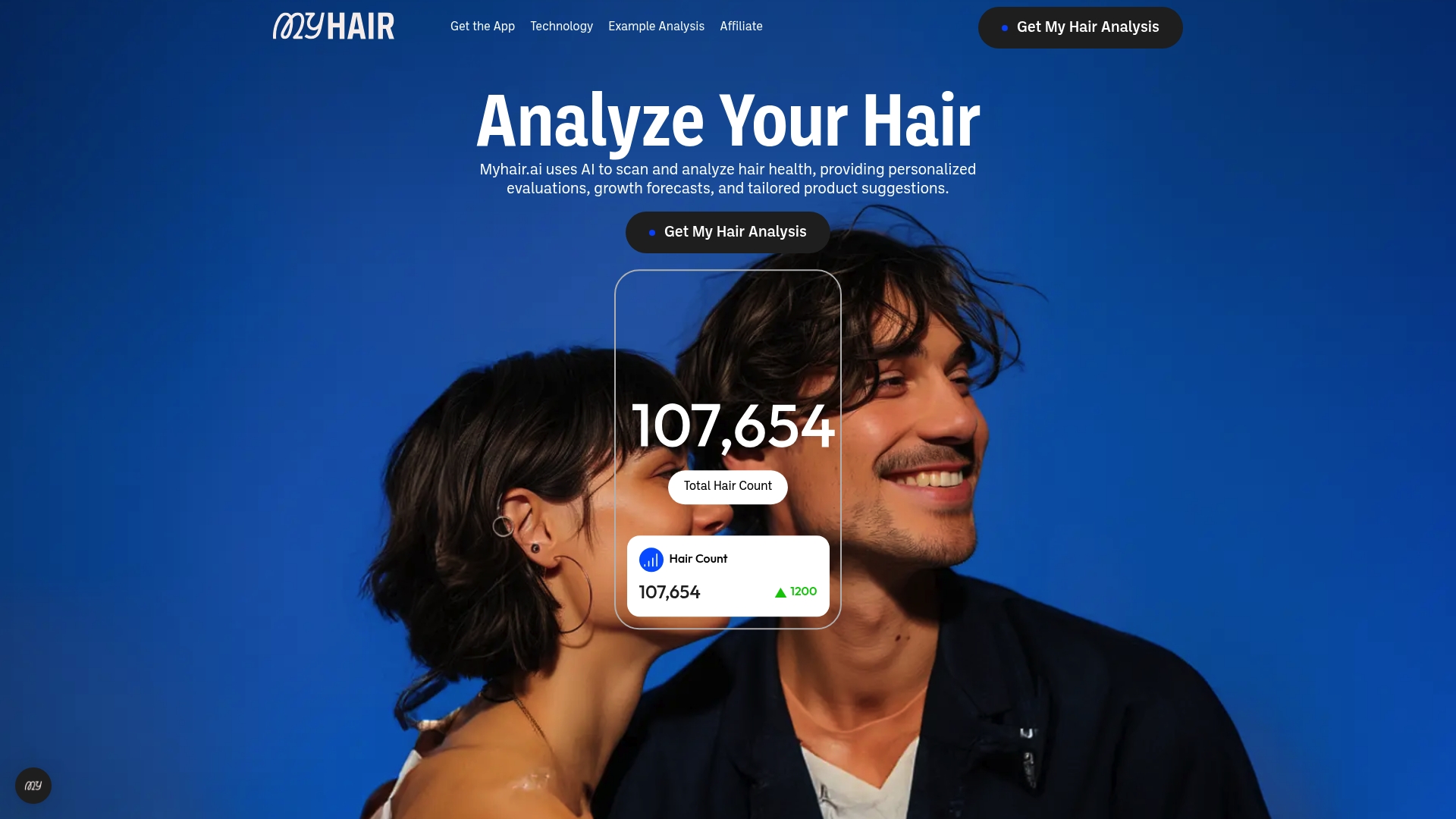
The platform maps your hair health over time, so you can see exactly how your routine is performing rather than guessing. Myhair also provides tailored product recommendations matched to your scan results, removing the guesswork from every purchase. Start your hair health assessment today and build a routine that is actually designed for your hair, not someone else's.
FAQ
What is a personalized hair care routine?
A personalized hair care routine is a structured set of cleansing, conditioning, and treatment steps matched to your specific hair texture, porosity, and scalp condition. It differs from generic routines by addressing your individual biology rather than applying one-size-fits-all advice.
How often should I wash my hair?
Most people should wash their hair every 2 to 4 days, based on scalp oiliness and hair type. The American Academy of Dermatology recommends adjusting frequency to how quickly your scalp accumulates oil and dirt rather than following a fixed schedule.
What are the best hair care products for damaged hair?
Damaged hair responds best to sulfate-free shampoos, deep conditioning masks with proteins and shea butter, and leave-in conditioners with glycerin or ceramides. Ketoconazole shampoos address dandruff specifically, while clarifying treatments remove buildup that worsens damage over time.
How can I track hair growth progress at home?
Take monthly photos under consistent lighting and keep a simple journal noting shedding levels, texture changes, and product adjustments. AI tools like Myhair's scanner provide objective Hair Score data from each scan, making progress tracking more accurate than visual assessment alone.
Does scalp massage actually help hair grow?
Scalp massage improves blood circulation to hair follicles, and research indicates this is more effective for encouraging growth than topical peptide products used without it. Three to five minutes of circular massage during each wash session is enough to produce a measurable effect over time.