
Most people assume that regrowing hair requires a prescription or a clinical visit. That assumption is worth questioning. A growing body of research shows that certain essential oils can deliver hair growth similar to 2% minoxidil in controlled studies, which means the gap between your medicine cabinet and your bathroom shelf may be smaller than you think. This guide breaks down exactly how oils like rosemary and peppermint work at the follicle level, which ones have the strongest evidence, and how to build a routine that actually moves the needle for your specific hair and scalp needs.
Table of Contents
- How natural hair regrowth oils work
- Comparing top natural oils for hair regrowth
- Best ways to use natural hair regrowth oils
- Enhancing results with personalized, tech-driven hair care
- What most people miss about natural hair oils and regrowth
- Ready to take control of your regrowth journey?
- Frequently asked questions
Key Takeaways
| Point | Details |
|---|---|
| Science supports natural oils | Several oils like rosemary and peppermint match drug treatments in animal studies. |
| Consistency and technique matter | Frequent, diluted application and proper massage are key for results. |
| Personalization boosts outcomes | Combining natural oils with tech-driven tracking leads to more effective regrowth. |
| Oils aid, not replace, medications | Natural oils are best used as complements to, not substitutes for, clinical hair loss therapies. |
How natural hair regrowth oils work
Your hair follicles are living structures. They respond to blood flow, inflammation, and hormonal signals. Natural oils interact with all three of these pathways, which is why researchers take them seriously rather than dismissing them as folk remedies.
Rosemary oil, for example, works partly through vasodilation, meaning it widens blood vessels near the scalp. More blood flow means more oxygen and nutrients reaching each follicle. According to Cleveland Clinic, rosemary oil causes vasodilation and reduces inflammation, creating a more favorable environment for hair to grow. Peppermint oil works through a similar mechanism, stimulating circulation with its active compound menthol.
Some oils also show anti-DHT activity. DHT (dihydrotestosterone) is the hormone most responsible for androgenetic alopecia, the most common form of hair loss. Oils like rosemary appear to block DHT from binding to follicle receptors, slowing the miniaturization process that eventually leads to permanent loss.
Here is a quick summary of the core mechanisms:
- Vasodilation: Increases blood supply to follicles
- Anti-inflammatory action: Reduces scalp conditions that stunt growth
- DHT inhibition: Slows hormone-driven follicle shrinkage
- Antimicrobial properties: Keeps the scalp environment clean and balanced
Important: Natural oils work best as adjuncts to your routine, not as standalone replacements for FDA-approved treatments. If you are already using minoxidil or finasteride, oils can complement those therapies without interfering.
For oils to work, two things matter most: proper dilution and scalp massage. Essential oils are highly concentrated and should always be mixed with a carrier oil (like jojoba or coconut oil) before touching your scalp. Massage during application boosts absorption and amplifies the circulation benefits. Always patch test a small area first to rule out sensitivity. You can explore more about the benefits of natural oils to understand which properties matter most for your hair type.
Comparing top natural oils for hair regrowth
Not all oils are equal. The research landscape is uneven, and some oils have far more evidence behind them than others. Here is how the top three stack up.

| Oil | Key mechanism | Evidence level | Best for |
|---|---|---|---|
| Rosemary | Vasodilation, DHT blocking | Strong (human + animal) | Androgenetic alopecia |
| Peppermint | Circulation boost, follicle depth | Strong (animal) | Thinning, density loss |
| Lavender | Antimicrobial, stress reduction | Moderate (animal) | Scalp health, mild loss |
| Minoxidil (2%) | Vasodilation, follicle prolongation | FDA-approved standard | Baseline comparison |
The standout finding from recent research: nanoemulsions of essential oils deliver results close to minoxidil in animal studies. A nanoemulsion is simply a very fine mixture that allows the oil to penetrate the scalp more deeply and consistently than a standard topical application.
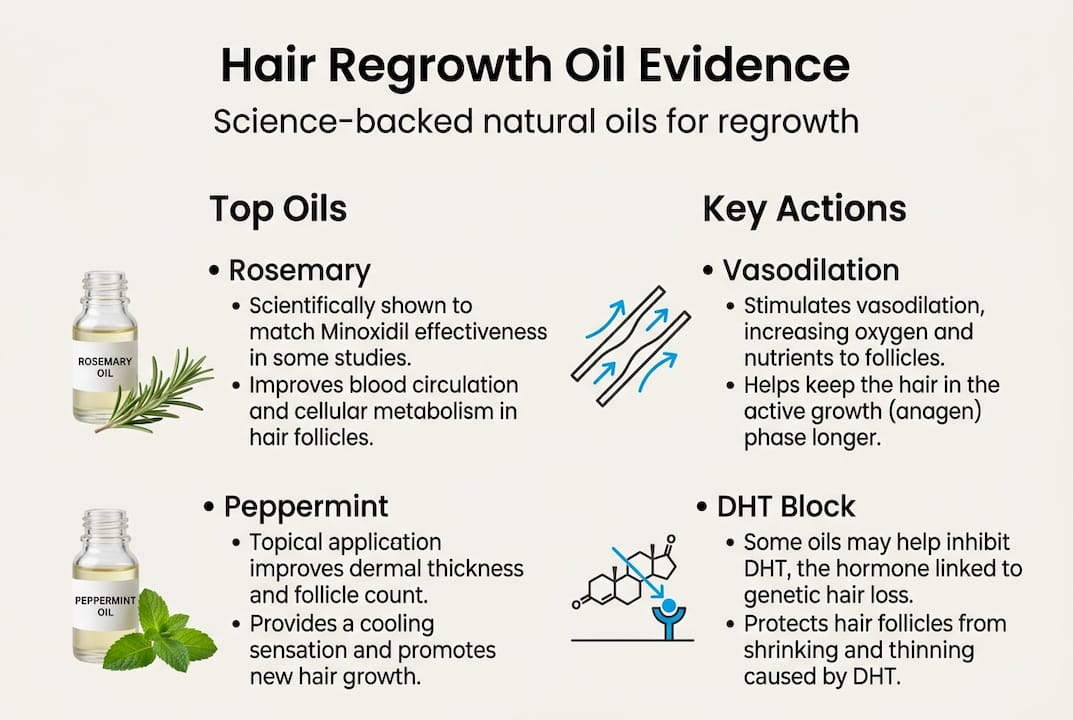
Peppermint oil deserves special attention. In mouse studies, peppermint oil outperformed 3% minoxidil for hair density and follicle depth. That is a striking result, even accounting for the fact that animal studies do not always translate directly to humans.
When choosing an oil, consider these practical factors:
- Scalp sensitivity: Peppermint can feel intense; lavender is gentler
- Hair loss type: Rosemary targets hormone-driven loss; lavender suits stress-related thinning
- Product format: Pre-diluted serums are convenient; pure essential oils give more control
- Allergies: Always check ingredient lists, especially with blended products
For a curated breakdown, check out top hair oils ranked by evidence and user experience. If you are dealing with active shedding, the guide on oils for hair loss covers targeted protocols for different loss patterns.
Best ways to use natural hair regrowth oils
Knowing which oil to use is only half the equation. How you apply it determines whether you see results or just end up with a greasy scalp and no progress.
Follow these steps for effective application:
- Choose your carrier oil. Jojoba, argan, or coconut oil all work well. Use about 1 tablespoon as your base.
- Add your essential oil. Use 3-5 drops of rosemary or peppermint per tablespoon of carrier oil. Never exceed this ratio.
- Warm the blend slightly. A few seconds in your palm activates the compounds and improves absorption.
- Section your hair. Part it into 4-6 sections to ensure even coverage across the scalp.
- Apply with fingertips. Use the pads of your fingers, not your nails, to work the oil into the scalp.
- Massage for 4-5 minutes. Use circular motions with light to medium pressure. This step alone has been shown to improve follicle stimulation.
- Leave it on for at least 30 minutes or overnight for deeper absorption, then wash out thoroughly.
Research confirms that lavender, peppermint, and rosemary oils yield rapid regrowth in mice with correct application technique, reinforcing that method matters as much as product choice.
Aim for 2-3 sessions per week. Daily use is not necessary and can actually cause buildup that clogs follicles.
Pro Tip: Combine rosemary and peppermint in the same blend for a synergistic effect. Both target circulation, and together they cover more of the biological pathways linked to hair growth.
Common mistakes to avoid:
- Applying undiluted essential oils directly to the scalp (causes burns and irritation)
- Expecting visible results in under 8 weeks
- Skipping the massage step and just coating the hair shaft
- Using the blend inconsistently, then wondering why it is not working
For more detailed protocols, the guide on how to use hair oil covers application for different hair textures. You can also find homemade oil recipes that combine multiple evidence-backed ingredients.
Enhancing results with personalized, tech-driven hair care
A solid oil routine is a great foundation. But for many people facing stubborn or complex hair loss, a generic protocol only gets you so far. This is where personalization changes everything.
AI-powered hair analysis tools can scan your scalp and hair density, track changes over time, and flag whether your current routine is actually working. Instead of guessing whether that new oil blend is helping, you get data. That shift from guesswork to measurement is significant.
Here is how DIY monitoring compares to AI-assisted analysis:
| Factor | DIY monitoring | AI analysis |
|---|---|---|
| Accuracy | Subjective, inconsistent | Objective, data-driven |
| Scalp health tracking | Visual only | Detailed pattern recognition |
| Progress measurement | Hard to quantify | Tracked over time with metrics |
| Product recommendations | Generic | Personalized to your hair profile |
| Time investment | High (manual logging) | Low (scan-based) |
Cleveland Clinic notes that natural oils work best as part of a larger routine, not as a complete replacement for clinical options. AI tools help you build and refine that larger routine intelligently.
Beyond technology, these habits amplify oil-based regrowth:
- Diet: Protein, iron, and zinc directly support follicle function
- Gentle styling: Tight hairstyles and heat tools counteract everything oils are trying to do
- Stress management: Cortisol disrupts the hair growth cycle at the hormonal level
- Sleep: Growth hormone peaks during deep sleep, which is when follicles do most of their repair work
Pro Tip: If you have fine or thinning hair, lighter carrier oils like jojoba absorb faster and do not weigh hair down. The guide on oils for thin hair covers the best options for low-density hair specifically. For a deeper look at a kitchen-staple option, the olive oil benefits article breaks down when it helps and when it hinders.
What most people miss about natural hair oils and regrowth
Here is the uncomfortable truth: most people who try natural oils and give up were not failing because the oils do not work. They were failing because they expected the wrong thing at the wrong time.
Natural oils are not fast. They are not dramatic. They work gradually, through repeated stimulation of follicles that may have been dormant for months or years. Expecting results in two weeks is like planting a seed and digging it up after three days to check on it.
The other issue is the "magic bullet" mindset. People pick one oil, use it inconsistently, and then declare that natural remedies are useless. Real results come from a personalized approach that accounts for your specific loss pattern, scalp condition, and lifestyle. Someone with stress-related shedding needs a different protocol than someone with hormone-driven thinning.
Science supports oils as a complementary treatment. That word matters. Complementary means alongside, not instead of. For insights into a particularly potent natural option, the research on black seed oil insights shows how targeted natural ingredients can be when used correctly. Patience, consistency, and personalization are the actual active ingredients in any successful natural regrowth plan.
Ready to take control of your regrowth journey?
You now have the science, the comparisons, and the step-by-step methods. The next move is making it personal. Generic routines produce generic results, and your hair loss has its own pattern, timeline, and triggers.

MyHair.ai combines AI-powered scalp scanning with tailored product guidance so you can stop guessing and start tracking real progress. Whether you are just starting with natural oils or looking to optimize an existing routine, the platform's AI hair analysis gives you a data-driven baseline to measure against. Start your personalized plan today through the hair analysis onboarding and see exactly where your hair stands and where it can go.
Frequently asked questions
Which natural oil is most effective for hair regrowth?
Peppermint and rosemary oils have the strongest evidence, with studies showing they can rival minoxidil's regrowth effects in animal models. Both target scalp circulation and follicle stimulation through different but complementary pathways.
How should I safely use natural hair regrowth oil?
Always dilute essential oils in a carrier oil before applying to your scalp, and massage the blend in using circular motions 2-3 times per week. Patch test a small area first to confirm your scalp tolerates the blend without irritation.
Can natural oils fully replace medical hair loss treatments?
Natural oils are best used alongside evidence-based therapies, not as replacements. Research confirms that oils are supportive adjuncts, not substitutes for FDA-approved options like minoxidil or finasteride.
How long before I see results with natural hair oils?
Consistent use 2-3 times per week for at least 3-6 months is typically needed before you notice meaningful changes in density or shedding reduction. Hair growth cycles are slow, and patience is non-negotiable.
Is AI-powered hair analysis necessary for effective regrowth?
AI tools are not required, but they remove the guesswork by tracking scalp health and progress with objective data. For anyone dealing with persistent or complex hair loss, that level of precision can make a real difference in how you adjust your routine over time.