TL;DR:
- Losing 50 to 100 hairs daily is normal for most men, reflecting the hair growth cycle. Sustained shedding above this range with visible thinning indicates potential hair loss or underlying health issues. Tracking density and pattern changes over time helps determine when to seek medical evaluation.
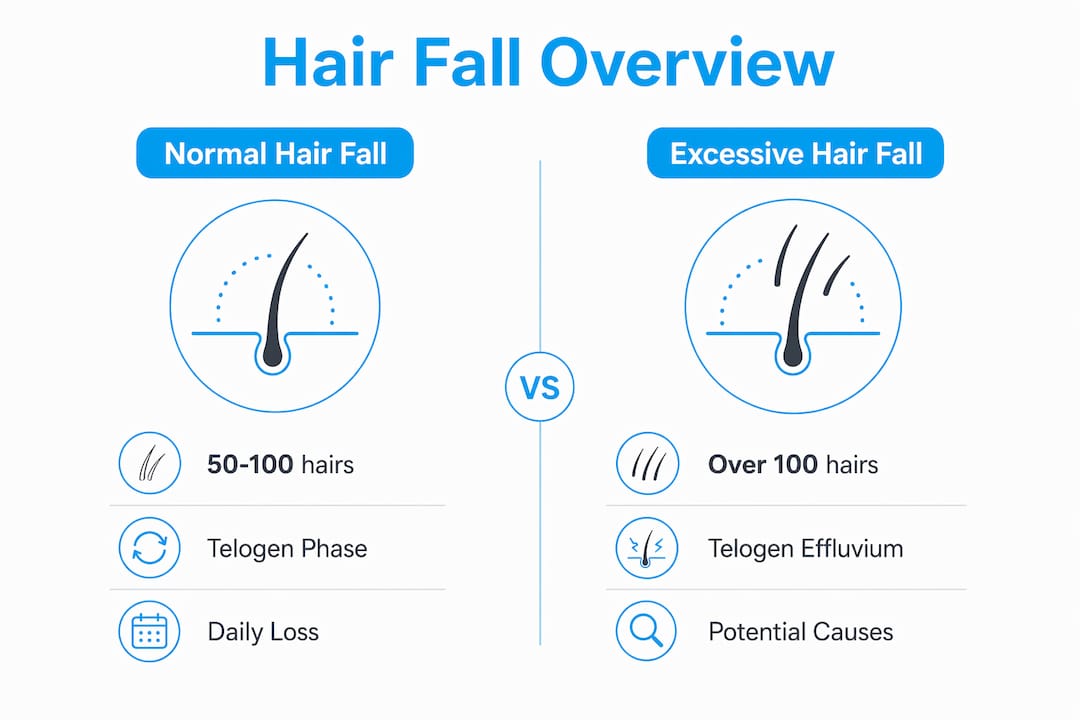
For most men, losing about 50–100 hairs per day is completely normal. That number can be somewhat higher on some days depending on how you count, but the consistent daily average across major clinical sources is in the typical 50–100 range. The real concern isn't a single bad-hair-day count. It's when shedding outpaces replacement over weeks and months.
If none of those apply, you're almost certainly in normal territory. If one or more does, keep reading.

Table of Contents
- Why your hair sheds every single day
- What the 50–100 hairs/day range actually means for your scalp
- What causes excessive shedding in men
- Why brushing and washing seem to make hair fall out more
- How to tell normal shedding from real hair loss
- What to do when you're losing more hair than normal
- How to track hair fall reliably over time
- Key Takeaways
- The part most men get wrong about hair fall
- Myhair gives you an objective baseline before your next appointment
- Useful sources and further reading
- FAQ
Why your hair sheds every single day
Hair doesn't grow continuously. Every follicle on your scalp cycles through three distinct phases, and shedding is built into that process.
- Anagen (growth phase): Lasts roughly 2–7 years. About 85–90% of your hair is in this phase at any given time, actively growing.
- Catagen (transition phase): A short 2–3 week window where the follicle shrinks and detaches from its blood supply.
- Telogen (resting/shedding phase): Lasts about 3 months. The hair sits dormant, then falls out as a new anagen hair pushes up from below. Roughly 10–15% of follicles are in telogen at any moment.
So when you lose 50–100 hairs a day, you're watching the telogen phase do exactly what it's supposed to do. The American Academy of Dermatology confirms this is normal cycle completion, not follicle failure.
Pro Tip: Men with shorter hair often think they're shedding less than men with longer hair. They're not. Shorter strands are just harder to spot on a pillow or in the shower drain. If you've recently cut your hair and suddenly "see less shedding," the biology hasn't changed.
What the 50–100 hairs/day range actually means for your scalp
Fifty to one hundred hairs sounds like a lot until you consider the full picture. A typical scalp carries roughly 100,000–150,000 hairs. Losing hairs in that range amounts to a very small percentage of your total follicle count. You wouldn't notice that in the mirror.
| Metric | Typical figure | Source |
|---|---|---|
| Normal daily shed range | 50–100 hairs/day | Mayo Clinic, AAD |
| Upper reported range (some methods) | Up to ~150 hairs/day | Cleveland Clinic |
| Total scalp hairs | ~100,000–150,000 | NYU Langone |
| Approximate % shed daily | Very small percentage | Derived from above |
The number that matters: Losing 100 hairs a day from a scalp of 100,000 is the equivalent of removing a single cup of water from a full bathtub. Visible density only drops when replacement consistently fails.
Here's what different daily counts look like in practice. At levels within the normal range, you might barely notice any shedding. Sustained shedding significantly above that can lead to visible thinning over time, because the normal balance is disrupted. For a deeper look at normal daily hair loss and what drives the variability, the context matters as much as the count.
What causes excessive shedding in men
The first thing to sort out is whether you're dealing with shedding or actual hair loss. They're clinically different. Shedding is the normal telogen cycle completing. Hair loss occurs when follicles stop producing replacement hairs altogether, which is what happens in androgenetic alopecia.
Common causes, and the signals that point to each:
- Telogen effluvium: Diffuse shedding across the whole scalp, often hundreds of hairs a day. Triggered by illness, surgery, major stress, crash dieting, or medication changes. Key signal: it starts 2–3 months after the trigger, not immediately.
- Androgenetic alopecia (male pattern baldness): Progressive thinning at the temples and crown. Driven by follicle sensitivity to DHT. Affects 30–50% of men by age 50 and is the most common form of hair loss in men. By the time you notice visible thinning, follicle miniaturization may already be well advanced.
- Alopecia areata: Sudden patchy loss, often coin-sized bald spots. Autoimmune in origin. Distinct from the gradual patterning of MPB.
- Medication-induced loss: Chemotherapy is the obvious one, but blood thinners, beta-blockers, and some antidepressants can also trigger shedding. Usually diffuse, not patterned.
- Thyroid and nutritional deficiencies: Low ferritin (iron stores), hypothyroidism, and vitamin D deficiency are all linked to diffuse shedding. These are among the first things a dermatologist will test for.
- Scalp disease: Fungal infections (tinea capitis), seborrheic dermatitis, or scarring conditions can damage follicles directly. Usually accompanied by itching, scaling, or redness.
The timing rule for telogen effluvium is one of the most clinically useful pieces of information here. If you had a serious illness, a high-stress event, or started a new medication two to three months before your shedding spiked, that lag is the diagnostic clue. Most telogen effluvium resolves on its own within six to nine months once the trigger is removed.
Why brushing and washing seem to make hair fall out more
Brushing and washing don't cause follicles to fail. What they do is collect hairs that were already in telogen and ready to detach. Avoiding washing or brushing doesn't stop the shedding — it just delays when those hairs become visible.
The distinction between a shed hair and a broken hair matters here. A hair that completed its cycle will have a small white or translucent bulb at the root end. That bulb is the follicle's root sheath, and its presence means the hair went through a normal telogen exit. A strand with no bulb, just a clean or frayed break, is mechanical or chemical damage: over-brushing, heat styling, bleaching, or tight hairstyles pulling the shaft apart.
Pro Tip: After your next shower, pick up a few fallen strands and look at the ends. White bulb = normal shedding. Clean break with no bulb = breakage. If most of what you're seeing is breakage, the fix is gentler grooming, not a dermatologist visit.
How to tell normal shedding from real hair loss
The short answer: look for pattern, density change, and timeline, not just a single day's count. A one-time spike of 150 hairs after a stressful week means almost nothing. Consistent counts above 100 for two or more months, combined with visible thinning or a shifting hairline, means something.
Here are four checks you can do at home:
- Hair-pull test. Grasp a small section of about 40–60 hairs between your fingers and pull gently but firmly from root to tip. Losing 6 or more hairs in a single pull is considered a positive result and warrants a closer look.
- Daily count method. Collect all shed hairs from your pillow, shower drain, and brush for three consecutive days. Average the count. Do this once a month rather than obsessing daily, since day-to-day variation is normal.
- Photo tracking. Take consistent photos of your crown, temples, and hairline under the same lighting every four to six weeks. Side-by-side comparison over three months is far more informative than any single-day count.
- Root bulb check. As described above: white bulb means normal shedding, no bulb means breakage.
Red flags that should prompt a clinician visit:
- Patchy bald spots appearing over days or weeks
- Sudden heavy clumps in the shower or on the pillow
- Scalp symptoms: pain, burning, scaling, or visible inflammation
- A family history of male pattern baldness that's accelerating faster than expected
- Shedding that started roughly 2–3 months after a major illness, surgery, or medication change
For a practical guide to recognizing early male pattern baldness specifically, the visual signs and timelines are worth reviewing before your first dermatology appointment.
What to do when you're losing more hair than normal
Start by reviewing the last three months. Any major illness, significant weight loss, new medications, or sustained high stress? That history is the first thing a clinician will ask about, so having it ready saves time.
If red flags are present or daily counts have been consistently above 100 for two or more months, see a primary care physician or dermatologist. Here's what to expect:
- Blood tests: CBC (complete blood count), ferritin and iron studies, TSH (thyroid-stimulating hormone), and sometimes vitamin D and zinc levels. These rule out the most common correctable causes of diffuse shedding.
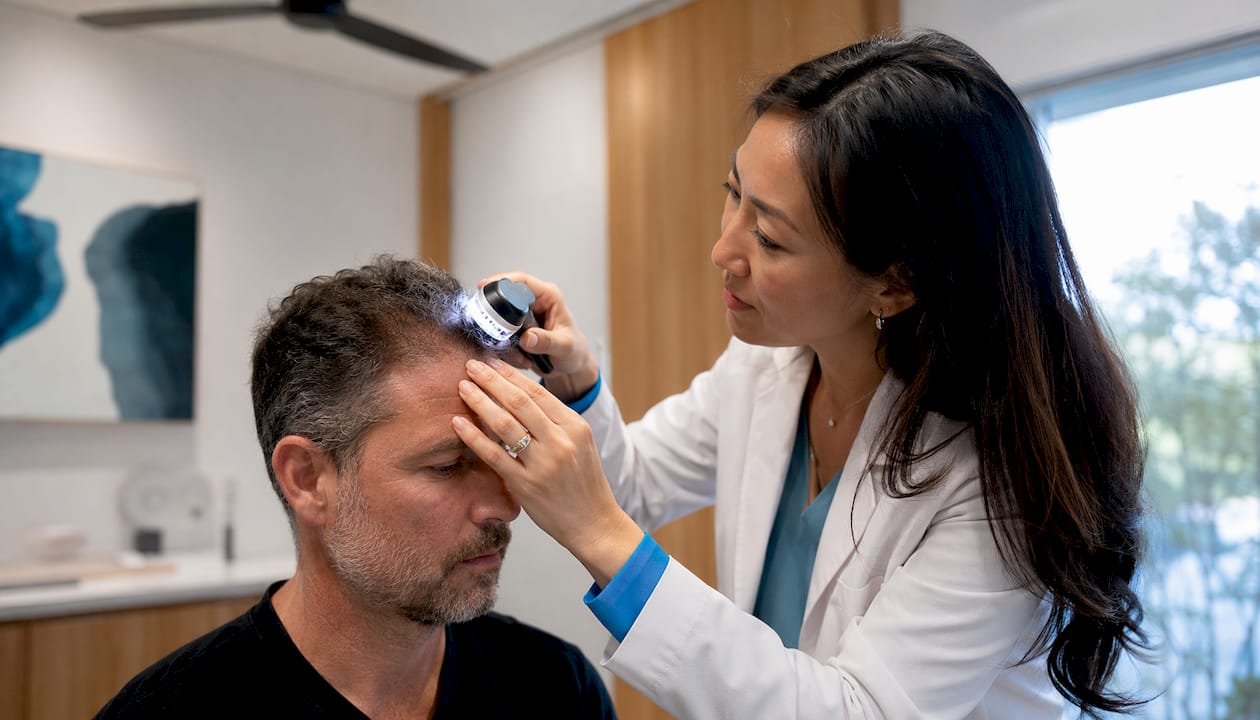
- Scalp exam: A dermatologist will look for miniaturization patterns, inflammation, or scarring using a dermatoscope.
- Possible biopsy: For ambiguous cases, a small scalp punch biopsy can confirm whether follicles are miniaturizing (androgenetic alopecia) or inflamed (alopecia areata, scarring alopecia).
Treatment depends entirely on the cause. Telogen effluvium usually resolves with supportive care once the trigger is addressed. For androgenetic alopecia, the two FDA-approved options are topical minoxidil and oral finasteride. Minoxidil prolongs the anagen phase; finasteride reduces scalp DHT by about 64%. Both require continuous use to maintain results, and neither fully reverses established baldness. Realistic timelines: expect 3–6 months before noticing meaningful change with either medication.
For everyday care that limits avoidable breakage, a few habits make a real difference. Use a wide-tooth comb on wet hair rather than a brush. Keep heat styling below 350°F when possible. Avoid back-to-back chemical treatments like bleaching and perming. A diet adequate in iron, protein, and zinc supports the anagen phase. Some men find that switching to a sulfate-free shampoo and conditioner reduces scalp irritation that can compound shedding. For more on hair care tips that support growth, the basics of gentle grooming are often underestimated.
How to track hair fall reliably over time
The most reliable way to detect real hair loss isn't counting hairs in the shower every morning. It's structured tracking: consistent photos plus standardized counts at regular intervals. Androgenetic alopecia progresses gradually, and by the time it's obvious in the mirror, miniaturization has often been underway for years. Structured tracking catches the trend earlier.
A practical workflow:
- Set a monthly photo schedule. Use the same room, same lighting (natural light from a window works well), and the same four angles: top-down crown, front hairline, left temple, right temple.
- For counts, use the same brush or comb each time, do a 60-second comb-through on dry hair, and count what comes out. Do this on the same day of the week, at the same time of day, to reduce variability from washing schedules.
- Log counts in a simple spreadsheet or notes app with the date. Three months of data tells you far more than any single reading.
- Compare photos side by side every three months, not week to week. Short-interval comparisons amplify anxiety without adding information.
AI-based tools like Myhair can add a layer of objectivity here. The platform uses scan-based analysis to assess hair density and track changes over time, which removes the subjectivity of eyeballing photos yourself. Structured imaging that measures hair per unit area consistently outperforms manual daily counts for detecting true density loss. That said, no app replaces a clinical diagnosis. Use tracking tools to build a clear picture before or between dermatologist visits, not instead of them.
Pro Tip: Standardize your count by always doing it before your first wash of the day. Post-wash counts aggregate hairs from the previous day or two and inflate the number, which is one reason brushing and combing give misleadingly high results.
Key Takeaways
Men typically lose a number of hairs per day within a recognized normal range depending on measurement method; the real signal is sustained loss beyond that range combined with visible thinning or patterning.
| Point | Details |
|---|---|
| Normal daily range | 50–100 hairs/day is considered normal for most men; some counting methods may produce counts up to around 150 without clinical concern. |
| Red flags to watch | Patterned thinning, patchy loss, clumps, or counts consistently above 100 sustained for months warrant a clinician visit. |
| Shedding vs. hair loss | Shedding is normal cycle completion; hair loss means follicles stop replacing shed hairs. |
| Telogen effluvium timing | Excessive shedding from stress or illness typically appears 2–3 months after the trigger, not immediately. |
| Myhair for tracking | Myhair's AI scan analysis provides objective density tracking to detect real change between dermatologist visits. |
The part most men get wrong about hair fall
Most men either panic too early or wait too long. The panic-too-early group counts hairs in the shower drain after a stressful week and convinces themselves they're going bald. The wait-too-long group notices their hairline shifting for two years and assumes it's normal variation until a dermatologist confirms significant miniaturization.
The evidence points to a middle path: track consistently, look for pattern and density change rather than raw daily counts, and act on sustained trends rather than single-day spikes. Telogen effluvium is temporary and self-resolving in most cases. Androgenetic alopecia is progressive, but early intervention with finasteride or minoxidil genuinely slows it. A five-year study on finasteride found that men who started treatment earlier maintained meaningfully higher hair counts than those who delayed, even when the delayed group eventually started the same medication.
The other thing worth saying plainly: a receding hairline is not a medical emergency. But it is worth monitoring, because the window for effective intervention is real. Waiting until you're visibly thinning to start tracking is like waiting until your car overheats to check the oil. The data was available earlier.
Myhair gives you an objective baseline before your next appointment
Most men who notice hair changes spend weeks second-guessing what they're seeing in the mirror. Myhair cuts through that uncertainty by giving you a data-backed picture of your hair density from a simple scan.

The platform analyzes your scalp using AI to produce a hair score that tracks density changes over time, not just a one-time snapshot. You get personalized insights based on your own scan history, which means you're comparing your scalp to itself rather than to a generic average. That's the kind of structured baseline a dermatologist actually finds useful. Myhair also provides tailored product recommendations based on your specific hair profile, so you're not guessing at what might help. Start your hair analysis today and bring real data to your next conversation with a clinician.
Note: Myhair provides monitoring and informational insights. It is not a diagnostic tool and does not replace clinical evaluation.
Useful sources and further reading
- American Academy of Dermatology: Hair shedding vs. hair loss — The AAD's clearest breakdown of the clinical distinction between normal shedding and alopecia, with the 50–100 hairs/day benchmark.
- Mayo Clinic: Hair loss symptoms and causes — Covers causes, diagnostic approach, and first-line tests including CBC, ferritin, and TSH.
- NYU Langone: Most men experience hair loss — Useful for understanding the prevalence of male pattern baldness and the clinical emphasis on pattern over count.
- Cleveland Clinic: How much hair loss is normal — Addresses measurement variability and the upper range (~150 hairs/day) some methods produce.
- NCBI Bookshelf: Male androgenetic alopecia — Comprehensive clinical reference on MPB prevalence, pathophysiology, and FDA-approved treatments.
- Healthline: How much hair loss is normal — Accessible overview of why brushing and washing aggregate shed hairs rather than cause loss.
FAQ
How much hair should a guy lose in a day?
Most men lose 50–100 hairs per day as part of the normal hair growth cycle. Some counting methods show up to around 150, but counts consistently above 100 over several months may indicate excessive shedding.
Is losing 100 hairs a day normal for men?
Yes. The American Academy of Dermatology considers up to 100 hairs per day within the normal range. The concern arises when counts stay above that threshold for months alongside visible thinning or patterned loss.
Is it normal to lose 200 hairs a day?
Consistently losing hairs daily above the normal upper limit may indicate telogen effluvium or another cause of excessive shedding. If it follows a stressful event or illness by about 2–3 months, telogen effluvium is a likely explanation and often resolves on its own.
Why am I losing 500 hairs a day?
Shedding daily amounts well above normal warrants a dermatologist visit. Telogen effluvium triggered by illness, surgery, or severe stress can temporarily increase daily counts, but a clinical evaluation including blood tests for iron, thyroid function, and other factors is the right next step.