TL;DR:
- Nutrafol hair oil targets the scalp to reduce inflammation and block DHT, promoting hair growth.
- It works best for early-stage thinning caused by stress, hormones, or inflammation.
- Consistent application and a holistic approach enhance results, not a quick fix.
Most people assume all hair oils do the same thing: add shine, reduce frizz, maybe smell nice. Nutrafol hair oil is built around a completely different premise. Instead of sitting on the hair shaft, it targets the scalp environment, using plant-based ingredients to calm inflammation and support the conditions your follicles need to produce stronger, denser strands. If you're between 25 and 45 and watching your ponytail shrink or your part widen, this guide breaks down what Nutrafol hair oil actually does, who it's really for, what users honestly experience, and how to work it into your routine without wasting time or money.
Table of Contents
- What is Nutrafol hair oil and how does it work?
- Who benefits most from Nutrafol hair oil?
- Experiences and results: What real users say
- How to use Nutrafol hair oil for best results
- The truth about Nutrafol hair oil for thinning hair
- Take your hair health to the next level
- Frequently asked questions
Key Takeaways
| Point | Details |
|---|---|
| Best for stress thinning | Nutrafol hair oil is most effective for hair loss driven by stress or lifestyle changes. |
| Results take time | Visible improvements such as less shedding and fuller hair may require 1-3 months of consistent use. |
| Combine for synergy | For optimal results, pair Nutrafol oil with oral supplements and healthy lifestyle changes. |
| Not a miracle solution | Nutrafol oil helps scalp health and thinning, but major regrowth may need a broader approach. |
What is Nutrafol hair oil and how does it work?
Nutrafol hair oil is a topical scalp treatment designed to complement the brand's well-known oral supplement line. While the supplements work from the inside out, the oil works locally, targeting the scalp directly to create a healthier growth environment. It's not a conditioning oil in the traditional sense. Think of it less like an argan oil treatment and more like a targeted scalp serum that happens to have an oil base.
The formula typically includes plant-derived actives such as saw palmetto, ashwagandha, and botanical oils known for anti-inflammatory and DHT-blocking properties. DHT (dihydrotestosterone) is the hormone most associated with follicle miniaturization, which is the process that makes your hair gradually thinner over time. By applying ingredients that work against DHT and soothe scalp inflammation directly at the source, Nutrafol oil aims to slow shedding and encourage the follicle to shift from a resting phase back into an active growth phase.
Here's what sets Nutrafol hair oil apart from a standard drugstore scalp oil:
- Targeted anti-inflammatory action rather than pure moisture delivery
- DHT-inhibiting plant actives that address one root cause of follicle miniaturization
- Scalp microbiome support to reduce the kind of chronic irritation that stalls growth
- Compatibility with oral Nutrafol for a layered, inside-out plus outside-in approach
Real users paint an encouraging picture. One widely shared account notes that reduced shedding and new growth appeared after roughly 1.5 months, even when the serum was used inconsistently, with a noticeably fuller ponytail after several more months of use.
"I honestly didn't expect much from a hair oil. But after six weeks, I was finding way less hair in the shower drain, and I could see tiny baby hairs along my hairline that hadn't been there before." — Nutrafol user review
That kind of early signal matters. It tells you the follicles are still viable and responding. The oil isn't regrowing dead follicles; it's waking up ones that have been dormant due to stress, inflammation, or hormonal fluctuation.
Who benefits most from Nutrafol hair oil?
Knowing a product works is only half the equation. The other half is knowing whether it will work for you. Nutrafol hair oil performs best in specific scenarios, and being honest about your hair loss pattern before you invest time and money is important.
The clearest candidates for strong results are people experiencing early-stage thinning driven by stress, nutritional gaps, hormonal shifts (like postpartum changes or perimenopause onset), or chronic inflammation. These are reversible or at least highly manageable causes, and the scalp responds well to anti-inflammatory topical support combined with lifestyle changes.
Here's a quick comparison to help you assess your fit:
| Hair loss type | Nutrafol oil likely to help? | Notes |
|---|---|---|
| Stress-related shedding | Yes, strong response | Pair with a stress hair loss remedy |
| Postpartum thinning | Yes, good response | Hormonal reset takes time; patience needed |
| Nutritional deficiency | Moderate, best combined | Add vitamins for hair loss orally |
| Early androgenetic alopecia | Modest response | Minoxidil often outperforms in this case |
| Advanced genetic hair loss | Limited | Topical oils alone are insufficient here |
| Scalp inflammation or dandruff | Yes, good response | Anti-inflammatory actives directly address this |
Research supports the strength of Nutrafol's approach for non-genetic causes. Oral Nutrafol shows 80% improvement in some studies for stress and lifestyle-driven thinning, and the topical oil is designed to layer on top of that effect.
For the best possible outcome, follow these steps to assess your fit before you start:
- Identify your primary trigger: is your thinning tied to a stressful period, a recent hormonal shift, or something in your family history?
- Track your shedding rate: more than 100-150 hairs per day over several weeks signals active loss worth addressing.
- Check your scalp: chronic itching, redness, or oiliness alongside thinning points to inflammation where Nutrafol oil can directly help.
- Consider whether you're also taking the oral supplement or planning to.
Pro Tip: Combining topical Nutrafol oil with the oral supplement is not just a sales pitch. The scalp benefits from local anti-inflammatory action while the supplement addresses systemic causes like cortisol spikes and nutrient depletion. Think of them as two lanes of the same highway.
Experiences and results: What real users say
User experience data for Nutrafol hair oil paints a realistic but genuinely encouraging picture. The pattern that emerges across reviews is one of gradual, cumulative progress rather than dramatic overnight change. That's actually a good sign: it means the product is supporting biological processes rather than masking problems with surface-level effects.

Here's a breakdown of what users in the 25 to 45 age range most commonly report:
| Timeline | What users typically notice |
|---|---|
| Weeks 1-3 | Scalp feels calmer, less itchy or greasy |
| Weeks 4-6 | Reduced daily shedding (less hair in drain, on brush) |
| Months 2-3 | New fine hairs or baby hairs appearing at temples or part |
| Months 3-6 | Increased density, fuller appearance, thicker ponytail |
A Daily Beast tester in the 25-45 age range reported reduced shedding and visible new patch growth after just 1.5 months, even with inconsistent application. That's a meaningful result because it suggests the formulation has enough potency that it works even when real-life routines aren't perfect.
The most commonly reported outcomes across users include:
- Reduced shower drain and brush shedding within 4-6 weeks
- Baby hairs or fine new growth along the hairline and part within 6-10 weeks
- Fuller, less limp ponytail after 3-6 months of regular use
- Calmer, less inflamed scalp often noticed within the first two weeks
What separates the users who see the best results from those who feel disappointed? Consistency is the clearest differentiator. People who apply the oil regularly, on a schedule, and pair it with at least some lifestyle adjustments (managing stress, improving sleep, reducing nutritional gaps) report the most satisfying outcomes. You can read a broader range of real Nutrafol reviews to see how these patterns show up across different hair types and backgrounds.
One important note: visible shedding reduction is often the first and most significant sign that a treatment is working. Many people mistake "less shedding" for "not enough regrowth" and give up too early. Less shedding is the foundation. Regrowth follows.
How to use Nutrafol hair oil for best results
Application technique matters more than most people realize with scalp oils. Slapping it on and hoping for the best is a recipe for mediocre results and potentially greasy roots.
Here is the most effective application method:
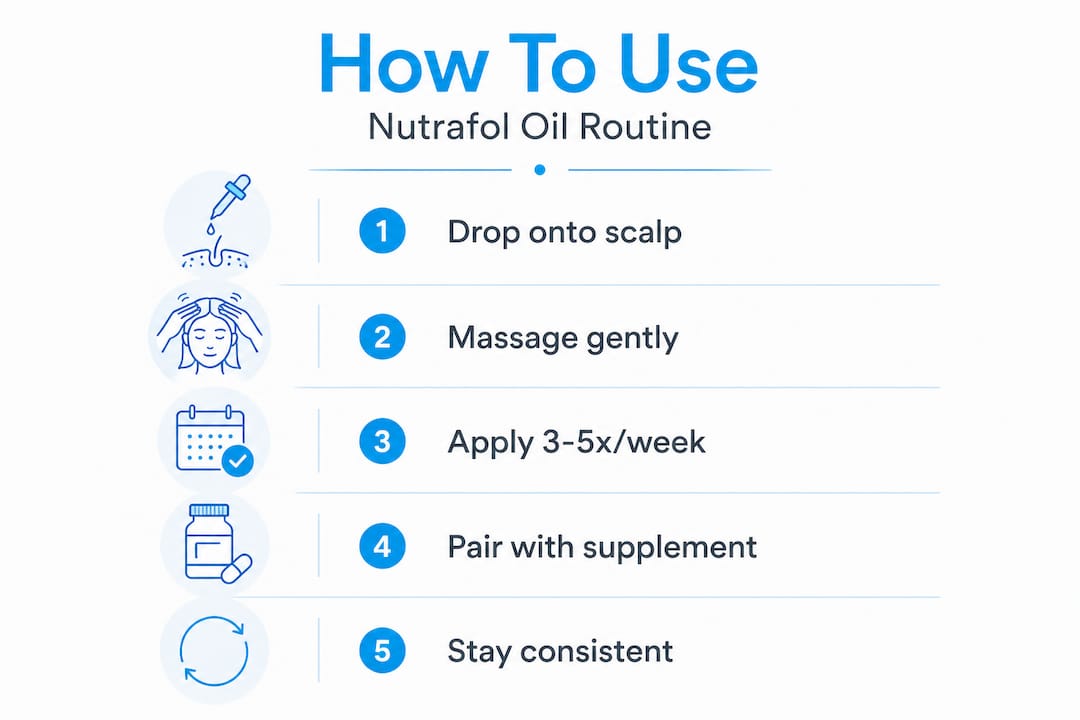
- Start with clean or lightly damp scalp. The oil absorbs better when there's no product buildup blocking follicle openings. Wash first, or apply on the day after washing.
- Part your hair in sections. Don't just squeeze oil onto the top of your head. Use a tail comb or your fingers to make 3-4 sections and apply directly to the scalp in each section.
- Use the dropper to apply small amounts. Less is more. Start with 4-6 drops per session and adjust based on how your scalp absorbs it.
- Massage with your fingertips for 2-3 minutes. This is not optional. Massage increases blood circulation to the follicle, which amplifies the effect of the active ingredients. Use gentle circular motions, not scratching.
- Leave it in. Nutrafol hair oil is designed as a leave-in treatment. Don't rinse it out.
- Apply at night if possible. Nighttime application gives the actives the longest possible window to work before you wash or style again.
Best frequency: most users see optimal results applying 3-5 times per week rather than daily. Daily use can lead to buildup for some scalp types. Experiment and adjust based on how your roots feel.
Research backs a combined approach: combining Nutrafol topical and oral products targets both systemic and localized causes of thinning, and optimal outcomes in stress and lifestyle cases come from using both simultaneously. You can learn more about how to use Nutrafol effectively including timing, dosage, and pairings that work.
Pro Tip: Set a phone reminder for your oil application days. Consistency beats intensity. Three steady, well-applied sessions per week outperform seven rushed, careless ones every time.
The truth about Nutrafol hair oil for thinning hair
Here is where we need to be direct with you, because the hair care industry has a long history of overselling hope to people who are already stressed about their hair.
Nutrafol hair oil is not a miracle product. It is a well-formulated, botanically sound topical treatment that works meaningfully for a specific subset of people with a specific type of hair loss. If you have early-stage thinning linked to stress, hormonal fluctuation, scalp inflammation, or lifestyle factors, this oil is a genuinely smart addition to your routine. It targets real biological mechanisms. The results, while gradual, are real.
But here's what the industry rarely says loudly: critics note that Nutrafol's data is largely company-funded, and its effects are more modest than minoxidil when it comes to genetic androgenetic alopecia. If your hair loss is primarily driven by genetics, you will likely need a stronger, clinically proven intervention as your primary tool, with Nutrafol oil playing a supporting role rather than being the headline act.
The other honest truth? Many people who struggle with thinning hair are dealing with a layered problem. There's rarely just one cause. Understanding how stress impacts hair at a biological level reveals why a scalp oil alone rarely solves the full picture when your cortisol has been elevated for months or years.
The users who genuinely benefit from Nutrafol oil are the ones who use it as one piece of a broader strategy: better sleep, managed stress, adequate protein and iron intake, regular scalp care, and when needed, clinical support. The oil amplifies those efforts. It does not replace them.
Think of it this way: if your hair is a plant, Nutrafol oil improves the soil quality. But you still need the right light, water, and nutrients for the plant to actually grow.
Take your hair health to the next level
You've just gotten a clear, honest look at what Nutrafol hair oil can and can't do. But knowing what products exist is only one part of the equation. The part most people skip is understanding their own specific hair loss pattern, what's driving it, and which solutions match their biology.

That's exactly what MyHair.ai's AI hair analysis is built for. Using advanced algorithms and your own scalp scans, MyHair.ai gives you a personalized assessment of your hair health, identifies your loss pattern, and tracks changes over time so you know if a product like Nutrafol is actually moving the needle for you. Stop guessing and start knowing. You can get personalized hair care recommendations tailored to your actual hair biology, not just general advice. It's the smartest next step after reading about what's possible.
Frequently asked questions
How long does it take to see results from Nutrafol hair oil?
Most users notice reduced shedding and new patches of growth within 1.5 to 2 months, with fuller, denser hair becoming visible after 3 to 6 months of consistent use.
Is Nutrafol hair oil effective for genetic (AGA) hair loss?
Results for genetic androgenetic alopecia tend to be more modest than minoxidil, so Nutrafol oil works best as a support tool for stress or lifestyle-related thinning rather than as a standalone genetic treatment.
Can you use Nutrafol hair oil with other Nutrafol products?
Yes, and it's actually recommended: combining the topical oil with the oral supplement targets both systemic and local causes of thinning, which typically produces better outcomes than using either product alone.
Are the results permanent if I stop using Nutrafol hair oil?
Results are not permanent after stopping. The scalp environment and follicle support the product provides diminishes over time, so ongoing use is generally needed to maintain the improvements you've achieved.
What are the most common side effects of Nutrafol hair oil?
Most users tolerate it well with no notable issues, though a small number report mild scalp irritation or sensitivity, particularly during the first few weeks of use.
Recommended
- How to use Nutrafol for hair growth: tips and science | MyHair
- Nutrafol Reddit Reviews: Real Hair Growth Stories 2025 | MyHair
- Fast Hair Growth Oil: Top Picks and Proven Tips for 2025 | MyHair
- Natural oils for hair growth: what actually works | MyHair
- 7 Nourishing Hair Oils for Healthy, Luxurious Hair Care - Joel C Ma Hair Studio