
Hair transplant surgery is the only true permanent hair replacement method available today. It works by relocating androgen-resistant follicles from the back of the scalp (the occipital donor zone) to thinning or bald areas, where they continue growing naturally for the patient's lifetime. The two primary techniques are follicular unit transplantation (FUT), which harvests a strip of scalp, and follicular unit extraction (FUE), which removes individual follicular units one by one. Both deliver lasting results, though the follicles may gradually thin with normal aging. Medical therapies like minoxidil and finasteride don't replace surgery, but they protect the native hair that surgery cannot cover.
- FUT: Strip harvesting; higher graft yield per session; leaves a linear scar
- FUE: Individual follicle extraction; avoids linear scarring; preferred for younger patients or short hairstyles
- Minoxidil / Finasteride: Adjunct therapies to slow ongoing loss and protect transplanted results
- Realistic expectation: A fuller head of hair is achievable; a completely full head often is not
Table of Contents
- How hair transplant surgery actually works
- What non-surgical hair restoration can and cannot do
- When to pursue surgery and how to protect results long-term
- How Myhair uses AI to personalize your hair care plan
- Key Takeaways
- FAQ
How hair transplant surgery actually works
The procedure itself
Surgery runs 4 to 8 hours as an outpatient procedure under local anesthesia. The surgeon harvests follicular units from the mid-occipital donor zone, which typically contains a high density of follicular units, then places them into recipient sites designed to mimic natural growth angles. Donor areas with low follicular unit density are generally considered unsuitable for harvesting.

Modern follicular unit placement replaced the old "plug" technique of the 1970s and 1980s. A skilled surgeon's hairline design is what separates a natural result from an obvious one. The artistry of graft placement, not just the harvesting method, drives the final appearance.
Who qualifies
Good candidates have a stable, well-defined hair loss pattern with at least 50% thinning in one or more areas, a healthy scalp, and adequate donor density. Patients with active scarring alopecias (such as lichen planopilaris) are not candidates until the condition has been disease-free for two years.
Most women with androgenetic alopecia are not ideal candidates because DHT affects their hair diffusely, leaving few stable donor sites. A small subset qualifies, including women with traction alopecia or trauma-related loss. For women exploring options, female transplant candidacy depends heavily on donor stability.
Timeline and risks
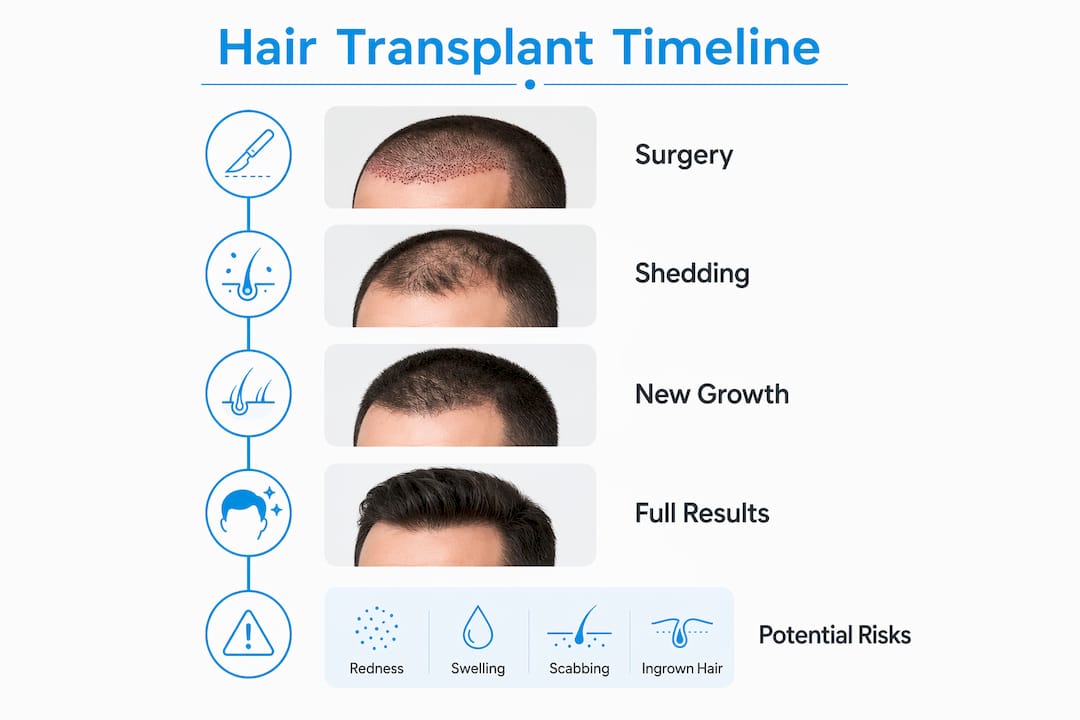
Transplanted hair sheds 2 to 8 weeks after surgery. New growth begins around month three, and most patients see meaningful results between 6 and 12 months. Possible complications include infection, scarring, graft failure, and shock loss of surrounding native hair.
Pro Tip: Ask any prospective surgeon to show photographic documentation taken at 6 to 12 months post-op. That window is when results are fully assessable, and a surgeon who tracks outcomes that carefully is one worth trusting.
What non-surgical hair restoration can and cannot do
Non-surgical options slow hair loss and, in some cases, partially reverse miniaturization. They cannot restore follicles that have already died.
Minoxidil (topical or oral, FDA-approved) increases blood flow to follicles and promotes thicker strands. It requires daily use indefinitely; stopping it reverses any gains within months. Finasteride blocks DHT conversion and is effective for male androgenetic alopecia, though it carries potential hormonal side effects. Both treatments need 4 to 6 months of consistent use before any visible improvement appears.
Platelet-Rich Plasma (PRP) therapy draws the patient's own blood, concentrates the plasma, and injects it into the scalp to stimulate injured follicles. As plastic surgeon Tim Neavin, MD, noted via the American Society of Plastic Surgeons, PRP works on injured follicles but cannot reincarnate dead ones, making it less effective for older patients with advanced loss. PRP sessions cost $500 to $1,500 each, with monthly treatments for three months followed by annual maintenance. Effectiveness is not universally established.
Low-level laser therapy (LLLT) uses 660 nm red light to stimulate follicles and is available OTC in comb and helmet devices. Evidence supports it as a non-surgical option for androgenetic alopecia, though results vary. For a broader look at non-surgical treatment options, the landscape in 2026 continues to expand.
The critical limitation across all non-surgical therapies: once follicles stop functioning entirely, surgery becomes the only option, and it is costlier and more invasive than early intervention would have been.
When to pursue surgery and how to protect results long-term
Timing matters more than most patients realize. Patients with more than 15% miniaturization in the recipient area should complete 6 to 12 months of medical therapy with minoxidil or finasteride before surgery. Skipping this step raises the risk of shock loss at the recipient site, which can be permanent rather than transient.
Androgenetic alopecia does not stop progressing after a transplant. Transplanted follicles retain their donor-site androgen resistance and keep growing, but the surrounding native hair continues to miniaturize without ongoing medical therapy. That gap is what makes post-surgical maintenance non-optional.
Recommended long-term care practices:
- Continue oral finasteride and low-level laser therapy throughout the perioperative period and indefinitely afterward
- Apply topical minoxidil consistently to preserve non-transplanted hair
- Schedule photographic documentation at 6 and 12 months post-surgery
- Follow up with your dermatologist or surgeon every 6 months for the first two years
- Monitor donor zone density before planning any additional sessions
Donor hair is a finite resource. A surgeon who plans graft allocation conservatively, accounting for future loss progression, protects your long-term coverage options. For a detailed look at key factors for success, candidacy evaluation and stabilization are where outcomes are won or lost.
Pro Tip: Early detection of miniaturization gives you more options. AI-based scalp analysis can flag follicle thinning before it becomes visible to the naked eye, letting you start medical therapy at the point where it is most effective.
How Myhair uses AI to personalize your hair care plan
Myhair's AI-powered platform analyzes scalp scans to produce a detailed picture of follicle health, miniaturization patterns, and growth trajectories. The AI analysis technology uses advanced algorithms to generate a personalized hair health score and project how loss may progress over time, giving you a data-backed foundation for deciding between medical therapy, surgical readiness, or both.
Key features of Myhair's analysis:
- Follicle density mapping: Quantifies follicular units per cm² across the scalp
- Miniaturization scoring: Detects early thinning before it becomes clinically obvious
- Growth projections: Models likely loss trajectories based on individual scan data
- Medical therapy optimization: Recommends when to start, adjust, or escalate treatment
- Progress tracking: Compares scans over time to measure response to therapy
- Upload a scalp scan through the Myhair app
- Receive a personalized hair health score with follicle-level detail
- Get tailored product and treatment recommendations
- Track changes at regular intervals to catch early warning signs
- Use the data to inform conversations with your surgeon or dermatologist
The Myhair AI hair scanner gives you the kind of baseline assessment that used to require a clinic visit. Start with a scan, understand exactly where your hair stands, and make every subsequent decision, surgical or otherwise, from real data rather than guesswork.
Key Takeaways
Hair transplant surgery offers the only permanent hair replacement solution, but long-term results depend on medical therapy, careful timing, and ongoing monitoring.
| Point | Details |
|---|---|
| Surgery is the only permanent fix | Transplanted androgen-resistant follicles grow for life; no non-surgical therapy matches that durability. |
| Stabilize before operating | Patients with over 15% miniaturization need 6 to 12 months of medical therapy before surgery to reduce shock loss risk. |
| Non-surgical options have hard limits | PRP costs $500 to $1,500 per session and cannot restore dead follicles, only injured ones. |
| Native hair keeps thinning post-transplant | Continuing minoxidil and finasteride after surgery protects the hair that grafts cannot cover. |
| AI analysis enables earlier action | Myhair's scalp scans detect miniaturization early, expanding the window for effective non-surgical intervention. |
FAQ
Is a hair transplant truly permanent?
Yes. Transplanted follicles retain their androgen resistance and continue growing for the patient's lifetime, though they may thin slightly with normal aging.
How long does it take to see results after surgery?
Most patients see results between 6 and 12 months post-surgery. Transplanted hair sheds in the first 2 to 8 weeks before new growth begins around month three.
Can non-surgical treatments replace a hair transplant?
No. Minoxidil, finasteride, PRP, and laser therapy can slow loss and thicken existing hair, but none can restore follicles that have already stopped functioning.
Who is not a good candidate for hair transplant surgery?
Patients with active scarring alopecia, insufficient donor density, or unstable hair loss patterns are generally not suitable candidates until those conditions are resolved or stabilized.
How does AI help with hair loss decisions?
AI-powered tools like Myhair analyze follicle density and miniaturization from scalp scans, producing personalized projections that guide the timing of medical therapy and surgical intervention.