Scalp treatments can genuinely improve your scalp's environment and how well other products absorb into it, but the payoff depends heavily on which method you pick, how consistent you are, and how much you spend. A device or serum backed by a real trial might add measurable density in months. A trendy scrub with no diagnosis behind it might just lighten your wallet. Weighing the pros and cons of scalp treatments starts with knowing which category you're actually considering.
TL;DR:
- Device-based treatments like electrotrichogenic devices show measurable density increases after six months of consistent use, according to clinical trials.
- Topical formulations and PRP demonstrate modest but statistically significant improvements in hair density and thickness with minimal adverse effects over 24 weeks.
- The effectiveness of treatments like microneedling heavily depends on combination with other therapies and requires multiple sessions over several months to produce visible results.
- Proper diagnosis and setting clear expectations are essential, as many treatments are ineffective if started without identifying the underlying scalp condition.
- AI scalp scans provide an objective baseline to guide treatment decisions and track progress, helping prevent unnecessary or ineffective procedures.
Table of Contents
- Pros and Cons of Scalp Treatments: What the Benefits Actually Look Like
- The Downsides of Scalp Care: Risks, Costs, and Where the Evidence Gets Thin
- What Clinical Trials Actually Show About Scalp Treatment Effectiveness
- How to Decide If a Scalp Treatment Is Worth It for You
- How MyHair.ai Thinks About Scalp Treatments
- Try a Free AI Scalp Scan Before You Book Anything
- Sources
- FAQ
Pros and Cons of Scalp Treatments: What the Benefits Actually Look Like
The benefits of scalp treatments break down into a few distinct mechanisms, and not every treatment delivers all of them. Understanding which one you're targeting keeps you from paying for a service that solves a problem you don't have.
Deep cleansing removes built-up sebum, product residue, and dead skin that block follicles. This matters more than it sounds. A clinical review of scalp health management notes that clearing follicular obstruction can optimize conditions for topical medical therapies like minoxidil to actually penetrate and work. A clogged scalp is a bad launchpad for anything you put on it afterward.
Reduced inflammation and improved comfort show up most clearly for people dealing with dandruff, itch, or scalp psoriasis. Calming that irritation is often the first visible win, well before any hair growth shows up. If flaking and itching are your main complaint, understanding the causes of dandruff and hair loss helps you separate a cosmetic issue from a medical one.
Circulation stimulation is the theory behind scalp massage and low-level light or electrotrichogenic devices. The idea is that better blood flow delivers more nutrients to the follicle. Evidence here is stronger for device-based approaches than for massage alone.
Better absorption is the quiet benefit that ties everything together. Treatments that prep the scalp often function as an adjunct that boosts whatever topical or clinic-based therapy comes next, rather than working as a standalone fix.
Here's a quick map of the common treatment types and what they realistically deliver:
- Professional deep-clean or exfoliation: removes buildup, improves comfort, sets up better product absorption.
- Scalp massage: low cost, relaxing, modest circulation support, weak standalone evidence for growth.
- Microneedling: creates micro-injuries meant to trigger a healing response; results are inconsistent alone.
- Device-based therapies (wearable electrotrichogenic or LED devices): measurable density gains in controlled trials, but require months of use.
- Topical serums and PRP: targeted formulations or platelet-rich plasma injections aimed directly at follicle health, often used alongside other treatments.
The Downsides of Scalp Care: Risks, Costs, and Where the Evidence Gets Thin
Most side effects from scalp treatments are local and temporary. Expect the possibility of redness, tenderness, or mild irritation after exfoliation or device use, and don't be alarmed by a short bout of shedding after microneedling or aggressive massage. That's usually a normal part of the hair cycle resetting, not permanent damage.
Invasive procedures carry a small but real infection risk. Needling tools, PRP injections, or anything that breaks the skin barrier need to happen with clean technique and, ideally, a trained provider. This is a low-probability risk, but it isn't zero.
Effectiveness is where things get inconsistent. Trials evaluating isolated scalp microneedling show mixed results. Some show no measurable density benefit when microneedling is used by itself. Better outcomes tend to appear when it's paired with a topical agent like minoxidil or with PRP, not as a solo intervention.
Then there's the practical burden. Real results usually require multiple sessions and months of patience, and dropping off partway through is a common reason people never see benefits. Cost adds up fast when you're paying per session over a quarter or more.
Watch for these red flags in any provider or product:
- No diagnostic step before recommending a treatment plan.
- High-pressure sales tactics pushing package deals on the first visit.
- Promises of a "cure" for pattern hair loss, which no scalp treatment alone can deliver.
- Vague answers about what a treatment actually does at the follicle level.
Pro Tip: Ask any provider what specific outcome they expect from your treatment and by when. If they can't give you a timeline or a way to measure progress, that's a sign the plan wasn't built around your diagnosis.
What Clinical Trials Actually Show About Scalp Treatment Effectiveness
Recent trial data gives a clearer picture than marketing copy ever will, and the numbers vary a lot by treatment type.
A 2026 randomized, sham-controlled trial of a wearable electrotrichogenic device found a mean increase in total hair density at 6 months compared with sham treatment. Side effects were mostly mild and transient, things like temporary redness or itching in a minority of users. That's a meaningful, statistically measured gain from a device you use at home, though it takes half a year of consistent use to show up.
On the topical side, a 24-week randomized, double-blind, placebo-controlled trial of a multi-targeted cosmetic formulation reported statistically significant increases in hair density and thickness, with no adverse events reported during the study. The magnitude was modest, smaller than what's typically seen with higher-dose minoxidil over longer stretches, but it came with a strong safety profile.
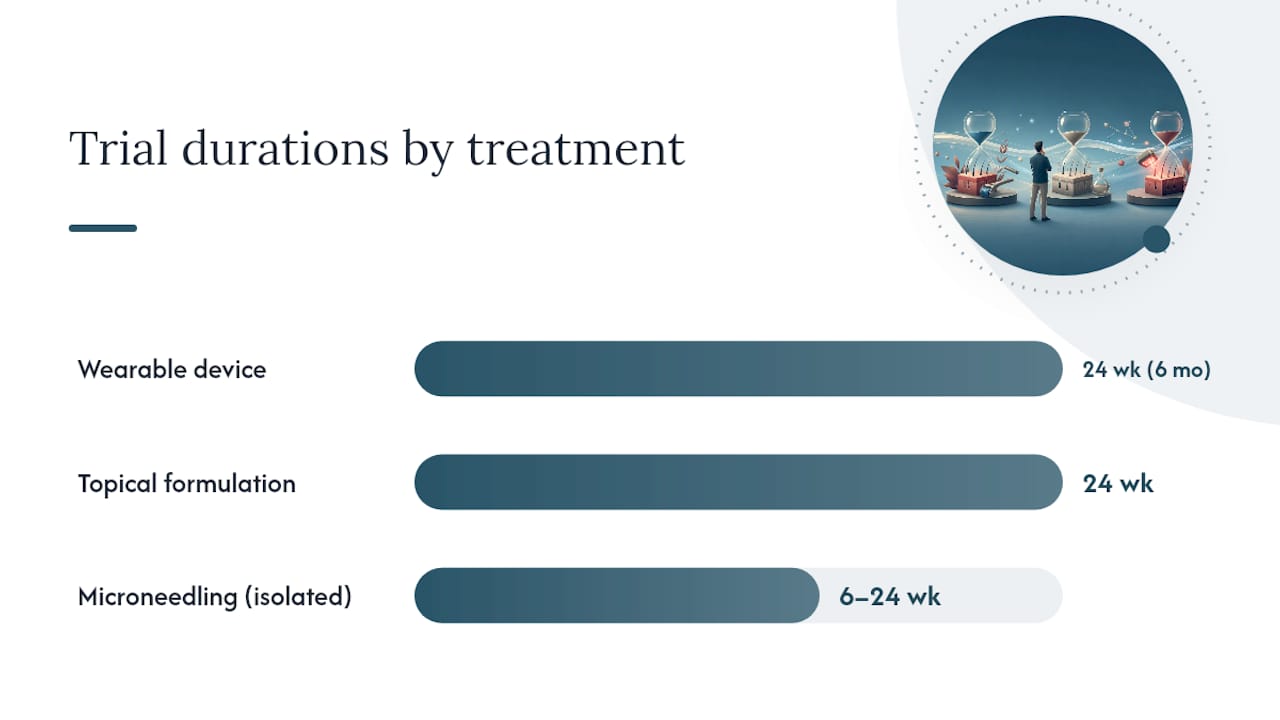
Microneedling's evidence base is the least consistent of the group. Reviews and guidelines point out that combination therapies routinely outperform any single treatment used alone, which explains why isolated microneedling underwhelms in some trials but performs better when stacked with a topical agent.
A few patterns hold across nearly all of this research:
- Trial durations that matter run 6 to 24 weeks minimum, sometimes 6 months for device data.
- Adherence drives outcomes. Skipping sessions or stopping early shrinks the measured effect.
- Long-term durability data, what happens after a year or two, is still limited across most new modalities.
How to Decide If a Scalp Treatment Is Worth It for You
Start with a diagnosis, not a product. A dermatologist or trichologist using microscopic scalp exam and baseline photos tells you whether you're dealing with androgenetic alopecia, a treatable inflammatory condition, or something else entirely. Skipping this step is the single most common reason people end up paying for the wrong treatment. Reading about personalized specialist evaluations is a good place to start if you've never seen a specialist for hair loss before.
Once you have a diagnosis, set a realistic timeline and budget before committing to a package. Ask a provider these questions:
- What diagnostic steps did you use before recommending this plan?
- What clinical evidence supports this specific treatment for my condition?
- How many sessions are needed, and over what timeframe?
- How will progress be monitored, and what happens if I don't respond?
- What's the full cost breakdown, including any maintenance phase?
Pro Tip: Get itemized pricing in writing before your first session. Providers who bundle "maintenance" into an open-ended subscription without a clear endpoint are the ones most worth questioning.
Aftercare matters too. Follow whatever gentle-cleansing or product-use instructions come with your treatment, and don't layer new active ingredients on top without checking they won't cause irritation.
How MyHair.ai Thinks About Scalp Treatments
Treatments work best when they follow a real diagnosis and actually fit your routine, not when they're bought on impulse. MyHair.ai's AI-driven scans and longitudinal tracking give you an objective baseline before you spend money on any paid procedure, then pair that baseline with tailored product and clinic recommendations. Scan first. Decide second.
— Cyriac
Try a Free AI Scalp Scan Before You Book Anything
Before you commit to a package of sessions, get a clear read on what your scalp and hair actually need. MyHair.ai's free plan lets you run an AI-powered scan that flags visible patterns in density, thickness, and scalp condition, the same kind of baseline a good provider should want before recommending treatment.
The scan doesn't replace a dermatologist, but it gives you something most people walk into a clinic without: objective, trackable data. That makes it easier to tell a provider what you're actually seeing over time and to judge whether a treatment is working instead of guessing. If you want ongoing tracking and more detailed recommendations, the Monthly plan runs $9.99 per month. If a scan points toward something a home routine won't fix, MyHair.ai's clinic directory and doctor listings help you find someone qualified nearby. Start with the free scan, then decide where your money actually needs to go.
This article is general information, not a substitute for advice from a qualified doctor. Consult a qualified healthcare professional about your own circumstances before acting on anything here.
Sources
- Efficacy, Safety, and Tolerability of a Wearable Electrotrichogenic Device in Men with Androgenetic Alopecia
- Hair growth-promoting effects of a multi-targeted cosmetic formulation (TrinogeniX™) in AGA: 24-week RCT
- Clinical review: scalp health and hair loss management (review/guideline perspective)
FAQ
What Are the Downsides of Scalp Treatments?
The main downsides are variable effectiveness, cost, and time commitment, since most treatments need weeks or months of consistent use before results show. Side effects are usually mild and temporary, like redness or irritation, though invasive procedures carry a small infection risk.
Is It Worth It to Get a Scalp Treatment?
It depends on the treatment and whether it follows a real diagnosis. A device-based therapy tested in a sham-controlled trial showed a measurable density gain at 6 months, while unproven treatments sold without any diagnostic step are a weaker bet for your money.
Do Dermatologists Recommend Scalp Scrubs?
Dermatologists generally support gentle exfoliation for removing buildup and improving comfort, especially for dandruff or product residue. They typically frame it as a supporting step, not a standalone fix for hair loss, and recommend pairing it with a proper diagnosis first, something covered in more detail in this guide to improving scalp health.
When Should a Scalp Treatment Be Avoided?
Avoid new scalp treatments if you have an active infection, open wounds, or an undiagnosed inflammatory condition like scalp psoriasis that needs medical therapy first. In those cases, see a dermatologist before adding exfoliation, microneedling, or devices, since treating the wrong condition can delay real relief.
How Much Does an AI Scalp Analysis Cost?
MyHair.ai offers a free plan for a baseline AI scan, with a Monthly subscription at $9.99 per month for ongoing tracking and personalized recommendations. Pricing for the Yearly plan is available directly on the site.