
The most reliable early signs of androgenic alopecia, also called androgenetic alopecia or pattern hair loss, are patterned thinning concentrated at the crown or temples, shorter and finer hairs along the part line, and a gradually widening center part in women. These changes appear slowly over months or years, which is exactly what makes them easy to dismiss until significant thinning has already occurred.
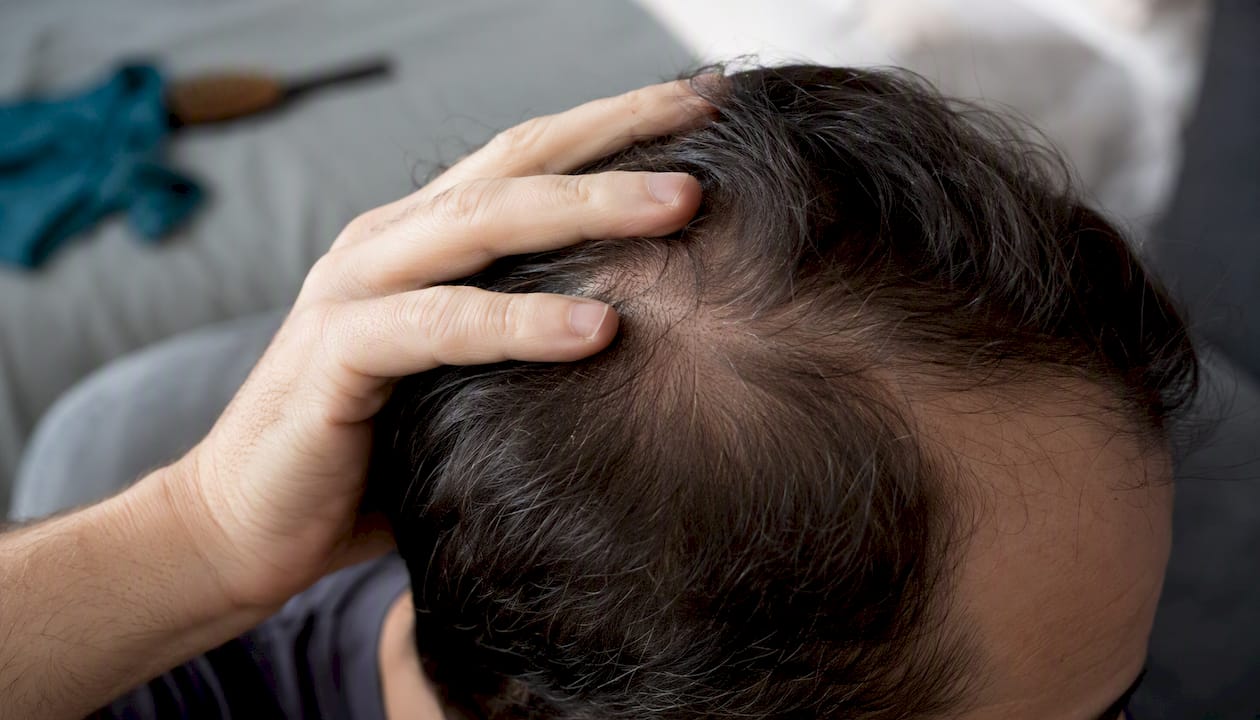
According to the Mayo Clinic, the most common symptoms of hair loss include gradual thinning on top of the head, a receding hairline in men, and a broader part or reduced ponytail volume in women. If you notice any of these, the single best next step is to take standardized photos now and compare them in three to six months.
Key hallmark signs to watch for:
- Patterned thinning concentrated at the crown, temples, or center part rather than diffuse all-over shedding
- Receding hairline forming an "M" shape at the temples in men
- Widening center part or visible scalp at the crown in women
- Miniaturized hairs: shorter, finer, almost wispy strands mixed in among normal-thickness hairs
- Increased shedding that feels above your normal baseline, especially on the pillow or in the shower drain
- Reduced ponytail circumference over time, even when total hair length stays the same
Pro Tip: Take a photo of your part line under bright, consistent lighting today and store it with a date label. That single image will be more useful than any memory-based comparison six months from now.
Key Takeaways
Androgenic alopecia is a progressive, genetically driven condition where early recognition and consistent documentation preserve the most treatment options.
| Point | Details |
|---|---|
| Hallmark signs | Patterned thinning, miniaturized hairs, widening part in women, and "M"-shaped recession in men are the defining signs. |
| Sex-specific patterns | Men lose hair at temples and crown; women show diffuse crown thinning with the frontal hairline largely spared. |
| Photo documentation | Standardized photos every 3–6 months are more reliable than memory for detecting gradual progression. |
| When to see a clinician | Sudden or patchy loss, scalp inflammation, or systemic symptoms warrant prompt evaluation to rule out other causes. |
| Myhair monitoring | Myhair's Hair Score feature provides AI-analyzed scalp scans and longitudinal tracking to support early, evidence-based decisions. |
Table of Contents
- How does androgenic alopecia present differently in men and women?
- What early signs can you check at home right now?
- Why does androgenic alopecia progress the way it does?
- What signs suggest a different cause of hair loss?
- When should you see a clinician, and what will they do?
- What treatments are available, and why does timing matter?
- How to monitor your hair loss at home with a reliable protocol
- Why early recognition matters more than most people realize
- Myhair's AI-powered hair tracking for people who want more than a photo folder
- Sources
- FAQ
How does androgenic alopecia present differently in men and women?
The pattern is the tell. In men, androgenetic alopecia typically starts with bitemporal recession, the hairline pulling back at both temples to form a recognizable "M" shape, followed by thinning at the vertex (the crown). Over time, the two zones can merge, leaving only a horseshoe-shaped band of hair around the sides and back. Onset can begin as early as the late teens or early twenties, though many men notice it more clearly in their thirties.
Women follow a distinctly different pattern. Rather than a receding hairline, female-pattern hair loss usually produces diffuse thinning across the crown with a widening center part, while the frontal hairline stays largely intact. This diffuse quality is part of why women often miss early signs: there is no dramatic recession to notice in the mirror, just a gradual sense that the part looks wider or the scalp more visible in bright light. Female-pattern loss tends to become more noticeable after menopause, when estrogen levels fall and the relative influence of androgens increases, though it can appear at any adult age.
Prevalence note: MedlinePlus notes that androgenetic alopecia affects tens of millions of Americans, with prevalence rising steadily with age in both sexes.
Clinicians use two classification systems to describe severity: the Norwood-Hamilton scale for men (stages I through VII, tracking recession and vertex thinning) and the Ludwig scale for women (grades I through III, tracking crown diffusion). These scales are clinical tools, not self-diagnosis checklists, but knowing they exist helps you communicate precisely with a dermatologist about where you fall.
What early signs can you check at home right now?
Most people notice androgenic alopecia only after meaningful thinning has already occurred. The American Academy of Dermatology points out that early signs like a widening part and reduced ponytail fullness are gradual and easy to miss without photos. A few simple checks done consistently can catch changes months earlier than the mirror alone.
- Take a standardized part-line photo. Stand under bright overhead light, part your hair in the same place you always do, and photograph straight down onto the scalp. This is your baseline. Repeat every three to six months.
- Measure your ponytail circumference. Pull your hair into a low ponytail at the same position each time and wrap a soft tape measure around it. A shrinking circumference over several months is a concrete, quantifiable early sign of hair thinning.
- Check for miniaturized hairs. Look closely at the hairs along your part or hairline. If you see short, fine, almost translucent strands mixed in with your normal hair, those are likely miniaturized follicles, a hallmark of androgenetic alopecia.
- Do a gentle hair-pull test. Grasp about 40 hairs between your thumb and forefinger, apply gentle traction, and slowly slide your fingers to the tips. Losing more than two or three hairs consistently across multiple scalp zones suggests active shedding worth tracking. Losing six or more per pull is typically considered clinically significant and warrants evaluation.
- Examine scalp visibility in bright light. Natural sunlight or a bright bathroom light will reveal scalp show-through that indoor lighting hides. Check the crown and part line specifically.
Pro Tip: Documenting every three to six months is far more reliable than trusting your memory. Changes in androgenic alopecia are so gradual that most people genuinely cannot recall what their part looked like a year ago without a photo.
Why does androgenic alopecia progress the way it does?
The biology comes down to one process: follicle miniaturization. In people genetically predisposed to pattern hair loss, hair follicles in susceptible scalp zones carry receptors that are abnormally sensitive to dihydrotestosterone (DHT), a hormone derived from testosterone. DHT binds to these receptors and progressively shortens the anagen (active growth) phase of the hair cycle. Each successive growth cycle produces a slightly shorter, thinner hair shaft until the follicle eventually produces only a fine, colorless vellus-like hair, or stops producing hair altogether.
This is why the visible signs of androgenic alopecia are what they are. You do not lose long hairs suddenly. Instead, the hairs that regrow after shedding come back shorter and finer each time, which is why the part line fills with wispy strands before it becomes visibly sparse. StatPearls at NCBI describes this as a genetically predetermined disorder driven by excessive androgen response, with progressive follicular miniaturization as the defining pathological feature.
| Progression stage | Typical visible sign | Approximate timeline |
|---|---|---|
| Early | Slightly wider part, finer hairs at crown or temples | Years 1–3 |
| Moderate | Visible scalp at crown, reduced ponytail volume | Years 3–6 |
| Advanced | Significant thinning or bald patches at vertex, deep recession | Years 6+ |
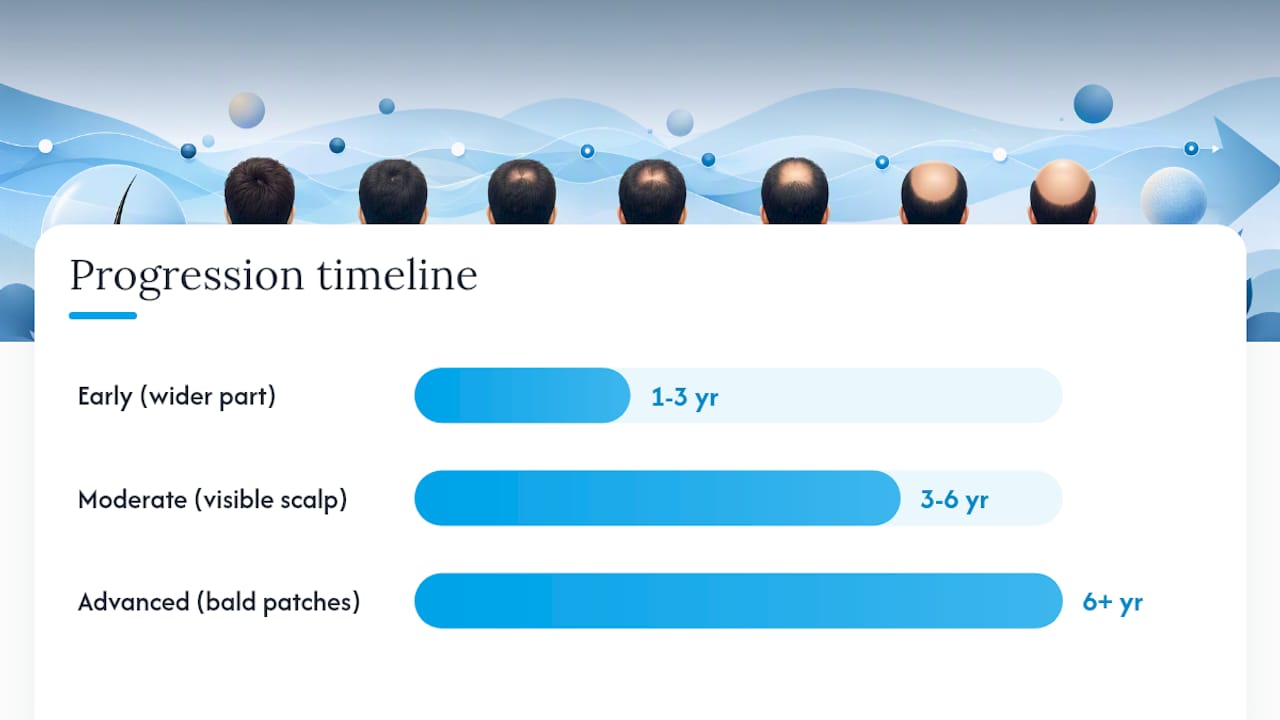
The timeline varies considerably by genetics and age of onset. What matters clinically is that follicles in the early and moderate stages can often still respond to treatment. Once a follicle is fully miniaturized and scarred, recovery becomes much harder, which is the core reason early detection has real practical value.
What signs suggest a different cause of hair loss?
Not every hair loss is androgenic alopecia, and getting the diagnosis wrong means getting the treatment wrong. Several red flags point toward other causes that need different management.
Seek prompt evaluation if you notice:
- Sudden, patchy loss appearing over days or weeks rather than gradual thinning over months. This pattern is more consistent with alopecia areata, an autoimmune condition.
- Scalp inflammation: redness, pain, tenderness, scaling, or oozing. These signs suggest infection (such as tinea capitis, a fungal scalp infection) or a scarring alopecia, neither of which is genetic pattern loss.
- Exclamation-point hairs: short hairs that are narrower at the base than the tip, a clinical marker for alopecia areata.
- Loss of eyebrows or eyelashes alongside scalp thinning, which can indicate alopecia areata, thyroid disease, or other systemic conditions.
- Systemic symptoms: unexplained weight change, fatigue, cold intolerance, or irregular menstrual cycles. These raise suspicion for thyroid dysfunction, iron deficiency anemia, or hormonal disorders like PCOS.
- Diffuse, sudden shedding across the whole scalp, often two to three months after a stressful event, illness, surgery, or significant weight loss. This pattern fits telogen effluvium, a temporary disruption of the hair cycle that typically resolves on its own.
- Traction-related loss along the hairline or temples in people who regularly wear tight hairstyles, braids, or extensions.
Harvard Health notes that women presenting with hair thinning alongside acne, hirsutism, or irregular cycles should be screened for PCOS, since management in that case involves addressing the underlying hormonal driver, not just the hair loss itself. When any of these red flags are present, labs including thyroid-stimulating hormone (TSH), ferritin, a complete blood count, and hormonal panels may be appropriate before assuming the cause is genetic.
When should you see a clinician, and what will they do?
See a dermatologist or your primary care provider if you notice rapid or sudden loss, any of the red flags listed above, or if you simply want a confirmed diagnosis before starting treatment. Pattern hair loss is common enough that many people self-diagnose, but a clinical exam rules out the conditions that mimic it and catches anything that needs different treatment.
A typical evaluation follows a clear sequence. The clinician takes a detailed medical and family history, since a family history of pattern baldness on either side is a strong predictor. They examine the scalp directly, often using dermoscopy, a handheld magnifying device that can visualize miniaturized hairs and follicular changes invisible to the naked eye. A hair-pull test is usually performed. Labs such as TSH, ferritin, and a CBC are ordered when the history or exam suggests a systemic cause. A scalp biopsy is rarely needed but may be performed when the diagnosis remains unclear after the standard workup.

The Cleveland Clinic confirms that this clinical workflow, history plus scalp exam plus selective labs, is the standard approach, with biopsy reserved for ambiguous cases. You do not need to wait until thinning is obvious to book that appointment. The earlier a clinician confirms the diagnosis, the more treatment options remain available.
What treatments are available, and why does timing matter?
Treatments for androgenic alopecia work best when follicles are still alive and producing some hair. Once miniaturization is complete and the follicle is gone, no topical or oral medication will restore it. That is the practical argument for acting early.
The most commonly used first-line options include:
- Topical minoxidil (2% or 5% solution or foam): available over the counter for both men and women, applied directly to the scalp. It extends the anagen phase and can thicken existing hairs and stimulate some regrowth. Results take four to six months to appear.
- Oral finasteride (1 mg daily, for men): a prescription medication that blocks the conversion of testosterone to DHT. Effective at slowing progression and producing modest regrowth in many men. Not recommended for women of childbearing potential due to teratogenicity risk. Side effects, including sexual dysfunction, affect a minority of users and are typically reversible on discontinuation.
- Low-level laser therapy (LLLT): FDA-cleared devices (combs, caps, helmets) that use red light to stimulate follicular activity. Evidence suggests modest benefit for early-stage loss; it is often used as an adjunct rather than a standalone treatment.
- Referral for advanced procedures: platelet-rich plasma (PRP) injections and hair transplant surgery are options for moderate to advanced cases. A dermatologist or hair restoration specialist can assess candidacy.
Finasteride is FDA-indicated for men only. Women who are or may become pregnant must not handle crushed or broken finasteride tablets, due to the risk of harm to a male fetus. It can also cause sexual side effects (reduced libido, erectile dysfunction) in a minority of men, which usually resolve after stopping treatment. Discuss these risks with a physician before starting.
Realistic expectations matter. No treatment stops androgenic alopecia permanently. The goal is to slow progression, maintain and thicken existing hairs, and potentially recover some density in areas of early thinning. For a deeper look at current options, the latest hair loss treatment overview at Myhair covers emerging therapies alongside established ones. Psychological effects, including reduced self-esteem and anxiety, are real and worth addressing alongside any physical treatment; speaking with a counselor or joining a support community can be a meaningful part of managing the condition.
How to monitor your hair loss at home with a reliable protocol
Consistent documentation turns a subjective feeling ("my hair seems thinner") into objective data you can act on. The Cleveland Clinic recommends periodic photo documentation as more reliable than memory-based assessments for tracking progression over time.
- Choose three fixed angles: top-down (part line), front hairline, and crown. Use the same parting every time.
- Control your lighting. Natural daylight from a window, or a consistent bathroom light, works well. Avoid flash, which flattens texture and hides scalp show-through.
- Use the same camera and distance. A smartphone held at arm's length, or propped at a fixed distance, gives consistent framing. Some people tape a small mark on the mirror as a positioning guide.
- Label every image immediately. File name or photo caption: date, angle, and any notes (e.g., "day 1 of minoxidil").
- Repeat every three to six months. Shorter intervals produce noise; longer intervals miss meaningful changes.
- Track simple metrics alongside photos: ponytail circumference in millimeters, a subjective 1–10 scalp visibility score, and part-line width in centimeters if you can measure it consistently.
AI-assisted tools add a layer of objectivity that manual photo logs cannot easily replicate. Myhair's Hair Score feature analyzes uploaded scalp scans using algorithms trained to detect miniaturization patterns, generate a standardized score, and plot changes on a longitudinal graph. For readers who want automated capture guidance and a visual progression report rather than a folder of unlabeled photos, that kind of structured workflow removes a lot of the guesswork from self-monitoring.
Pro Tip: Consistency beats perfection. A slightly imperfect photo taken on the same day every three months is worth far more than a perfect photo taken whenever you remember.
Why early recognition matters more than most people realize
Hair loss carries a weight that goes beyond aesthetics, and the clinical reality is that the window for effective intervention is real. Follicles in the early stages of miniaturization can still respond to treatment. Waiting until thinning is obvious means some of those follicles are already gone.
The pattern of androgenic alopecia is gradual enough that most people spend years in a state of vague concern before taking any documented action. That delay is understandable, but it costs options. A standardized photo taken today, a dermatologist appointment booked when red flags appear, and a consistent monitoring habit are not overreactions. They are the minimum steps that keep your choices open.
If you are reading this because something looks different in the mirror, that instinct is worth trusting. Document it, track it, and get it evaluated if it progresses or if any of the red flags described above appear.
Myhair's AI-powered hair tracking for people who want more than a photo folder
Tracking hair loss manually works, but it demands discipline most people do not sustain. Myhair offers a different approach: upload a scalp scan through the app onboarding, and the platform's AI analyzes your hair health, generates a Hair Score, and builds a longitudinal graph of your progression over time. You get standardized capture guidance so each scan is comparable to the last, tailored product recommendations based on your specific pattern, and a clear visual record you can share with a dermatologist.
This is not a replacement for a clinical diagnosis. It is the layer between "I think something is changing" and "I have documented evidence to show my doctor." For anyone managing early androgenic alopecia, that evidence layer is exactly what makes treatment conversations productive. Get your Hair Score and start building a record that actually tells you something.
Sources
- Androgenetic alopecia - MedlinePlus Genetics
- Androgenetic Alopecia - StatPearls - NCBI Bookshelf
- Hair loss - Symptoms and causes - Mayo Clinic
- Hair loss: Early signs - American Academy of Dermatology (AAD)
- Male pattern baldness (androgenic alopecia) - Cleveland Clinic
Consult a board-certified dermatologist for a personalized evaluation. This article provides general information only and is not a substitute for professional medical advice.
FAQ
How do you know if you have androgenetic alopecia?
The clearest indicators are gradual, patterned thinning at the crown or temples in men and a widening center part or reduced ponytail volume in women, with no scalp inflammation or sudden onset. A dermatologist can confirm the diagnosis through scalp exam and dermoscopy.
How is androgenetic alopecia treated?
First-line treatments include topical minoxidil for both sexes and oral finasteride for men; low-level laser therapy and hair restoration procedures are options for more advanced cases. Treatment slows progression and can thicken existing hairs, but works best when started before significant follicle loss has occurred.
Low-dose oral minoxidil requires medical supervision: it can cause fluid retention, a faster heart rate, and lowered blood pressure, so clinicians typically monitor blood pressure and ask about heart conditions before prescribing. It is not recommended during pregnancy or breastfeeding. Discuss these risks with a physician before starting.
How do you fight DHT-related hair loss?
Finasteride reduces DHT levels by blocking the enzyme that converts testosterone to DHT, and is the most studied pharmacological approach for men. Minoxidil does not block DHT but counteracts its effects by extending the hair growth phase.
How can you get thicker hair with androgenic alopecia?
Topical minoxidil applied consistently can thicken miniaturized hairs over four to six months, and low-level laser therapy may add modest benefit as an adjunct. Cosmetic options like thickening shampoos can improve the appearance of existing hair while medical treatments work.
Recommended
- Comprehensive Guide to Treating Androgenetic Alopecia: Options and Solutions | MyHair
- Alopecia on Hairline: Causes, Signs, and New Solutions 2025 | MyHair
- Alopecia Androgenetica Treatment: Best Options for 2025 | MyHair
- Early Male Pattern Baldness: Causes, Signs, and Smart Solutions for 2025 | MyHair