
TL;DR:
- Choosing between boutique surgical practices, high-volume FUE specialists, academic programs, or medical spas depends on your specific needs for surgical expertise, volume, oversight, or adjunct therapies.
- Always request itemized quotes and verify surgeon credentials through independent sources before committing to any clinic.
The strongest alternatives to Solve Clinics fall into four clinic categories: board-certified boutique surgical practices, high-volume FUE specialists, accredited academic or hospital-affiliated programs, and transparent medical-spa models that publish itemized quotes. Each serves a different patient profile.
Board-certified boutique practices offer the deepest surgical expertise and personalized planning. Best for complex cases or patients who want a single surgeon managing every step. High-volume FUE specialists prioritize throughput and often carry the most before/after documentation. Best for straightforward hairline restoration on a defined budget. Academic or hospital-affiliated programs bring oversight and research-backed protocols. Best for patients with medical comorbidities or reconstructive needs. Medical-spa models with surgical oversight emphasize adjunct therapies like PRP/PRF alongside the procedure. Best for patients who want bundled maintenance from day one.
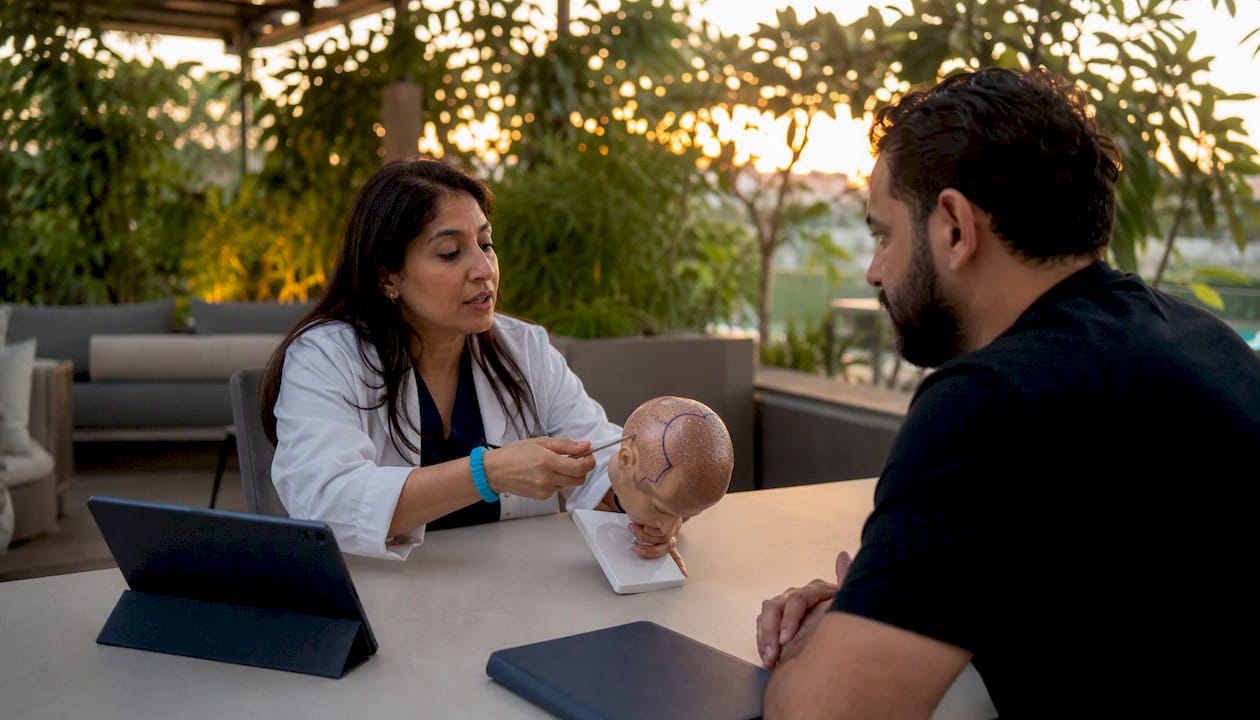
Before booking a consult anywhere, upload your photos to Myhair's AI scanner to generate a standardized hair analysis you can share with any clinic for a more accurate graft estimate.
TL;DR
- Request an itemized quote from at least two clinic categories before committing.
- Verify surgeon credentials through ISHRS (International Society of Hair Restoration Surgery) or board certification records.
- Upload your scan to Myhair to standardize your baseline before consults.
Table of Contents
- How do the main alternative clinic categories compare?
- What should you ask when evaluating a Solve Clinics alternative?
- What do hair transplants cost in the U.S., and does insurance cover it?
- Why long-term maintenance matters as much as the surgery itself
- How do you verify a clinic's before/after claims?
- What happens between your first consult and visible results?
- How Myhair helps you prepare before your first consult
- Key Takeaways
- The case for transparency over the lowest price per graft
- Myhair gives you a clinic-ready report before you spend a dollar
- Useful sources for your research
- FAQ
How do the main alternative clinic categories compare?
Choosing between clinic types comes down to what you actually need: surgical depth, volume experience, or bundled long-term care. The table below maps each category against the dimensions patients use most.
| Category | Pricing transparency | Procedure types | Surgeon credentials | Before/after docs | Post-op care (PRP/PRF, meds) | Financing | Consult format |
|---|---|---|---|---|---|---|---|
| Boutique surgical practice | Often itemized on request | FUE, FUT, body hair | Board-certified, fellowship-trained | Detailed, dated galleries | Varies; surgical focus | Clinic plans, third-party lenders | In-person primary |
| High-volume FUE specialist | Published per-graft rates common | FUE, no-shave FUE | ISHRS-member surgeons | Large galleries, high case volume | PRP add-ons common | Broad financing options | Virtual + in-person |
| Medical spa with surgical oversight | Package pricing; adjuncts bundled | FUE, PRP/PRF, scalp therapies | Oversight MD; check credentials carefully | Marketing-heavy; verify independently | Strong adjunct focus | Membership or package plans | Virtual-first |
| Academic/hospital-affiliated program | Fee schedules; insurance billing possible | FUE, FUT, reconstructive | Residency-trained, academic credentials | Peer-reviewed case documentation | Comprehensive; research protocols | Insurance billing for reconstructive | In-person required |
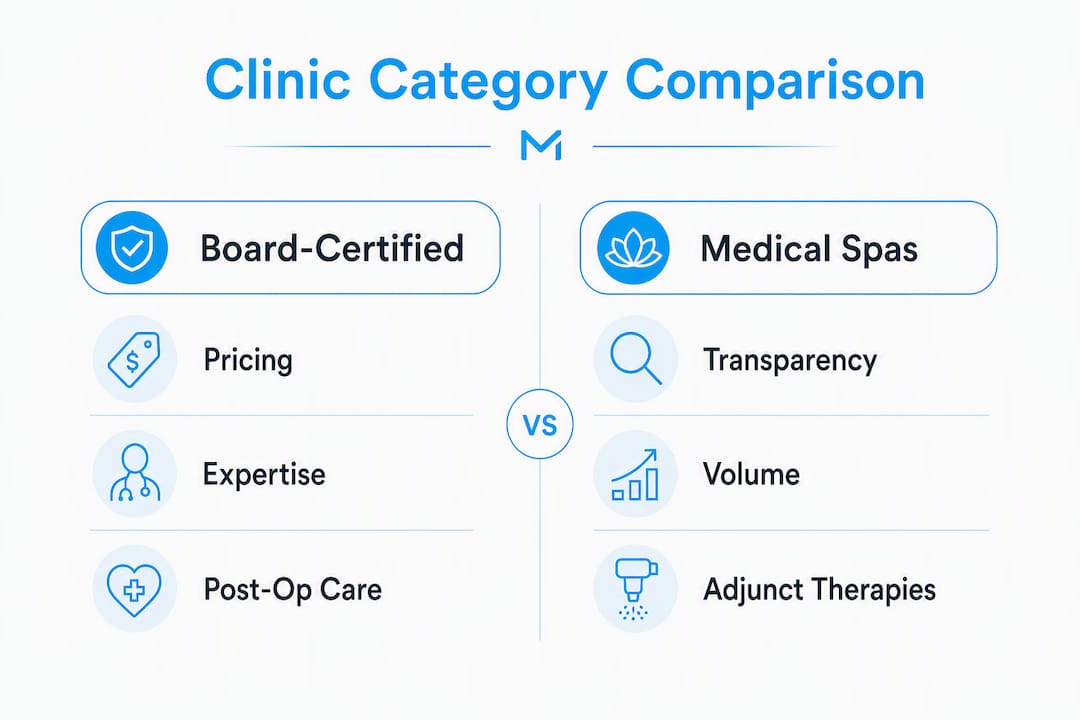
Aggregator directories can surface local options across all four categories, but treat them as a discovery starting point, not a vetting tool. Credentials and independent reviews still need separate verification.
Category tradeoffs worth knowing:
- Boutique practices offer cost predictability once you get an itemized quote, but availability is limited and wait times can stretch months.
- High-volume specialists have the most documented cases, which helps you evaluate typical results, but the surgeon-to-patient ratio during surgery matters. Ask directly.
- Medical spas bundle PRP/PRF well, but their scope differs from surgical centers in ways that matter for complex cases. A med spa is not a substitute for a surgical practice if your case involves significant density loss.
- Academic programs carry the strongest oversight but the slowest scheduling. Worth it for reconstructive cases; possibly overkill for cosmetic hairline work.
What should you ask when evaluating a Solve Clinics alternative?
Focus on clinics that publish itemized quotes and documented treatment plans. Pricing transparency is the single most reliable differentiator between clinics that are easy to compare and those that aren't.
Evaluation checklist:
- Verify surgeon credentials. Confirm ISHRS membership or board certification. Ask how many years the surgeon has performed hair restoration specifically.
- Request an itemized graft estimate. The quote should specify extraction method (FUE vs. FUT), estimated graft count, and per-graft rate separately.
- Confirm extraction technique. FUE, FUT, no-shave FUE, and body hair transplant each carry different costs, recovery times, and scar profiles.
- Ask about typical graft counts for your pattern. A Norwood III hairline and a Norwood VI crown are completely different procedures. Get a range, not a single number.
- Request dated before/after photos. Photos should include patient context (age, hair type, graft count) and be from the actual operating surgeon.
- Check independent reviews. Yelp, Google, and dedicated platforms like hairtransplant.review carry reviews that marketing pages don't.
- Probe the post-op follow-up schedule. How many follow-ups are included? At what intervals? What triggers a concern visit?
- Ask about PRP/PRF and adjunct therapies. Are they included, optional, or not offered? What's the cost if separate?
- Confirm financing and guarantee terms. What happens if results fall below the documented plan?
Red flags that should stop your shortlisting:
- Surgeon refuses to provide credentials or ISHRS membership number.
- No itemized quote available before you pay a deposit.
- Pressure to pay the full amount upfront before pre-op testing.
- No documented aftercare plan or follow-up schedule.
Pro Tip: A per-graft rate is a starting figure, not a final quote. Solve Clinics, for example, lists per-graft starting rates of $5 for shaved FUE and $6 for no-shave FUE; your total depends on graft count, technique, and any adjunct therapies added. Always convert the per-graft rate into a total estimated cost before comparing clinics.
What do hair transplants cost in the U.S., and does insurance cover it?
Expect a wide range. Small cases often start around mid-thousands of dollars. A typical single-session FUE for cosmetic hairline restoration runs higher, and large or complex cases cost more.
Per-graft pricing is a baseline, not the bill. Total graft count, extraction method, and adjunct therapies all shift the final number. No-shave FUE carries a premium over shaved FUE because of the added technical complexity and operating time. That differential can add up quickly across 2,000+ grafts.
Cost range reference:
- Small case (under 1,500 grafts): $3,000–$6,000
- Mid-range case (1,500–3,000 grafts): $6,000–$12,000
- Large case (3,000+ grafts): $12,000 and up
On insurance: cosmetic hair loss procedures are almost never covered. The exception is reconstructive surgery tied to documented medical necessity, such as scarring from burns or trauma. Solve Clinics' terms note that the clinic does not operate as a managed-care entity, which reflects the broader reality that most hair restoration practices sit outside standard insurance billing. For financing, common options include clinic-direct payment plans, third-party medical lenders (CareCredit, Alphaeon Credit), and phased treatment plans that split procedures across sessions.
Why long-term maintenance matters as much as the surgery itself
The quality of a clinic's long-term care plan can be as important as the surgical outcome. Hair loss is a chronic condition. A transplant addresses existing follicles; it doesn't stop ongoing loss in untreated zones. Clinics that bundle or document maintenance plans deliver better lifetime value because they're treating the whole picture.
Look for these maintenance services when evaluating any alternative:
- PRP/PRF protocols with documented session frequency and pricing.
- Finasteride and minoxidil guidance, including whether the clinic has an in-house prescriber.
- Scalp health monitoring at follow-up visits.
- Touch-up or density-improvement plans with clear eligibility criteria.
- Outcome tracking with dated photos at 3, 6, and 12 months post-op.
Medical spas often lead on adjunct therapies like PRP/PRF, while surgical practices may focus on operative technique and graft survival. Neither model is universally better. The right fit depends on whether you need more surgical depth or more ongoing regenerative support. Many patients benefit from combining treatment strategies across both.
Pro Tip: Ask any clinic for their documented follow-up adherence rate. A clinic that tracks how many patients complete their 12-month follow-up schedule is one that takes long-term outcomes seriously. If they can't answer the question, that tells you something.
How do you verify a clinic's before/after claims?
Trust only documented, dated before/after galleries with patient context and independent reviews. Marketing-only galleries, where lighting, angles, and cropping vary between photos, are weak evidence.
- Ask for original photos with dates, magnification notes, and graft count documented.
- Request third-party review links (Google, Yelp, hairtransplant.review) rather than testimonials on the clinic's own site.
- Confirm whether the images represent typical results or exceptional cases. Ask directly: "What does an average outcome look like for my pattern?"
- Watch for consistent lighting changes between before and after shots, extreme cropping that hides the scalp perimeter, or a gallery where every patient appears to have identical hair texture.
A reasonable baseline for independent reviews: look for a pattern across at least 20–30 verified patient reviews on third-party platforms before drawing conclusions. One or two glowing reviews on a clinic's own site prove nothing.
What happens between your first consult and visible results?
Consultations typically start with a virtual evaluation or in-person assessment, followed by an itemized quote and surgical plan. Booking follows after pre-op clearance and scheduling availability.
Typical timeline:
- Initial consult (virtual or in-person).
- Pre-op testing and medical clearance: 1–4 weeks.
- Surgery date scheduling: depends on clinic capacity; popular clinics may book 2–4 months out.
- Immediate post-op care: first 2 weeks (washing protocol, activity restrictions, graft protection).
- Shedding phase: 1–3 months post-op (normal; transplanted hairs shed before regrowing).
- Early regrowth: 3–6 months.
- Visible maturation: 9–12+ months for full density assessment.
Bring to your consult:
- Photos showing your hairline at multiple ages if available.
- A complete list of current medications (finasteride, minoxidil, blood thinners).
- Notes on previous hair-loss treatments and outcomes.
Some clinics, including those with travel programs, offer free initial consultations and preliminary graft estimates subject to in-person confirmation. If you're considering an out-of-state clinic, confirm what's virtual versus what requires an in-person visit before you book travel.
How Myhair helps you prepare before your first consult
Myhair turns your photos into a standardized hair analysis report you can share with any clinic for a more accurate graft estimate. Before you sit across from a surgeon, having a documented baseline changes the conversation.
What Myhair's platform offers:
- Scanner camera: Upload photos to generate a scan-based hair density and loss-pattern report. Start your scan here.
- Hair score: A standardized metric that lets you compare your baseline across consults and track change over time.
- AI-based growth projections: Personalized projections based on your scan data, not generic pattern charts.
- Clinic-ready report: A shareable document clinics can use to refine graft estimates before your in-person visit.
- Clinic directory: Myhair's curated clinic list filters for data completeness, giving you a vetted starting shortlist.
Pro Tip: Bring your Myhair report to every consult. Clinics that engage with standardized data rather than dismissing it tend to be the ones that take documentation seriously across the board.
Key Takeaways
Choosing the right alternative to Solve Clinics requires verifying surgeon credentials, requesting itemized quotes, and confirming long-term maintenance plans before you book.
| Point | Details |
|---|---|
| Itemized quotes are non-negotiable | Request a quote that separates graft count, per-graft rate, and adjunct therapy costs before comparing clinics. |
| Per-graft rate is a starting figure | Total cost depends on graft count and technique; no-shave FUE carries a premium over shaved FUE. |
| Verify credentials independently | Confirm ISHRS membership or board certification directly, not through the clinic's own marketing. |
| Long-term care matters | Prioritize clinics with documented PRP/PRF protocols, follow-up schedules, and outcome tracking. |
| Myhair standardizes your comparison | Upload your scan to Myhair to generate a clinic-ready report before your first consult. |
The case for transparency over the lowest price per graft
The per-graft rate gets most of the attention in hair transplant research, and it's almost always the wrong number to optimize for. A clinic charging $4/graft with no documented follow-up plan, no independent reviews, and a surgeon whose credentials you can't verify is a worse deal than one charging $6/graft with a 12-month outcome protocol and 200 verified patient reviews.
Hair loss doesn't stop after surgery. The transplanted follicles survive, but untreated zones continue thinning. A clinic that treats the procedure as a one-time transaction is selling you half a solution. The ones worth choosing treat hair restoration as a long-term relationship: documented baselines, scheduled follow-ups, and adjunct therapies that address ongoing loss. That's what evaluating a clinic's ongoing care capability actually looks like in practice.
Use the checklist in this article during every consult. And use Myhair to standardize your baseline before you walk into the first one. The combination reduces the gap between what a clinic promises and what you can actually hold them to.
Myhair gives you a clinic-ready report before you spend a dollar
Most patients walk into hair transplant consults with nothing but photos on their phone. Myhair changes that. Upload your photos through the AI-powered scanner, and you get a standardized hair density and loss-pattern report that any clinic can use to sharpen their graft estimate before you commit to anything.
Two immediate benefits: you arrive at every consult with documented baseline data instead of a verbal description, and you can compare itemized quotes across clinics using the same reference point. That makes the difference between a quote that sounds good and one you can actually evaluate. Ready to build your report? Start your hair analysis here.
Useful sources for your research
- Myhair clinic directory — curated shortlist filtered for data completeness and clinic profile quality.
- FitRx hair loss resource — practical guidance on non-surgical hair-loss management and maintenance planning.
Prioritize independent patient reviews and direct credential verification over any directory listing, including this one.
FAQ
Is a hair transplant at Solve Clinics worth it?
Independent reviews describe Solve Clinics as patient-centered with personalized treatment plans. Whether it's worth it depends on your case complexity, budget, and how the itemized quote compares to alternatives in your area.
Solve Clinics publishes $5 per graft for shaved FUE and $6 per graft for no-shave FUE, with PRP sessions at $330. Those are per-graft starting rates; total cost depends on your graft count and any adjunct therapies.
Does insurance cover hair transplants?
Cosmetic hair loss procedures are almost never covered by insurance. Reconstructive cases tied to documented medical necessity, such as scarring from trauma or burns, may qualify, but standard hairline restoration does not.
Are hair transplants covered by insurance at alternative clinics?
The coverage reality is the same regardless of clinic. Most U.S. hair restoration practices, including alternatives to Solve Clinics, operate outside standard insurance billing for cosmetic procedures. Financing through third-party medical lenders is the most common payment alternative.
How do I find credible alternatives to Solve Clinics near me?
Start with ISHRS's surgeon directory to find board-certified specialists by location, then cross-reference with independent review platforms. Myhair's clinic directory also filters for data completeness to give you a vetted starting shortlist.