
The main visible symptoms of hair aging are graying, reduced shine, increased dryness and brittleness, thinning or density loss, and slower growth. These changes trace back to pigment loss, follicle miniaturization, and a breakdown in the protective lipid layer coating each hair shaft. By age 65, roughly 53% of men and 37% of women show some form of age-related hair loss or thinning.
TL;DR:
- Approximately 53% of men and 37% of women show signs of hair loss or thinning by age 65, mainly due to follicle miniaturization and aging processes.
- Graying usually starts in the 30s, first appearing at the temples, and is influenced by genetics and ethnicity, with the pattern progressing predictably over time.
- Aging hair tends to become duller and more brittle as lipid protection thins, with external damage from UV, heat, and chemicals accelerating these changes.
- Hair growth cycles shorten with age, reducing growth rate and maximizing length, especially after the mid-30s, which also coincide with increased visible thinning.
- Minoxidil remains the only widely supported medical treatment for age-related thinning, while lifestyle and proper care can slow visible aging signs.
Table of Contents
- Color Changes and Graying: What Happens and Why
- Texture and Shaft Changes: Dryness, Brittleness, and Loss of Shine
- Density and Thinning: Follicle Miniaturization and Senescent Alopecia
- Growth Cycle Changes and Timeline: How Rates and Phases Shift With Age
- Causes and Contributors: Intrinsic vs Extrinsic Factors
- When to See a Clinician and What Actually Works
- Practical Hair-Care and Styling Tips to Reduce Visible Aging Signs
- How Myhair Helps You Track These Changes Over Time
- The Real Question Isn't What's Changing, It's What You Do About It
- Sources
- FAQ
Color Changes and Graying: What Happens and Why
Graying starts inside the follicle, not on the surface. Melanocyte stem cells that supply pigment gradually decline, and each new hair strand that grows in carries less melanin than the last. Eventually a follicle stops producing pigment altogether, and the hair that emerges is white.
Timing varies widely, but graying often begins in a person's 30s, with genetics and ethnicity shaping how early and how fast it spreads. The pattern tends to follow a predictable path:
- Grays typically show up at the temples first.
- The pattern then moves toward the crown and top of the scalp.
- Body and facial hair usually gray later, or not at all, than scalp hair.
- Some people see scattered gray by their late 20s, while others stay mostly pigmented into their 50s.
None of this is abnormal. It is simply melanocyte activity winding down at a pace set largely by your genes.
Texture and Shaft Changes: Dryness, Brittleness, and Loss of Shine
Aging hair looks duller because it is losing its natural coating. Sebum production slows with age, and the hair shaft loses much of its 18-MEA layer, the thin lipid film that keeps the outer cuticle smooth and reflective. Once that layer thins out, porosity increases and moisture escapes faster than conditioners can replace it, regardless of how often you condition.
Inside the shaft, changes to the cortex and a drop in keratin expression make each strand stiffer and less able to hold water. That combination raises the odds of breakage and split ends. External stress speeds all of it along:
- UV exposure breaks down proteins in the cuticle over time.
- Heat styling tools dry out the shaft and weaken its structure.
- Repeated chemical treatments (color, relaxers, perms) strip the cuticle layer faster than it can rebuild.
- Mechanical stress from tight styles or rough brushing accelerates shaft wear, called weathering.
Pro Tip: Run your fingers down a single strand from root to tip. If it feels rough or catches, the cuticle has already lost significant smoothness, even if you can't see damage yet.
Density and Thinning: Follicle Miniaturization and Senescent Alopecia
Follicles don't disappear overnight. They shrink. Follicle miniaturization is the process where each growth cycle produces a slightly thinner, shorter hair than the one before, until some follicles stop producing visible hair altogether. Over years, this reduces both individual shaft diameter and total scalp density.
It helps to separate two things that often get lumped together:
- Senescent alopecia is diffuse, gradual thinning tied purely to chronological aging and affects the whole scalp fairly evenly.
- Androgenetic alopecia (pattern balding) follows hormone-driven patterns, typically a receding hairline or thinning crown in men and a widening part in women, and can start well before other aging signs appear.
The PMC review on follicle aging links both processes to stem cell exhaustion and chronic low-grade inflammation around the follicle. Visually, watch for a part line that looks wider than it used to, a ponytail that feels thinner in your hand, or scalp that shows through under bright light. Combined with the 53% and 37% prevalence figures cited earlier, thinning is less an exception with age than a statistical likelihood.
Growth Cycle Changes and Timeline: How Rates and Phases Shift With Age
Every hair cycles through three phases: anagen (active growth), catagen (a brief transition), and telogen (resting, before shedding). What changes with age is the anagen phase. It shortens, so each hair spends less time actively growing before it sheds, which means slower visible growth and shorter maximum hair length over time.
Rough timelines look like this:
- 20s to early 30s: Growth cycles run at full length; early graying may appear in some people.
- Mid-30s to 40s: Graying tends to become more noticeable; growth rate starts a gradual decline.
- 50s and beyond: Anagen phase shortening becomes more pronounced; density loss and texture changes are more visible.
None of these ranges are fixed. Genetics, hormone levels, and lifestyle factors shift the timeline earlier or later for any given person.
Causes and Contributors: Intrinsic vs Extrinsic Factors
Hair aging runs on two tracks that constantly interact. Intrinsic factors are the biological clock running inside every follicle:
- Oxidative stress that damages follicle cells over time
- Melanocyte and follicle stem cell exhaustion
- Immunosenescence, or a weakening immune response around the follicle
- Hormonal shifts, particularly during perimenopause and andropause
- Declining DNA-repair capacity in follicle cells
Extrinsic factors come from outside the body and speed up what genetics would otherwise handle more slowly:
- Cumulative UV exposure
- Repeated heat styling and chemical processing
- Smoking, which restricts blood flow to the scalp
- Poor nutrition, especially low protein or iron intake
- Chronic stress, which can push follicles into premature shedding
These two tracks feed each other. Melanin synthesis itself generates reactive oxygen species as a byproduct, and layering environmental oxidative stress on top compounds pigment and follicle damage faster than either factor alone. Certain lifestyle contributors deserve closer attention if you're trying to figure out which ones apply to your own timeline.
When to See a Clinician and What Actually Works
Most graying and gradual thinning is ordinary aging and doesn't need medical evaluation. Some signs do, though:
- Rapid shedding over weeks rather than years
- Patchy bald spots rather than diffuse thinning
- Visible scalp redness, scaling, or inflammation
- Sudden hair loss following illness, surgery, or major stress
A clinician evaluating hair loss typically starts with a history and scalp exam, sometimes followed by basic bloodwork (thyroid, iron, vitamin D) and a pull test or trichoscopy to assess follicle density.
On treatment, a 2026 expert Delphi consensus identified minoxidil as the only pharmacologic therapy with consensus support for age-related thinning. Cosmetic approaches (fibers, volumizers, color) can improve appearance but don't affect follicle biology. Reversing gray hair pigment itself remains outside what current treatments can reliably do. If you're weighing next steps, reviewing available treatment options before your appointment gives you better questions to ask.
Practical Hair-Care and Styling Tips to Reduce Visible Aging Signs
You can't stop follicle aging, but you can slow how fast it shows. Start with the basics: use gentle, low-alkaline cleansers, follow with a hydrating conditioner, and add a leave-in on days when hair feels especially dry. Skip formulas built for oil control. Aging hair rarely has an oil problem.
Protection matters as much as hydration:
- Use UV-protectant sprays or a hat during long sun exposure.
- Lower the heat setting on styling tools, or air-dry when possible.
- Space out chemical treatments and get trims every 8 to 12 weeks to manage split ends before they travel up the shaft.
- Consider volumizing shampoos or a lighter cut to make thinning less visually obvious.
Pro Tip: If your regular conditioner suddenly stops feeling like enough, that's often the 18-MEA lipid layer thinning out, not a sign your product stopped working. Switch to a heavier, oil-based leave-in instead of doubling up on the same conditioner.
For structural thinning specifically, targeted care routines for thinning hair go further than general dryness fixes.
How Myhair Helps You Track These Changes Over Time
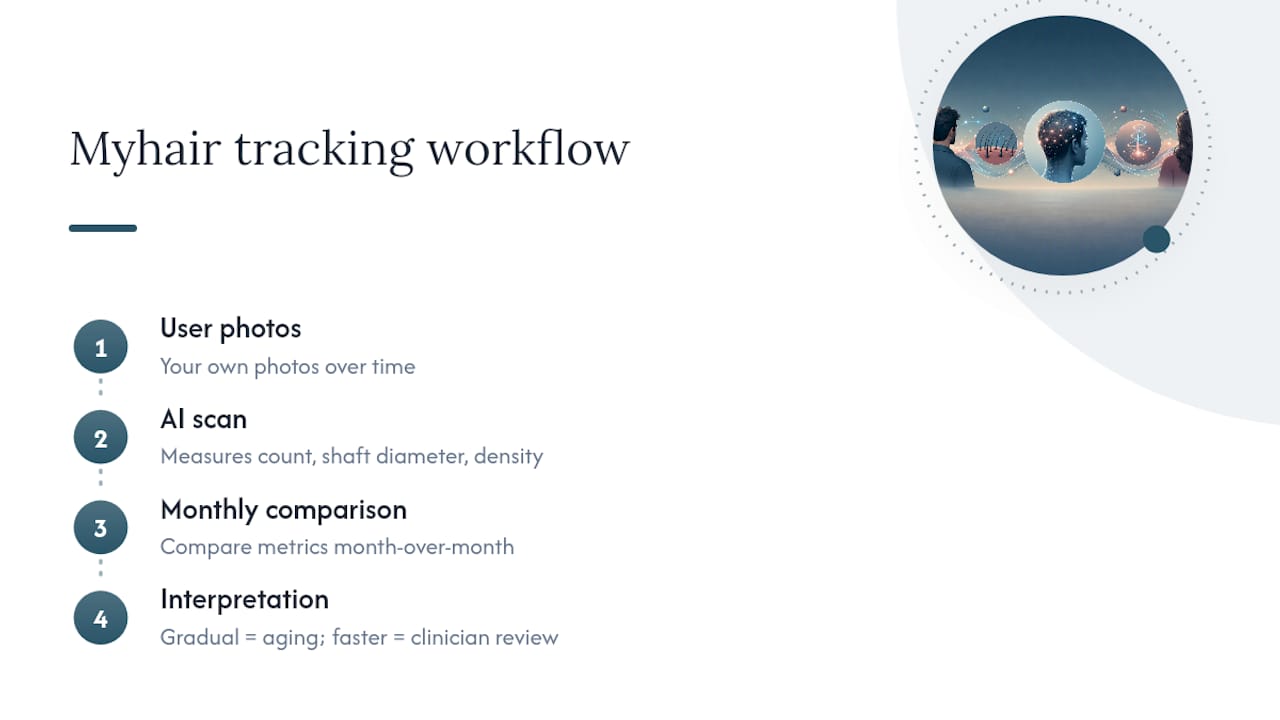
Spotting hair aging by eye is unreliable. Density loss creeps in over years. Myhair's AI-powered scanning tool measures hair count, shaft diameter, and density from your own photos, giving you objective numbers instead of a hunch. Tracking those metrics over months shows whether change is gradual aging or something faster that warrants a clinician's opinion.
The Real Question Isn't What's Changing, It's What You Do About It
Most people treat every gray hair or a slightly thinner ponytail as a five-alarm event, and that's the wrong instinct. The research is pretty consistent here: graying, reduced shine, and slow diffuse thinning are close to universal by late middle age, not warning signs. The mistake isn't worrying about hair aging. It's failing to distinguish it from pattern loss or a scalp condition, which need different action entirely.
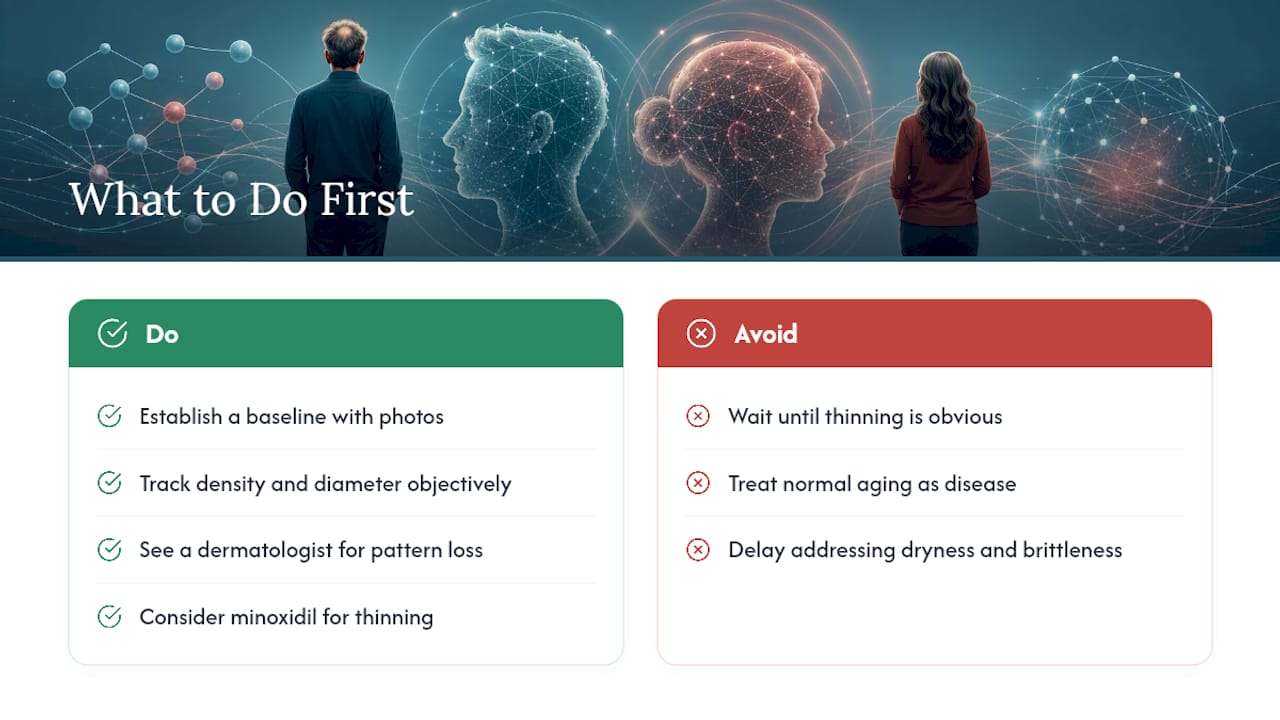
What gets underrated is timing. Waiting until thinning is obvious to the naked eye means you've already lost density you can't easily get back. Waiting until graying "bothers you enough" to address dryness and brittleness means dealing with split ends that took two years to develop.
If there's one place to start, it's establishing a baseline before you decide anything is wrong. Objective tracking, whether that's photos taken consistently or a tool that measures density and diameter over time, tells you whether you're looking at ordinary aging or something that deserves a dermatologist's attention. Minoxidil has real consensus support for thinning. Cosmetic fixes have limits. Knowing which category you're in changes everything about what you should try next.
— Cyriac
This article is general information, not a substitute for advice from a qualified doctor. Consult a qualified healthcare professional about your own circumstances before acting on anything here.
Sources
- PubMed: aging hair prevalence and mechanisms
- PMC review: mechanisms of hair aging and follicle changes
- MedlinePlus: Aging changes in hair and nails
- Hair aging revisited: expert Delphi consensus (2026)
FAQ
What Are Five Signs That Hair Is Aging?
The five most common signs are graying, reduced shine, dryness and brittleness, thinning or reduced density, and slower growth, all driven by pigment loss, follicle miniaturization, and declining lipid protection in the hair shaft.
Can Hair Loss From Aging Be Reversed?
Age-related thinning from follicle miniaturization generally can't be fully reversed, but minoxidil is the only pharmacologic therapy with expert consensus support for slowing or partially improving age-related thinning.
At What Age Does Most People's Hair Turn Gray?
Graying often begins in a person's 30s, though timing varies widely based on genetics and ethnicity, and scalp hair typically grays before body or facial hair.
What Hair Color Looks Most Aging?
This has more to do with contrast against skin tone and gray coverage than color itself; flat, uniform color with no dimension tends to look more aging than shades with subtle variation that mimic natural growth patterns.