TL;DR:
- Teenage hair loss is common and often caused by genetics, hormones, or nutritional deficiencies. Early diagnosis and tailored treatment, including lifestyle changes and medical interventions, can effectively slow or reverse hair thinning. Regular monitoring and consulting healthcare professionals help teens manage their hair health confidently.
Teenage hair loss is defined as the thinning or shedding of hair that occurs during adolescence, driven most often by genetic predisposition, hormonal shifts, or nutritional gaps. Approximately 16% of teenage boys aged 15–17 show early signs of male pattern hair loss, while around 12% of females aged 20–29 experience noticeable thinning. Those numbers mean hair loss in teens is far more common than most people realize. Recognizing the cause early is what separates a temporary setback from a long-term problem.
What causes teenage hair loss?
Teenage hair loss, known clinically as adolescent alopecia, has several distinct causes. Knowing which one applies to you changes everything about how you respond.
Genetics and hormones are the most common drivers. About 25% of men with a genetic predisposition to baldness show signs before age 21, typically as a receding hairline or crown thinning. The hormone dihydrotestosterone (DHT) shrinks hair follicles over time in people with this genetic sensitivity.
Hormonal conditions hit teenage girls differently. Polycystic Ovary Syndrome (PCOS) can trigger hair loss alongside acne and irregular periods. If you are a teenage girl experiencing all three symptoms together, that combination points directly to a hormonal cause that needs medical attention.
Nutritional deficiencies are a frequently missed cause. Low iron, vitamin D, and B vitamins all disrupt the hair growth cycle. Teens who skip meals, follow restrictive diets, or eat heavily processed food are especially at risk.
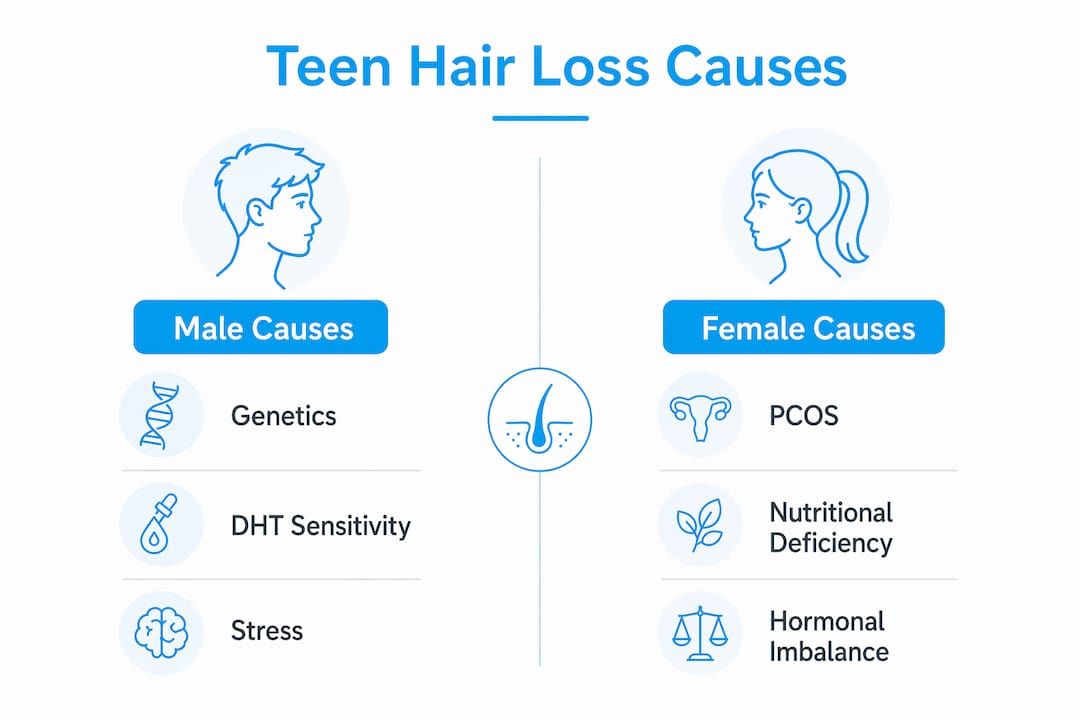
Stress and telogen effluvium catch many teens off guard. Telogen effluvium is a stress-triggered shedding condition with a 2–3 month delay between the stressful event and the visible hair loss. That delay makes it hard to connect the cause and effect without knowing what to look for.
Other causes include:
- Traction alopecia from tight ponytails, braids, or extensions pulling on follicles repeatedly
- Alopecia areata, an autoimmune condition causing patchy, circular bald spots
- Scalp fungal infections like tinea capitis, which require antifungal treatment
Pro Tip: If you noticed heavy shedding after a stressful exam period, illness, or major life change, count back 2–3 months. That is likely when the trigger happened, not when you started losing hair.
How do you tell a maturing hairline from real hair loss?
Not every hairline change signals a problem. A maturing hairline is a natural, uniform, and stable backward shift of the hairline that happens during the teen years, particularly in boys. It does not involve dramatic thinning and does not progress rapidly. Many teens asking "why am I balding at 17" are actually experiencing this normal change.
Here is how to tell the difference:
| Feature | Maturing hairline | Pathological hair loss |
|---|---|---|
| Pattern | Uniform, slight recession | Uneven, patchy, or diffuse |
| Speed | Slow and stable | Noticeable month to month |
| Temple area | Slight rounding | Significant temple loss |
| Hair density | Stays full | Visibly thinner overall |
| Scalp visibility | Not visible | Scalp shows through |
Early androgenetic alopecia in teens shows up as uneven thinning, temple recession, and reduced density at the crown. Alopecia areata looks completely different: it creates round, smooth bald patches rather than a gradual thinning pattern. Telogen effluvium causes widespread shedding across the whole scalp, not concentrated in one area.
Monthly photos taken under the same lighting are the most reliable tracking method to detect real progression. Myhair's AI-powered scanner makes this process consistent and objective, removing the guesswork from comparing photos month to month.
Pro Tip: Use the mature hairline guide from Myhair to compare your hairline against documented examples before assuming the worst.
When should you see a doctor about hair thinning?
Seeing a doctor is the right call when shedding persists beyond 3 months. Experts recommend professional consultation after that threshold, along with a scalp examination and targeted blood work.
The standard diagnostic process for teenage hair thinning typically follows these steps:
- Clinical scalp examination. A dermatologist checks the pattern, density, and scalp condition directly. This rules out fungal infections and identifies the loss pattern.
- Blood panel. Ferritin, TSH, and vitamin D are the three most commonly overlooked markers in adolescent hair loss. Low ferritin (iron stores) is a frequent culprit in teenage girls. Thyroid dysfunction affects both sexes.
- Medical and family history. A doctor will ask about recent illness, stress, diet changes, medications, and family history of hair loss. This context shapes the diagnosis more than any single test.
- Trichoscopy or scalp biopsy. In unclear cases, a dermatoscope magnifies the scalp to assess follicle health. A biopsy is rare but used when autoimmune causes are suspected.
- Hormone panel for girls. If PCOS is suspected, androgen levels, LH, and FSH are tested alongside the standard blood work.
Self-medicating with adult hair loss products without a diagnosis leads to wasted time and, in some cases, side effects that are not appropriate for teenagers. A diagnosis first, then treatment.
What are the best treatment options for teens with hair thinning?
Treatment for teen hair thinning depends entirely on the cause. Reversible causes like nutritional deficiencies, telogen effluvium, and traction alopecia respond well to lifestyle changes. Genetic hair loss requires a different approach.
Nutritional support is the first line of defense for deficiency-related loss. A diet rich in iron, zinc, biotin, and vitamin D supports the hair growth cycle directly. A doctor-supervised supplement plan is safer than buying random products off a shelf. The complete guide to hair growth supplements from Myhair covers which nutrients matter most and why.
Topical minoxidil is the most studied treatment for androgenetic alopecia in teens. Low-dose formulations are used under medical supervision. It works by extending the active growth phase of hair follicles. Results take time.
Stress management is non-negotiable for telogen effluvium. Sleep, regular meals, and reducing chronic stress all support hair cycle recovery. No topical treatment fixes stress-driven shedding on its own.
Key points on treatment expectations:
- Hair regrowth after addressing a trigger takes 3–6 months before visible improvement appears. The hair growth cycle is slow by nature.
- Traction alopecia reverses when the damaging hairstyle stops, but only if the follicles have not been permanently scarred.
- Platelet-rich plasma (PRP) therapy and microneedling are emerging options for adolescents, though they are typically reserved for cases that do not respond to first-line treatments.
- Genetic hair loss is managed, not cured. Early intervention slows progression significantly.
Pro Tip: Before spending money on supplements, get your ferritin and vitamin D levels tested. Supplementing nutrients you are not deficient in does nothing for hair growth and may cause other imbalances.
For a full breakdown of treatment paths, the thinning hair treatment guide from Myhair covers options by cause and severity.
Real stories: how teens are managing hair loss
Hair loss at 16 or 17 can feel isolating, but the experience is shared by more teens than most realize. The teens who manage it best share a few common habits.
- They tracked changes early. Teens who started monthly photo comparisons caught progression before it became severe. Early data leads to earlier treatment.
- They got a diagnosis before trying products. Many teens waste months on supplements or shampoos that do not address their actual cause. A blood test changed the approach entirely for those with low ferritin.
- They told someone. Whether a parent, school counselor, or doctor, talking about hair loss reduced the anxiety that was, in some cases, making the shedding worse.
- They separated identity from hair. Confidence during treatment comes from understanding that hair loss is a medical condition, not a reflection of health or worth.
- They stayed consistent. Hair recovery is slow. Teens who stuck with their treatment plan for 6 months saw results. Those who switched products every few weeks saw none.
The mental health side of teen hair thinning is real. Anxiety and self-consciousness are common, and they are valid. Connecting with a dermatologist or trichologist early removes the uncertainty that feeds that anxiety.
Key Takeaways
Teenage hair loss is treatable in most cases when the cause is identified early and addressed with the right approach.
| Point | Details |
|---|---|
| Common causes vary by sex | Genetics and DHT drive male teen hair loss; PCOS and iron deficiency are leading causes in girls. |
| Maturing hairline is normal | A uniform, stable hairline shift in teen boys is not pathological hair loss. |
| See a doctor after 3 months | Persistent shedding beyond 3 months warrants blood tests for ferritin, TSH, and vitamin D. |
| Recovery takes 3–6 months | Hair regrowth after treating the root cause takes several months due to the growth cycle. |
| Track with photos | Monthly photos under consistent lighting are the most reliable way to monitor progression. |
What I have learned from watching teens navigate hair loss
The biggest mistake I see is the wait-and-see approach combined with self-treatment. A teen notices thinning, buys a popular shampoo, waits three months, sees no change, and then finally sees a doctor. By that point, months of potential treatment time are gone.
The second mistake is assuming every hairline change is genetic hair loss. A maturing hairline is genuinely normal in boys aged 15–18. Panicking over a natural process leads to unnecessary stress, which can actually worsen shedding through telogen effluvium. The irony is real.
What actually works is simple: get a photo baseline, see a doctor if shedding persists, and follow the treatment plan with patience. The teens I have seen manage this well are not the ones who found the best product. They are the ones who got accurate information early and acted on it consistently.
Myhair exists precisely for that baseline step. An AI-powered scan gives you objective data about your hair density and pattern before you walk into a doctor's office. That data makes the conversation more productive and the diagnosis faster.
— Cyriac
Myhair's AI tools for tracking teen hair health
Knowing whether your hair loss is progressing or stabilizing is the hardest part of managing it as a teenager. Gut feeling is not reliable. Photos taken on different days, in different lighting, with different angles tell you nothing useful.
Myhair's AI-powered hair scanner analyzes your scalp and hair density from a photo and gives you a measurable hair health score. That score tracks over time so you can see whether your situation is improving, stable, or worsening. The app onboarding takes minutes and sets up a personalized monitoring plan based on your specific pattern. For teens who want data before their first dermatologist appointment, or between appointments, this is the most direct way to stay informed.
FAQ
What is the most common cause of teenage hair loss?
Genetics and hormonal changes, particularly elevated DHT sensitivity, are the most common causes in teenage boys. In teenage girls, iron deficiency and PCOS are the leading drivers.
Is balding at 16 or 17 permanent?
Not always. Hair loss caused by nutritional deficiencies, stress, or traction alopecia is often reversible once the trigger is removed. Genetic hair loss is progressive but can be slowed significantly with early treatment.
How do I know if my hairline is just maturing or actually receding?
A maturing hairline moves back uniformly and stays stable without significant thinning. A receding hairline progresses noticeably over months and is often accompanied by reduced density at the temples or crown.
How long does it take to see results from treatment?
Hair regrowth after addressing the root cause takes 3–6 months due to the natural hair growth cycle. Visible improvement before that window is unlikely regardless of the treatment used.
Should I take hair loss supplements without seeing a doctor first?
No. Supplementing without knowing your deficiency levels wastes money and can cause imbalances. A ferritin, TSH, and vitamin D blood test identifies whether supplements are actually needed and which ones.