
Sudden hair thinning or excessive shedding can feel both alarming and isolating, especially when it seems to have no clear cause. For many women in midlife, the real culprit is often hidden in plain sight: a malfunctioning thyroid. Thyroid dysfunction disrupts the delicate hair growth cycle, often resulting in diffuse, uniform thinning across the scalp rather than patchy bald spots. Discover how understanding this thyroid connection, along with the latest in AI technology, can help you take charge of hair regrowth and reclaim your confidence.
Table of Contents
- Thyroid Hair Loss Defined And Debunked
- Types, Causes, And Early Warning Signs
- How Thyroid Affects The Hair Growth Cycle
- Regrowth Timelines And Expectations
- Maximizing Regrowth: AI Insights And Treatments
Key Takeaways
| Point | Details |
|---|---|
| Thyroid-Related Hair Loss is Reversible | Hair loss caused by thyroid dysfunction can often be reversed when hormone levels are normalized. |
| Understand the Hair Loss Patterns | Thyroid-related hair loss appears as diffuse thinning, differing from other types like male pattern baldness. |
| Watch for Systemic Symptoms | Accompanying symptoms such as fatigue, temperature sensitivity, and brittle nails suggest thyroid dysfunction. |
| Use Comprehensive Testing | Request thorough thyroid testing (including TSH, free T3, free T4, and antibodies) to ensure accurate diagnosis and treatment. |
Thyroid Hair Loss Defined And Debunked
Thyroid-related hair loss is one of the most misunderstood conditions affecting women in midlife. Many think it's permanent, unavoidable, or unrelated to their thyroid diagnosis. None of these beliefs are accurate.
What Actually Happens to Your Hair
When your thyroid malfunctions, it disrupts the normal hair growth cycle. Your hair follicles need thyroid hormones to function properly, and when levels drop or spike, follicles stop producing new hair at the expected rate.
Both hypothyroidism and hyperthyroidism trigger hair loss, but they work differently. The result is telogen effluvium, a condition where hair prematurely enters the shedding phase. Instead of gradual daily hair loss, you experience sudden, noticeable thinning across your entire scalp.
Unlike male pattern baldness, thyroid-related hair loss appears diffuse and uniform. You'll notice thinning everywhere, not just at your hairline or crown. This matters for diagnosis.
The Key Differences That Matter
Thyroid hair loss differs from other types in critical ways:
Here's a quick comparison of thyroid-related hair loss versus other common types of hair loss:
| Aspect | Thyroid-Related Hair Loss | Androgenic Alopecia | Alopecia Areata |
|---|---|---|---|
| Pattern | Diffuse thinning, full scalp | Receding hairline/crown | Patchy bald spots |
| Onset | Sudden, within months | Gradual over years | Rapid, overnight/within days |
| Affected Areas | Scalp, eyebrows, body hair | Mainly scalp | Scalp, beard, other areas |
| Reversibility | High with hormone correction | Partial | Often spontaneous |
- Pattern: Affects scalp, eyebrows, and body hair simultaneously
- Reversibility: Hair regrowth happens once hormone levels normalize
- Timeline: Typically starts 2-3 months after thyroid dysfunction begins
- Severity: Ranges from minimal shedding to noticeable thinning
Why Your Doctor Should Know This
Thyroid evaluation should be routine whenever you experience unexplained hair loss. Many women get referred to dermatologists first, but blood work identifying thyroid dysfunction is the real answer.
Thyroid hormone disruption interferes with your hair follicles' ability to grow and maintain hair. Fix the thyroid, and your hair typically bounces back.
Autoimmune thyroid conditions complicate things further. When your immune system attacks thyroid tissue, it may also target hair follicles. This overlap means addressing thyroid health becomes even more critical.
What Doesn't Cause Thyroid Hair Loss
Debunking myths matters here. Your thyroid doesn't cause hair loss because:
- You're getting older (age accelerates shedding, but thyroid dysfunction is the direct cause)
- You're stressed (stress itself doesn't cause thyroid dysfunction)
- You're not washing your hair enough (hygiene doesn't affect hormone levels)
- Your genetics guarantee hair loss (genetics influence thyroid disease risk, not the hair loss itself)
Your thyroid-related hair loss is reversible when hormone levels return to normal, making diagnosis and treatment your actual priority.
Pro tip: Request comprehensive thyroid testing including TSH, free T3, free T4, and thyroid antibodies when discussing hair loss with your doctor, as standard TSH tests alone may miss autoimmune thyroid conditions.
Types, Causes, And Early Warning Signs
Thyroid-related hair loss comes in distinct patterns, each tied to whether your thyroid is overactive or underactive. Recognizing these differences early helps you address the problem before significant thinning occurs.
How Hair Loss Manifests
Unlike patchy baldness, thyroid hair loss appears as diffuse thinning across your entire scalp. You'll notice hair shedding everywhere simultaneously, not concentrated in one area. This pattern matters because it immediately points doctors toward systemic issues like thyroid dysfunction rather than localized problems.
Hair loss related to thyroid disease usually involves the entire scalp rather than specific patches. The shedding extends beyond just your head too—eyebrows, underarms, and leg hair thin simultaneously.
Both hypothyroidism and hyperthyroidism trigger this response, but the hair texture differs:
- Hypothyroidism: Hair becomes brittle, dry, and breaks easily
- Hyperthyroidism: Hair feels soft and fine, almost wispy
What Actually Causes the Hair Loss
Your thyroid hormones regulate the hair growth cycle. When production drops or spikes, follicles get confused about when to grow versus when to shed. This disruption pushes hair into the telogen phase prematurely, causing accelerated shedding.

The timing matters here. Hair loss may not appear immediately after your thyroid goes haywire. Most women notice significant shedding 2-3 months after thyroid dysfunction begins, making it hard to connect the dots at first.
Early Warning Signs You Shouldn't Ignore
Thyroid problems send multiple signals beyond just hair loss. Watch for these combinations:
- Unexplained fatigue or sudden weight changes
- Temperature sensitivity (feeling cold when others are warm)
- Brittle nails alongside thinning hair
- Dry skin that doesn't improve with moisturizer
- Noticeable hair shedding during showers
When hair loss occurs alongside systemic symptoms like fatigue and weight fluctuations, thyroid dysfunction becomes the leading suspect. Don't dismiss these as separate issues—they're connected.
Autoimmune thyroid disease complicates things further. Your immune system may attack both thyroid tissue and hair follicles simultaneously, sometimes creating patchy patterns in addition to diffuse shedding.
Hair loss appearing several months after other thyroid symptoms suggests your condition has been disrupting your system longer than you realize—making early testing critical.
Pro tip: Track your hair shedding patterns in a simple log for two weeks before your doctor visit, noting the daily amount and coinciding symptoms like fatigue or temperature sensitivity, as this documentation strengthens your case for thyroid testing.
How Thyroid Affects The Hair Growth Cycle
Your thyroid doesn't just regulate metabolism or body temperature. It directly controls whether your hair grows, stays put, or falls out. Understanding this mechanism explains why thyroid dysfunction creates such dramatic hair loss.
The Chemical Messengers at Work
Thyroid hormones T3 and T4 send signals directly to your hair follicles. Thyroid hormones stimulate hair matrix keratinocyte proliferation, essentially telling your follicles to produce new cells and keep growing. Without adequate thyroid hormone, this growth signal weakens significantly.
These hormones do more than just trigger growth. They also regulate melanin production, which explains why thyroid-related hair loss often includes graying or color changes alongside thinning.
How the Hair Cycle Gets Disrupted
Normal hair growth follows three distinct phases:
- Anagen (growth phase): Hair actively grows for 2-7 years
- Catagen (transition phase): Growth stops for 1-2 weeks
- Telogen (shedding phase): Hair rests, then falls out over 2-3 months
Thyroid dysfunction throws this schedule off. Thyroid hormones regulate the initiation and duration of the anagen phase, which means an imbalance either shortens how long hair grows or extends how quickly it sheds.
What Happens With Low Thyroid (Hypothyroidism)
When your thyroid underperforms, follicle cells stop multiplying as efficiently. This slowdown pushes more hairs into the telogen phase prematurely. Instead of a gradual daily loss of 50-100 hairs, you experience accelerated shedding affecting hundreds of hairs simultaneously.
Your hair also becomes drier and more brittle because thyroid hormones affect sebum production, the natural oil protecting your strands.
What Happens With High Thyroid (Hyperthyroidism)
Overactive thyroid creates different problems. Excessive hormone stimulation disrupts the normal cycling pattern, even though cell proliferation increases. This chaotic growth cycle still results in hair loss, just through a different mechanism.
Hyperthyroid-related hair often feels softer and finer because follicles can't maintain normal structural integrity under excessive hormonal stress.
Your hair cycle mirrors your thyroid's health—fix the hormone imbalance, and the cycle gradually normalizes over months as new growth restarts.
Pro tip: Since understanding hair growth cycles helps track recovery, use MyHair's scan feature monthly to monitor follicle activity changes as your thyroid medication stabilizes, providing concrete evidence of regrowth beginning.
Regrowth Timelines And Expectations
Hair regrowth after thyroid treatment isn't instant, but it is predictable. Understanding realistic timelines helps you stay motivated through recovery instead of abandoning treatment prematurely.
The First 8 Weeks: A Temporary Setback
Here's what surprises most women: your hair shedding may actually increase in the first 2 months after starting thyroid medication. This temporary spike happens because your normalized hormones trigger a telogen release—all those hairs stuck in shedding phase finally let go simultaneously.
This isn't a sign treatment is failing. It's proof your follicles are responding to hormonal correction.
The 3-6 Month Window: Real Progress Begins
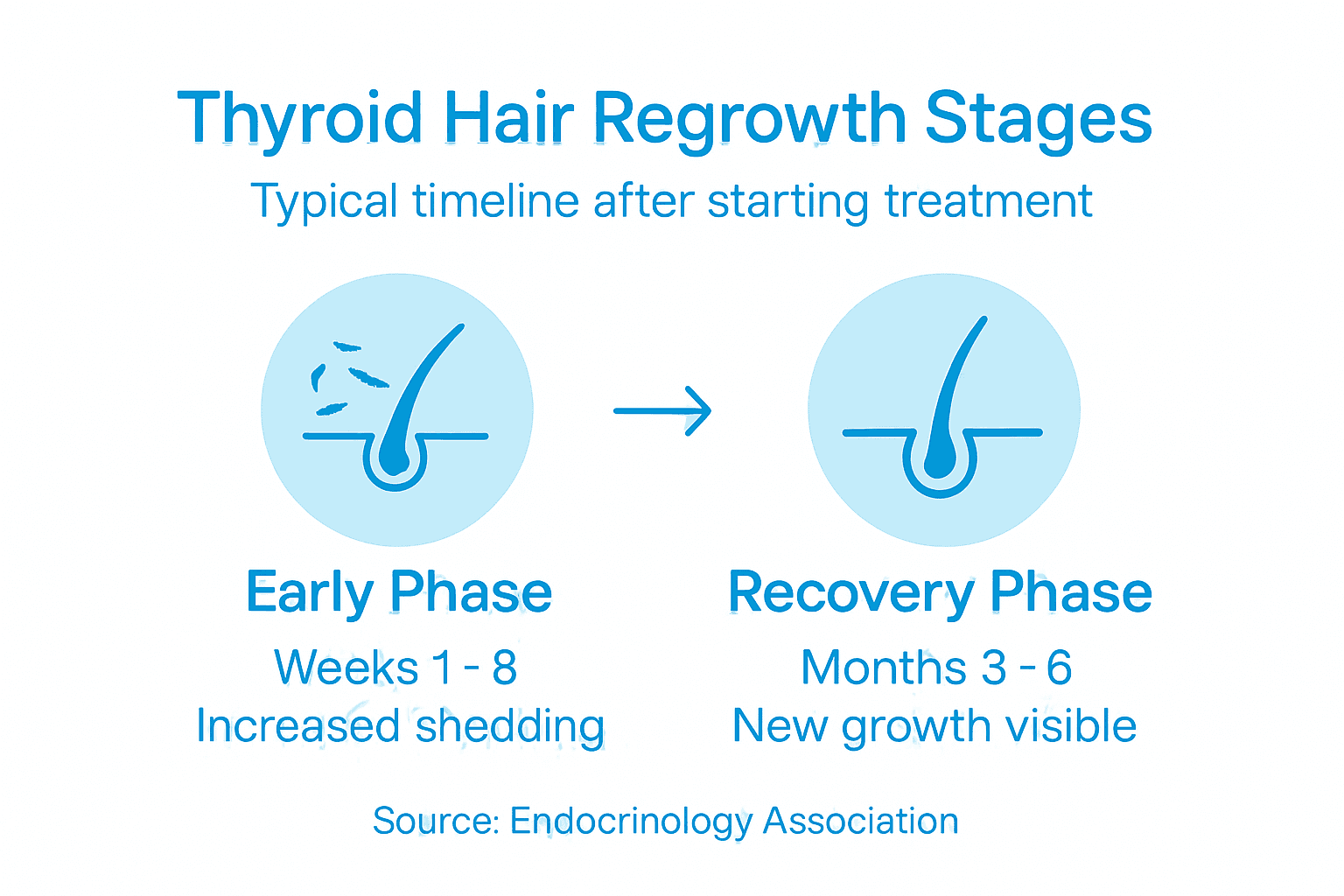
Hair loss caused by hypothyroidism generally begins improving within 3 to 6 months after levothyroxine normalizes hormone levels. You'll notice less shedding during showers, fewer hairs on your pillow, and new baby hairs appearing around your hairline.
This window varies based on medication dosing and how quickly your doctor adjusts your prescription. Some women see improvement at month three; others need five months.
The 9-12 Month Mark: Near-Complete Restoration
Full thickness and density restoration takes longer because hair needs multiple complete growth cycles to regenerate. By month nine, most women report noticeable thickening and volume return.
Year one typically marks substantial recovery, though some continued improvement continues through month 18.
To better understand regrowth timelines, here is an overview of what to expect after starting thyroid treatment:
| Time After Treatment Starts | What to Expect | Visible Change |
|---|---|---|
| 0-2 months | Increased shedding (telogen release) | No new growth, shedding persists |
| 3-6 months | Reduced shedding, new baby hairs | Early regrowth noticeable |
| 9-12 months | Thickness and density return | Full scalp improvement |
What Affects Your Timeline
Regrowth speed depends on several factors:
- Medication consistency: Missing doses delays recovery significantly
- TSH stabilization: Faster normalization means quicker regrowth
- Baseline hair health: Damaged hair takes longer to recover
- Age and genetics: Women in their 40s-50s may see slightly slower regrowth
- Autoimmune factors: Hashimoto's disease may complicate timelines
Setting Realistic Expectations
Expect gradual, not dramatic change. Hair growth progress appears as reduced shedding first, then increased density over months. You won't wake up with full hair suddenly—instead, you'll notice incremental improvements each month.
Take baseline photos now so you can objectively track changes. Your eyes adjust quickly to gradual improvements, making progress harder to notice without visual references.
Hair regrowth requires completing multiple hair cycles—expecting full recovery in under 6 months sets you up for disappointment, but 9-12 months brings substantial, visible improvement.
Pro tip: Maintain consistent thyroid medication timing (take it the same time daily on an empty stomach), attend all follow-up appointments for TSH monitoring, and keep monthly scan records using MyHair to document follicle recovery objectively rather than relying on subjective observation.
Maximizing Regrowth: AI Insights And Treatments
Modern thyroid hair loss treatment goes beyond simply normalizing hormone levels. Artificial intelligence now offers personalized insights into your unique regrowth patterns, allowing you to optimize results faster.
How AI Enhances Thyroid Hair Recovery
AI applications in thyroid disease management include personalized patient monitoring and treatment optimization by synthesizing data from medical records, imaging, and patient health metrics. This approach transforms generic thyroid management into customized protocols tailored to your specific regrowth timeline.
AI doesn't replace your doctor's care. Instead, it amplifies effectiveness by identifying patterns invisible to the human eye.
Data-Driven Medication Optimization
AI systems analyze how quickly your body responds to thyroid medication dosages. This helps doctors adjust your prescription more precisely, potentially reaching optimal TSH levels faster than traditional monitoring alone.
Faster hormone stabilization means earlier hair regrowth initiation. Even small improvements in medication timing or dosage can accelerate recovery by weeks.
Personalized Regrowth Tracking
Traditional hair assessment relies on subjective observation. AI-powered scanning technology measures actual follicle density, diameter, and pigmentation changes month to month.
This objective data shows progress you might miss otherwise:
- Baseline measurements before treatment begins
- Monthly follicle diameter changes
- New hair growth rate calculations
- Pigmentation recovery in grayed areas
- Density improvements across scalp zones
Combining Treatments for Maximum Results
Thyroid medication forms your foundation, but complementary approaches accelerate regrowth. AI-powered hair growth therapy identifies which supplementary treatments work best for your specific hair loss pattern.
These might include:
- Targeted nutritional support addressing deficiencies
- Topical treatments optimized for your hair type
- Stress management interventions
- Scalp health protocols
The Timeline Advantage
Women using AI-guided regrowth strategies often report noticeable improvement 4-6 weeks earlier than those following standard thyroid management alone. This acceleration happens because AI identifies optimal conditions faster.
Consistency matters more with AI monitoring. When you see objective progress via scan comparisons, medication adherence improves naturally.
Personalized AI insights transform thyroid hair regrowth from a guessing game into a measurable, optimizable process with concrete monthly progress tracking.
Pro tip: Use MyHair's AI scanning feature immediately after starting thyroid medication to establish baseline measurements, then scan monthly to track objective follicle changes rather than relying on subjective mirror observations, giving your doctor concrete data for medication adjustments.
Take Control of Thyroid Hair Loss with Personalized AI Insights
Thyroid hair loss can feel overwhelming as it disrupts your natural hair growth cycle and leads to diffuse thinning across your scalp and eyebrows. The frustration of sudden shedding, brittle or wispy hair, and waiting months for regrowth are common challenges. Understanding these patterns and tracking real progress is key to staying motivated and confident during recovery
MyHair.ai offers you precise, personalized solutions built on advanced AI technology designed to analyze your unique hair patterns affected by thyroid hormone imbalances. Our platform goes beyond guessing by providing objective follicle assessments, monitoring your regrowth stages, and recommending customized treatments tailored to your specific needs. Take your first step toward restoring your hair health today with MyHair.ai. Discover detailed hair health insights, keep a consistent regrowth log, and get expert-backed advice that complements your thyroid treatment journey. Learn more about how to track hair growth and recover smarter at https://myhair.ai and start regaining control now.
Frequently Asked Questions
What is thyroid-related hair loss, and how does it differ from other types?
Thyroid-related hair loss is characterized by diffuse thinning across the entire scalp, which differs from other types like androgenic alopecia that usually follows a specific pattern. It can affect scalp hair as well as other body hair and is often reversible once thyroid hormone levels are normalized.
How long does it take to see hair regrowth after starting thyroid treatment?
Hair regrowth typically begins within 3-6 months after normalizing thyroid hormone levels. However, some women may experience an initial increase in shedding in the first 2 months due to a telogen release, which is a temporary response to treatment.
What role do thyroid hormones play in hair growth?
Thyroid hormones T3 and T4 send signals to hair follicles to promote growth. When these hormone levels drop or rise significantly, they disrupt the hair growth cycle, leading to premature shedding and hair loss.
Are there any specific treatments or supplements that can support hair regrowth after thyroid treatment?
In addition to thyroid medication, complementary approaches, such as targeted nutritional support, topical treatments, and scalp health protocols, can enhance hair regrowth. Utilizing AI-powered tracking can help tailor these treatments to your specific needs.