
TL;DR:
- Triangle hairline is a stable patch of fine vellus hairs near the temples, not balding.
- Proper diagnosis relies on clinical examination, dermoscopy, and AI imaging to distinguish it from other conditions.
- Monitoring stability over time is essential, and unnecessary treatments like steroids should be avoided.
If you've noticed a small, triangular patch of thin hair near your temple and immediately feared the worst, you're not alone. Most people who experience a triangle hairline assume they're looking at early-stage pattern baldness or a mysterious form of alopecia. That assumption is not just wrong — it can lead to treatments that waste money, irritate your scalp, and solve nothing. Understanding what a triangle hairline actually is, how to diagnose it correctly, and how modern AI tools can personalize your approach is the difference between overreacting and taking genuinely smart action.
Table of Contents
- What is a triangle hairline?
- How is triangle hairline diagnosed?
- Triangle hairline vs other hair loss: What's the difference?
- What should you do if you have a triangle hairline?
- Why personalization and tech matter with triangle hairline
- Discover your personalized triangle hairline analysis
- Frequently asked questions
Key Takeaways
| Point | Details |
|---|---|
| Triangle hairline is stable | Unlike pattern baldness, triangle hairline does not progress or spread. |
| Diagnosis requires expertise | A clinical exam and AI trichoscopy are key to distinguishing triangle hairline from other conditions. |
| Personalized monitoring helps | Using AI-powered tracking ensures you avoid unnecessary treatments and get tailored recommendations. |
| Avoid aggressive therapies | Steroids and strong medications typically do not help with triangle hairline. |
What is a triangle hairline?
Let's begin by understanding exactly what sets a triangle hairline apart from other hairline changes you might notice in the mirror.
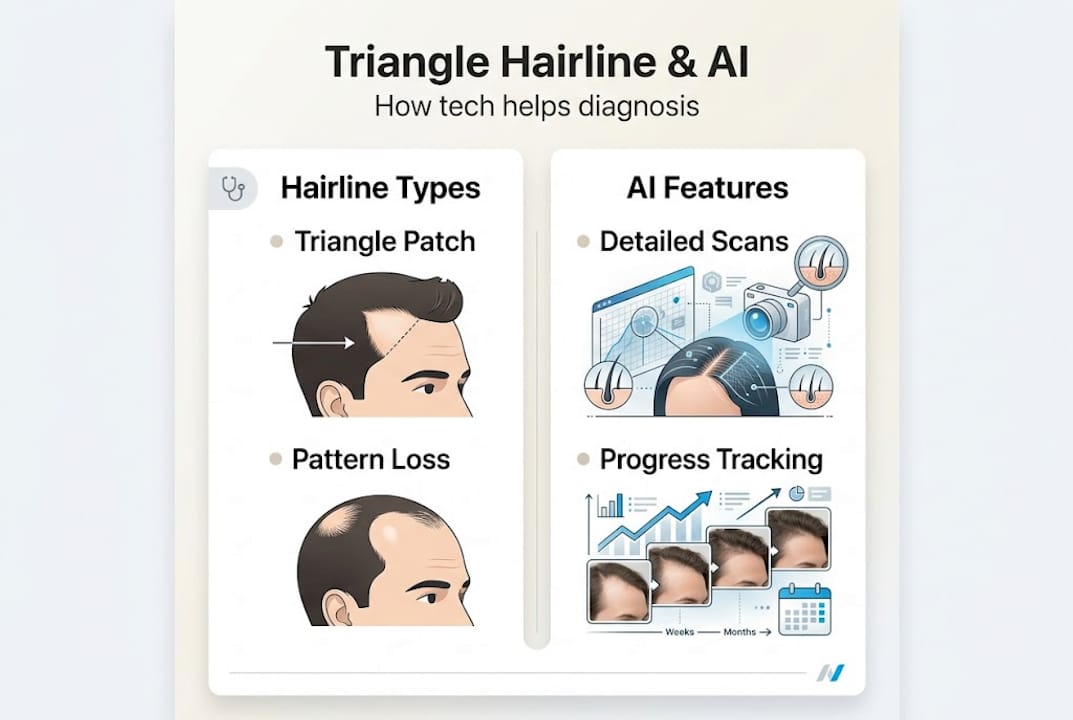
A triangle hairline, more formally known as temporal triangular alopecia (TTA), is a sharply defined patch of fine hair located in the temporal region of the scalp, usually near the temples or forehead. The key word here is "fine." The area is not actually bald. Instead, it's covered by vellus hairs, which are the soft, short, almost invisible hairs that typically cover the body before normal terminal (thicker, pigmented) hairs grow in. This distinction matters enormously because it changes everything about how the condition should be managed.
TTA is localized and stable, meaning it doesn't typically spread, progress, or worsen over time the way androgenetic alopecia (pattern hair loss) does. It is not driven by DHT, the hormone responsible for most male pattern baldness. It is not an autoimmune attack like alopecia areata. It simply exists as a patch of fine, underdeveloped hair in a predictable location. In many cases, it has been there since childhood and only becomes noticeable once surrounding hair grows thicker with age.
This is precisely why a normal hairline for men can look very different from person to person, and why understanding your specific hairline types is the first step to smart hair care.
Key features of a triangle hairline
- Located in the temporal (temple) area, often unilateral (one side only)
- Covered by vellus hairs, not completely smooth or bald
- Sharply defined borders with a triangular or oval shape
- Stable over time, not progressive
- Not associated with inflammation, itching, or pain
- Often present since birth or early childhood, just unnoticed
- Not responsive to DHT-blocking treatments
Triangle hairline vs. other common hair loss types
| Feature | Triangle hairline (TTA) | Pattern baldness (AGA) | Alopecia areata |
|---|---|---|---|
| Progression | Stable, non-progressive | Progressive | Variable, can regrow |
| Hair in patch | Vellus (fine) hairs | No hair | Usually none |
| Inflammation | None | None | Sometimes present |
| DHT-driven | No | Yes | No |
| Location | Temple area | Crown, temples, M-shape | Any area |
| Age of onset | Often childhood | Adult | Any age |
One of the most common mistakes people make is running to their dermatologist convinced they are losing their hairline, only to be prescribed steroids or hair loss medications that have no clinical basis for TTA. A proper hairline analysis saves you from that path before it starts.
How is triangle hairline diagnosed?
Once you know what to look for, the next step is a careful diagnosis — and this is where precision really pays off.

Diagnosing TTA is not a simple glance-and-go situation. Because the condition mimics other forms of hair loss in appearance, the process requires a layered approach. Rushing to a diagnosis, or worse, self-diagnosing from a photo, is how people end up spending months on steroids or minoxidil when neither will make any meaningful difference.
Here is how a proper diagnosis typically unfolds:
- Clinical examination: A trained clinician looks at the shape, size, and borders of the affected area. TTA tends to have clean, well-defined edges that are unusual for inflammatory or autoimmune hair loss conditions.
- Dermoscopy or trichoscopy: This is the game-changer. A dermatoscope (a specialized magnifying device) allows a clinician to see the actual hair fibers within the patch. The diagnosis via trichoscopy reveals vellus hairs, empty follicles, and a total absence of inflammation or "black dots," which are hallmarks of alopecia areata.
- Ruling out alopecia areata: In alopecia areata, you often see exclamation-point hairs (short hairs that taper at the base), black dots, and sometimes subtle redness or tenderness. None of these appear in TTA.
- Ruling out pattern baldness: Pattern baldness shows miniaturization (progressively shrinking hair shafts over time), usually across a broader zone. A single, stable temporal patch with no miniaturization pattern points away from AGA.
- AI-assisted imaging: Emerging platforms now allow AI hair assessment based on scan data, which can identify vellus hair patterns and track the affected area over time without requiring a clinic visit.
"Temporal triangular alopecia is frequently misdiagnosed as alopecia areata, leading to unnecessary steroid treatments that produce no improvement. The presence of vellus hairs and absence of inflammation are the critical distinguishing features."
This misdiagnosis problem is real and frustratingly common. Many people are given potent topical corticosteroids, wait hopefully for results, and then return to their doctor confused about why nothing changed. The answer is simple: steroids treat inflammation. TTA has no inflammation to treat.
Pro Tip: If you're unsure about your diagnosis, take consistent, well-lit photos of your temporal area every four weeks for three months. Stable appearance is one of the strongest indicators of TTA. An AI platform can help you track and analyze these changes objectively, removing the guesswork from your monthly comparisons.
Understanding the causes of hairline changes gives you the broader context to interpret what you're actually seeing, whether it turns out to be TTA or something else entirely.
Triangle hairline vs other hair loss: What's the difference?
It can be easy to mistake a triangle hairline for other types of hair loss, but key differences make all the difference in choosing your next steps.
When we say the stakes are high, we mean it practically. Misidentifying TTA as androgenetic alopecia could lead someone to start finasteride or dutasteride, medications that carry real hormonal side effects and are simply not indicated for TTA. Misidentifying it as alopecia areata could mean months on immunosuppressive steroids or even injections into the scalp. Neither outcome is acceptable when the actual condition is stable and non-threatening.
TTA's stable, localized nature sets it apart fundamentally from both AGA and alopecia areata. The hair in the patch does not miniaturize over cycles the way AGA hair does. It stays consistently fine throughout a person's life. Meanwhile, alopecia areata tends to evolve, either cycling through loss and regrowth phases or, in more severe cases, expanding to affect larger scalp areas.
A particularly important insight from emerging research is that TTA is often underdiagnosed and mistreated because clinicians don't always reach for a dermatoscope when they see a temporal patch. The recommendation from experts is to monitor for three to six months before any intervention, specifically to confirm stability. This monitoring period alone would prevent countless unnecessary treatments.
What AI analysis adds to the equation
In ambiguous cases where dermoscopy findings are unclear, AI tools change the picture. Advanced imaging algorithms can detect vellus hair patterns, quantify hair density in specific zones, and flag changes that might not be visible to the naked eye. This matters especially when:
- The patch is small and hard to assess clinically
- You don't have easy access to a specialist with trichoscopy equipment
- You want ongoing monitoring without repeated clinic visits
- You're trying to rule out early AGA before committing to a treatment protocol
Comparing a M-shaped hairline with a stable temporal patch visually can be confusing. An AI-driven platform cuts through that confusion with objective data. Similarly, if you're exploring bald spot solutions, accurate identification is the essential first step before any product or treatment makes sense.
Demographic and clinical cues at a glance
- TTA: Often detected in children or young adults; more common than reported; affects men and women equally; unilateral in most cases
- AGA: Predominantly adult males; bilateral temple recession; worsens progressively without treatment
- Alopecia areata: Affects all ages and genders; can appear suddenly; often shows spontaneous regrowth; immune-mediated
Getting this right the first time is not just about saving money on products that won't work. It's about protecting your confidence and your scalp from interventions it doesn't need.
What should you do if you have a triangle hairline?
Once you've confirmed you have a triangle hairline, what comes next? The answer is more measured than most people expect.
The instinct when you notice any unusual hairline feature is to act immediately. Buy a growth serum. Start a supplement. Book a consultation for a transplant. Most of the time, with TTA, none of those first impulses are necessary. Here's a practical, step-by-step path that makes actual sense:
- Get an accurate diagnosis first. Use either a professional trichoscopy exam or an AI-powered scan to confirm what you're actually looking at. Don't assume.
- Monitor for three to six months. Because TTA is stable by nature, simply watching the area carefully over time provides powerful diagnostic information. If nothing changes, you almost certainly have TTA.
- Skip the steroids. Since TTA has no inflammatory component, corticosteroid creams or injections will not improve the condition. Using them anyway risks skin thinning and other side effects with zero benefit.
- Focus on overall scalp health. While TTA itself doesn't respond to most topical treatments, keeping your scalp clean, nourished, and well-circulated supports the health of surrounding terminal hairs. This matters for your overall hairline appearance.
- Consider personalized product recommendations. A tailored approach, guided by AI analysis of your specific hair patterns and scalp condition, helps you invest in products that actually match your biology rather than generic solutions.
- Explore consultation if confidence is affected. For some people, the appearance of a temporal patch causes real distress. Options like hairline-specific styling advice, scalp micropigmentation, or cosmetic products can make a meaningful difference.
Pro Tip: Before spending anything on hair products or treatments, use MyHair's research platform to get a data-driven picture of your scalp and hairline. Understanding what's actually happening at a follicular level helps you skip the products that won't work and invest in the ones that will.
For those considering whether the approach differs by gender, understanding female hairline care shows how personalized strategies change based on individual anatomy and hormone profiles. The same principle applies to TTA — your specific situation should drive every decision.
Why personalization and tech matter with triangle hairline
Here's an uncomfortable truth that the hair care industry rarely acknowledges: most people with triangle hairline are overtreated, not undertreated. They spend months chasing a solution to a problem that isn't progressing, driven by fear and a lack of accurate information. The conventional approach, which is to see something unusual at the hairline and immediately prescribe or purchase, fails this group almost every time.
What actually works is honest, data-driven monitoring combined with targeted action only when needed. That's exactly where AI tools shift the conversation. Instead of reacting emotionally to a patch you noticed this morning, you can build a clear picture of what your hairline looks like over time, compare it against established patterns, and make decisions based on real evidence.
Understanding your hairline type is not a vanity exercise. It's the foundation for every smart hair decision you'll make. A stable triangle hairline doesn't require a product arsenal. It requires informed awareness and the confidence to know when to act and when to simply monitor. One-size-fits-all advice will always miss this nuance. Personalized AI analysis won't.
Discover your personalized triangle hairline analysis
Knowing you have a triangle hairline is just the beginning. The next step is understanding your unique hair health picture in detail, so every decision you make is backed by real data, not guesswork.

MyHair's AI-powered analysis uses advanced imaging to evaluate your hairline, detect vellus hair patterns, and track changes over time with precision. The platform connects you directly to tailored product recommendations matched to your specific scalp profile. Onboarding is quick and designed to get you from scan to insights in minutes. You can also explore our research platform for deeper context on your results. If you're ready to stop guessing and start understanding, get started with MyHair today and take your first genuinely informed step toward confident hair health.
Frequently asked questions
Is a triangle hairline a sign of balding?
No, a triangle hairline is usually stable and not a sign of progressive balding like pattern hair loss. Unlike AGA, TTA is localized and not driven by DHT, meaning it doesn't follow the same miniaturization pathway.
How can I tell if I have triangle hairline or alopecia areata?
Triangle hairline shows a stable patch with vellus hairs and no inflammation, while alopecia areata typically presents with sudden, round hairless spots and sometimes redness. Trichoscopy diagnosis can definitively tell the two apart by looking for black dots and exclamation-point hairs, which appear in alopecia areata but not TTA.
Should I use steroid creams for a triangle hairline?
Steroid creams are usually ineffective for triangle hairline because the condition has no inflammatory component to target. Applying them based on a misdiagnosis risks side effects like skin thinning without delivering any improvement.
Can AI help diagnose triangle hairline accurately?
Yes, AI trichoscopy analysis can distinguish triangle hairline from similar conditions by detecting vellus hair patterns through detailed imaging. AI prioritizing trichoscopy is especially valuable for ambiguous cases where clinical exam alone is inconclusive.