
Your hairline is as unique as your fingerprint, and yet most hair advice treats every scalp the same. Common hairline types include straight, rounded, rectangular, triangular, M-shaped, widow's peak, uneven, cowlick, high, middle, low, and U-shaped, each with its own genetic blueprint and health implications. Knowing which type you have is the first step toward building a hair care strategy that actually works for you. This guide breaks down every major hairline pattern, explains what gender and genetics have to do with it, and gives you practical steps to protect and optimize what you've got.
Table of Contents
- Understanding the most common hairline types
- Gender differences: Comparing male and female hairline patterns
- Mature, receding, and uneven hairlines: What they mean for hair health
- Personalized strategies for managing and optimizing your hairline
- Take the next step: AI-powered hairline assessment and tailored solutions
- Frequently asked questions
Key Takeaways
| Point | Details |
|---|---|
| Hairline shapes are diverse | There are many hairline types, each reflecting unique genetics and health influences. |
| Gender strongly affects patterns | Men and women display distinct hairline shapes and rates of thinning, requiring different approaches. |
| Early intervention matters | Recognizing changes early and using proven treatments boosts chances of preserving hair health. |
| Personalized solutions work best | Tailoring strategies to your hairline type leads to more effective and satisfying results. |
Understanding the most common hairline types
Before you can act on your hair health, you need to know what you're working with. Recognizing hairline types is less about aesthetics and more about understanding the signals your scalp is sending.
Here's a quick breakdown of the major types:
- Straight hairline: Runs in a nearly horizontal line across the forehead. Common in both men and women, often considered a "neutral" baseline.
- Rounded (bell-shaped) hairline: Curves gently downward at the center. Frequently seen in women and associated with a softer facial frame.
- Rectangular hairline: Flat across the top with sharp corners. More common in men, giving a boxy, defined look.
- Triangular hairline: Widens toward the temples, creating a V-like shape at the center. Can appear naturally or develop with age.
- M-shaped hairline: Features two peaks with temple recession. A hallmark of early androgenetic alopecia in men.
- Widow's peak: A distinct downward point at the center of the forehead. Genetic in origin and found in both sexes.
- Uneven hairline: One side sits higher than the other. Usually inherited and not a sign of hair loss.
- Cowlick: A section of hair that grows in a spiral or against the grain near the hairline. Purely structural.
- High hairline: Sits further back on the scalp, creating a larger forehead. Can be genetic or the result of gradual recession.
- Middle hairline: Falls between high and low, considered the most "average" position.
- Low hairline: Sits close to the eyebrows. Common in certain ethnicities and often hereditary.
- U-shaped hairline: A deep curve that dips significantly at the center. Less common but entirely natural.
The table below gives you a side-by-side comparison to help you identify your own pattern:
| Hairline type | Shape description | Most common in | Primary cause |
|---|---|---|---|
| Straight | Horizontal, even line | Men and women | Genetics |
| Rounded | Soft downward curve | Women | Genetics |
| Rectangular | Flat top, square corners | Men | Genetics |
| M-shaped | Two peaks, temple recession | Men | DHT/genetics |
| Widow's peak | Central downward point | Both | Genetics |
| Cowlick | Spiral growth pattern | Both | Hair follicle angle |
| High | Far back on scalp | Both | Genetics or recession |
| U-shaped | Deep central curve | Both | Genetics |
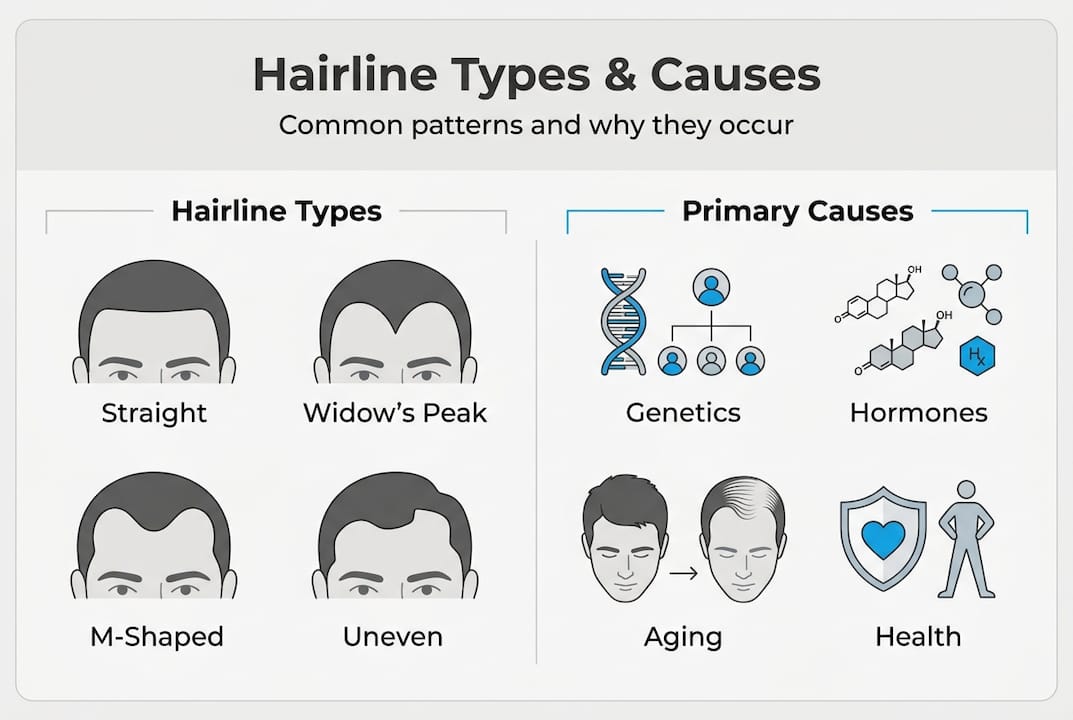
The straight hairline type is one of the most frequently searched because it sits right on the border between "normal" and "receding" for many people. Shape alone doesn't tell the whole story, but it's a powerful starting point.
Gender differences: Comparing male and female hairline patterns
With a foundational understanding of hairline types, it's important to recognize how your gender influences these patterns and what that can mean for your hair health.
Research makes the differences clear. Men's hairlines are higher and more angular, with linear shapes at 45.9% and M-shaped at 42.6%, plus temporal recessions showing an inverted triangle pattern in 65.6% of cases. Women's hairlines sit lower and rounder, with linear at 36.1% and round at 38.5%, and more convex temporal shapes overall.
A Japanese study found that frontal linear and M-shaped patterns dominate in men at 88.5%, while women show much more variety. Among women specifically, 81% have a widow's peak and 98% show lateral mounds, those subtle rounded bumps at the sides of the hairline that most people never notice.
"The female hairline is architecturally more complex than most people realize. Lateral mounds, widow's peaks, and convex temporal shapes all contribute to a softer, more varied profile that differs significantly from the male pattern."
Here's what to watch for based on your sex:
Signs of a healthy hairline:
- Consistent density along the entire hairline edge
- No visible scalp through the front hairline
- Stable position over 6 to 12 months
- Symmetrical or predictably asymmetrical shape
Signs worth monitoring:
- Gradual widening of the part (especially in women)
- Temple recession that wasn't there before (especially in men)
- Miniaturized hairs (short, thin, wispy strands) along the hairline
- Scalp visibility increasing over time
Understanding your normal male hairline versus what's considered a shift is critical for men, while women benefit most from tracking the middle hairline types and overall density rather than focusing solely on the front edge. For women specifically, female hairline solutions often look very different from male-focused treatments.
Mature, receding, and uneven hairlines: What they mean for hair health
Recognizing your hairline type is just the start. Understanding related health patterns empowers you to take proactive steps before small changes become bigger problems.
The most important distinction to get right is mature versus receding. A mature hairline retreats evenly 1 to 2 cm in the late teens and early twenties, then stabilizes with no thinning. A receding hairline shows progressive, uneven temple recession exceeding 2 cm, driven by DHT and androgenetic alopecia, and it doesn't stop on its own.

Many men panic at 19 when their hairline shifts slightly, assuming the worst. In reality, that even, slight retreat is a normal part of facial maturation. The red flag is asymmetry, acceleration, and miniaturization happening together.
For uneven and cowlick-type hairlines, cowlicks and uneven patterns are natural and typically genetic. A high hairline can be either genetic or age-related thinning, so context matters. If your hairline has always sat high, that's your baseline. If it used to be lower and has shifted, that's worth investigating.
Here's a step-by-step approach to tracking your hairline health:
- Photograph your hairline monthly under consistent lighting. Use the same angle every time.
- Measure from your brow to your hairline at the center and both temples. Note any changes.
- Check for miniaturization by looking closely at the hairline edge for short, thin hairs mixed in with normal ones.
- Track your part width if you're a woman. A widening part is often the first sign of diffuse thinning.
- Consult a professional if you notice more than 1 cm of change over 6 months or visible scalp through the front.
- Consider a hairline analysis to get an objective baseline before changes accelerate.
Pro Tip: If you're under 30 and noticing temple recession, don't wait. Early intervention with minoxidil significantly improves outcomes for young people concerned about hairline changes. Starting early keeps more options open. For those dealing with more advanced patterns, exploring alopecia hairline solutions can clarify what's available at each stage.
Personalized strategies for managing and optimizing your hairline
With clear knowledge of your hairline's meaning, you're ready to explore strategies that fit your unique needs rather than generic advice designed for no one in particular.
The key principle here is matching your response to your actual situation. Not every hairline needs treatment. Some just need monitoring.
For women: Women rarely recede frontally, with frontal fibrosing alopecia being the notable exception. The bigger concern is diffuse thinning tracked on the Ludwig scale, where hair thins across the crown and part rather than at the temples. Avoid panicking over a slightly uneven front hairline. Focus instead on overall density, part width, and scalp visibility at the crown. Female-specific solutions are built around this diffuse pattern, not the temple-focused approach used for men.
For men: The Norwood scale puts temple recession front and center. If your temples are moving, that's your signal to act. Early intervention with minoxidil boosts outcomes significantly for youth concerned about hairline changes, and the earlier you start, the more hair you preserve.
Here's a practical checklist for strengthening your hair health regardless of type:
- Track changes consistently using photos and measurements, not just memory
- Get an accurate hair count to establish a real baseline before changes feel obvious
- Reduce mechanical stress on the hairline: tight ponytails, extensions, and heat styling all accelerate traction-related thinning
- Support scalp health with regular gentle massage to improve circulation
- Address nutritional gaps since deficiencies in iron, zinc, and biotin directly affect hair density
- Use clinically backed topicals like minoxidil if recession is confirmed, not just suspected
Pro Tip: There is no "ideal" hairline. A widow's peak, a cowlick, or a naturally high forehead are not problems to fix. Focus your energy on what's actually changing, not on what doesn't match an imaginary standard. The goal is healthy, stable hair, not a specific shape.
Take the next step: AI-powered hairline assessment and tailored solutions
These strategies are a solid start, but real progress begins when you stop guessing and start measuring. MyHair.ai's AI hair analysis tool gives you an objective look at your hairline and scalp health using advanced image analysis, so you're working from facts, not assumptions.

Once you have a baseline, the platform tracks changes over time and matches you with product recommendations tailored to your specific pattern, whether that's diffuse thinning, temple recession, or something else entirely. You can get started through app onboarding in minutes and establish your hair score baseline right away. Knowing your numbers changes how you approach every decision about your hair, from which products to use to when to escalate to a professional.
Frequently asked questions
How do I tell if my hairline is receding or just maturing?
A mature hairline moves back evenly by 1 to 2 cm in late teens and then stabilizes with no thinning. A receding hairline shows uneven temple recession exceeding 2 cm that continues progressing over time.
Why do men and women have different hairline shapes?
Hormones and genetics drive the difference. Men's hairlines are higher and more angular, often M-shaped, while women's tend to be lower, rounder, and rarely recede at the front.
Are cowlicks and uneven hairlines normal?
Yes. Cowlicks and uneven patterns are inherited traits and not a sign of hair loss unless they're accompanied by visible thinning or density changes.
What treatments help slow hairline recession?
Early minoxidil use significantly improves outcomes for young people noticing changes, and pairing it with consistent tracking through professional analysis gives you the clearest picture of what's working.