Healthy hair patterns fall into four visual groups: straight (Type 1), wavy (Type 2), curly (Type 3), and coily (Type 4). A healthy example of each looks different — straight hair reflects light evenly and lies flat without grease; wavy hair holds a defined S-shape with minimal frizz; curly hair springs back when stretched; coily hair retains moisture and detangles without snapping. But pattern alone does not tell you whether hair is healthy. The real measures are porosity (how well strands absorb and hold moisture), elasticity (how far a wet strand stretches before breaking), and cuticle integrity (whether the outer layer is smooth or lifted and rough).
- Type 1 (straight): Healthy = high shine, no breakage, scalp oils distribute evenly
- Type 2 (wavy): Healthy = defined S-waves, low frizz, bounces back after touching
- Type 3 (curly): Healthy = springy ringlets, soft to the touch, minimal single-strand knots
- Type 4 (coily): Healthy = retains moisture, stretches without snapping, detangles with conditioner
The fastest way to confirm where you stand: run the at-home porosity float test and elasticity snap test described below, or upload a scan to Myhair for an objective baseline.
Table of Contents
- What are the main types of healthy hair patterns?
- What structural properties actually determine hair health?
- How to test and photograph your hair for an accurate assessment
- Pattern-specific care: what works for each hair type
- When should you consult a professional or use an AI assessment?
- Key Takeaways
- The case for measuring what you cannot see
- Myhair gives you a personalized hair health baseline
- FAQ
- Useful sources
What are the main types of healthy hair patterns?
Hair is grouped into four main visual types — straight, wavy, curly, and coily — each with subtypes A, B, and C that capture how tight or loose the pattern runs.
Type 1 (Straight)
- 1a: Completely flat, silky, very fine; oils travel fast from root to tip
- 1b: Straight with slight body and a few coarser strands
- 1c: Thicker, prone to frizz; the most resistant of the straight types
Type 2 (Wavy)
- 2a: Loose, flat S-shape; fine and easy to blow out
- 2b: More defined S-waves; frizz-prone in humidity
- 2c: S-waves with a few loose curls mixed in; sits right at the edge of Type 3
Type 3 (Curly)
- 3a: Loose, large spirals about the width of a taper candle
- 3b: Tighter ringlets, roughly the circumference of a marker barrel
- 3c: Pencil-width coils packed densely; the driest and most breakage-prone of the Type 3s
Type 4 (Coily)
- 4a: S-shaped coils that wrap around a chopstick; loses moisture quickly
- 4b: Z-shaped bends with a cotton-like texture; significant shrinkage
- 4c: Tightest Z-pattern, fewest cuticle layers, highest fragility
The Andre Walker Hair Typing System — developed by Oprah Winfrey's longtime stylist — established this 1–4 framework and remains the most widely recognized reference. More recently, the L'Oréal Curl Classification System added quantitative geometric parameters: curve diameter and twist number. Those metrics predict mechanical behavior (how much tension a strand tolerates before breaking) far better than a visual label alone.
Visual typing is the right starting point for styling decisions, but it tells you almost nothing about damage risk. Pair it with structural tests — porosity, elasticity, strand diameter — before making any care or chemical-service decision.
What structural properties actually determine hair health?
Knowing your visual type is useful. Knowing your porosity is what actually drives product choices.
Porosity measures how readily the cuticle layer opens to absorb moisture and how well it seals to retain it. Low-porosity hair resists water entry; high-porosity hair absorbs fast but loses moisture just as quickly. Two people with identical 3b curls can have opposite porosities and need completely different products. Clinicians now measure elasticity, curve diameter, and twist count alongside visual type because those metrics predict styling tolerance and damage risk more accurately.
- Strand diameter: Fine strands break under less tension than coarse ones; they also get weighed down by heavy oils
- Density: The number of strands per square inch affects how products distribute and how long styles hold
- Elasticity: A healthy wet strand stretches 30–50% before returning to its original length without snapping
- Cuticle integrity: Smooth, flat cuticles reflect light and lock in moisture; lifted or cracked cuticles signal chemical or heat damage
Quick at-home tests:
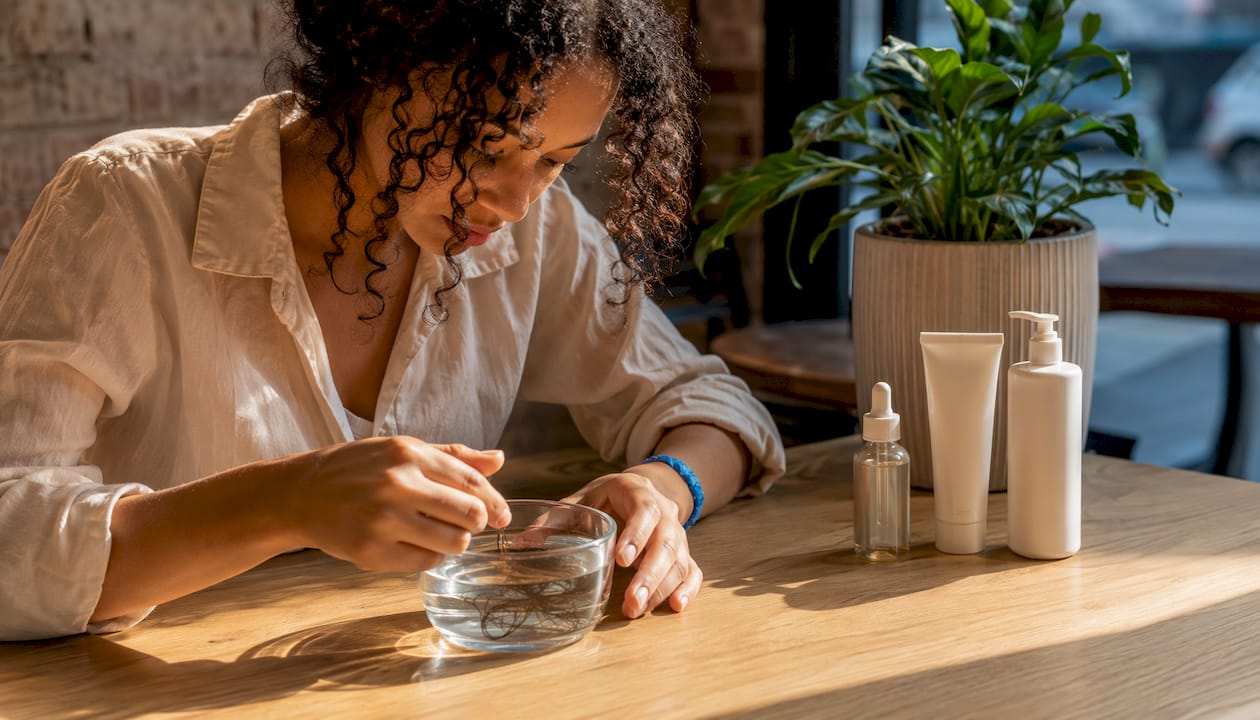
- Porosity float test: Drop a clean, shed strand into a glass of room-temperature water. If it floats for several minutes, porosity is low. If it sinks quickly, porosity is high.
- Elasticity snap test: Wet a single strand and stretch it slowly. Healthy hair stretches and returns. Hair that snaps immediately has low elasticity — a sign of protein deficiency or damage.
- Density check: Part your hair and look at the scalp. If it is barely visible, density is high. If you can see scalp clearly without parting, density is low.
Pro Tip: Prioritize porosity when choosing treatments. A high-porosity strand needs protein-rich products to fill gaps in the cuticle; a low-porosity strand needs heat or steam to open the cuticle before conditioning. Matching to curl type alone often leads to product buildup or persistent dryness.
How to test and photograph your hair for an accurate assessment
Accurate self-assessment takes about 15 minutes and gives you the data an AI scan or stylist needs to make useful recommendations.
Step-by-step self-tests:
- Wash hair with a clarifying shampoo and let it air-dry completely — no products. This removes buildup that distorts results.
- Run the porosity float test on a shed strand (see above).
- Run the elasticity snap test on a wet strand from a different section.
- Part hair in four places (crown, sides, nape) and note whether the scalp is visible without effort — that is your density read.
- Inspect the scalp under good light for redness, flaking, or tenderness.
Photo and scan checklist for AI tools like Myhair:
- Use natural daylight or a bright, neutral artificial light — no flash
- Shoot against a plain white or light gray background
- Capture four angles: top of crown, left side, right side, and nape
- Take one set of photos with hair wet and one with hair dry
- Include a parted section so the AI can assess density and scalp condition
- Note the date, any recent chemical or heat treatments, and products currently in use
Avoid testing within four weeks of a relaxer or heavy color service — the strand's mechanical properties will be temporarily altered and results will not reflect your baseline.
Pattern-specific care: what works for each hair type
Dermatologists recommend adjusting wash frequency and conditioning based on hair type, applying shampoo at the scalp, and being gentle when detangling wet hair. Here is what that looks like per pattern.
Type 1 (Straight)
- Wash frequently as needed; scalp oils can accumulate quickly
- Use lightweight conditioners; avoid heavy butters or oils that flatten the shaft
- Skip heavy styling products — they create buildup without adding benefit
Type 2 (Wavy)
- Wash about weekly; too frequent washing can disrupt the wave pattern
- Apply lightweight creams or sprays to damp hair and air-dry or diffuse gently
- Anti-humidity serums reduce frizz without weighing waves down
Type 3 (Curly)
- Condition at every wash; curly hair is drier because oils struggle to travel down the curl
- Detangle with conditioner in the shower using a wide-tooth comb or fingers — never dry
- Deep condition weekly to maintain elasticity and reduce single-strand knots
Type 4 (Coily)
- Wash once weekly or every other week; use conditioner at every wash
- Use hot oil treatments periodically to support moisture retention in densely packed fine strands
- Limit relaxer touch-ups to only new growth at spaced intervals to reduce cumulative damage
- For a full stepwise routine, the 4C hair care guide at Myhair covers protective styling and moisture sealing in detail
Universal cautions across all types:
- "Pain equals damage" — if braids, cornrows, or weaves cause scalp pain, the tension is high enough to cause traction injury and long-term thinning
- Keep heat tools below 350°F for fine or high-porosity hair; coarse, low-porosity hair can tolerate slightly higher settings, but always use a heat protectant
- Match products to porosity first, curl type second
Pro Tip: Type 4 coily hair often appears coarse but is made of many fine strands packed tightly together — which is exactly why it is the most fragile. Treat it with the same care you would give fine straight hair, not the rough handling its dense appearance might suggest.
When should you consult a professional or use an AI assessment?
Some changes in your hair pattern or scalp need more than a product swap.
Red flags that warrant a dermatologist or trichologist visit:
- Sudden diffuse shedding (more than usual on your pillow, in the shower, or on your brush)
- Noticeable thinning at the crown, temples, or hairline
- Scalp inflammation, persistent itching, or visible scarring
- Pain during or after styling, especially with protective styles
- Pattern changes after a chemical service that do not resolve within 6–8 weeks
AI scans add real value for baseline tracking and early detection — quantifying porosity shifts, monitoring miniaturization over time, and flagging changes before they become visible to the naked eye. They do not replace a clinical exam when scarring, inflammation, or significant shedding is present. For readers exploring clinical options, hair loss prescription services can bridge the gap between at-home monitoring and a full clinical consult.
Prep checklist before any appointment (clinical or AI scan):
- Photograph your hair and scalp under consistent lighting — same angle, same time of day
- List every product used in the past 30 days, including oils, gels, and treatments
- Note the timeline: when did you first notice the change?
- Record any recent chemical services, heat treatments, or dietary changes
- Bring or upload photos from 3–6 months earlier if available — before-and-after context is the single most useful thing a clinician or AI can work with
Key Takeaways
Porosity, elasticity, and cuticle integrity determine hair health more reliably than visual curl pattern alone — match your care routine to those metrics, not just your Type 1–4 label.
| Point | Details |
|---|---|
| Four visual pattern groups | Straight, wavy, curly, and coily each have healthy markers: shine, elasticity, intact cuticle, and moisture retention. |
| Porosity overrides curl type | Two people with the same curl pattern can need opposite products if their porosity differs. |
| Simple at-home tests | The float test (porosity) and snap test (elasticity) give you the data you need in under 10 minutes. |
| Styling caution: pain equals damage | Tension styles that cause scalp pain risk traction injury and long-term thinning — stop the style immediately. |
| Myhair AI scan | Myhair delivers objective porosity, elasticity, and hair-score metrics from a photo scan, with longitudinal tracking and tailored product recommendations. |
The case for measuring what you cannot see
Most hair advice stops at the visual level — "you have 3c curls, use this cream." That framing misses the point. Two people with identical curl patterns can have completely different porosity levels, strand diameters, and elasticity readings, which means they need different products, different wash frequencies, and different chemical-service timelines. The visual taxonomy is a useful shorthand, but it was never designed to drive clinical or product decisions.
The shift toward quantitative metrics — curve diameter, twist number, mechanical elasticity — reflects what hair scientists have known for years: the properties you cannot see with the naked eye are the ones that predict breakage, moisture loss, and styling tolerance. A 2026 clinical perspective formalizes this by advocating geometric parameters alongside visual systems, which is exactly the direction AI-based assessment tools are moving.
The practical implication: do the tests. A 10-minute float-and-snap assessment at home gives you more useful information than a decade of buying products based on curl type alone. And if you want a more complete picture — one that tracks changes over time and flags early signs of miniaturization — an AI scan is the logical next step, not a luxury.
Myhair gives you a personalized hair health baseline
Knowing your pattern is step one. Getting an objective measurement of porosity, elasticity, and overall hair score is what turns that knowledge into a plan you can actually follow.
Myhair's AI-powered hair scanner analyzes your uploaded photos and returns a scored assessment covering porosity, elasticity, and hair health — the same metrics this article covers, measured objectively rather than estimated by eye. The hair score updates with each scan, so you can track whether your routine is working over weeks and months. Onboarding takes a few minutes: upload photos in natural light from the four angles described above, answer a short intake questionnaire, and receive tailored product recommendations matched to your specific metrics. Your data stays private and is used solely to generate your personal assessment. Ready to move from guessing to knowing? Run your first scan at Myhair and get a baseline you can build on.
FAQ
What are the four main types of healthy hair patterns?
The four types are straight (Type 1), wavy (Type 2), curly (Type 3), and coily (Type 4), each with A, B, and C subtypes. Healthy hair in every group shows good elasticity, intact cuticles, and adequate moisture retention.
Does hair pattern determine how healthy your hair is?
No. Pattern describes shape; health is determined by porosity, elasticity, and cuticle integrity. Two people with the same curl type can have very different health profiles depending on those structural properties.
How do I identify my hair type at home?
Wash and air-dry your hair without products, then observe the natural pattern. Pair that visual check with a porosity float test and an elasticity snap test for a complete picture.
Can hair patterns change over time?
Yes. Hormonal shifts, chemical services, heat damage, and nutritional changes can all alter curl pattern and texture. Tracking photos over time — or using an AI scan — helps you catch changes early.
When should I see a dermatologist about my hair?
Sudden diffuse shedding, scalp inflammation, visible scarring, or pain during styling are all reasons to book a clinical exam rather than adjust your routine.
Useful sources
The sources below informed the taxonomy, structural tests, and care guidance throughout this article. Save them before a clinical consult or AI scan.
- Tips for healthy hair — American Academy of Dermatology: Dermatologist-backed wash, conditioning, and detangling guidance by hair type. Informs the structural tests and pattern-specific care checklists.
- Black hair: Tips for everyday care — AAD: Frequency recommendations for Type 4 hair, relaxer timing, and the "pain equals damage" styling caution.
- Clinical perspective on curl classification — PMC: 2026 clinical perspective advocating quantitative geometric metrics (L'Oréal Curl Classification System) alongside visual systems. Informs the taxonomy update discussion.
- Hair Types — WebMD: Accessible overview of the four visual types and porosity basics.
- Hair types and care instructions — Medical News Today: Type-specific oil distribution and washing cadence guidance.
- What are the four types of hair — MedicineNet: Structural detail on coily hair fragility and maintenance implications.
| Source | Best used for |
|---|---|
| AAD — healthy hair tips | Wash frequency, detangling rules, structural tests |
| AAD — Black hair care | Type 4 frequency, relaxer timing, traction caution |
| PMC — curl classification | Taxonomy update, geometric metrics, L'Oréal system |
| WebMD — hair types | Visual taxonomy, porosity overview |
| Medical News Today | Pattern-specific washing cadence |
| MedicineNet | Coily hair fragility and fine-strand structure |