
TL;DR:
- WOW Hair Growth Oil combines natural ingredients to improve hair health but lacks strong clinical evidence for regrowth.
- Scientific support suggests oils mainly reduce breakage and enhance scalp condition, with minoxidil remaining the proven regrowth option.
- Real user feedback shows improved shine and reduced hair fall but limited success in reversing significant hair loss.
Hair growth oils flood every social media feed, with WOW Hair Growth Oil among the most talked-about. Millions of people dealing with thinning hair or frustrated by shedding turn to these products hoping for a fix. But the space between viral testimonials and clinical reality is wide. Before you invest your time, money, and expectations into any oil, it helps to know what the evidence actually supports, what real users report, and how to match any solution to your specific hair situation. This guide cuts through the noise with ingredient-level analysis, honest user feedback, and guidance on when to level up to something more targeted.
Table of Contents
- What is WOW Hair Growth Oil and how does it work?
- Is there scientific evidence supporting WOW Hair Growth Oil?
- What do real users and influencers say?
- How should you use WOW Hair Growth Oil, and who can benefit most?
- Personalized alternatives: When should you consider AI-driven or medical solutions?
- The uncomfortable truth about hair growth oils
- Explore smarter, personalized hair solutions
- Frequently asked questions
Key Takeaways
| Point | Details |
|---|---|
| Scalp health focus | WOW Hair Growth Oil helps mainly by improving scalp hydration and reducing breakage, not true regrowth. |
| Limited evidence | Clinical studies support FDA-approved treatments for hair regrowth, while oils provide only mild improvements. |
| Personalization matters | For significant loss, tailor your routine with personalized analysis rather than generic products. |
| Consistency counts | Using oils like WOW regularly for at least 1-3 months is key for any visible benefit. |
What is WOW Hair Growth Oil and how does it work?
WOW Hair Growth Oil is a plant-based hair oil product that combines several popular natural ingredients, most notably onion oil, rosemary, coconut oil, and castor oil. Each ingredient brings something different to the table, and understanding what they are supposed to do helps you set realistic expectations before you start.
Here is a quick breakdown of the main ingredients and their proposed roles:
- Onion oil: Contains sulfur compounds thought to nourish hair follicles and support scalp circulation. Onion juice showed hair regrowth in a randomized controlled trial within 6 weeks for people with alopecia areata, a specific autoimmune condition causing patchy loss.
- Rosemary oil: Believed to improve blood flow to the scalp, which may help follicles stay active. Some studies compare its effects to early minoxidil results, though evidence is still limited.
- Coconut oil: A well-researched oil for reducing protein loss in hair. It penetrates the hair shaft better than most oils, reducing breakage and keeping strands stronger.
- Castor oil: Rich in ricinoleic acid, castor oil is popular for thickening the look of hair, though scientific backing for actual regrowth is thin.
| Ingredient | Proposed benefit | Evidence level |
|---|---|---|
| Onion oil | Follicle stimulation, sulfur nourishment | Limited RCT (alopecia areata only) |
| Rosemary oil | Scalp circulation, possible follicle activation | Small studies, comparable to minoxidil in one trial |
| Coconut oil | Protein retention, reduced breakage | Moderate, well-supported |
| Castor oil | Moisture, visual thickness | Low, mostly anecdotal |
Collectively, these ingredients work through a few mechanisms: hydrating the scalp, providing antioxidants that reduce oxidative stress on follicles, and offering fatty acids that strengthen the hair shaft. You can read more about the science behind natural oils for hair growth and a dedicated breakdown of onion oil benefits to see how these ingredients compare more broadly.
Pro Tip: Before you start any new hair oil, scan the ingredient list for common allergens like fragrance compounds or specific plant extracts. A patch test on your inner arm for 24 hours can save you a lot of scalp irritation later.
Is there scientific evidence supporting WOW Hair Growth Oil?
Knowing the claims is only half the picture. What does science actually say about WOW and similar hair growth oils?
The honest answer: not much, at the product level. There are no product-specific clinical trials for WOW Hair Growth Oil itself. Most evidence that exists applies to individual ingredients, and even then, the results are mixed or limited to very specific conditions.
Onion oil is the most studied ingredient in the formula, but its RCT support is narrow. It showed measurable regrowth specifically in people with alopecia areata, not general androgenic alopecia (the most common type of hair loss). Extending those results to everyone experiencing hair thinning is a leap the data does not fully support.
"Rosemary oil has shown limited evidence in some studies comparable to minoxidil, but dermatologists continue to recommend FDA-approved treatments as the primary option for meaningful regrowth." — Dermatologist consensus covered in expert reviews on hair growth oils
Here is how oils stack up against proven treatments:
| Approach | Clinical evidence | Best use case | Expected results | |---|---|---| | WOW Hair Growth Oil | Low (ingredient-level only) | Scalp health, maintenance | Reduced breakage, better texture | | Rosemary oil | Moderate (limited studies) | Mild thinning, early-stage loss | Possible slowing of loss | | Minoxidil (topical) | High (FDA-approved) | Androgenic alopecia | Measurable regrowth in most users | | Finasteride | High (FDA-approved, oral) | Male pattern baldness | Proven to slow loss and regrow |
The bottom line from experts is that minoxidil remains the proven standard for real regrowth, while oils offer value mostly for scalp conditioning and reducing mechanical damage. That does not mean oils are useless. It just means you need to be clear on what you are trying to achieve. If you want to build a smart how to build an oil routine around realistic goals, the science can absolutely support that.
What do real users and influencers say?
Evidence is important, but so are real-world experiences. How do users and online communities actually feel about WOW Hair Growth Oil?
On Amazon, WOW Hair Growth Oil carries a strong rating, with the majority of reviews being positive. Users frequently mention improved shine, less hair fall during combing, and softer texture. But look closely and a pattern emerges: almost all the enthusiastic reviews describe better hair health, not new hair sprouting from previously bald or thinning areas.
"I've been oiling my hair for years and it definitely looks healthier, but let's be real, the oils didn't bring back my hairline. That's what minoxidil is for." — Representative Reddit user in r/finethinhair
On Reddit and TikTok, the picture gets more complicated. Many users are skeptical that any oil can genuinely stimulate new growth, especially for those with patterned hair loss. Several TikTok creators have called out "hair growth oil" branding as misleading marketing aimed at people who are desperate for a solution.
What users love about WOW Hair Oil:
- Noticeable reduction in hair fall during washing
- Improved shine and manageability
- Pleasant scent compared to raw onion oil products
- Feels lighter than pure castor oil
Common complaints or misconceptions:
- Expecting full regrowth where hair has been lost for years
- Greasy residue if not washed out properly
- Results plateau quickly without complementary scalp care
- Frustration when results do not match marketing visuals
The reality is that consistency matters enormously. Many users who report positive results have been using the oil as part of a broader routine that includes a good diet, gentle washing, and reduced heat styling. Check out these natural hair oil routines for examples of how context shapes results.

How should you use WOW Hair Growth Oil, and who can benefit most?
For those ready to try or already using WOW Hair Oil, understanding best practices and who should consider alternatives is essential.
Best practices for using WOW Hair Growth Oil:
- Apply 2-3 times per week to the scalp, not just the lengths of your hair.
- Use a dropper or your fingertips to massage the oil in circular motions for at least 5 minutes.
- Leave it on for a minimum of 30 minutes, or overnight for deeper conditioning.
- Wash out thoroughly with a gentle sulfate-free shampoo.
- Commit to at least 60 to 90 days before evaluating results; consistent use over 60-90 days is the minimum window to judge any hair oil fairly.
- Pair with a nutrient-rich diet and minimize heat and chemical damage.
Who benefits most from WOW Hair Oil:
- People with mild thinning who want to slow visible shedding
- Those with dry, brittle hair or a flaky scalp
- Anyone looking for a maintenance step alongside other treatments
- Individuals with sensitive scalps who react to harsher topical treatments
Who should look elsewhere:
- Anyone experiencing significant, rapid hair loss
- Those with chronic scalp conditions like seborrheic dermatitis or psoriasis (see a dermatologist first)
- People expecting to regrow hair in areas that have been bald for years
For a more detailed breakdown, check these effective oil routine tips and hair oil recommendations to compare options suited to your hair type.
Pro Tip: Track your progress with monthly photos taken in the same lighting and angle. A dedicated tool like a hair analysis app can add objective data to what you are feeling subjectively.
Personalized alternatives: When should you consider AI-driven or medical solutions?
Some readers will get good results with WOW Hair Oil, but if your needs are more advanced, it is worth considering high-tech or medical approaches.
There are clear signs that a generic oil is not enough. If you are losing more than 100 hairs per day consistently, noticing a widening part, or seeing significant scalp visibility, an oil alone will not address the underlying cause. Root causes like hormonal shifts, nutrient deficiencies, or autoimmune triggers require targeted identification.
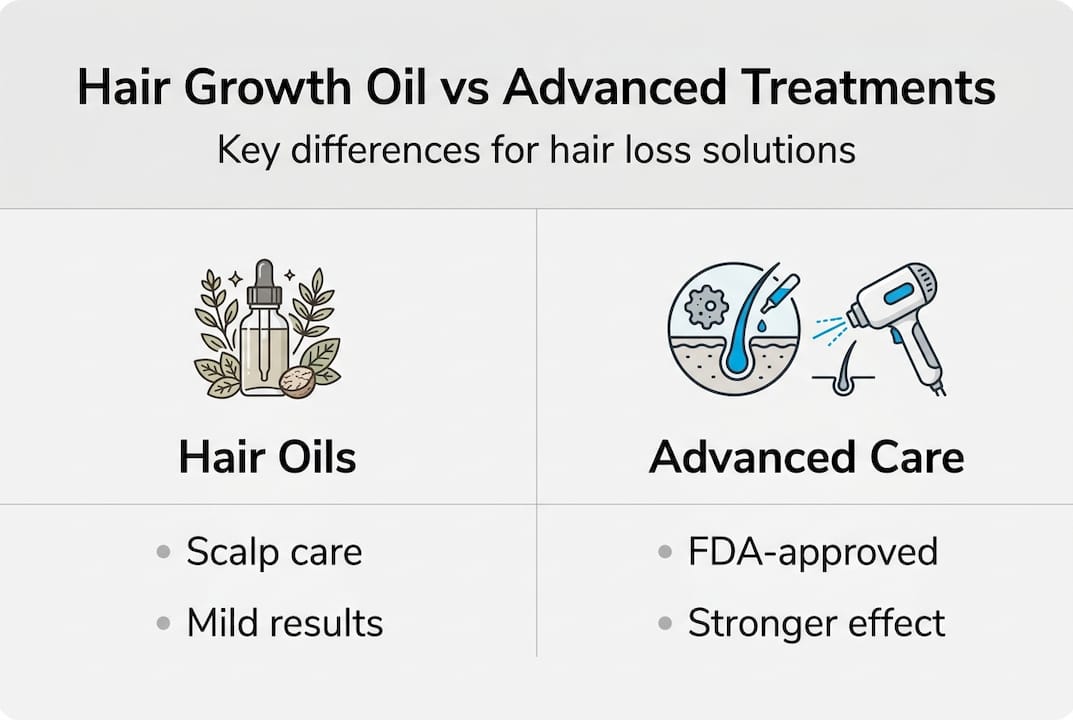
This is where AI-powered hair analysis changes the game. Instead of guessing which product might work, a platform built on smart algorithms can assess your actual scalp condition, track changes over time, and point you toward products and routines that fit your specific pattern of loss. That is a fundamentally different approach from picking an oil off a shelf because it has good reviews.
Advantages of personalized and AI-driven approaches over generic oils:
- Identifies your specific type of hair loss, not just symptoms
- Tracks measurable change over weeks and months with objective data
- Recommends treatments based on your scalp profile, not averages
- Flags when you need professional medical consultation
- Helps you avoid wasting money on products that do not match your condition
For serious hair loss, FDA-approved advanced treatments like minoxidil and finasteride remain the gold standard. Over 80% of dermatologists recommend minoxidil as the first-line option for significant regrowth. Oils work best as an adjunct to these treatments, not as a replacement.
The uncomfortable truth about hair growth oils
Stepping back, here is what most guides and hype videos do not tell you about hair growth oils and real results.
The marketing around products like WOW Hair Growth Oil is built on a mix of real ingredient science and inflated promises. Brands are not lying exactly, they are just framing scalp health improvements as hair regrowth. Those are two very different things.
Oils make your hair look better. They reduce breakage, add shine, improve scalp moisture, and create an environment where existing hair can thrive. That is genuinely valuable. But creating new follicular activity where it has stopped? That takes a different category of intervention entirely.
"If any oil truly regrew lost hair reliably, every dermatologist in the world would be prescribing it. The fact that they do not tells you everything about where oils sit in the treatment hierarchy."
The smartest approach is to be honest about what stage you are at. For early maintenance and scalp health, a quality oil routine like the one outlined in these hair oiling routine insights can genuinely support your hair. But combining that with objective tracking and, when necessary, proven medical treatment is what actually moves the needle.
Explore smarter, personalized hair solutions
If you have been going back and forth between products, trying different oils and routines without a clear picture of what is actually happening on your scalp, that guessing game has a better alternative.

MyHair.ai uses AI-driven analysis to give you a real assessment of your hair health, track changes over time, and recommend solutions tailored to your specific pattern and scalp condition. Instead of trial and error, you get clarity. Start with a personalized hair analysis to understand your unique situation, or get your hair score in minutes. Ready to move beyond guessing? Start with MyHair today and get answers that actually match your hair.
Frequently asked questions
How long does it take to see results with WOW Hair Growth Oil?
Most users notice improvements in hair texture and reduced shedding within 1 to 3 months, but consistent use over 60-90 days is the minimum needed to evaluate any real change. Significant new regrowth is unlikely based on current evidence.
Can WOW Hair Growth Oil regrow hair for everyone?
No hair oil regrows hair universally. WOW may improve scalp conditions and reduce breakage, but minoxidil remains proven as the first-line treatment for meaningful regrowth in androgenic alopecia.
Are there any risks or side effects from using WOW Hair Growth Oil?
Some users report scalp irritation, especially from the onion oil component. Always do a patch test on your inner arm for 24 hours before applying to the scalp, and discontinue use if redness or itching develops.
Is WOW Hair Growth Oil suitable for sensitive scalps?
Natural oil formulas can work for sensitive scalps with monitoring, but it is important to avoid products with added fragrances or harsh preservatives. Start with small amounts and increase gradually.