TL;DR:
- Coconut oil strengthens hair shafts and reduces breakage but does not promote hair regrowth.
- Best suited for dry, damaged, curly, or thick hair types due to its penetrating properties.
- Proper application, frequency, and realistic expectations are key to optimizing benefits.
Coconut oil sits in millions of bathrooms worldwide, often marketed as the ultimate solution for thinning, breaking, or dull hair. The reality is more interesting than the hype suggests. While no clinical evidence supports coconut oil as a treatment for genetic hair loss conditions, it genuinely does strengthen hair shafts, cut down on breakage, and improve moisture retention in ways that science backs up. This guide walks you through exactly what coconut oil can do for your hair, who benefits most, how to apply it correctly, and how to troubleshoot when things go sideways.
Table of Contents
- What coconut oil hair treatment can (and can't) do-do)
- Who benefits most from coconut oil hair treatments?
- How to prepare and apply coconut oil: Step-by-step guide
- Troubleshooting, tips, and optimizing your results
- Our perspective: Why coconut oil works (and doesn't) for real people-for-real-people)
- Next steps: Personalize your hair care with MyHair
- Frequently asked questions
Key Takeaways
| Point | Details |
|---|---|
| Breakage protection | Coconut oil prevents hair breakage and strengthens hair shafts, not regrowth. |
| Best for dry hair | People with dry, damaged, curly, or thick hair benefit the most from coconut oil treatments. |
| Personalized routine | Applying coconut oil 1–2 times per week works well for most and should be adjusted for hair type. |
| Consider enriched oils | Formulas enriched with additional ingredients may deliver even better results for shine and strength. |
What coconut oil hair treatment can (and can't) do
Let's clear something up before you reach for that jar. Coconut oil is an exceptional conditioning and protective agent, but it is not a regrowth serum. Understanding the difference between those two things will save you months of frustration.
What coconut oil actually does well:
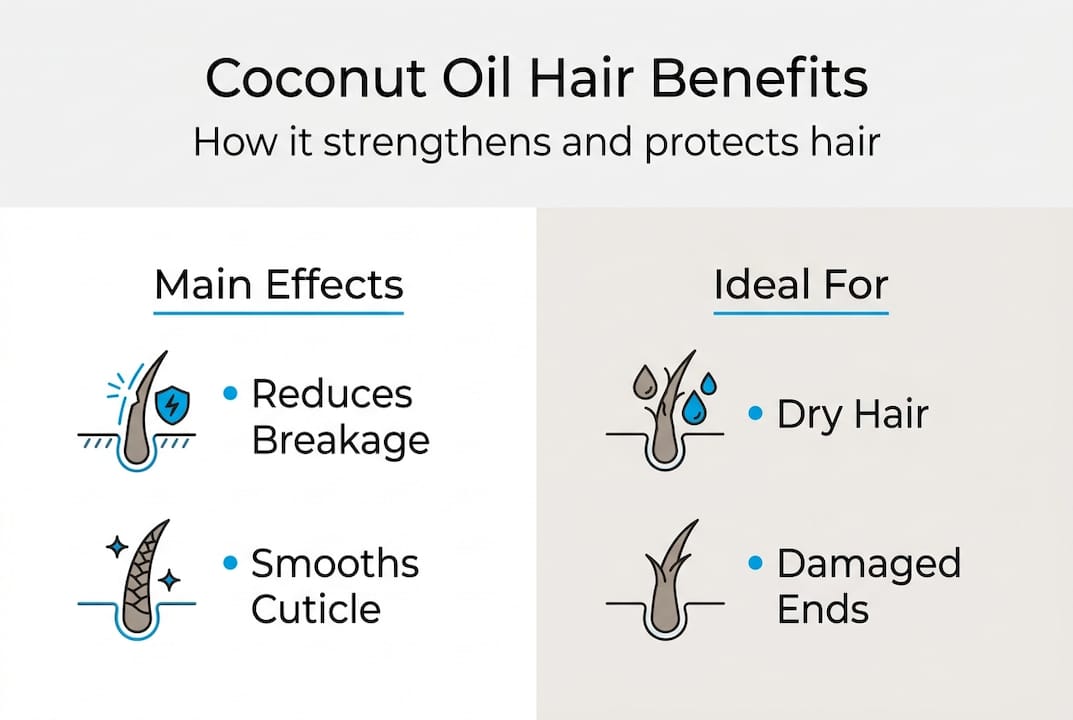
Coconut oil is rich in lauric acid, a medium-chain fatty acid with a molecular structure small enough to actually penetrate the hair shaft rather than just coat the outside. Most oils, like argan or olive oil, sit on the surface. Coconut oil goes deeper, which is why it reduces protein loss from hair during washing. That means your strands stay structurally stronger over time, and you lose less hair to breakage during combing, heat styling, or chemical processing.
For anyone dealing with dry, brittle, or damaged hair, this is genuinely significant. Hair that breaks less appears fuller and longer. Over time, that reduced breakage compounds into real, visible improvement.
What coconut oil cannot do:
Here is where the marketing often misleads people. Conditions like androgenetic alopecia (pattern baldness) or alopecia areata are rooted in follicle-level biology, hormones, and immune responses. Coconut oil, applied to the shaft or scalp, cannot influence those processes. The science on this is consistent: coconut oil reduces breakage but not follicular loss, meaning it will not create new follicles or reactivate dormant ones. If you are losing hair due to these conditions, you need treatments targeting the root cause, not a conditioning oil.
That said, there is a meaningful distinction between shedding caused by follicle issues and shedding caused by weak, breakage-prone strands. Coconut oil addresses the second category very well. For a full picture, you can explore what the research says about coconut oil for hair loss specifically.
Plain oil versus enriched formulas:
Research comparing different coconut oil formulas is worth noting. A randomized double-blind study found that enriched coconut oil blends outperformed plain coconut oil in several measurable ways, including hair fall reduction and tensile strength. So while plain coconut oil is a solid starting point, enriched versions with added botanicals or nutrients may deliver better results for some users.
| Feature | Plain coconut oil | Enriched coconut oil blend |
|---|---|---|
| Penetrates hair shaft | Yes | Yes |
| Reduces protein loss | Yes | Yes, often enhanced |
| Targets dandruff | Moderate | Better (added actives) |
| Reduces hair fall | Moderate | Stronger evidence |
| Improves tensile strength | Yes | Superior in RCT |
Pro Tip: If you have fine or oily hair, use coconut oil sparingly on the mid-lengths to ends only. Applying it to the scalp or roots when you already produce excess sebum will accelerate buildup and leave hair looking flat within hours.
For those specifically dealing with damaged hair benefits, coconut oil's shaft-penetrating action is the feature that matters most.
Who benefits most from coconut oil hair treatments?
Not every head of hair responds to coconut oil the same way. Knowing your hair type before you start will save you a lot of trial and error.
Hair types that see the strongest results:
Dry, curly, thick, and chemically processed hair are the top beneficiaries. These hair types share a common problem: the cuticle layer (the outermost protective shield of each strand) is often raised, damaged, or stripped. Coconut oil seals and fills those gaps, reducing moisture loss and making hair more resilient to everyday stress. People with naturally coarser or drier hair textures tend to see visible improvement faster because the baseline moisture deficit is greater.
Research supports this clearly. Dry and damaged hair types respond best to coconut oil, while fine or oily hair requires careful, restrained use to avoid greasiness and buildup. The rule is simple: more porous hair absorbs more oil, so you need less product than you think for fine hair, and can use more for thick or curly textures.
Fine and oily hair: proceed with care:
If your hair tends to look greasy by midday or goes flat easily, coconut oil is not off-limits, but it needs a lighter touch. Apply a tiny amount (think a pea-sized portion) to the ends only, never the scalp or roots. This gives you some of the protective benefits without weighing your hair down. Skip the overnight treatment entirely. A 20-minute pre-wash treatment is your maximum.
Scalp conditions and dandruff:
Here is an underappreciated benefit. Virgin coconut oil contains antioxidants and antimicrobial compounds that can reduce Malassezia, the yeast commonly associated with dandruff. Regular scalp application of virgin coconut oil may noticeably reduce flaking over several weeks. This is not a replacement for medicated dandruff shampoos in severe cases, but it is a real, evidence-supported benefit for mild to moderate scalp irritation.
"Virgin coconut oil, with its higher antioxidant content and antimicrobial activity, is the preferred form for scalp health support, particularly for fungal-linked dandruff."
Why virgin coconut oil matters:
Refined coconut oil goes through chemical processing that strips out many of the beneficial compounds. Virgin coconut oil benefits include a higher concentration of polyphenols, tocopherols (vitamin E), and the antimicrobial lauric acid at its full potency. When choosing a product, look for labels that say "virgin" or "cold-pressed" and avoid anything labeled "refined" or "RBD" (refined, bleached, deodorized).
| Hair type | Recommended use | Frequency | Key benefit |
|---|---|---|---|
| Dry/thick/coarse | Mid-length to ends + scalp | 2x per week | Deep moisture, shaft protection |
| Curly/coily | Full application, overnight | 1-2x per week | Curl definition, reduced frizz |
| Chemically processed | Ends and damaged sections | 1-2x per week | Protein loss reduction |
| Fine/oily | Ends only, pre-wash | Once per week | Light conditioning |
| Normal | Mid-length to ends | Once per week | Maintenance, shine |
For coconut oil for damaged hair specifically, focusing application on the most compromised sections (ends and areas exposed to heat) gives you the best return.

How to prepare and apply coconut oil: Step-by-step guide
Good results from coconut oil come down to technique as much as the oil itself. Here is a reliable, step-by-step process based on what the evidence says actually works.
What you will need:
- Virgin or cold-pressed coconut oil (solid at room temperature below 76°F)
- A small bowl for melting
- A wide-tooth comb
- An old towel or hair cap
- A gentle, sulfate-free shampoo for washing out
Step-by-step application:
-
Melt the oil if it is solid. Place a tablespoon or two in a small bowl and set it in warm water for a minute or two. You want it liquid but not hot. Applying hot oil to your scalp or hair can cause damage.
-
Section your hair into 2 to 4 sections using clips or ties. This ensures even coverage and prevents you from missing patches.
-
Apply oil from mid-length to ends first. This is where hair is oldest and most damaged. Use your fingers to work the oil through each section, coating evenly.
-
Add a small amount to the scalp if you have a dry scalp or dandruff concerns. Use your fingertips to massage gently in circular motions. Skip this step if your scalp is already oily.
-
Comb through with a wide-tooth comb to distribute evenly and detangle.
-
Cover with a shower cap or wrap in an old towel to trap warmth, which helps the oil penetrate deeper.
-
Leave it on for at least 30 minutes. For deeper conditioning, leave overnight and wash out in the morning. Overnight treatments are especially effective for very dry or damaged hair.
-
Wash thoroughly using a gentle shampoo. You may need two lather cycles to fully remove the oil. Follow with conditioner on the ends if needed.
How often and how much:
Using coconut oil 1 to 2 times per week is the sweet spot for most people. Research tracking hair shaft consistency over time found that regular coconut oil users showed 65% lower variability in hair diameter, with surface roughness (Rq) dropping by 30% after just 20 oil-wash cycles. That is measurable structural improvement from a consistent routine.
| Application schedule | Hair condition | Expected result |
|---|---|---|
| Once per week | Normal to slightly dry | Maintenance, shine |
| Twice per week | Dry, damaged, or curly | Visible strength, less breakage |
| Once per week (ends only) | Fine or oily | Light protection, no buildup |
| Overnight (weekly) | Very dry or chemically processed | Deep repair, improved texture |
Pro Tip: Warm the oil slightly before application and gently massage your scalp for 5 minutes. This increases circulation and helps the oil absorb more evenly, making the treatment more effective regardless of hair type.
An AI-powered coconut oil routine can help you dial in the exact frequency and method based on your specific hair data, which is especially useful if your hair type falls somewhere between categories.
For additional practical guidance on coconut oil for hair fall tips, tailored advice makes a big difference in outcomes.
Troubleshooting, tips, and optimizing your results
Even people who follow the steps correctly sometimes run into issues. Here is how to recognize problems early and fix them.
Signs you are using too much coconut oil:
- Hair looks greasy even after washing
- Strands feel heavy or limp
- Scalp feels clogged or itchy
- Hair has lost volume and appears flat
If any of these apply, you are likely overusing the oil. This is one of the most common mistakes, especially among people with fine or low-porosity hair. Low-porosity hair has tightly packed cuticles that resist absorption, meaning the oil just sits on the surface rather than penetrating.
How to fix buildup:
Use a clarifying shampoo once every two to four weeks to fully strip away residue. Look for formulas labeled "clarifying" or "deep clean." After a clarifying wash, follow up with a good conditioner because clarifying shampoos strip moisture along with buildup.
Consider enriched coconut oil for better results:
If plain coconut oil is not delivering the results you hoped for, an enriched blend might be worth trying. A randomized controlled trial on enriched coconut oil involving 44 women over 8 weeks found that an enriched Vatika formula outperformed plain coconut oil across multiple metrics: less hair fall, reduced dandruff, improved tensile strength, and better shine. The added botanical ingredients made a statistically significant difference in real-world outcomes.
"Enriched coconut oil blends represent a meaningful upgrade for users who have plateaued on plain coconut oil, particularly for reducing shedding and improving mechanical strength of strands."
Tracking your results:
This part is often skipped, and it is a mistake. Your perception of whether something is working can be unreliable, especially when changes happen gradually. Take consistent photos in the same lighting, at the same angle, once a month. Keep a simple note of how much hair you find on your brush after detangling. These records give you objective data to work with.
Tips for better results:
- Pair coconut oil with a thicker hair routine for a more complete approach to volume and density
- Address hair breakage directly with protective styling and reduced heat use alongside your oil routine
- Stay consistent for at least 8 to 12 weeks before judging results, since hair improvement happens on the hair's growth timeline
Our perspective: Why coconut oil works (and doesn't) for real people
After following the research and hearing from thousands of users, one thing stands out clearly: coconut oil succeeds when people use it for the right reasons and fails when it carries unrealistic expectations.
Coconut oil is one of the best tools available for dryness, breakage, and general hair resilience. It is not, and never will be, a cure for genetic hair loss. The people who get the most from it are those who understand their hair type, apply it consistently, and treat it as one piece of a larger personalized routine rather than a standalone solution.
What the science behind coconut oil consistently shows is that benefits accumulate over time. The 30% improvement in surface roughness after 20 oil-wash cycles mentioned earlier is a great example. These are not dramatic overnight changes; they are steady, structural improvements that add up over months.
The smartest approach is pairing coconut oil with a personalized hair care plan that accounts for your unique hair type, scalp condition, and specific goals. Universal routines produce average results. Tailored routines produce real ones.
Next steps: Personalize your hair care with MyHair
If you have been experimenting with coconut oil and wondering whether you are on the right track, the answer lies in understanding your specific hair health data, not generic advice.

MyHair.ai uses AI-powered analysis to assess your hair's actual condition, tracking changes over time and telling you exactly what your hair needs at every stage. You can get your Hair Score in minutes to see where your hair currently stands. For a deeper look at what the data says about treatments like coconut oil, see the research behind our recommendations. Ready to go further? Start your hair analysis and get a personalized routine built around your real hair biology, not guesswork.
Frequently asked questions
Does coconut oil really regrow hair or reverse baldness?
Coconut oil does not cause new hair growth or reverse baldness. It reduces breakage and protects hair shafts, which can make existing hair look fuller, but it cannot reactivate dormant follicles or counter the hormonal causes of pattern hair loss.
How often should I use coconut oil on my hair?
Applying coconut oil 1 to 2 times per week works well for most hair types, giving you consistent conditioning benefits without causing buildup or greasiness over time.
Can coconut oil help with dandruff?
Yes, particularly virgin coconut oil's antimicrobial activity targets Malassezia yeast on the scalp, which is a common driver of dandruff, making it a useful complementary treatment for mild to moderate cases.
Is enriched coconut oil better than plain coconut oil?
In a randomized double-blind trial, enriched coconut oil outperformed plain oil in reducing hair fall, dandruff, and improving tensile strength and shine over 8 weeks, making it worth considering if plain oil has not delivered the results you expected.