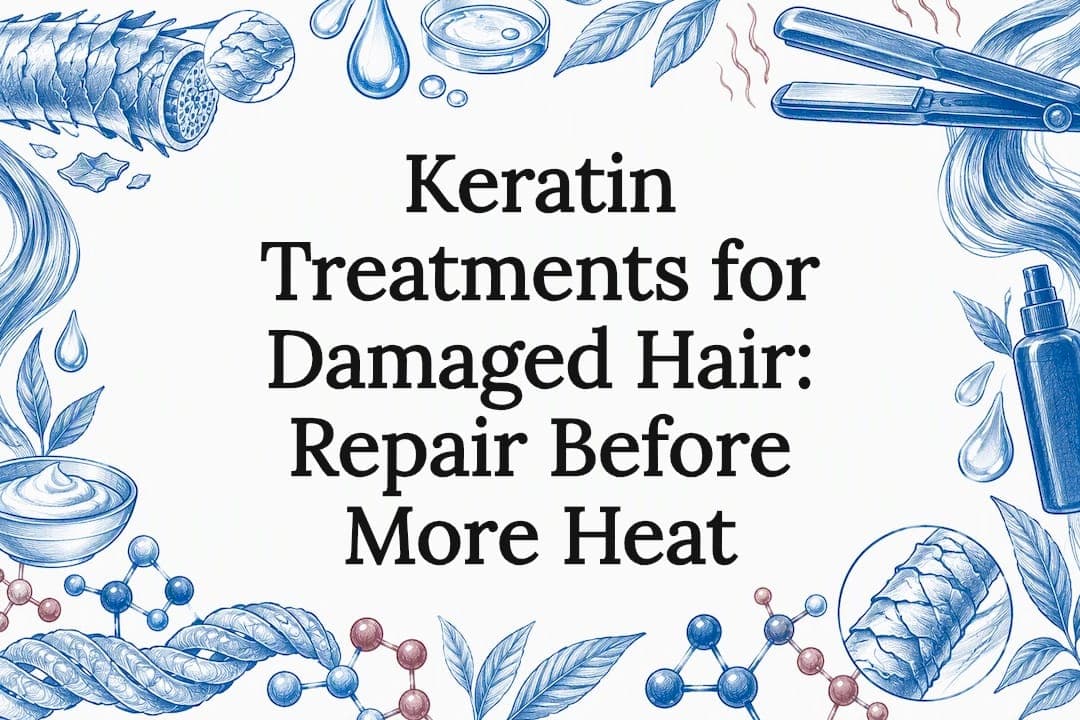
Keratin smoothing can make damaged hair look sleeker and shinier within days, but the heat and aldehyde chemistry behind that result often add stress to a fiber that is already weakened. For most people with chemically treated or heavily damaged hair, a conservative reset and targeted repair work beats jumping straight into a keratin service. The sections below break down how the treatment works, who it suits, and how to recover if damage shows up afterward.
TL;DR:
- Heated keratin products can release formaldehyde despite unclear labels; OSHA's workplace limit is 0.75 ppm, so favor salons with strong ventilation.
- Wait if hair is snapping, gummy when wet, or recently bleached, relaxed, or permed; ask a stylist for strand and patch tests first.
- If you proceed, request a lower flat iron temperature, shorter passes, no overlap on previously treated sections, and a full ingredient list.
- If breakage follows treatment, pause chemicals and high heat for 8 to 12 weeks, trim compromised ends, then alternate protein repair with moisture care weekly.
Table of Contents
- How Keratin Smoothing Actually Works on Hair
- Benefits and Risks: What the Research Actually Shows
- Is Your Hair a Good Candidate for Keratin Smoothing?
- Reducing Harm if You Decide to Go Ahead
- Rebuilding Hair After Keratin Damage
- How We Think About Keratin Decisions at MyHair
- Get a Hair Check Before You Book a Smoothing Service
- FAQ
- Sources
How Keratin Smoothing Actually Works on Hair
Most keratin smoothing treatments combine a liquid keratin protein coating with an aldehyde crosslinker, then use a flat iron to seal that mixture onto the hair shaft. The heat denatures the outer cuticle just enough to let the protein and crosslinking agent bond to the hair, which is what creates the smooth, frizz-free finish.
That bonding step is also where the risk lives. Chemical straightening processes alter the hair's disulfide bonds, and repeated chemical processing amplifies shaft weakening and raises the odds of breakage over time, according to a review of chemical straighteners and hair-fiber effects. On hair that has already been bleached, relaxed, or heat-styled heavily, the cuticle is often lifted and the protective 18-MEA lipid layer is already thin, so there is less structural reserve to absorb another round of heat and chemical exposure.
A few things matter here:
- Keratin smoothing seals and coats the shaft; it does not rebuild lost protein or restore the natural lipid layer.
- Heat sealing above the hair's safe thermal range can cause cuticle lift and cortical bubbling that does not reverse.
- Repeated treatments compound existing weakness rather than resetting it.
Keratin treatments cosmetically smooth hair, but they do not repair the internal protein structure that chemical damage has already broken down, based on findings in the chemical straightener review.
Benefits and Risks: What the Research Actually Shows
Keratin treatments earn their popularity because the short-term payoff is real. Hair dries faster, frizz drops noticeably, and the strands feel smoother to the touch for weeks at a time. For hair that is only mildly frizzy with an intact cuticle, that trade-off can be reasonable.
The risks sit on two fronts: what the chemicals do to the air you breathe, and what the heat does to the fiber itself.
- Many keratin formulas rely on aldehyde crosslinkers, and the FDA has warned that hair-smoothing products can release formaldehyde gas when heated, even when labels do not clearly disclose it.
- OSHA sets a permissible exposure limit for airborne formaldehyde at 0.75 ppm, and product testing has found some keratin products carry formaldehyde content far above levels considered safe once heated and released into salon air.
- Repeated sealing treatments can trap product residue inside the shaft, raising porosity and leaving hair more prone to snapping under tension.
- Products marketed as "formaldehyde-free" can still release formaldehyde or contain formaldehyde-releasing preservatives, so labels alone are not a reliable safety check.
Airborne formaldehyde from keratin treatments can exceed OSHA's 0.75 ppm exposure limit, which is why ventilation and ingredient checks matter as much as the cosmetic result, per OSHA's formaldehyde fact sheet.

Is Your Hair a Good Candidate for Keratin Smoothing?
Before booking anything, it helps to run through a short checklist based on where your hair actually stands right now, not where you wish it was.
- Check for active breakage. Snapping strands, visible splits, or hair that feels gummy when wet are signs to wait, not proceed.
- Mind your chemical timeline. If you bleached, relaxed, or permed your hair recently, give it several weeks before adding another chemical process on top.
- Test strand elasticity. Stretch a damp strand gently; hair that stretches and springs back is healthier than hair that stretches and stays limp or breaks.
- Run a comb-through test. Hair that snags and breaks mid-shaft, rather than just at the ends, points to deeper structural damage.
- Watch how it absorbs water. Hair that soaks up water instantly and takes a long time to dry often has a raised, porous cuticle, a sign that more heat and chemicals may do more harm than good.
Milder cases, like surface frizz on hair that still feels springy and intact, tend to tolerate smoothing better. Anyone unsure should ask a stylist for a patch test and a strand test before committing to a full service.
Pro Tip: If a strand test shows limited spring-back, treat that as a stop sign for chemical smoothing until the hair rebuilds some elasticity.

Reducing Harm if You Decide to Go Ahead
If you decide a keratin treatment still makes sense for you, a few procedural steps can meaningfully cut both chemical exposure and heat damage.
- Ask the salon for the product's full ingredient list and safety data sheet, and skip anything listing formaldehyde or methylene glycol.
- Confirm the room has strong ventilation, since airborne formaldehyde concentrations rise fast in closed salon spaces during the heat-sealing step.
- Request a lower flat-iron temperature and shorter pass times over each section, especially on previously bleached or relaxed hair.
- Have your stylist avoid overlapping product onto hair that was treated in a prior session, since that area has the least structural reserve left.
- Switch to a sulfate-free, gentle cleanser afterward to protect the seal without stripping it too fast.
Pro Tip: Bring your own ingredient checklist to the salon consultation; most stylists will happily review product labels with you before starting.
These steps do not make keratin smoothing risk-free, but they shrink both the inhalation exposure and the thermal load on fiber that is already compromised.
Rebuilding Hair After Keratin Damage
If your hair feels drier, more brittle, or breaks more easily after a keratin service, a structured reset works better than reaching for another quick fix.
- Pause chemicals and high heat for 8 to 12 weeks to let new, undamaged growth come in and stop compounding the stress on existing fiber.
- Get a trim to remove the most compromised ends, since no product reverses split or hollowed-out shaft sections.
- Run a clarify, repair, hydrate cycle: a clarifying wash to remove buildup, a protein-based treatment to patch the cortex, then a moisture mask to restore flexibility.
- Alternate protein and moisture weekly rather than loading up on one or the other, since over-proteinizing already fragile hair can make it stiffer and more prone to snapping.
- Escalate to a professional if breakage persists past 12 weeks or if you notice scalp irritation, since that points to something beyond standard at-home repair.
For specific product categories that fit this cycle, our breakdown of essential products for damaged hair recovery and the causes behind common breakage patterns offer a closer look at what to reach for during each phase.
How We Think About Keratin Decisions at MyHair
We built an AI hair analysis to give you a clearer picture of your hair's actual condition before you spend money on a chemical service that might not suit it. A scan can flag breakage patterns, estimate porosity, and give you a sense of whether your hair needs a reset period before any smoothing treatment makes sense.
We do not claim a scan replaces a stylist's patch test or a dermatologist's exam. What it offers is a faster, lower-stakes first look, something to bring into the conversation with a professional rather than a verdict on its own. Our onboarding scan is built around that kind of practical, information-first check, and it pairs naturally with the suitability checklist above.
— Cyriac
Get a Hair Check Before You Book a Smoothing Service
We built our Free Plan so you can run an AI scan of your hair before committing to any salon chemical service, keratin included. It gives you a read on porosity, breakage patterns, and overall condition, the same markers that decide whether smoothing is a reasonable option right now.
- Start with a free scan to see where your hair currently stands.
- Move to our Yearly or Monthly plan for ongoing tracking as your hair changes.
- Browse our hair clinic directory if your scan points toward a condition that needs in-person specialist care.
A quick scan costs you nothing but a few minutes, and it beats guessing whether your hair can handle another chemical process. Start your scan before your next salon appointment.
This article is general information, not a substitute for advice from a qualified doctor. Consult a qualified healthcare professional about your own circumstances before acting on anything here.
FAQ
Is keratin treatment good for damaged hair?
It depends on how damaged the hair already is. Mildly frizzy, structurally intact hair often tolerates smoothing fine, but hair with active breakage or recent chemical processing tends to fare worse, since the treatment adds heat and chemical load on top of existing weakness.
What is the downside of keratin treatment?
The main downsides are airborne formaldehyde exposure during heat sealing, which OSHA limits to 0.75 ppm in occupational settings, and the risk that repeated heat sealing raises porosity and weakens the fiber further. Labels claiming "formaldehyde-free" are not always reliable, so ingredient checks matter more than marketing claims.
Which hair treatment is best for damaged hair?
There is no single best option; it depends on the damage profile. Hair with intact strands but surface dryness often responds well to protein and moisture cycling rather than chemical smoothing, while severely compromised hair usually needs a reset period before any treatment, chemical or otherwise, is appropriate.
How do you fix keratin damaged hair?
Start with a conservative reset: pause chemical services and high heat for 8 to 12 weeks, trim the most damaged ends, and cycle between clarifying, protein repair, and hydration. If breakage continues past that window, a professional bond-building service or a dermatologist visit is the next step.
Sources
- Hair Smoothing Products That Release Formaldehyde When Heated | FDA
- Formaldehyde: Facts About Formaldehyde | OSHA
- Review on chemical straighteners and hair-fiber effects (Wiley, 2013)