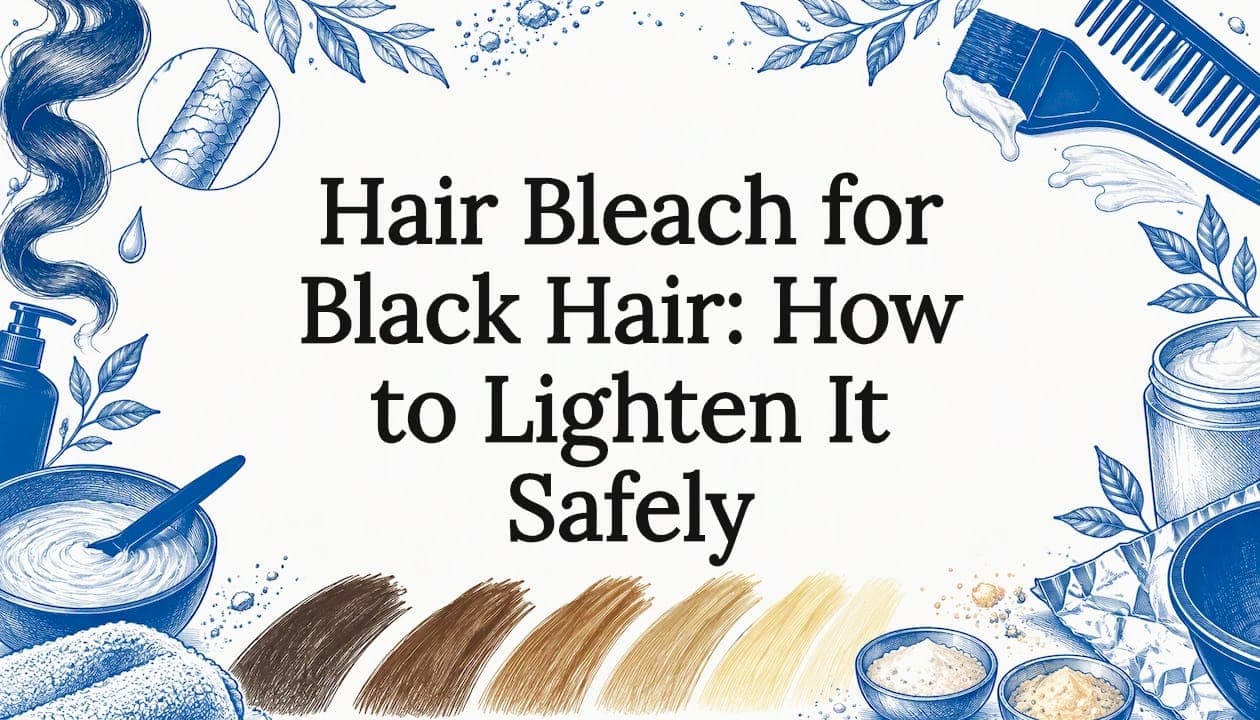
Black hair can be bleached, but it is the hardest base to lift. It goes through a warm orange stage before it gets to yellow, and it usually takes more than one session to reach a true blonde or a clean base for vivid color. In my experience the best result comes from choosing a lightener that matches your hair's condition, testing on a strand first, and lifting in stages instead of in one long sitting.
TL;DR
- Black hair holds a lot of pigment, so expect warm orange and yellow tones on the way to blonde. Plan on several sessions for a very light result.
- Always do a strand test and a skin patch test first. If your hair is already dry, brittle or stretchy when wet, wait and repair it before bleaching.
- Dyed-black hair behaves differently from natural black hair. Box dye is often harder to lift and less predictable.
- Never leave bleach on longer than the maximum time on the product's instructions, and keep strong developer off your scalp.
- After bleaching, I focus on conditioning and on tracking how your hair responds over weeks, not days.
Table of Contents
- What bleach actually does to black hair
- How light can black hair realistically go?
- Natural black hair versus black box dye
- Is your black hair healthy enough to bleach?
- Choosing a bleach for black hair
- A staged approach that protects your hair
- Protecting your scalp
- When to see a colorist instead
- Aftercare for bleached black hair
- Perspective
- Track your hair before and after bleaching
- FAQ
- Sources
What bleach actually does to black hair
Bleach is an oxidizing lightener. It opens the cuticle and breaks down melanin, the pigment inside the hair. Black hair has a lot of dark pigment packed deep in the cortex, so more of it has to be dissolved before the hair looks light. That is why the color moves through stages instead of jumping straight to blonde: the dark pigment fades into red-orange, then orange, then yellow, and only later toward pale yellow.

The price of that process is real. A study of human hair after bleaching found that protein loss rose with the severity of bleaching and that oxidative damage reached the fiber's inner structure, especially the cortical intermediate filaments. In plain terms: the harder you bleach, the weaker the strand gets from the inside, not just the surface.
I do not say this to scare you off. I say it because it shapes every decision below. Lifting black hair is a trade between how light you want to go and how much structure you are willing to spend to get there. Staying a few shades short of platinum is often the smartest version of the trade.
How light can black hair realistically go?
The honest answer depends on three things: your natural level of darkness, whether the hair has been colored before, and how healthy it is today.
- Natural black hair, healthy: It can usually reach a warm golden or light brown-blonde in one or two careful sessions. Pale blonde or white blonde takes multiple rounds, and some colorists will tell you it is not worth the damage.
- Previously bleached or lightly colored hair: It lifts more predictably, but the ends are often already porous and need protection.
- Dyed black hair: It is the least predictable. Color correction guidance from the British Columbia Open Textbook for hairstylists notes that lifting through artificial pigment is less predictable than lifting virgin hair, and that it can reveal a mix of warm underlying pigment and leftover artificial color. Multiple formulas or appointments may be needed.
I would rather you set the goal as "the next level up" than "blonde by Saturday." If you want a pastel or vivid shade like pink, blue or silver, you need the hair to be lifted to a pale yellow base first. That is the point where black hair is the most demanding.
If you want a full picture of how much lightening is realistic and when a professional makes sense, this at-home hair color guide is a good companion read on choosing products and setting expectations.
Natural black hair versus black box dye
People searching this topic usually mean one of two very different situations, and I treat them differently.
Natural black hair has only its own melanin to remove. The process is predictable, if slow.
Box-dyed black hair carries layers of artificial pigment on top of whatever your natural color is. The same Open Textbook chapter explains that oxidative permanent and demi-permanent color and non-oxidative direct dyes need to be removed differently, and it warns that bleach can open the cuticle and push artificial color deeper into the cortex. That is the main reason I tell people not to simply pile bleach on top of old black dye and hope.
What I suggest if you are in this situation:
- Work out what is on your hair. Do you know the product, and has it been applied once or repeated over several months?
- Do a strand test in a hidden section before committing. It tells you how the dye and your natural pigment will lift together.
- If the result is patchy or very warm, stop and see a colorist instead of adding another round at home. Correction with multiple formulas is professional work.
Is your black hair healthy enough to bleach?
This is the step most people skip, and it is the one that decides the outcome. The Trichological Society's overview of colouring and decolouring hair describes how professionals check hair before bleaching: a visual examination, elasticity and porosity checks, compatibility testing, and strand tests to see how the hair will lift and whether it can handle the process.
You can do a simplified version at home:
- Look and feel. Is the hair rough, split, or full of snapped short pieces? That is a sign to wait.
- Stretch. Healthy wet hair stretches a little and returns. Hair that stretches and stays limp, or snaps at once, is not ready.
- History. Count the bleaching, relaxers, high heat and color you have had in the last year. All of them add up.
- Strand test. Mix a small amount, apply to a hidden section, and check the lift and the strand's strength at the maximum time on the instructions.
If you want a more objective read, I built a lot of what we do around this idea. Our guide to four lab-backed tests you can do at home walks through ways to read your hair's resilience before you apply anything harsh.
Patch testing matters as much as strand testing
The strand test checks your hair. A patch test checks your skin. The Trichological Society's guidance states that oxidation dyes need an allergy test in the 48 hours before application, and that decolouring also calls for patch testing of the oxidant concentration immediately before use. Skip neither. A scalp reaction is far worse than a bad strand.
Choosing a bleach for black hair
There is no single best product, but there are clear criteria. When I help someone choose, I look at these.
| What to look at | Why it matters for black hair |
|---|---|
| Powder or cream lightener made for dark bases | Dark hair needs a lightener designed to lift multiple levels, not a color kit that lifts only slightly. |
| Developer strength | Stronger developer lifts faster but raises the risk to your scalp and hair. Stay with what the product instructions specify. |
| Bond-protecting additives | These are designed to help reduce structural stress during lightening. Follow the product's own directions. |
| Maximum processing time | This is the hard ceiling on the instructions. It is not a target. |
| Your hair's texture and density | Fine or coily hair can behave very differently from thick, straight hair at the same timing. |
A word on developer. You will see numbers like 20, 30 and 40 volume. In general, the higher the number, the stronger the oxidizer, and the higher the risk of irritation and breakage. The Trichological Society's guidance says to avoid high-concentration hydrogen peroxide when scalp exposure is possible. So my practical rule is simple: use the strength your lightener's instructions call for, leave strong developer to professionals, and keep it off your scalp as far as the instructions allow.
Also be wary of anything marketed as lifting black hair in minutes with no damage. Lightening works by changing the hair's chemistry. Some formulas are gentler than others, but none is free.

A staged approach that protects your hair
The single best way to reduce damage is to avoid asking for too much at once. Here is the sequence I recommend.
- Prepare for a week or two. Focus on moisture and gentle handling. Skip heat styling and any other chemical services close to the day.
- Patch test and strand test. See above. Note how long the strand took to reach the shade and how it felt afterward.
- Apply to the mid-lengths and ends first if your hair is long, and the roots last, since heat from the scalp speeds up lifting at the roots. Work in clean sections so no area gets double coverage.
- Avoid overlapping. The Trichological Society's guidance warns against saturating areas that are already decolored. Overlap is where breakage lines form.
- Watch the clock and the color. Check the strand regularly, and never go past the maximum time on the product's instructions.
- Rinse thoroughly, then condition.
- Stop and rest. If you are still orange, that is normal for black hair. Wait, repair, and lift again later instead of leaving bleach on longer.
How many sessions will it take?
There is no honest universal number, because it depends on your starting darkness, the product, and your hair's tolerance. What I can say with confidence is that, for very dark hair, a single session usually ends in an orange or golden stage, and reaching a pale blonde or a vivid-color base typically means more than one round with recovery time in between. Color-correction guidance from the Open Textbook also says multiple formulas or appointments may be needed when lifting through artificial color. Ask a licensed colorist for a realistic estimate after they have seen your hair in person.
Protecting your scalp
Bleach on skin can burn. Irritation tends to show up as stinging, redness or swelling. If your scalp burns during the process, rinse the product out right away with cool water. If you develop significant pain, blistering, swelling of the face, or trouble breathing, get medical care at once; a dermatologist or your primary care provider can look at ongoing reactions.
Two habits help. First, never bleach over a scalp that is already irritated, scratched or sunburned. Second, avoid applying right at the scalp more than the instructions advise. Leaving a little room at the roots, and then bringing the lightener up at the end of the process, is a common approach.
If you are already noticing shedding or thinning, I would hold off on bleach altogether and get a baseline first. That is exactly why we wrote about running a quick AI scan before harsh treatments.
When to see a colorist instead
I like a good home project, but some situations call for a professional:
- You want to go from black to platinum or white.
- Your hair is dyed black and you do not know what is in it.
- You have already bleached it and it feels gummy, stretchy or snaps.
- You have a history of scalp reactions to color products.
- You have chemically straightened or relaxed hair, or a mix of treatments.
A colorist can do an in-person assessment, tailor the formula in sections, and stage the lifting across visits. That is not an upsell. It is the same assessment-first process the professional training material describes.
Aftercare for bleached black hair
After bleaching, the cuticle is rougher and the hair is more porous, so it loses moisture quickly. The Open Textbook's guidance on color correction points to strengthening treatments at home between appointments and to avoiding further lifting on ends that are already compromised and porous.
My aftercare checklist:
- Condition deeply and regularly. A rich conditioning mask once a week is a sensible baseline, more if the hair feels dry.
- Go gentle with heat. Lower temperatures, a heat protectant, and fewer styling days.
- Handle wet hair carefully. Detangle gently from the ends up, with a wide-tooth comb.
- Be careful with toning products. Purple or blue shampoo can neutralize brassy yellow or orange, but use it sparingly on dry hair.
- Trim as needed. Split, broken ends do not repair themselves.
- Do not re-lift too soon. Give the strands time to recover, and never bleach over the ends again.
For product ideas and routines, our guides on hair treatment for bleached hair and understanding hair breakage from bleach go deeper, and if your hair is already past that point, see our piece on treatment for over-processed hair. If you wear extensions over lightened hair, a dedicated guide to caring for bleached hair can help you keep tones and texture in good shape. And if your hair is natural or textured, our list of good hair products for natural hair and our notes on shampoo for black hair cover the basics of gentle cleansing.
Perspective
Most hair-lightening advice focuses on the product. I think the bigger issue is that people are guessing about their own hair. They do not know their baseline, so they cannot tell whether a bleach session cost them a little or a lot.
That is the gap we built MyHair to close. Our app is designed to scan your hair, assess its condition, and track how it changes over time, so you can see whether your routine is helping before the next round of lightening. We also offer tailored product recommendations based on your results, and a directory of hair clinics and specialists for when a problem needs a professional.
My view is simple: bleach black hair when the data says it is ready, lift in stages, and measure the recovery. A lighter color is a choice. Losing length to breakage should not be a surprise.
Cyriac
Track your hair before and after bleaching
If you are planning to lighten black hair, I would start by getting a baseline. Our app scans your hair, gives you a detailed health assessment, and lets you follow changes over time, so you can see how bleaching and aftercare are affecting it. You can start on the free plan, and the monthly subscription is $9.99 per month for advanced features. Start at myhair.ai, or see the subscription options.
If you want to read more about what a scan can tell you, our hair analysis test guide explains the process. And if you are worried about thinning that has nothing to do with bleach, you can browse hair clinics and hair restoration doctors in our directory.
FAQ
Can I put bleach on black hair?
Yes, but go slowly. Black hair has the densest pigment to remove, so expect an orange stage on the way to blonde and plan for more than one session for a big change. Do a strand test and a patch test first, and see a colorist if your hair is dyed black or already damaged.
What hair bleach is best for black hair?
Look for a lightener designed for dark bases, with a clear maximum processing time, and use the developer strength the instructions call for. Added bond-protecting steps can be useful, and the best choice also depends on your hair's texture and condition. A colorist can recommend a formula after examining your hair.
How can I bleach black hair without damaging it?
You cannot remove all risk, but you can reduce it. Check that your hair is healthy, strand test, avoid overlapping on previously lightened sections, and never exceed the maximum time on the instructions. Spread the lightening over several sessions and give your hair recovery time in between.
What volume of developer should I use on black hair?
Use the strength specified by the lightener's instructions. Higher-concentration hydrogen peroxide raises the risk of scalp irritation and breakage, and the Trichological Society's guidance advises avoiding it when scalp exposure is possible. If you think you need something stronger, that is a good reason to book a professional.
Sources
- The physical and chemical disruption of human hair after bleaching (PubMed)
- 7.3 Decolourization and Toning, Hair Colour for Hairstylists: Level 2 (BCcampus Open Textbook)
- Colouring and Decolouring the Hair (The Trichological Society)