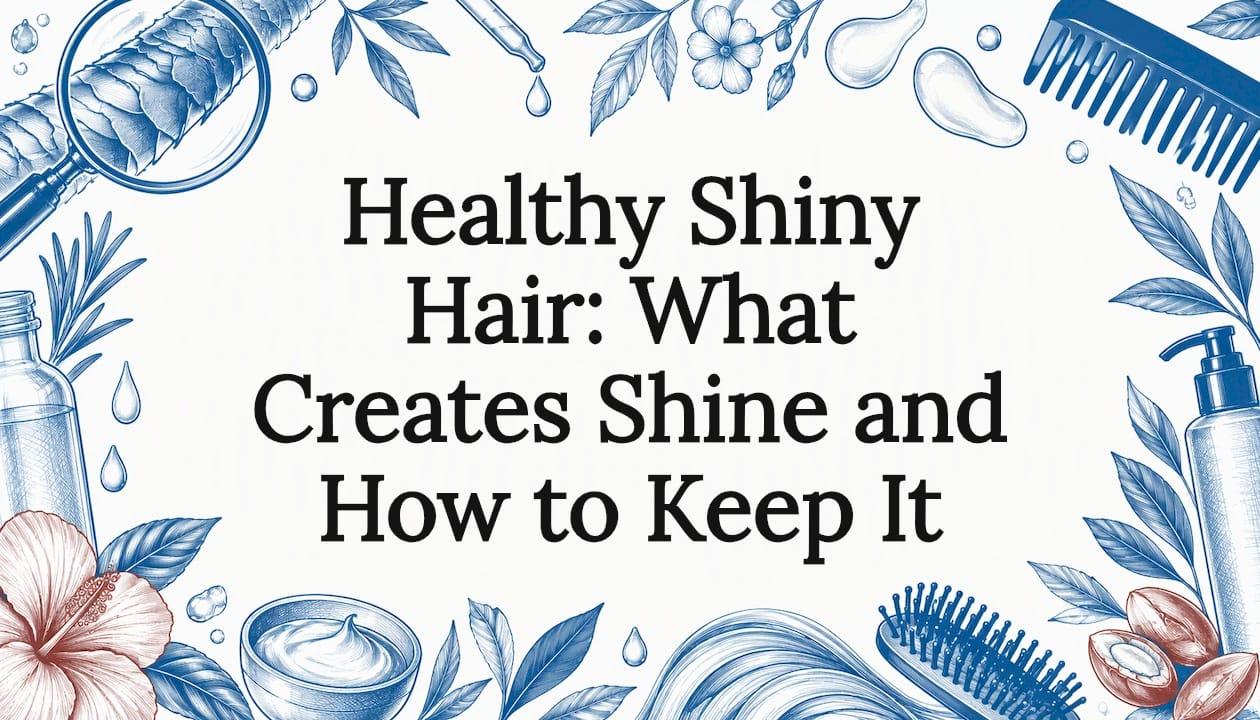
Shiny hair is hair with a smooth, undamaged outer layer, so the way you wash, dry, style and treat it matters more than any single shine product. The cuticle, the hair's protective outer shell, reflects light evenly when it is smooth. When it is roughened by heat, friction or chemicals, hair looks dull. Below is the routine that protects the cuticle, the facts on diet and supplements, and how to tell a shine problem from a shedding problem. If you want to see how your own hair changes week by week, our app tracks hair condition from your scans over time.
TL;DR
- Shine is a cuticle story: a smooth cuticle reflects light evenly, a damaged one scatters it.
- Wash to suit your scalp and hair type, condition every time, and handle wet hair gently with a wide-tooth comb and a towel.
- Keep heat low, limit how often you use it, and let hair air-dry when you can.
- Supplements are unlikely to add shine unless you have a real deficiency. Enough protein and iron is the nutrition goal.
- Sudden shedding or changes from your normal baseline deserve a conversation with a healthcare provider, and tracking gives you the evidence to bring.
Table of Contents
- What actually makes hair shiny
- Build a routine that protects the cuticle
- Heat is the fastest way to lose shine
- Chemical processing: shine has a ceiling
- Does what you eat change shine?
- Track what changes: your own baseline
- Try our scan-based tracking
- When dull hair is really a shedding problem
- Our perspective
- Frequently asked questions
- Sources
What actually makes hair shiny
Each strand has an inner core, the cortex, wrapped in a cuticle made of overlapping scales. Researchers describe 6 to 8 layers of these scales protecting the cortex. When the scales lie flat, light bounces off the surface in one direction and you see a gloss. When they lift, chip or wear away, light scatters and the hair looks flat, dry or frizzy.

That is why shine is a useful sign but not a perfect one. It reflects the condition of the surface, and a few other things that have nothing to do with how well you treat your hair.
Why your hair type changes how shiny it looks
Straight hair reflects light more easily than wavy or curly hair, because a straight fiber gives light a more uniform surface to bounce off. Curly hair has more bends, so the light breaks up in many directions. A curly head can be perfectly healthy and still show a softer glow than a straight one.

The practical consequence: compare your hair with its own past, not with a photo of someone else's. A fair test of progress is whether your hair looks and feels smoother than it did a month ago.
Oil on the scalp matters too
The scalp's natural oil, sebum, coats the hair and adds sheen. Too little leaves hair dry and dull, while a scalp that gets oily fast needs more frequent washing. This is one reason there is no single correct wash schedule.

Build a routine that protects the cuticle
The American Academy of Dermatology (AAD) lays out the basics in its healthy hair tips. Here is how they turn into a routine, with where each step usually goes wrong.
- Match products to your hair type. Choose shampoo and conditioner for your texture and scalp, not for the claim on the front of the bottle. The common mistake is using a heavy formula on fine hair, which leaves it limp, or a light one on thick, dry hair, which leaves it rough.
- Wash at the right rhythm. The AAD says straight hair with an oily scalp may need daily shampooing, while dry, textured, curly or thick hair can be washed as needed, at least once every 2 to 3 weeks. The mistake is copying a friend's schedule when your scalp behaves differently.
- Shampoo the scalp, not the lengths. Apply shampoo to the scalp, where oil and product collect. Rinsing the suds down the lengths cleans them well enough without drying out the ends.
- Condition every time you shampoo. Conditioner enhances shine, lowers static and improves strength, according to ColumbiaDoctors. It works by coating the strand. Lab work also shows that low-molecular-weight conditioning agents can penetrate the hair fiber. The mistake is skipping it on days when hair feels fine, or leaving it only on the ends when the mid-lengths are the dry part.
- Add a little leave-in. Dermatologists say a small amount on damp hair can make it smoother and shinier and reduce frizz and static. A small amount is the key: more weighs hair down.
- Handle wet hair gently. Detangle with a wide-tooth comb, and wrap hair in a towel or soft T-shirt to absorb moisture rather than rubbing it. Wet hair is fragile, and rough toweling lifts the cuticle you just smoothed.
- Trim regularly. Split ends make hair look rough and uneven. A common recommendation is a trim every 10 to 12 weeks to remove them. For more on that, see our guide to split end treatment.
If you want a fuller walkthrough of the daily basics, our posts on five tips for healthy hair and a healthy hair care routine go through them step by step.
A worked example
Say you have shoulder-length, dry, wavy hair that frizzes by midday. A realistic week might look like this: shampoo the scalp twice a week, condition the lengths every time, apply a pea-sized amount of leave-in to damp hair, blot with a T-shirt, detangle with a wide-tooth comb, and air-dry on most days. You have changed no product category and added no expensive treatment, yet each step protects the cuticle. After a few weeks the surface is smoother and reflects more light.
Heat is the fastest way to lose shine
Blow dryers, flat irons and curling irons work by temporarily breaking the hydrogen bonds that hold your hair's shape. That is how they straighten or curl it. The research review on hair structure notes that temperatures of 235 to 250°C on dry hair, or 155 to 160°C on wet hair, may denature the proteins of the hair shaft. Many irons reach those temperatures.
The AAD's guidance for reducing heat damage is simple: use the lowest heat setting that works, limit how often you style with heat, and air-dry when possible. Its healthy hair tips add that low or medium heat is the better choice.
If you do blow-dry, technique counts. The same review suggests that holding the dryer at least 15 cm from the hair and keeping it moving may be less damaging than letting hair air-dry naturally. So the goal is not to ban the dryer, it is to avoid parking hot air on one spot.
| Habit | What it does to the cuticle | Better version |
|---|---|---|
| Flat iron on dry hair at maximum heat | Can denature hair proteins | Lowest setting that works, fewer days per week |
| Dryer held close to the hair | Concentrates heat on one area | Keep it at least 15 cm away and moving |
| Rubbing wet hair with a towel | Lifts and roughens the cuticle | Blot or wrap with a towel or T-shirt |
| Brushing wet hair hard | Snags fragile strands | Wide-tooth comb, gently |
Chemical processing: shine has a ceiling
Perms, relaxers and dyes only work because they disrupt the cuticle enough for chemicals to get inside. That is why dermatologists advise minimizing styling and chemical processing when you want more shine. You do not have to give up color. Space out treatments, avoid overlapping on previously processed lengths, and put more attention into conditioning, because processed hair cannot fully match the smoothness of untreated hair.
Our care for your hair guide covers how to build a maintenance routine around treated hair.
Does what you eat change shine?
Hair is built from protein, and its growth depends on enough nutrients. The NHS guidance on hair care says a healthy diet matters and that a lack of vitamins or minerals, especially iron and protein, can contribute to hair loss. ColumbiaDoctors adds that low iron or anemia can increase shedding.
Supplements are a different matter. Consumer research group Which? reports that biotin is unlikely to improve hair growth or shine unless you have a genuine deficiency. So the sensible nutrition goal is a diet with enough protein and iron. If you suspect a deficiency, ask a doctor for a blood test before buying anything.
Track what changes: your own baseline
Shine is subjective, and it shifts with humidity, lighting and the last product you used. A better measure is your baseline: how your hair normally looks, feels and sheds. ColumbiaDoctors advises that you note your normal hair condition and look for a cause when it changes from that baseline in a short period.
Here is a simple method:
- Take photos in the same light, at the same angle, once every two weeks.
- Write down changes to your routine: a new shampoo, more heat, a color appointment.
- Note shedding, texture changes and scalp comfort alongside shine.
- Compare after six to eight weeks, not after three days.
This is where we come in. Our app analyzes hair health from your scans and tracks how it changes over time, and it suggests products tailored to your results. You can start on the free plan, and the monthly subscription is 9.99 USD per month for advanced features.
Try our scan-based tracking
If you would rather have your hair's progress laid out for you than keep a notebook, you can start with the free plan and scan your hair. Our analysis gives you a detailed assessment of your hair health and follows how it changes, with tailored product recommendations based on your results. The monthly plan costs 9.99 USD per month, and a yearly option is on the same page.
To begin, open the scanner and follow the onboarding.
When dull hair is really a shedding problem
Dullness alone is usually a care issue. Shedding is a different signal. ColumbiaDoctors notes that sudden changes in texture or increased shedding may point to an underlying condition such as thyroid disease, anemia or PCOS. It advises seeing a healthcare provider for hair loss that is not normal for you, or for a scalp rash, itching or pain that does not go away within 24 hours.
If your hair is thinning rather than just dull, particularly around the hairline, this explainer on hair thinning at the temples describes the causes and the options for professional assessment. Our own post on how to spot thinning and the first-aid timeline for visible shedding help you decide what you are looking at.
When you are ready to talk to a specialist, our directory lists hair clinics and hair restoration doctors, so you can compare options in one place. Bring your tracked photos and notes: they give the professional a timeline instead of a guess.
Our perspective
Most people chase shine with products and ignore the pattern behind it. We think shine is the visible end of a long chain: how you wash, how hot your tools run, how you dry, how often you color, and what your scalp is doing. One good week of care does not show up clearly, and neither does one bad week of styling.
That is why we built our app around scans and tracking instead of a single verdict. Our approach is to analyze hair health from your scans, follow how it changes over time, and match product recommendations to your individual results. The point is that you stop guessing which habit helped and which one hurt.
We also believe a good routine and good escalation go together. If your tracked results show shedding rather than dullness, you should be able to move straight to hair clinics and restoration doctors from the same place. That is why we offer a directory of both.
Cyriac
Frequently asked questions
How can I make my hair healthy and shiny?
Pick shampoo and conditioner for your hair type, wash at a rhythm that suits your scalp, and condition after every wash. Handle wet hair gently with a wide-tooth comb, blot it dry, and keep heat low and occasional, as the AAD advises. Consistency over weeks matters more than any single product.
Does shiny hair mean it is healthy?
Usually shine signals a smooth cuticle, which is a good sign. But hair type affects it too, since straight hair reflects light more readily than wavy or curly hair. Judge your hair against its own baseline rather than against other people's.
What nutrient makes hair shiny?
No single nutrient adds gloss on its own. Hair depends on enough nutrients overall, especially protein and iron. Biotin and similar supplements are unlikely to boost shine without a real deficiency, so ask a doctor before supplementing.
How do I get glass-smooth hair without damaging it?
Coat the strand with conditioner, add a little leave-in on damp hair, and cut back on heat and chemical processing. If you use a dryer, keep it moving and at least 15 cm away, per the hair structure review. Regular trims remove the split ends that break up a smooth surface.
Sources
- Tips for healthy hair, American Academy of Dermatology
- How to stop damaging your hair, American Academy of Dermatology
- Dermatologists' top tips for using leave-in conditioner, American Academy of Dermatology
- Straight to the Point: What Do We Know So Far on Hair, PubMed
- Effects of thermal treatments with a curling iron on hair, PubMed
- Is Your Hair Healthy? ColumbiaDoctors
- Good hair care advice, Gloucestershire Hospitals NHS
- Is biotin really the secret to great skin, hair and nails? Which?