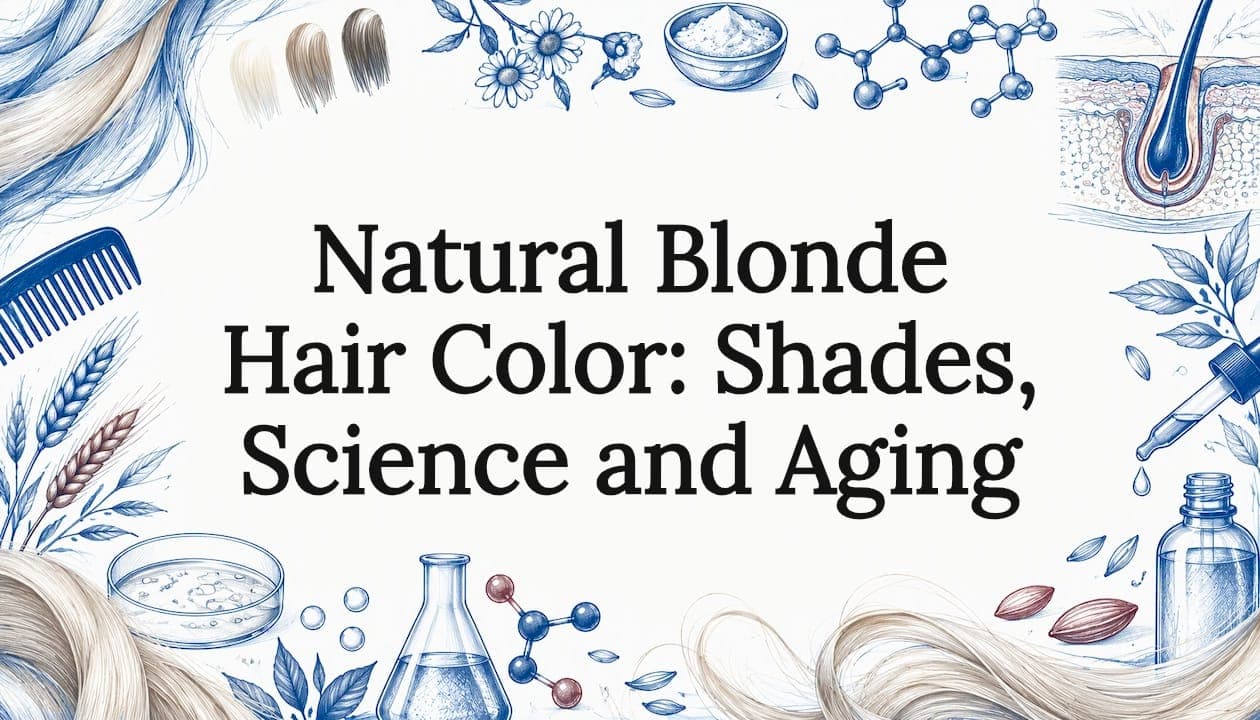
Natural blonde hair color is hair with very little pigment, and it covers a wider range than most people expect. It runs from pale, almost white-gold to sandy, honey and dark golden tones, and the visible hue always carries some warmth. In this guide I explain what makes hair blonde, how the shades differ, why blonde so often darkens, and how I think about keeping a blonde look, natural or colored, in good condition.
TL;DR
- Natural blonde comes from low levels of eumelanin, the dark pigment in hair, and many genes shape the result.
- Shades range from cool and ashy to warm and golden, with neutral tones like sandy in between.
- Light hair often darkens through childhood and the teen years, and blondes go gray at the same rate as everyone else.
- Blonde is not limited to one ancestry: a separate genetic variant produces it in the Solomon Islands.
- If you color your hair blonde, healthy hair holds the shade better, so I track condition before and after.
Table of Contents
- What natural blonde hair color really is
- Natural blonde shades and how they differ
- Why blonde hair darkens with age
- Do natural blondes go gray or white?
- Can people of color be naturally blonde?
- How to get a blonde that looks natural
- Keeping blonde healthy, natural or colored
- Perspective: why I look at blonde through the scalp first
- Track your hair before you change your color
- FAQ
- Sources
What natural blonde hair color really is
Hair color comes down to melanin. The type and amount of melanin in your hair is set by many genes, and MedlinePlus Genetics names MC1R as the best-studied hair-color gene in humans. Blond hair results from very little eumelanin. The Cleveland Clinic describes it more specifically: blonde hair has no black eumelanin and only a small amount of brown eumelanin.
That is why "blonde" is a spectrum and not a single color. Slightly more or less pigment, or a different balance between the dark and the warm red-yellow pigments, moves a head of hair from near-white to honey to a deeper sandy tone. When I look at a scan, I never see a single flat color. I see strands of different thickness and density, each catching light differently, which is also why natural blonde looks so dimensional.
Why natural blonde looks multi-tonal
A true natural blonde rarely has one uniform shade. The roots are usually a little deeper, the mid-lengths lighter, and the ends brightest where the sun has touched them. Fine strands also let light pass through, so the color seems to shift as you move. This is the quality people try to copy when they ask a colorist for "natural" blonde, and it is the reason a single flat box-color tone rarely looks like the real thing.

Natural blonde shades and how they differ
Colorists sort blondes along two lines: how light the hair is and how warm or cool it reads. The levels below are the general scale used in salons, from darker to lighter, and I use them as a map, not a rulebook.
| Shade family | Typical look | Undertone |
|---|---|---|
| Platinum or very pale blonde | Near white, very little warmth | Cool |
| Ash blonde | Soft, gray-toned, muted | Cool |
| Light golden or beach blonde | Bright, sunny, clear | Warm |
| Honey blonde | Medium, glowing, rich | Warm |
| Sandy or beige blonde | Soft and balanced | Neutral |
| Dark blonde or dishwater | Deeper, flatter, close to light brown | Neutral to cool |
| Strawberry blonde | Blonde with a reddish-copper edge | Warm |
The tonal logic is simple. Hair with more of the warm red-yellow pigment (pheomelanin) reads golden or strawberry, while hair with more brown eumelanin reads ash or sandy. Even the palest natural blonde keeps a trace of yellow, so a pure icy white-blonde is almost always a colored result and not a natural one.
Warm, cool or neutral: which one is yours?
I suggest a quick, honest check in daylight, with no makeup and no filters. Look at the roots near your temples, since they show your base best. If the hair leans yellow or copper, you are warm. If it leans gray or beige-ash, you are cool. If you cannot decide, you are probably neutral, and neutral blondes tend to be the most flexible when it comes to coloring because they sit between the two families.

As a rule of thumb that colorists commonly repeat, cool blondes pair with cooler skin undertones and warm blondes with golden ones, and neutral shades work on almost everyone. I treat that as a starting point for a conversation with your stylist, not a law.
Why blonde hair darkens with age
This is the most common question I hear from people who were towheads as kids. According to MedlinePlus Genetics, in people of European descent light hair may darken as they grow older, and blond-haired children often have darker hair by their teens. Researchers speculate that certain hair-pigment proteins switch on as children grow, perhaps in response to the hormonal changes around puberty.
In plain terms, your follicles start making more brown eumelanin, and a hair that was once a pale gold becomes a muted dark blonde or light brown. It is a normal, biological shift. It is not damage, and nothing you did to your hair caused it.
What I look at when blonde turns darker
I separate three things that people lump together:
- Pigment change. Hormonal shifts at puberty, and for some people during or after pregnancy, can change how much eumelanin the follicle produces.
- Surface dullness. Mineral buildup, chlorine and sun exposure can make blonde look flat and brownish even when the pigment has not changed. A clarifying routine can bring light back, and I explain how I handle mineral deposits in my hard water treatment guide.
- Thinning or density change. If the hair looks darker because the scalp is showing through, that is a different question entirely, and it is worth tracking over time.
That third point matters. Light hair and a light scalp make thinning easier to see in photos, and sometimes a person assumes a color change when density is changing. If you notice more scalp than before, my overview of age-related hair loss factors lists what to look at first.
Do natural blondes go gray or white?
Yes, and on the same schedule as everyone else. Nemours KidsHealth explains that gray hair is not a true gray or white pigment but a lack of pigment and melanin. It also states that people with naturally lighter hair are just as likely to go gray as those with darker hair, and that once you notice a few gray hairs it can take more than 10 years for all your hair to turn gray.
The reason blondes feel as if they escape gray is visual. A silver strand blends into pale gold far better than it does into dark brown, so the first ones are harder to spot. Once the proportion grows, the tone can shift from golden to a cooler, flatter ash, and that is the moment many blondes notice the change.
If you are moving toward silver and want a plan, I wrote about white hair solutions, including how to care for hair as the pigment fades.
Can people of color be naturally blonde?
Yes. Blond hair is most common in people from Northern Europe, but it is not exclusive to one ancestry. Researchers at Stanford Medicine reported that a homegrown genetic variant, distinct from the gene behind blond hair in Europeans, is responsible for blond hair in 5 to 10 percent of the indigenous population of the Solomon Islands. In other words, blond hair evolved independently in more than one part of the world.
That answers a question I see often: a person with dark skin and natural blond hair is not unusual or "dyed" by default. It is a different genetic route to a similar result. Hair texture is another variable. Blonde can be straight, wavy, curly or coily, and coily textures often look deeper and more golden because of how light moves through the curl pattern.
How to get a blonde that looks natural
Many readers searching this keyword are not natural blondes at all. They want a blonde that looks like it grew that way. Here is how I would brief a colorist.
Ask for dimension, not a single shade
The giveaway of a bought blonde is flatness. Natural blonde mixes warm, neutral and cool threads, with a slightly deeper root. So ask for techniques that build that variation, such as balayage, babylights, a soft root shadow and a gloss to even out the tone. A rooted blonde also grows out gently, which means fewer salon visits.
Match the shade to your own coloring
Start from your eyebrows, your eye color and your skin undertone, and stay within two or three levels of your natural base when you want the result to look believable. A jump of many levels is possible, but it is a high-maintenance commitment and it asks more of your hair.
Tone, but do not over-correct
Brassiness, the yellow or orange cast that creeps into lightened hair, is a normal part of blonde life. Purple shampoo used once or twice a week neutralizes yellow. If your hair looks more orange than yellow, purple shampoo will not help and can make the color look muddy, so that is a conversation for your colorist and a professional gloss. I would rather you have a gentle routine than chase tone at home every few days.
Keeping blonde healthy, natural or colored
Lightening hair means removing pigment, and that makes strands more porous and more fragile. Healthy hair holds tone better and reflects more light, which is exactly what makes blonde look expensive. My routine advice is simple:
- Wash less often and use lukewarm water instead of hot.
- Use a gentle, sulfate-free cleanser and heat protection before styling.
- Add a deep conditioning or bond-support treatment on a regular schedule.
- Clarify occasionally to remove buildup, especially if you have hard water.
- Schedule a gloss or toner with your colorist when the tone drifts.
If your hair is already lightened, I walk through repair and restoration for bleached hair and explain what causes breakage from bleach. For habits that apply to any colored hair, I put together four high-impact habits for color-treated hair.
Going back toward your natural color
Some people want to return to their own blonde or dark blonde after years of lightening. I tell them the same thing every time: grow out gradually. A soft root blend, then lowlights or a gloss in your natural level, avoids a harsh line and gives your hair time to recover. During that period I suggest checking your hair's condition regularly, because the ends are the oldest and most processed part and they show strain first.
Perspective: why I look at blonde through the scalp first
Most blonde advice starts with the shade. We start with the hair that has to carry it.
Blonde, natural or colored, is the least forgiving color for fine, thin or stressed hair. Light strands show scalp more easily, they show damage more easily, and they show tone drift more easily. So when someone asks us how to get or keep a blonde, we ask a different first question: what condition is the hair in right now, and how is it changing?
That is what our app is built for. It analyzes a scan of your hair and scalp with AI, gives you an assessment of your hair health, and lets you track change over time. If you color your hair, that gives you a baseline before the salon visit and a way to see whether your routine is helping. We also recommend products matched to your analysis, and our directory lists hair clinics and restoration doctors if you want to speak with a professional about thinning.
We believe the best blonde starts with a clear picture of your own hair. Color is the finishing touch, not the foundation.
Cyriac
Track your hair before you change your color
If you are thinking about going blonde, staying blonde or growing out a lighter shade, I recommend starting with a baseline. The MyHair app analyzes your scan, shows how your hair health is trending and suggests tailored products. You can start on the free plan, and the monthly subscription for advanced features is $9.99 per month on the subscription page.
If you also want an expert opinion on thinning or shedding, you can browse hair restoration doctors and hair clinics in the directory.
FAQ
What hair color is natural blonde?
Natural blonde is hair with very little eumelanin, so it is light and always carries some yellowish warmth. It spans pale platinum-like tones, golden and honey shades, and deeper sandy or dark blonde. Where your hair sits on that range depends on many genes, with MC1R the best studied.
What is the most natural-looking blonde?
I would point to a multi-tonal blonde with a slightly deeper root, built from warm, neutral and cool threads and kept within a couple of levels of your own base color. Balayage, babylights and a gloss create that look. A single flat shade almost never reads as natural.
Do natural blondes go gray or white?
Yes. Nemours KidsHealth notes that people with lighter hair are just as likely to go gray as people with darker hair. Silver strands simply blend into pale hair at first, so graying is less noticeable until the proportion grows.
Can people of color be naturally blonde?
Yes. Stanford Medicine reported a genetic variant, separate from the European one, that produces natural blond hair in 5 to 10 percent of the indigenous population of the Solomon Islands. Blond hair has arisen independently in different populations.
Why did my blonde hair turn brown?
For most people it is a normal pigment change. MedlinePlus Genetics notes that light hair often darkens as people grow older, with blond children frequently having darker hair by their teens. If the darkening comes with visible thinning, track it and consider speaking with a dermatologist or hair restoration doctor.
Sources
- MedlinePlus Genetics: Is hair color determined by genetics?
- Cleveland Clinic: Melanin
- Stanford Medicine: Naturally blond hair in Solomon Islanders rooted in native gene