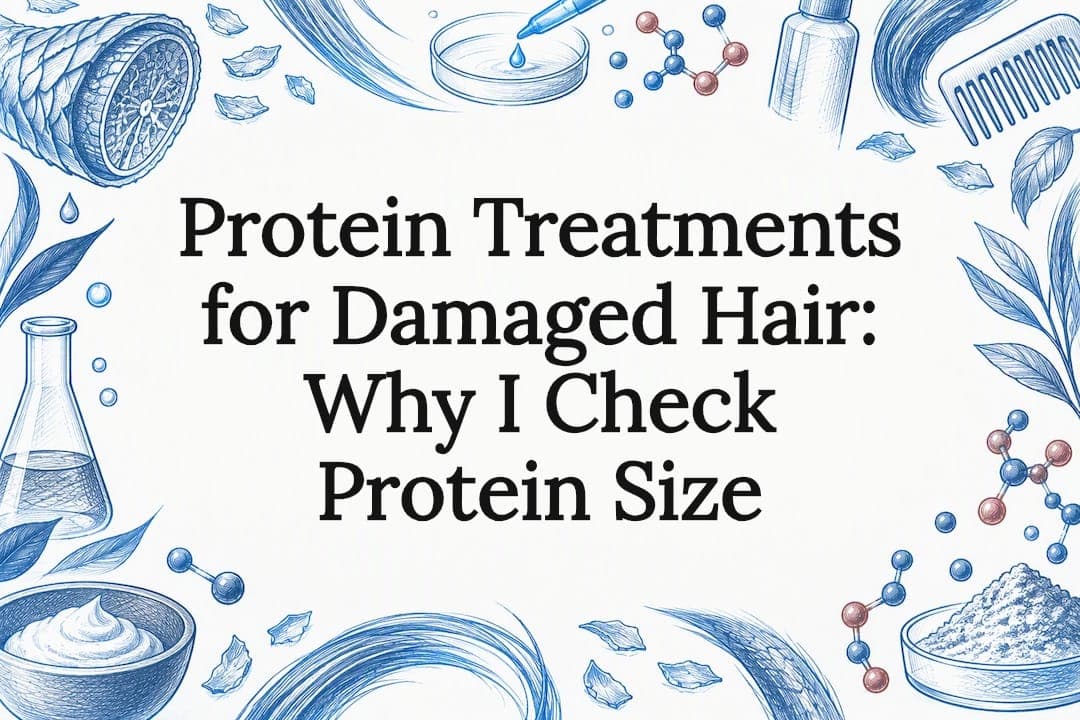
If your hair snaps when stretched, feels limp despite conditioner, or has lost its spring after color or heat styling, a protein treatment is usually the right next step. These treatments fill structural gaps in the hair shaft, and most people see less breakage and better elasticity within one to three applications. The one caution we flag upfront: some smoothing products release formaldehyde gas when heated, so we always check ingredients before booking a salon service.
TL;DR:
- A wet strand that stays stretched, sinks quickly in water, or feels gummy can signal damage; consult a stylist if the cause is unclear.
- Look for hydrolyzed keratin or named peptides; smaller molecules penetrate the cortex, while vague keratin claims may describe ingredients that mainly coat strands.
- Start with one treatment every four to six weeks, then follow with moisture; stop if hair becomes stiff, brittle, strawlike, or easier to break.
- Some salon smoothing formulas release harmful gas when heated; ask whether they contain formaldehyde, formalin, or methylene glycol, and check ventilation and safety information.
- Protein treatments help prevent breakage, but they do not treat thinning caused by follicle changes or affect new hair growth; seek advice for scalp symptoms.
Table of Contents
- What protein treatments do and how they work
- Signs your hair needs a protein treatment
- Ingredient science: molecular weight, keratin peptides, and what research shows
- How to use protein treatments: salon vs at-home
- How to choose the right protein product type
- DIY protein masks and safety
- Avoiding protein overload and sequencing with moisture
- How protein treatments interact with hair growth and hair loss
- Fitting protein treatments into your broader hair care routine
- What I've learned tailoring protein cycles to real hair
- Get a personalized read on your hair before you commit to a treatment
- FAQ
- Sources
What protein treatments do and how they work
Hair is built mostly of keratin, and damage from color, heat, or chemical processing creates gaps in that structure, particularly in the cortex, the inner layer that gives a strand its strength and stretch. A protein treatment works by depositing keratin fragments or peptides into those gaps, temporarily patching the cortex and reinforcing the cuticle, the outer layer that controls shine and smoothness.

The two layers respond differently. Cortex repair affects strength and elasticity because that's where the structural proteins sit. Cuticle smoothing affects how light reflects and how strands feel, which is why some products produce instant shine without doing much for breakage.
Expected outcomes from a protein treatment include:
- Reduced breakage as filled gaps mean fewer stress points where strands snap.
- Improved elasticity so hair stretches and returns to shape instead of snapping or staying stretched.
- Smoother cuticle and more shine, often visible immediately after rinsing.
- Temporary stiffness right after treatment, which usually softens within a day or two as the hair reabsorbs moisture.
Shine and smoothness show up immediately. Strength gains build with repeated, well-spaced treatments, which is why a single protein mask rarely fixes months of chemical damage. The size of the protein molecule used determines how deep it penetrates, a detail we unpack in the research section below.
Signs your hair needs a protein treatment
A few simple home tests tell you whether your hair is asking for protein or something gentler.
- Do the stretch test. Take a clean, wet strand and gently pull it between two fingers. Healthy hair stretches slightly and springs back; hair that stretches a lot without returning, or breaks outright, is showing protein loss.
- Check porosity with a float test. Drop a clean strand in a glass of water. Hair that sinks quickly is often highly porous, meaning the cuticle has gaps that let moisture in and out too fast, a common sign protein treatment will help.
- Watch how hair behaves when wet. Limp curls that lose their pattern, hair that feels gummy or mushy when saturated, or strands that stretch like gum are all protein-deficiency signals.
- Count breakage during detangling. Finding more than a few short strands with no root on your brush or in the shower drain, especially after color or heat styling, points to structural damage rather than normal shedding.
- Get a professional opinion for ambiguous cases. A stylist can examine strand diameter and elasticity directly and is worth consulting before a major chemical service if you're unsure whether you're dealing with protein loss, dryness, or both.
Ingredient science: molecular weight, keratin peptides, and what research shows
Not all "protein" on an ingredient label behaves the same way, and molecular weight is the detail that matters most. Research on hydrolyzed keratin applied to textured, chemically relaxed hair found that low and mid molecular weight keratin peptides penetrate deeper into the hair cortex, while high molecular weight peptides mostly sit on the surface instead of absorbing in. In that same research, mid and high molecular weight peptides measurably increased the hair's stiffness (Young's modulus) and reduced breakage in the tested samples.
Mid- and high-molecular-weight keratin peptides increased Young's modulus and reduced hair breakage in relaxed textured hair, while lower-weight peptides penetrated more deeply into the cortex.
That distinction gives you a practical shopping filter: a product listing "hydrolyzed keratin" or named peptides is more likely to contain smaller, penetrating actives, while vague "keratin" or polymer claims often describe larger molecules that coat rather than repair.
A second study found that enzymatic crosslinking outlasts a simple protein rinse. An enzyme-based keratin and serine repair solution using transglutaminase decreased alkali solubility by roughly half and increased fracture stress, with the repair effect persisting after five wash cycles. That longevity comes from the crosslinking forming stronger chemical bonds to the hair's existing proteins, rather than simply coating the strand until the next shampoo.
Separately, researchers testing recombinant human keratin K31 on chemically damaged hair recorded large increases in strand diameter and tensile strength in lab conditions, suggesting intact keratin proteins can integrate into damaged hair rather than just sitting on top of it. Most retail formulas still use hydrolyzed proteins instead of intact keratin, mainly because hydrolyzed forms dissolve and formulate more reliably in a bottle.
Newer work is pushing the molecular-weight idea further. A 2026 paper on rationally designed palmitoylated tripeptides, including one called pal-KCV, reported close to a 44% improvement in tensile strength along with deep penetration visible under confocal microscopy. These engineered peptides are still mostly in development, but they hint at where premium repair formulas are headed: smaller, purpose-built molecules rather than generic hydrolyzed protein blends.
How to use protein treatments: salon vs at-home
Salon protein services typically use a two-step, heat-activated system: a protein-rich solution applied first, then sealed in with a flat iron or heat cap to help it bond to the strand. At-home options range from single-use protein masks to lighter leave-in treatments meant for weekly use, and they rarely require heat to work.
- Shampoo with a clarifying or gentle cleanser to remove buildup so the treatment can reach the strand directly.
- Apply the protein mask to damp, towel-dried hair, focusing on mid-lengths and ends where damage concentrates.
- Leave it on for the time stated on the label, usually 10 to 20 minutes for at-home masks; longer isn't better and can cause stiffness.
- Rinse thoroughly with cool to lukewarm water, then follow with a lightweight conditioner to reintroduce moisture.
- Watch how your hair feels over the next day. Springy and smooth means it worked; brittle or straw-like means you overdid it or used too strong a formula for your hair's current state.
Before a salon appointment, ask your stylist what protein type the product uses, whether it requires heat activation, and whether the salon can share the product's safety data sheet. A reputable salon will have this information ready.
Pro Tip: Start with one protein treatment every four to six weeks and adjust based on how your hair responds, rather than following a fixed schedule everyone else uses.
Pause protein treatments if hair starts feeling stiff, straw-like, or more prone to snapping than before, which signals you've added more protein than your hair can absorb.
How to choose the right protein product type
Picking the right type of product matters more than picking a specific brand. Match the formula to your actual damage level and hair texture rather than whatever is trending.
- Severity of damage: Mild dryness calls for a lightweight protein leave-in; chemical damage from bleach or relaxers usually needs a stronger, rinse-out protein mask.
- Porosity: High-porosity hair absorbs protein quickly and may need it more often; low-porosity hair benefits from lighter formulas applied with gentle heat to help penetration.
- Texture: Fine hair tends to get overwhelmed by heavy protein masks, while coarse or textured hair usually tolerates and needs more frequent protein support.
- Desired result: If your main goal is shine and smoothness, a lighter cuticle-coating formula works; if the goal is strength and reduced breakage, look for named peptides or hydrolyzed keratin on the label.
- Ingredient transparency: A product that names its protein type and molecular weight gives you more control than one that just says "protein complex."
- Heat requirement: Confirm whether a product needs blow-drying or a flat iron to activate, since skipping that step can mean you're not getting the full effect.
Retail protein masks are generally the most budget-friendly option and work well for mild to moderate damage maintained at home. Salon protein services cost more but include professional-grade formulas and heat activation, which matters most for severe chemical damage. If you're dealing with hair that's been bleached or heavily processed, our guide to repairing bleached hair walks through a fuller repair sequence.
DIY protein masks and safety
A few simple at-home mixes can offer mild, temporary protein support between salon visits or store-bought treatments:
- Egg and yogurt mask: Whisk one egg with two tablespoons of plain yogurt, apply to damp hair for 15 to 20 minutes, then rinse with cool water to avoid cooking the egg into your strands.
- Gelatin rinse: Dissolve one tablespoon of unflavored gelatin in warm water, apply after shampooing, leave for 10 to 15 minutes, and rinse thoroughly.
- Mayonnaise treatment: Full-fat mayonnaise contains egg protein and oil; apply for 20 minutes under a shower cap for mild conditioning plus a light protein boost.
These DIY options are gentle and temporary compared with formulated hydrolyzed protein products, so expect to repeat them more often for a comparable effect, and always rinse thoroughly to avoid residue or odor.
The bigger safety concern sits with keratin smoothing treatments, not protein masks. The FDA warns that certain hair smoothing products release formaldehyde gas when heated, and exposure above 0.1 parts per million can cause serious eye, nose, and lung irritation. Before booking a keratin smoothing service, ask the salon directly whether the product contains formaldehyde, formalin, or methylene glycol, confirm the space has working ventilation, and request to see the product's safety data sheet if you have any doubt.
Avoiding protein overload and sequencing with moisture
Too much protein without enough moisture leaves hair feeling stiff, brittle, and more likely to snap, the opposite of what you're after. Watch for straw-like texture, increased shedding, or a loss of natural movement as signs you've overdone it.
A simple four-step cycle keeps protein and moisture balanced:
- Test first using the stretch and porosity checks described earlier to confirm you actually need protein before adding it.
- Run a protein cycle of one to two treatments spaced several weeks apart, watching how your hair responds after each one.
- Follow with a moisture cycle, using hydrating masks and leave-ins for two to four weeks to restore softness and flexibility.
- Reassess with the stretch test before deciding whether to repeat protein or stay in moisture mode longer.
Bond-builders, which repair internal disulfide bonds rather than adding surface protein, fit well between protein and moisture phases, especially after chemical services like bleaching or relaxing. For a deeper look at breakage-specific sequencing, see our guide to fixing hair breakage.
How protein treatments interact with hair growth and hair loss
Protein treatments work on the hair shaft, the part of the strand that's already grown out of the scalp, not on the follicle itself, so they don't directly influence how fast new hair grows or whether a follicle produces hair at all. What they can do is protect existing strands from snapping off before reaching their full length, which matters for anyone trying to retain length while growing out hair.
For people dealing with hair loss conditions rather than breakage, the picture is different. Thinning from androgenetic alopecia, postpartum shedding, or other scalp-driven causes stems from follicle activity, not shaft strength, so a protein treatment won't address the underlying cause. Applying heavy protein formulas directly to an already sensitive or irritated scalp also isn't advisable without checking with a professional first, since some formulations can feel harsh on compromised skin.
If you're noticing both breakage along the strand and overall thinning at the root, it's worth distinguishing between the two issues rather than assuming one treatment fixes both. A protein treatment can keep existing hair strong, but concerns about shedding, thinning, or scalp changes deserve a conversation with a dermatologist or hair restoration specialist who can look at the follicle side of the equation.
Fitting protein treatments into your broader hair care routine
A protein treatment works best as one part of a routine rather than a standalone fix. Pairing it with a consistent cleansing schedule, regular trims to remove already-damaged ends, and heat protection before styling gives the protein something stable to work with instead of constantly repairing fresh damage.
Sequence matters: cleanse first to remove buildup, apply protein to clean strands, follow with moisture to prevent stiffness, and finish with a leave-in or light oil to seal the cuticle. Skipping the moisture step is the most common mistake we see, since it's what leaves hair feeling strong but brittle instead of strong and flexible.

If you're also using heat styling tools regularly, a heat protectant applied after your moisture step reduces the chance of undoing the protein's work. For color-treated hair, spacing protein treatments around color appointments, rather than right before or after, helps avoid compounding two different kinds of stress on the strand at once. Readers managing long-term damage from repeated chemical processing may find our guide to treating over-processed hair useful for building out a fuller routine. The goal is a repeating cycle, not a one-time fix, since hair structure changes with every wash, style, and season.
What I've learned tailoring protein cycles to real hair
I once worked with someone whose curls had gone limp after months of box color, and we tracked strand elasticity and detangling breakage count over six weeks instead of just looking at how hair looked day to day. The numbers moved before the look did: breakage per detangling session dropped noticeably within three protein cycles, even though visible shine took longer to show up.
That's why I favor measurable tracking, like stretch percentage and photographed tangling, over guessing from how hair feels on a given day. If you're unsure where your hair stands right now, start with the stretch and porosity tests from earlier before choosing a product strength.
— Cyriac
Get a personalized read on your hair before you commit to a treatment
Picking between a light leave-in, a rinse-out mask, or a salon protein service is easier when you know your hair's actual porosity and damage level instead of guessing from a label. Our AI-powered scan at Myhair analyzes your hair from photos and gives you a personalized assessment, then matches you with product types suited to what it finds rather than a generic recommendation.
What this looks like in practice:
- A free scan through our free plan that gives you a baseline read on your hair's current condition.
- Tailored product suggestions based on your specific porosity, texture, and damage pattern.
- A clinic directory at Myhair if your scan points toward concerns that go beyond strand-level repair.
If you want ongoing tracking and deeper analysis, our subscription plans start at $9.99 per month and unlock progress tracking over time. Start with a free scan and see where your hair actually stands.
FAQ
What does a protein treatment do?
A protein treatment fills structural gaps in the hair cortex and reinforces the cuticle, which reduces breakage and restores elasticity in damaged strands. Shine and smoothness usually show up right away, while strength improvements build over repeated, well-spaced applications.
Are salon protein treatments worth it?
Salon protein services use professional-grade formulas with heat activation, which tends to work better for severe chemical damage than at-home masks alone. For mild to moderate damage, a retail protein mask used consistently at home can deliver comparable results at lower cost.
What's the difference between a deep conditioner and a protein treatment?
A deep conditioner adds moisture and softness without changing the hair's internal protein structure, while a protein treatment specifically rebuilds structural gaps left by chemical or heat damage. Hair that's dry but structurally intact usually needs a deep conditioner, while hair that's breaking or losing elasticity needs protein.
How much does a protein treatment cost?
Costs vary widely by location and whether you choose a salon service or a retail product, so we'd recommend checking with a local salon for an exact quote. At-home protein masks are generally the lower-cost option for maintaining results between professional treatments.
Sources
- Formaldehyde in Hair Smoothing Products: What You Should Know | FDA
- Penetration of different molecular weight hydrolysed keratins into hair fibres and their effects on the physical properties of textured hair - PMC
- Bio‑active designed peptide for hair keratin strengthening - Rha - International Journal of Cosmetic Science