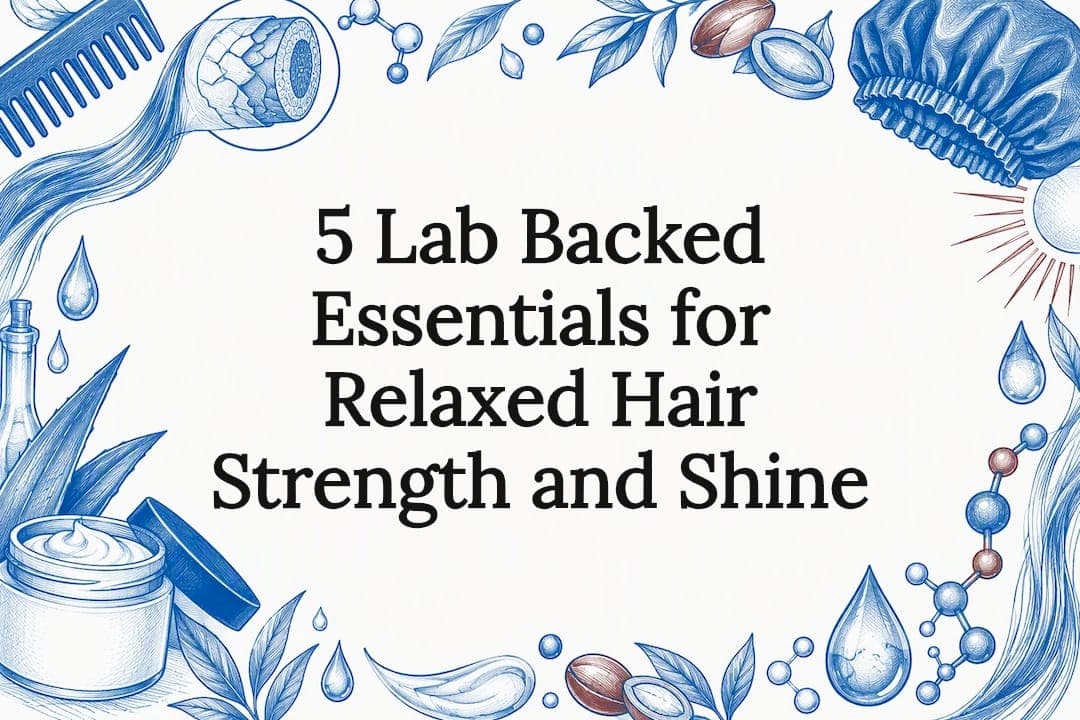
If you have relaxed hair, prioritize five product categories: a moisturizing or sulfate-free shampoo, a rinse-out conditioner, a deep-conditioning mask, a water-based leave-in, and a sealing oil or cream. The rule underneath all of it: keep moisture and protein in balance, and shield the cuticle from heat and mechanical stress, since relaxed strands have already lost structural protein and can't absorb more damage without breaking.
TL;DR:
- Use high-molecular-weight hydrolyzed keratin peptides in protein treatments, as they significantly improve hair strength and reduce breakage in relaxed hair.
- Apply heat protectants containing film-forming polymers before blow-drying or flat ironing, and keep flat irons below 200°C whenever possible.
- Space out relaxer touch-ups to avoid overlapping and always neutralize to restore hair pH, preventing damage from alkaline residuals.
- Prioritize balancing protein and moisture weekly by alternating masks and avoid overdoing protein treatments to prevent stiffness and brittleness.
- Conduct a porosity test by dropping shed hair in water to determine the best moisturizers, and adapt your routine based on environmental factors like humidity and sun exposure.
- ✓Personalized hair health insights
- ✓Assessments based on your scans
- ✓Hair change tracking over time
- ✓Tailored product recommendations
Table of Contents
- What each relaxed hair product actually does
- How to pick the right product for moisture or protein needs
- Thermal protection and polymer pretreatments that actually work
- A simple weekly routine for relaxed hair
- Common mistakes that undo your relaxed hair routine
- When a personalized scan beats general advice
- Protecting your scalp from chemical burns and breakage
- Matching products to your hair's porosity
- How humidity and sun exposure affect relaxed hair
- Transitioning from relaxed to natural hair
- Why pH matters more than most people realize
- What the research actually tells you to prioritize
- Get product picks matched to your actual hair, not a general routine
- FAQ
- Sources
What each relaxed hair product actually does
Every product in your routine has one job, and using the wrong one for the wrong problem is how relaxed hair ends up dry, limp, or snapping off at the ends.
Moisturizing shampoos clean without over-drying, usually relying on mild surfactants instead of harsh sulfates. Clarifying shampoos strip buildup but can also strip the fatty acids relaxed hair needs, so save them for occasional use, not every wash.
Rinse-out conditioners smooth the cuticle after shampooing, while deep-conditioning masks sit longer and work deeper into the cortex. Choose a protein-based mask when hair feels weak or stretches without snapping back, and a moisture-based mask when hair feels stiff, straw-like, or hard to detangle.
Leave-ins and creams should be water-first formulas, meaning water appears near the top of the ingredient list, followed by humectants like glycerin that draw moisture into the strand.
Sealing oils and creams go on last, after the hair is already damp or moisturized. They lock hydration in rather than providing it, which is why oil alone on dry hair rarely fixes dryness.
- Moisturizing shampoo: cleans gently, preserves lipids
- Deep mask: protein for weak hair, moisture for stiff hair
- Leave-in: water-based, applied to damp strands
- Sealant: oil or cream applied last, never first
For more on matching products to damage type, see this guide to damaged hair repair products.
How to pick the right product for moisture or protein needs
Relaxed hair loses cystine, a key structural amino acid, during the relaxing process, which is part of why it becomes more fragile over time, according to research on lye and no-lye relaxer treatments. That protein loss is the reason moisture and protein have to be managed as a pair, not as separate problems.
Statistic callout: Research on hydrolyzed keratin peptides found that high-molecular-weight keratin peptides (around 75 kDa) and mid-range peptides improved tensile strength and reduced breakage in relaxed textured hair more than low-molecular-weight versions, meaning the size of the protein molecule, not just its presence, determines how much it helps.
- Check the label for hydrolyzed keratin or peptides and note whether molecular weight is listed; mid to high weights tend to perform better on relaxed hair.
- Look for glycerin, panthenol, or aloe as moisture sources, and fatty alcohols like cetyl or stearyl alcohol for slip and softness.
- Treat with protein no more than once every one to two weeks; over-use leaves hair stiff and prone to snapping.
- Alternate with moisture masks on opposite weeks to keep the balance even.

Thermal protection and polymer pretreatments that actually work
Flat ironing relaxed hair above 200°C causes measurable protein denaturation and cuticle damage, increasing the odds of breakage. A cosmetic science study on thermal pretreatments found that polymeric pretreatments, including VP/acrylates/lauryl methacrylate copolymer and polyquaternium-55, cut post-styling combing breakage by about 50%, with one polymer reducing breakage by as much as 76% in testing.
- Look for film-forming polymers (listed as copolymers or polyquaterniums) in heat protectants.
- Apply protectant to damp hair before blow-drying, not just before flat ironing.
- Keep flat irons below 200°C on relaxed hair whenever your style allows it.
Pro Tip: Section hair into four to six parts before flat ironing so each pass takes one stroke instead of three, reducing repeated heat exposure on the same strands.
A simple weekly routine for relaxed hair
Consistency matters more than any single product. A workable week looks like this:
- Day 1: pre-poo with a light oil or conditioner for 15 to 20 minutes, then detangle gently with a wide-tooth comb before shampooing.
- Day 1: moisturizing shampoo, rinse-out conditioner, then a moisture mask if hair feels stiff.
- Day 1: leave-in cream followed by a sealing oil, then style with minimal heat.
- Days 2 to 6: refresh with a light leave-in or water-based spritz as needed, sleep in a satin or silk cap or bonnet.
- Day 7: protein mask instead of moisture mask, once every one to two weeks rather than every week.
Space relaxer touch-ups to new growth only, never overlapping previously relaxed sections, and avoid combining a relaxer appointment with a protein treatment in the same week. For more tactical tips, see this guide to stopping hair breakage.
Common mistakes that undo your relaxed hair routine
Small habits cause most of the damage people blame on products.
- Brushing wet relaxed hair stretches already weakened strands past their limit; detangle with fingers or a wide-tooth comb instead.
- Skipping heat protectant removes the polymer film shown to cut breakage, leaving the cuticle exposed to direct heat.
- Relying on oil alone as "moisture" seals in existing dryness rather than adding hydration, since oils aren't humectants.
- Over-clarifying strips the fatty acids relaxed hair needs; save clarifying shampoo for buildup, not routine washing.
- Stacking two protein treatments in one week, or skipping moisture after protein, leads to stiff, brittle strands that snap.
When a personalized scan beats general advice
General guidance gets you most of the way, but relaxed hair varies widely in porosity, density, and existing damage, which is where a personalized scan helps close the gap. An AI-driven scan can assess hair diameter, visible breakage patterns, and scalp condition, then match those findings to specific product categories instead of leaving you to guess between a protein mask and a moisture mask.
That kind of targeted list shortens the trial-and-error most people go through with relaxed hair, especially around balancing protein and hydration. For more on repair-focused ingredient choices, see this breakdown of natural hair repair methods and this list of essential products for damaged hair recovery.
Protecting your scalp from chemical burns and breakage
Relaxer chemicals are formulated to break down the hair's internal bonds, and that same process can irritate or burn the scalp when it's left on too long or applied too often. A scalp burn usually starts as tingling or stinging during application and can progress to redness, tenderness, or small open areas if the relaxer isn't rinsed promptly.
Protect your scalp before every touch-up by applying a protective base, often petroleum jelly or a specific scalp protector, along the hairline and part lines before the relaxer goes on. Never relax hair that's already irritated, scratched, or recently chemically treated, and never scratch your scalp in the days before an appointment, since broken skin lets the relaxer penetrate too deep.
If burning happens, rinse immediately with cool water and avoid shampooing with anything harsh for several days afterward. Once the scalp has healed, a fatty-acid-based neutralizing step after relaxing can help restore lipids the alkaline process stripped, which is the logic behind neutralizing compositions described in haircare patent literature that use natural oils to rebalance the hair after processing.
For breakage specifically, the fix is almost always moisture and protein balance rather than a single miracle product. Breakage concentrated at the demarcation line, where relaxed and new growth meet, usually means touch-ups are overlapping previously processed hair, a mechanical stress point that only spacing out services correctly can fix.

Matching products to your hair's porosity
Porosity, how easily hair absorbs and releases moisture, changes after relaxing because the cuticle is chemically altered, and it affects which products actually work.
Low-porosity relaxed hair has a tighter cuticle that resists moisture absorption, so lightweight, water-based leave-ins and heat-assisted deep conditioning (a warm cap or hooded dryer) help products penetrate instead of sitting on top of the strand.
High-porosity relaxed hair, often the result of the relaxing process itself raising the cuticle, absorbs moisture fast but loses it just as quickly. These strands benefit from richer creams, heavier sealants, and protein treatments more often, since the structural protein loss is usually more pronounced here.
Medium-porosity hair, the most common after relaxing, tends to respond well to the standard weekly rotation of moisture and protein without needing extreme adjustments in either direction.
A simple porosity check: drop a clean strand of shed hair into a glass of water. Hair that floats is typically low porosity, hair that sinks quickly is typically high porosity, and hair that sinks slowly falls in the middle. Use that as a starting point, then adjust based on how your hair actually responds to a given product over two or three uses.

How humidity and sun exposure affect relaxed hair
Relaxed hair reacts to its environment differently than natural hair because the altered cuticle doesn't regulate moisture as well. Humidity pushes water vapor into the strand unevenly, which is what causes frizz and reversion at the roots, while dry climates pull moisture out faster than usual, leading to brittleness.
In humid conditions, lean on anti-humectant creams or lightweight gels that seal the cuticle smooth rather than heavy oils, which can feel greasy without actually controlling frizz. In dry or cold conditions, richer leave-ins and more frequent sealing with oils or butters help offset the faster moisture loss.
Sun exposure degrades hair proteins over time and can fade color-treated relaxed hair, so a leave-in or styling cream with UV filters, or simply a hat or scarf during long outdoor days, protects strands that are already more vulnerable than virgin hair. Swimming in chlorinated or salt water strips lipids fast, so rinsing and deep conditioning afterward is worth the extra step rather than an occasional one.
Transitioning from relaxed to natural hair
Transitioning means growing out natural texture while trimming away relaxed ends over time, and it changes your product needs gradually rather than all at once.
Early on, the demarcation line between relaxed and natural hair is the weak point, since the two textures have different porosity and strength, so deep conditioning becomes more frequent, often weekly, to keep that junction from snapping. Protective styles that minimize manipulation at the line, like braids or twists, reduce stress on the most fragile section of each strand.
As more natural hair grows in, product needs shift toward curl-defining creams and heavier moisturizers suited to coarser, more porous natural texture, while the relaxed ends still need the moisture and protein balance already described. Many people trim small amounts regularly rather than doing one "big chop," which spreads out the adjustment instead of shocking the routine all at once.
Expect the transition to take a year or more depending on growth rate and how much length you're willing to trim along the way, and expect your product rotation to keep evolving as the ratio of relaxed to natural hair shifts.
Why pH matters more than most people realize
Healthy hair and scalp sit around a slightly acidic pH, typically in the 4.5 to 5.5 range, and relaxers are strongly alkaline, which is exactly how they break down the hair's internal bonds to straighten it. After relaxing, the hair and scalp are pushed well outside that natural range, and bringing them back matters for both comfort and strength.
A pH-balanced shampoo or conditioner, usually labeled as such, helps close the cuticle back down after the alkaline relaxing process, which reduces porosity-driven dryness and frizz. Using products that are too alkaline on relaxed hair keeps the cuticle lifted, making it easier for moisture to escape and for mechanical damage to turn into breakage.
This is also why the neutralizing step after a relaxer application isn't optional. It's specifically designed to bring hair back toward a normal pH and stop the chemical process before it over-processes the strand, a step reflected in neutralizing composition research focused on restoring lipids after alkaline treatment.
What the research actually tells you to prioritize
Most relaxed hair advice treats every product category as equally urgent, but the evidence points somewhere narrower: protein-moisture balance and heat protection do more for strength than any sealant, oil, or trending ingredient. The keratin peptide research makes that case directly, since molecular weight, not the mere presence of protein, determined which treatments actually reduced breakage.
Where conventional advice falls short is treating moisture and protein as separate problems you alternate between on a fixed schedule. Your hair's actual condition, not a calendar, should decide which one it needs this week. Skipping that assessment is how people end up protein-overloaded or chronically dry while following a "routine" that looks correct on paper.
If you take one thing from this guide, prioritize heat protection before you upgrade anything else.
— Cyriac
Get product picks matched to your actual hair, not a general routine
An AI-powered scan can assess your hair's condition and recommend specific products instead of leaving you to test the protein-versus-moisture guesswork on your own.
Start with the Free Plan to see what the scan picks up, or move to the Monthly plan at $9.99 per month on the app onboarding page for ongoing tracking and recommendations as your hair changes.
| Plan | What it offers | Where to start |
|---|---|---|
| Free Plan | Initial AI hair scan and basic insights | Myhair |
| Monthly | ongoing tracking and product recommendations | app onboarding subscription |
| Yearly | Ongoing tracking and product recommendations | app onboarding subscription |
Run your first scan on the scanner page to get a starting point for your own routine.
FAQ
What is good for relaxed hair?
A moisturizing shampoo, rinse-out conditioner, deep-conditioning mask, water-based leave-in, and a sealing oil or cream cover the core needs of relaxed hair. The right balance between protein and moisture matters more than any single product, since relaxed strands have already lost structural protein during processing.
How do I keep my relaxed hair silky?
Keep moisture and protein balanced through regular deep conditioning, and always seal with oil or cream after a water-based leave-in rather than using oil alone. Avoid brushing wet hair and skipping heat protectant, since both increase mechanical and thermal stress on strands that are already more fragile than natural hair.
What should I avoid with relaxed hair?
Avoid brushing or combing wet hair roughly, skipping heat protectant before any hot tool, and relying on oil as your only form of hydration, since oils seal moisture in rather than adding it. Over-clarifying and stacking protein treatments too close together are also common causes of stiffness and breakage.
How do I keep my relaxed hair from frizzing?
Frizz on relaxed hair usually comes from humidity disrupting the altered cuticle, so lightweight anti-humectant creams or gels work better than heavy oils in humid conditions. Sealing properly after each wash and avoiding reversion-prone styles in high humidity also helps keep results longer between washes.
How often should I deep condition relaxed hair?
Most relaxed hair benefits from a deep-conditioning mask once a week, alternating between moisture-focused and protein-focused formulas depending on how the hair feels. Hair that feels stretchy or weak needs protein, while hair that feels stiff or straw-like needs moisture, and overusing either can cause the opposite problem.
Sources
- Penetration of different molecular weight hydrolysed keratins into hair fibres and their effects on the physical properties of textured hair
- Cosmetic and amino acid analysis of the effects of lye and no-lye relaxer treatment on adult black female South African hair
- Neutralizing hair compositions and methods (Patent #9420863)